Where Do Locals Eat In Split?
Where Split residents actually eat: the neighbourhood konobas around Veli Varos and Bacvice, the green market, the dishes on local tables, and the food tours that walk you through it.
Split, the coastal city in central Dalmatia on the Adriatic, has two parallel food scenes. One wraps itself around Diocletian's Palace, facing the flow of summer visitors that arrives through a port which counted 6.05 million passengers in 2025. The other sits a few streets back, in Veli Varoš, around Bačvice, and along the morning queues at the green market, and it is where the city's 160,577 residents, the 2021 census figure, actually feed themselves. This page maps that second scene: which neighbourhoods hold it, which dishes appear on local tables, what the honest checks are before you sit down anywhere, and how a food tour can walk you through it in one afternoon.
How Do You Recognise A Place Where Locals Eat In Split?
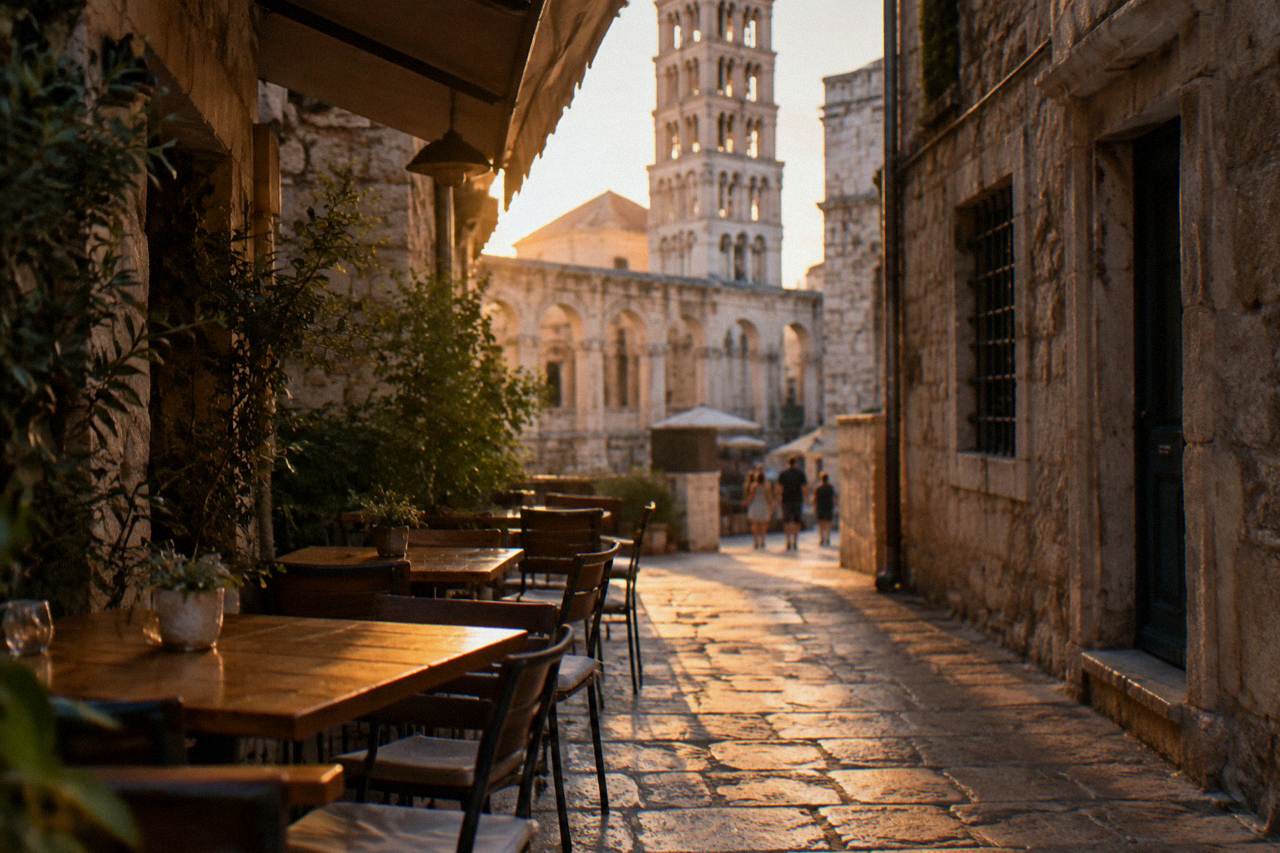
The reliable signs are structural, not culinary: a printed menu with posted prices, a location one or more streets back from the Peristyle and the Riva, a terrace without a hostess working the passing crowd, and a room that fills after 20:00 rather than at noon. Split's own public-order rules, which fine soliciting and require posted prices, push honest venues toward exactly this shape. None of these checks names a venue, and none needs to. The city decision that took effect in 2026 fines soliciting for tours and accommodation in the historic core, and the tourism board's Enjoy Respect page tells visitors plainly that posted prices and itemised bills are the standard to expect. A konoba whose menu is printed, priced in euro, and handed over without ceremony passes every test the city itself applies.
The geography does half the work. Diocletian's Palace measures roughly 20.8 hectares as the UNESCO property inscribed in 1979, and everything inside that footprint pays premium rents and prices for the footfall. Walk five minutes west from the Golden Gate into Veli Varoš, the old fishermen's quarter under Marjan, or ten minutes east to the streets behind Bačvice, and the calculus changes: the kitchens there cook for the neighbourhood first. The green market sits between the two worlds and belongs firmly to the second; its stalls open at dawn and thin out by early afternoon, timed for residents, not for arrivals.
Where Do Locals Eat In Split?
Split residents eat in three rings around the palace: the Veli Varoš konobas under Marjan's slope, the everyday grills and bakeries of Bačvice and Firule near the sand, and the streets radiating from the green market and the Dobric area, where morning commerce turns into simple lunches. Hvar and Brac draw the boat crowds, but the local table in the city itself lives in these three rings. Veli Varoš is the strongest of them. The quarter's stone lanes sit below Marjan's 178 m Telegrin peak and its 819 steps, so the walk home burns off what the konoba serves, which is the arrangement Dalmatian eating has always preferred. Around Bačvice, the city's sandy city beach and the 1908 birthplace of picigin, the eating is lighter and faster: bakeries, grill windows and terraces that serve the people who have just finished a game in the shallows.
Firule, the next bay east, and Žnjan further along do the same job for a quieter crowd. What unites all three rings is that they are walking distance from the palace, 500 to 600 m in the case of the harbour-side edge, yet psychologically a world away from the Peristyle's noon guard change, which ran 28 May to 27 September 2026. If a venue's terrace looks out at a monument, treat it as a monument-view venue; if it looks out at a parked car and a laundry line, treat it as dinner.
A food tour is one legitimate shortcut into these rings, because a local guide takes you straight to the stalls and counters that matter and explains what each one sells. The options above include a walking food tour built around a full meal, which is the format that best mirrors how Split eats, plus two coastal and island trips that pair a day on the water with food stops. For readers building a whole day around the table, the broader things to do in Split overview places the food scene alongside the palace, Marjan and the beaches.
To let a local guide lead the way through these rings, book a Split food tour here.
What Do Locals Actually Order In Split?
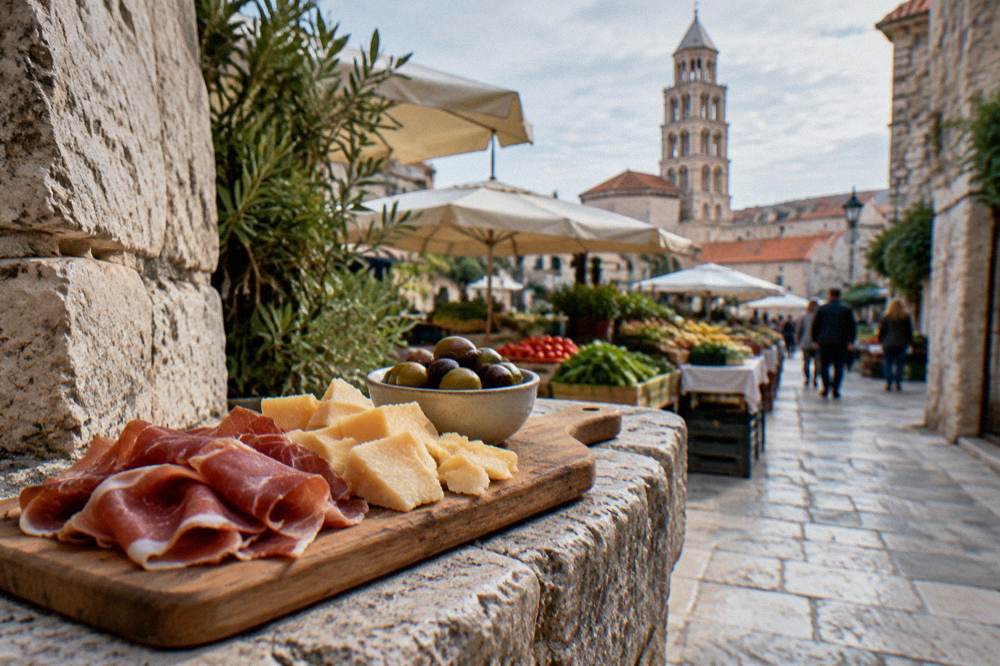
The local order in Split is built on the Adriatic larder: small oily fish such as sardines and anchovies rather than premium fillets, grilled white fish priced by the kilo, cuttlefish risotto black with its own ink, peka cooked under a bell of embers, and the Dalmatian starter plate of pršut, cheese and olives. Soparnak, the chard-filled pie, and fresh sheep cheese round out the everyday list. The pattern to notice is that nothing on it is fast to cook. Peka in particular is ordered ahead, because the bell needs hours over coals, and a konoba that offers it instantly to a walk-in is telling you something. Cuttlefish risotto carries the same logic: the ink needs time, and the restaurants that serve it well start it in the morning.
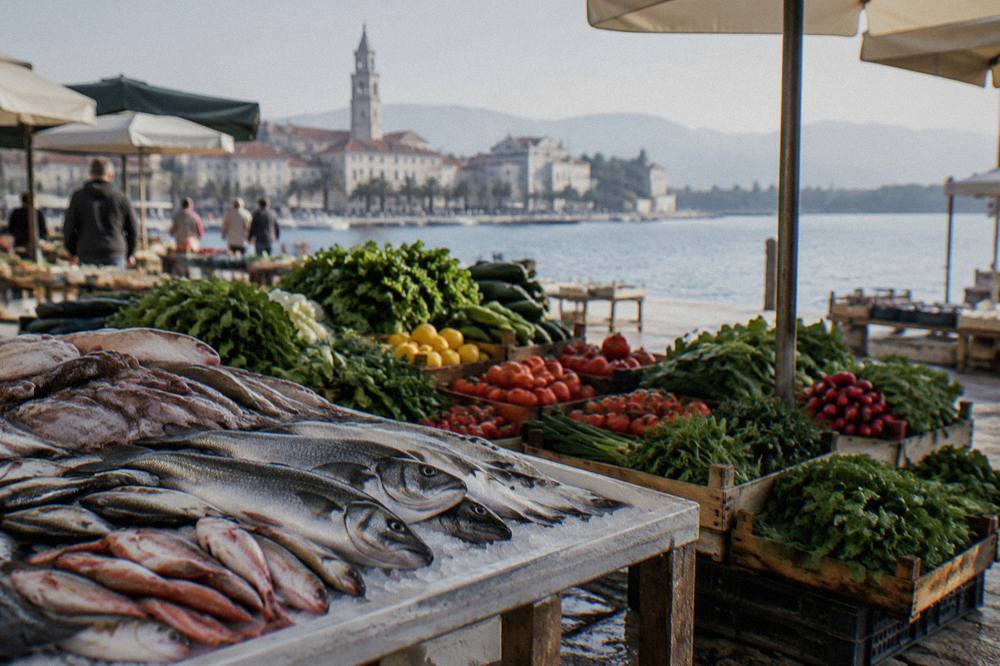
Season matters as much as the dish. The green market's stalls follow the Dalmatian year, and the DHMZ Split Marjan station table, covering 1948 to 2024, explains the rhythm: July means 26.2 C means and 26.6 mm of rain, so the summer table leans to tomatoes, cucumber, grilled fish and cold plates, while November, the wettest month at 115.5 mm, pulls the cooking indoors toward stews and peka. Asking the stall holder or the waiter what came in that morning is the single most local sentence available in Split. The full index of guides sits on Split Croatia Travel Guide.
| Dish Or Plate | What It Is | The Local Test |
|---|---|---|
| Grilled white fish | Whole fish priced by the kilo, chargrilled with olive oil and lemon | The price per kilo is shown on the menu, and the fish is shown before cooking |
| Cuttlefish risotto | Rice cooked slowly with cuttlefish ink | It takes time; a version ready in minutes is a warning sign |
| Peka | Meat or octopus braised under a metal bell over embers | Ordered in advance, hours before serving |
| Pršut, cheese, olives | The standard Dalmatian starter plate | The cheese is sheep cheese, and the plate arrives without prompting |
| Sardines and anchovies | Small grilled oily fish, the everyday catch | Cheap, plentiful and eaten with the hands |
| Soparnak | Chard and onion filled pie | A farmers' dish, not a menu centrepiece |
The bill deserves the same attention as the order. Croatian menus itemise, a cover charge appears on the printed menu if it is charged at all, and the price per kilo for fish is posted before you commit. These are checks the city's own consumer rules make straightforward, and they work in every ring of the city, from Veli Varoš to the palace cellars' ticket desk, which the Split City Museum runs 8:30 to 20:00 for the substructures if the food wait needs filling with history.
What Does Eating Out In Split Cost, And Which Rules Shape It?
Eating in Split runs on the euro, with an accommodation-side tourist tax of about 2.65 EUR per person per night in high season, 1 April to 30 September, under 12 free and 12 to 18 half price, collected by your host and confirmed at booking. At the table itself, the posted menu is the whole contract: fish by the kilo, a cover charge only if printed, and an itemised bill on request. The street rules matter around the meal too. Alcohol in the historic centre carries a 300 EUR fine, climbing on monuments and bathing in fountains the same, and sleeping in public spaces 150 EUR. A glass of wine belongs on a licensed terrace, and in 2026 that distinction is enforced, not advisory.
None of this makes Split expensive by force; it makes it legible. The prices that matter, the ones on the menu, are printed before you sit. Readers weighing the whole budget should read the dedicated cost breakdown, which handles restaurant pricing in more depth than this page, alongside what to avoid in Split for the traps that catch diners specifically.
| Practical Item | What Applies In Split | Where It Comes From |
|---|---|---|
| Currency | Euro, since 1 January 2023 | European Central Bank |
| Tourist tax | About 2.65 EUR per person per night, high season 1 April to 30 September, under 12 free, 12 to 18 half | Collected by accommodation, confirmed at booking |
| Street alcohol in the historic centre | 300 EUR fine | City Enjoy Respect rules |
| Shop alcohol at night | No retail sales 21:00 to 06:00, 1 June to 15 September | 2026 city decision, repeats from 1 June 2027 unless changed |
| Emergency number | 112 | National service |
Can A Tour Show You The Local Table In One Day?
Yes, and the food-focused walking tour is the format that does it, because it moves through the green market, the bakery counters and the konoba terraces in the order a local day would, with a guide who names what each stall sells. Pair it with a morning on the water and you have the full Split rhythm: paddle or swim first, eat after. The related tour below is the coastal half of that pairing, a guided kayak trip along the city's shore that ends with the whole evening free for a Veli Varoš dinner, and its live listing carries the current price and departure details.
For readers whose appetite runs to the islands, the four-islands trip to Zlatni Rat, Hvar and the Pakleni islands bundles a long day of sailing with food and a wine tasting ashore, and it shows why the island table and the city table share the same larder. Neither trip replaces the neighbourhood konoba; they frame it.
The food tour above is the one that answers this page's question directly, since it is built around stops a local would choose and a full meal rather than a tasting parade. After it, the month you visit will shape the menu more than any guide can, and the piece on the best month to visit Split lines the calendar up against the weather station's own numbers.
If a boat day and a food walk both fit the itinerary, book the food walk for the evening and let the sea decide the morning. Split's port alone moved 6.05 million passengers in 2025, and the same terminals that move them also move the fish, which is the connection every local table in this city quietly depends on.
Common Questions About Where Locals Eat In Split
Where do locals eat in Split?
In the rings around the palace: Veli Varoš konobas under Marjan, the grills and bakeries of Bačvice and Firule, and the streets feeding off the green market, all within a short walk of the Old Town.
Is food in Split expensive?
Menus are posted in euro and itemised, fish is priced by the kilo, and a cover charge appears only if printed. The dedicated cost page on this site breaks restaurant pricing down in detail.
Can you drink alcohol in public in Split?
No. Drinking in the historic centre carries a 300 EUR fine under the city's Enjoy Respect rules, and shops inside the core cannot sell alcohol between 21:00 and 06:00 from 1 June to 15 September. Licensed terraces are unaffected.
What is peka and why do you order it ahead?
Peka is meat or octopus braised under a metal bell over embers, and it needs hours, so konobas ask for advance notice. A venue offering it instantly to a walk-in is cutting the method short.
Is the green market worth visiting for eating?
Yes, as a market first and a food source second: the stalls open at dawn, sell the Dalmatian larder by season, and thin by early afternoon, so the morning is the window.
Do food tours in Split go where locals eat?
The walking food tour format does, since it is built around market and konoba stops with a full meal rather than a single tasting room. Confirm the exact route on the operator's live listing.
Split rewards the diner who walks five minutes past the first menu waved in their direction, and the city's own rules, posted prices, itemised bills and licensed terraces, make that walk the easiest good decision of the day.