Is Diocletian Palace Free?
Yes, you can walk into Diocletian's Palace in Split for free. This guide explains which parts cost nothing and which parts need a ticket, with current prices.
Diocletian's Palace in Split, on Croatia's Adriatic coast, is free to enter. That answer surprises people who expect a gate and a ticket booth, because the palace is not a monument behind a fence: it is the Old Town itself, a grid of streets, squares, bars and apartments built inside a Roman retirement residence constructed for Emperor Diocletian around 295 to 305 AD. Nobody charges you to walk in. UNESCO inscribed the Historical Complex of Split with the Palace of Diocletian in 1979, and the protected property covers 20.8 hectares of living city.
What does cost money are the specific sights inside the palace walls: the cellars, the cathedral complex with its bell tower, and the museums. This page sets out, line by line, what is free, what is ticketed, and what each ticket covers, so you can plan a visit to Split without guessing.
Is Diocletian Palace Free?
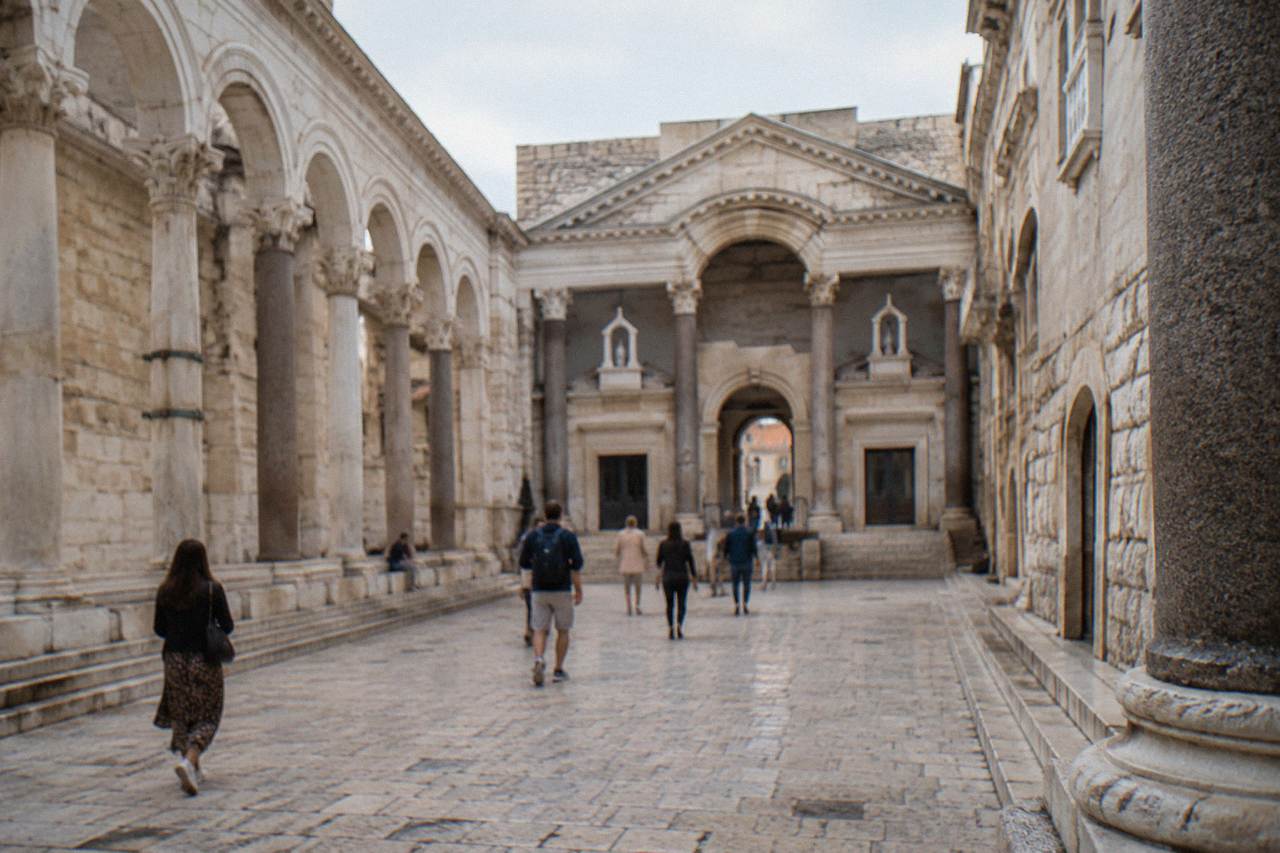
Yes, entering Diocletian's Palace in Split costs nothing at all. There is no entrance gate, no ticket office for the palace as a whole and no opening hours, because roughly three thousand people live and work inside it and its streets are public city streets. You can walk the Peristyle, the Golden Gate, the cellars' exterior and every alley at any hour, free of charge. Only the individual attractions within the walls, the cellars, the Cathedral of St Domnius complex and the museums, sell their own tickets.
The reason is structural. The palace was never abandoned and rebranded as an attraction. From the moment refugees from nearby Salona settled inside its walls, the building became a town, and the town kept growing. Shops occupy the old service corridors, apartments sit above Roman arches, and the main east and west gates funnel pedestrian traffic exactly as they did in the late 3rd and early 4th century. A ticket for "the palace" would in practice be a ticket for a public street.
So the practical question shifts. You will not pay to get inside, but you will probably pay for something inside, because the two headline sights, the substructures and the cathedral, are ticketed. For the wider picture of how the palace fits into a visit, see the guide to Diocletian's Palace on this site, and for the budget view, free things to do in Split.
Which Parts Of Diocletian's Palace Can You Walk Into For Free?
The Peristyle, the main square of the palace, is free, as are the Golden Gate, the Silver and Iron Gates, the Prokurative square just outside the walls, the Riva seafront promenade, the Grgur Ninski statue by the Golden Gate, and every public street and alley inside the walls. The Roman guard change on the Peristyle at noon, which ran from 28 May to 27 September 2026, is also watched free of charge. None of these has a ticket, a turnstile or a closing time.
The Peristyle is the heart of the free experience. It is the colonnaded courtyard where the emperor once appeared, framed by stone arcades, with the cathedral and the mausoleum entrance on one side and cafes spilling across the paving. Street performers work the square in the evenings, and at midday in season the Roman guard change draws a crowd in period costume. From the Peristyle you can walk south through the substructures' street-level entrances as far as the ticketed zone begins, and north past the Vestibule, the domed antechamber, to the Peristyle's northern colonnade and out to the Golden Gate, all without paying anything.
The Grgur Ninski statue by the Golden Gate is a free stop in its own right: local custom says touching the statue's toe brings luck, and the bronze has been polished to a shine by decades of exactly that. The walk from the Golden Gate down the cardo, the palace's north-south main street, to the Peristyle takes minutes and passes the best-preserved street frontage in the complex. Then continue south and you emerge from the bronze gates onto the Riva, the palm-lined promenade where the palace meets the Adriatic.
A guided walk is one way to make sense of the free parts, since the palace gives up little without explanation. A small-group palace walking tour covers the Old Town's layout and history with a guide, and there are also tip-based walks, where the walk itself is free and you pay the guide what you choose; confirm the arrangement with the guide before you set off. Details and live availability for both sit on the operator's live listing, and you can Check availability for the guided option.
If you'd like the palace decoded as you walk, book a Split walking tour here.
What Do The Ticketed Parts Of Diocletian's Palace Cost?
The cellars, or substructures, are run by the Split City Museum and listed at 10 EUR for an adult, open Monday to Sunday from 8:30 to 20:00. The Cathedral of St Domnius complex starts from about 5 EUR, with combined tickets up to about 15 EUR covering the cathedral, crypt, baptistery, treasury and bell tower. The Split City Museum at Papalić Palace charges 10.00 EUR, 8.00 EUR reduced, family 18.00 EUR.
The cellars are the best-value ticket in the complex. They are the barrel-vaulted lower level of the palace, preserved because centuries of filling kept them intact, and they mirror the layout of the emperor's residential floor above. One detail worth knowing before you go: the central part of the cellars is under restoration until the end of 2026, but the passage stays open, so you still walk the main vaults. The Split City Museum's price list confirms the museum ticket and hours, and the cellars' own listing on the museum site carries the 10 EUR adult figure. More of these guides are collected on Split Croatia Travel Guide.
The cathedral complex is a separate scheme. The Cathedral of St Domnius occupies Diocletian's mausoleum, the bell tower rises 57 m beside it, the Temple of Jupiter across the Peristyle is now the Baptistery of St John, and a kiosk on the Peristyle sells single-site and combined tickets. Prices come from a secondary guide rather than an official price page, so treat them as about: singles from 3 to 7 EUR, combinations from about 9 to about 15 EUR covering all five parts. Shoulders and knees must be covered inside the cathedral. The cathedral of St Domnius guide on this site goes deeper into what each part contains.
| Sight inside the palace | Cost | Notes |
|---|---|---|
| Peristyle and all public streets | Free | Open at all hours |
| Golden Gate and Grgur Ninski statue | Free | Statue by the gate |
| Cellars (substructures) | 10 EUR adult | Monday to Sunday 8:30 to 20:00, central part under restoration to end of 2026 |
| Cathedral complex singles | From about 5 EUR | Cathedral, crypt, baptistery, treasury, bell tower priced separately |
| Cathedral combined tickets | Up to about 15 EUR | All five parts, sold at the Peristyle kiosk |
| Split City Museum, Papalić Palace | 10.00 EUR adult | 8.00 EUR reduced, family 18.00, closed Mondays |
One more paid stop sits inside the walls: the Temple of Jupiter, now the Baptistery of St John, is ticketed within the cathedral scheme rather than separately. And if a swim after the palace is on your plan, the sea is a short walk from the south wall; the question can you swim in the sea in Split is answered separately on this site.
Do You Need A Guided Tour Of Diocletian's Palace In Split?
No, a guided tour is not required and the palace remains free to explore alone, but the building explains very little by itself. There are almost no information panels, the layers run from Roman substructures to medieval chapels to Venetian-era facades, and a guide turns an hour of wandering into a coherent story. A guided small-group walk covers the layout, the emperor and the city's later history in one loop.
Whether that matters depends on what kind of traveller you are. The free walk, Peristyle to Golden Gate to Riva, works perfectly well without a guide and costs nothing. But the palace rewards decoding: the ground plan you are walking is the lower floor of a fortified imperial villa, the cathedral was the emperor's tomb, and the streets follow the Roman grid so precisely that you can navigate by it. A guide supplies exactly that frame, and a historian-led version goes further, tracing the city from Diocletian's time to the present in a single walk.
How Long Should You Allow For Diocletian's Palace In Split?
A walk through the free parts of the palace takes about an hour, covering the Golden Gate, the cardo, the Peristyle, the Vestibule and out onto the Riva. Add the cellars and the cathedral complex and a half day fills easily, especially in summer when queues for the bell tower stretch. A full day lets you add the Split City Museum and the green market beside the walls.
The pacing question matters because the palace sits at the centre of everything else in Split. The ferry port, the main bus station and the railway station sit together on Obala kneza Domagoja, 500 to 600 m from the palace, so cruise passengers and ferry arrivals walk straight into it. The cruise port day guide covers that scenario in detail. If you have only one day, the palace walk, the cellars and the Riva are the core loop, and the surrounding questions, like where locals eat in Split, fill the rest.
Season changes the experience more than the clock does. July means a mean temperature of 26.2 C on the DHMZ Split-Marjan station record for 1948-2024, and 18 days at 30 C or more, so morning and evening walks are the comfortable ones. November brings the wettest month of the station record at 115.5 mm of rain, but also emptier streets inside the walls. Whatever the month, the palace costs the same to enter, which is nothing.
For a trip built around the palace, pair it with a day out: the same departures hub that connects the palace to the port also launches the Krka and Plitvice day trips, and a guided Plitvice excursion with entry tickets included removes the one chore those parks impose, timed online entry with the visitor's name printed on the ticket.
Common Questions About Diocletian's Palace In Split
Is Diocletian Palace free?
Yes. The palace is a public quarter of Split with no gate, no ticket and no closing time. Only the cellars, the cathedral complex and the museums inside the walls charge admission.
Do You Have To Pay To Walk Through The Old Town Of Split?
No. The Old Town sits inside and around Diocletian's Palace, and every street, square and gate in it is free public space, including the Peristyle and the Golden Gate.
Are The Cellars Of Diocletian's Palace Free?
No. The substructures are run by the Split City Museum and listed at 10 EUR for an adult, open Monday to Sunday from 8:30 to 20:00. The central part is under restoration until the end of 2026 with the passage open.
Can You Enter The Cathedral Of St Domnius For Free?
No, but the cost is modest: singles start from about 5 EUR and combined tickets reach about 15 EUR for all five parts, sold at the kiosk on the Peristyle. Shoulders and knees must be covered.
Is Diocletian's Palace Open At Night?
Yes. Because the palace is a living quarter, its streets never close, and the Peristyle and gates are at their quietest and most atmospheric late in the evening, all free of charge.
Is A Tour Of Diocletian's Palace Worth It If Entry Is Free?
Free entry covers the streets but not the explanation, and the building has almost no interpretive signage. A guided small-group walk adds the history that the stones themselves do not volunteer, and tip-based walks run locally if you prefer that arrangement.
In short: budget nothing for the palace itself and about 10 to 15 EUR per person for each of the ticketed sights you choose inside it, then decide whether a guide adds the story you want on top.
