Diocletian Palace
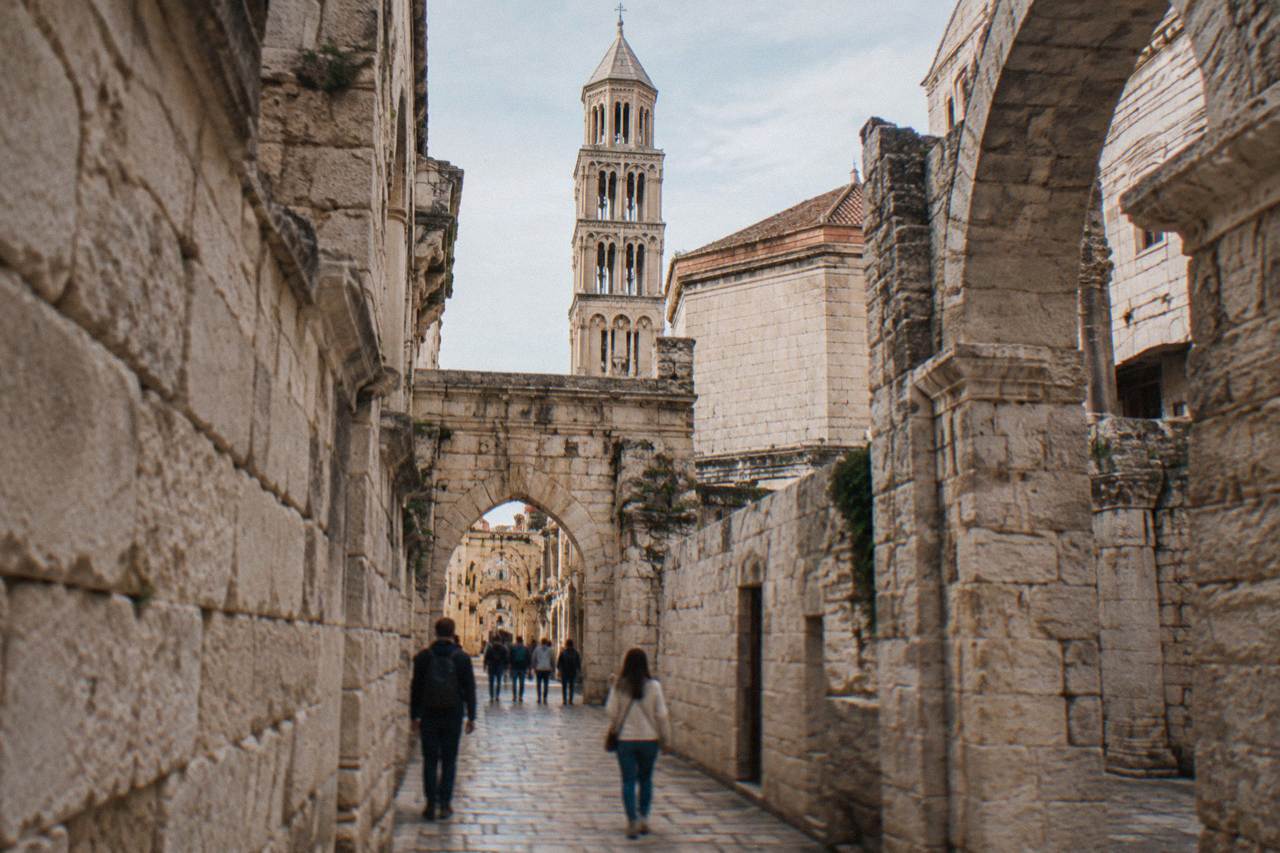
Diocletian Palace is the Roman core of Split, a living palace built around 295 to 305 AD for Emperor Diocletian and now a UNESCO-listed quarter where people still live, shop and worship.
Short answer
Diocletian Palace is the Roman palace at the centre of Split's Old Town, built c. 295 to 305 AD, UNESCO-listed since 1979. The streets, Peristyle, Golden Gate and Riva are free; the cellars, cathedral complex and museums carry tickets from a few euros.
Diocletian Palace is the Roman heart of Split, a coastal city in Dalmatia on the Adriatic, and it is not a ruin behind a fence. People live inside it, shops and bars fill its ground floors, and the Cathedral of St Domnius stands where the emperor's mausoleum stood. UNESCO inscribed the "Historical Complex of Split with the Palace of Diocletian" in 1979, a property of 20.8 hectares, and the palace itself was built around 295 to 305 AD for Emperor Diocletian. This guide from the Split Croatia Travel Guide editorial desk sets out what the sources say about what to see, what costs money, what is free, and how to build a day around it.
What Is Diocletian Palace In Split?
Diocletian Palace is a late Roman imperial residence built between about 295 and 305 AD for Emperor Diocletian, and Split grew inside and around it. UNESCO inscribed the Historical Complex of Split with the Palace of Diocletian in 1979, and the listed property covers 20.8 hectares. Unlike a fenced archaeological site, the palace today is a working quarter of streets, homes, churches, bars and markets at the centre of a city of 160,577 people.
The palace was a retirement residence, and its plan still shapes the streets. The southern half once dropped toward the sea along the Riva, and the northern half held service areas and barracks. Diocletian came from the Dalmatian coast, and the site sits on a bay backed by the Marjan peninsula. Over the centuries the palace interiors were subdivided, and the modern Old Town occupies the Roman shell, which is why the property inscription covers a historical complex rather than a bare monument.
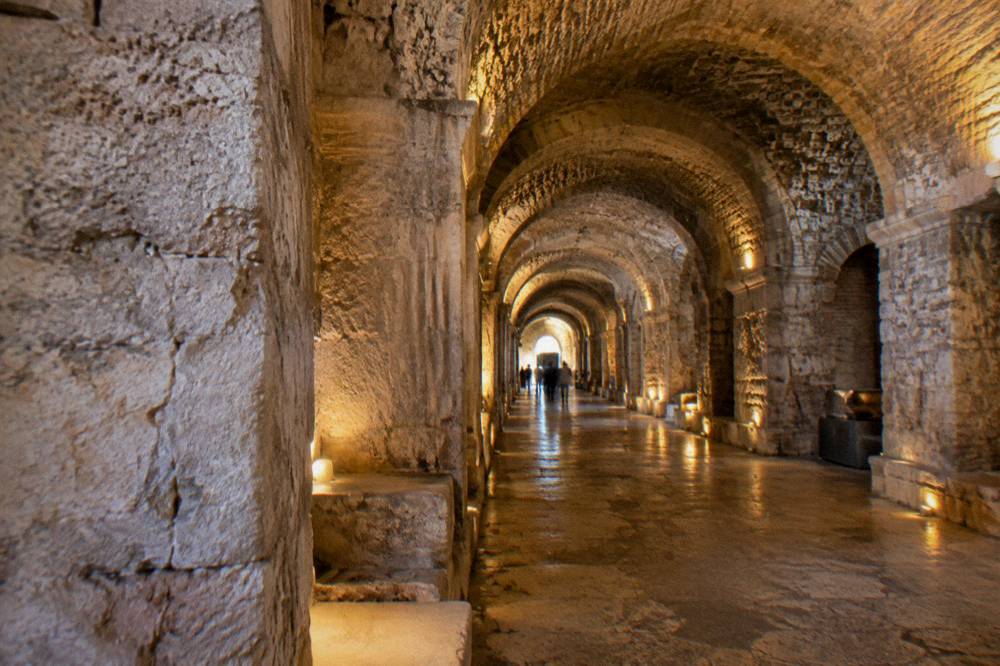
Two structures survive in near original form at the core of the complex. The Peristyle, the rectangular colonnaded court at the palace's heart, still stages public life, and the temple that became first a church and then the Cathedral of St Domnius still anchors the western sacred axis. The palace substructures, the cellars beneath the southern half, mirror the layout of the floors above and are now the most complete surviving section of the building. The Split City Museum runs them, and its pages list the opening hours as Monday to Sunday, 8:30 to 20:00, with a closure on 5 April.
What Can You See Inside Diocletian Palace In Split?
The palace splits into free public space and ticketed sites. Free: the Peristyle, the Riva promenade, the Prokurative square, the Golden Gate, the Grgur Ninski statue, the markets, Marjan hill and the city beaches. Ticketed: the palace cellars, the Cathedral of St Domnius complex, the Temple of Jupiter, now the Baptistery of St John, the Split City Museum and other museums.
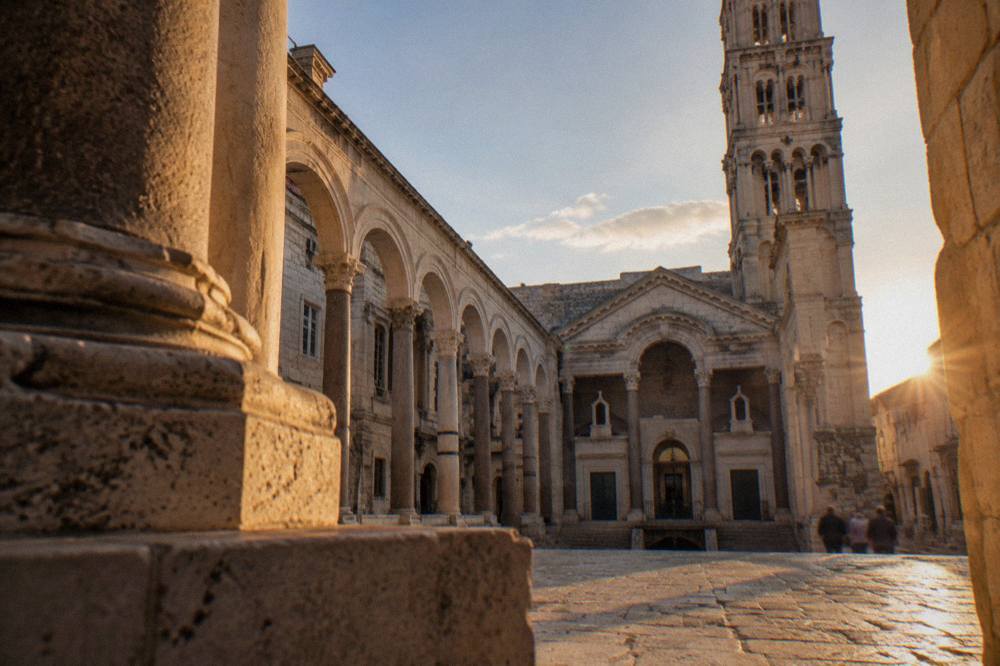
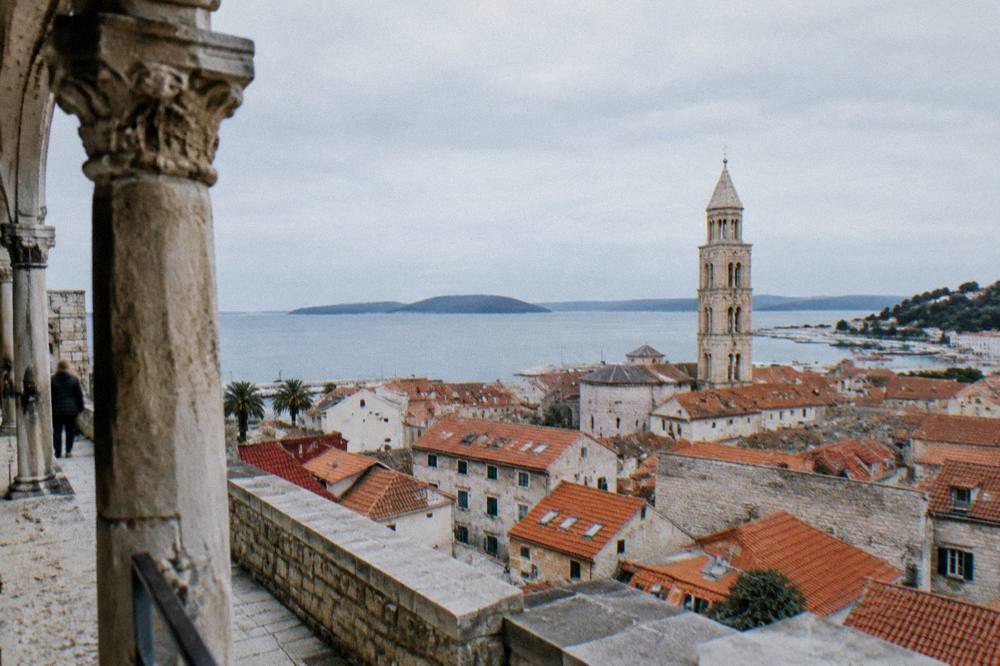
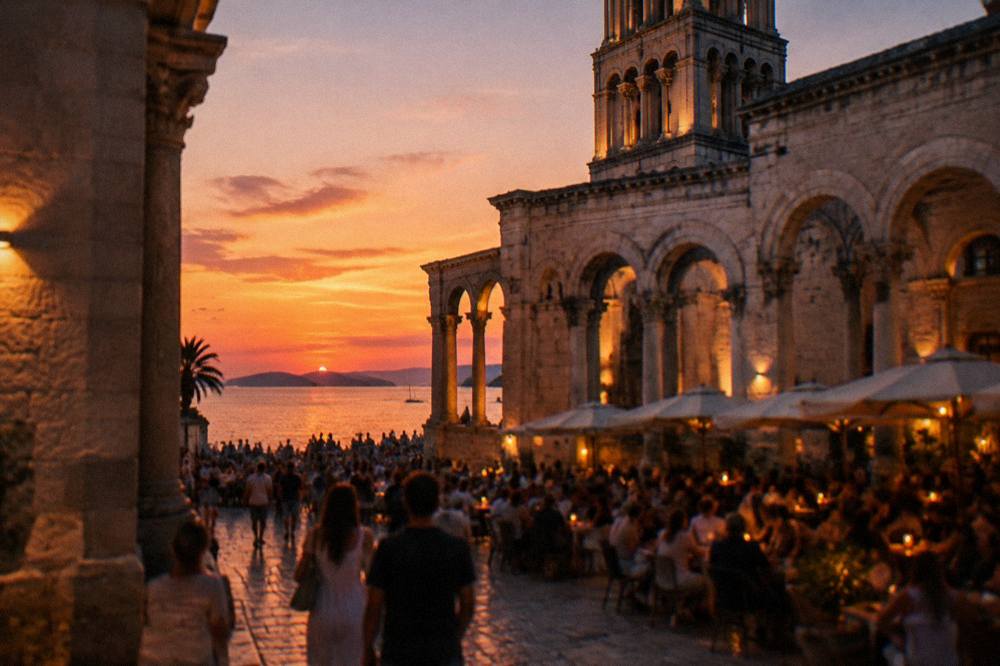
The free layer alone fills half a day. The Peristyle is the palace's stage: a colonnaded court framed by the cathedral's 57 m bell tower and the deconsecrated spaces around it. From the Peristyle, the cardo and decumanus, the two main Roman streets, still run north and east through the quarter. At the northern edge, the Golden Gate opens toward the statue of Grgur Ninski, and a short walk west reaches the Prokurative, the neo-Romanesque arcaded square beside the Riva. The Riva promenade runs along the line of the former southern facade, where the sea once reached the palace walls.
The ticketed layer adds depth. The cellars, covered in their own section below, show the undercroft of the imperial apartments. The cathedral complex, described in detail by the cathedral of St Domnius guide, includes the mausoleum-church, the crypt, the treasury, the bell tower and the baptistery. The Temple of Jupiter, a compact Roman temple beside the cathedral, survives as the Baptistery of St John and is ticketed inside the cathedral scheme. A secondary guide reports cathedral entry from about 5 EUR with combined tickets up to about 15 EUR, sold at the kiosk on the Peristyle, and visitors should confirm current prices at the kiosk. Shoulders and knees must be covered inside the cathedral.
One live performance also belongs to the palace calendar: the change of Diocletian's Roman Guard on the Peristyle at noon ran daily from 28 May to 27 September 2026, with 2027 dates to be confirmed on the city's events pages.
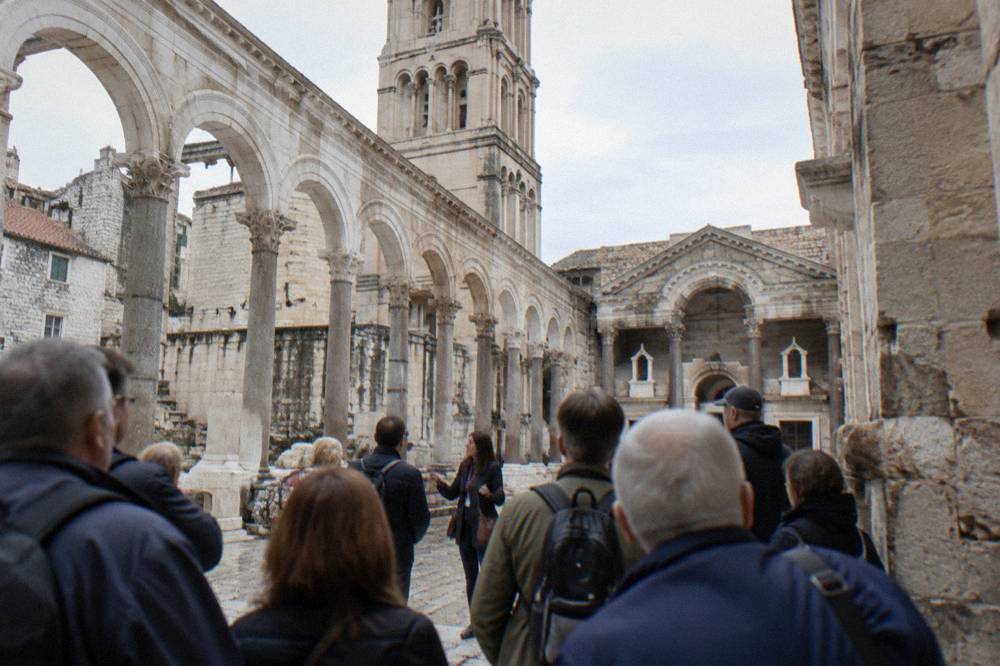
For visitors who want the whole story with a guide attached, the site's featured pick is the small-group Diocletian's Palace walking tour, which covers the palace and Old Town in a group kept small, Check availability.
If you want the whole story with a guide, book a history walking tour here.
How Much Does It Cost To Visit Diocletian Palace In Split?
Walking the palace streets costs nothing, and the main tickets are the cellars at 10 EUR adult as reported for the Split City Museum's price list, the City Museum itself at 10.00 EUR adult with 8.00 EUR reduced and an 18.00 EUR family ticket, and the cathedral complex from about 5 EUR with combined tickets up to about 15 EUR. The Ethnographic Museum is 7.00 EUR adult and the Archaeological Museum 8 EUR, or 10 EUR combined with Salona within 7 days.
The cellars, run by the Split City Museum, are the palace's headline ticket. They cost 10 EUR adult, while the City Museum's own price list gives 10.00 EUR adult, 8.00 EUR reduced and family 18.00 for the Papalić Palace museum itself, open Tuesday to Sunday, 9:00 to 20:00, closed Mondays and public holidays. The museum's pages list cellars hours as Monday to Sunday, 8:30 to 20:00. The central part of the substructures is under restoration to the end of 2026, and the passage stays open through the works.
| Site in or beside the palace | Adult price | Source status |
|---|---|---|
| Palace streets, Peristyle, Golden Gate, Riva, Prokurative, Grgur Ninski statue | Free | No ticket on any official source |
| Palace cellars (substructures) | 10 EUR | City Museum's pages |
| Split City Museum, Papalić Palace | 10.00 EUR, reduced 8.00, family 18.00 | Official price list |
| Cathedral of St Domnius complex | From about 5 EUR, combined tickets up to about 15 EUR | Secondary guide, confirm at the Peristyle kiosk |
| Ethnographic Museum | 7.00 EUR, reduced 4.00, family 15, Vestibule 2.00 | Official price list |
| Archaeological Museum | 8 EUR, combined with Salona 10 EUR within 7 days | Official price list |
Two money questions come up again and again, and the site's answers pages cover them in depth: is Diocletian Palace free? and is there a dress code for entering Diocletian's Palace?. In short, the public space is free and only the enclosed monuments charge, and the dress code applies to the cathedral, not the streets.
When Is The Best Time Of Day To Visit The Palace?
Morning and evening are the calmest hours inside the palace, and the sources support this from the climate record: the DHMZ Split-Marjan station, for the period 1948 to 2024, records a July mean of 26.2 C with 18 days at 30 C or more, and an August mean of 25.9 C with 17 days at 30 C or more. The stone lanes hold heat, so the cellars, with hours from 8:30, suit a morning slot and the Peristyle and Riva suit the evening.
The monthly picture, from the DHMZ Split-Marjan table, shows how the seasons shape a visit. July is the driest month at 26.6 mm of rain and November the wettest at 115.5 mm. December sunshine runs 120.8 hours against 353.3 hours in July. None of this closes the palace: it is a living quarter, open year-round, and winter light on empty stone is a genuine reason to come off-season.
| Month | Mean temperature (C) | Rain (mm) | What it means for the palace |
|---|---|---|---|
| January | 8.0 | 77.8 | Quiet lanes, warm layers, cellars and museums |
| April | 14.4 | 62.0 | Mild walking weather before peak crowds |
| July | 26.2 | 26.6 | Driest month, 18 days at 30 C or more, visit early |
| August | 25.9 | 41.3 | Peak season, 17 days at 30 C or more, evening walks |
| October | 17.2 | 77.0 | Warm sea air, thinner crowds, some rain |
| November | 12.7 | 115.5 | Wettest month, museum mornings |
The DHMZ Split-Marjan station table covers 1948 to 2024 and is the source for every figure above. The noon guard change on the Peristyle, in its 2026 season from 28 May to 27 September, gives the high-season day a fixed centrepiece if you accept the crowds around it.
What Are The Palace Cellars And Why Do They Matter?
The cellars are the substructures beneath the imperial apartments, and they are the best-preserved part of the whole palace because later generations built above rather than through them. The Split City Museum runs them with hours Monday to Sunday, 8:30 to 20:00, and the adult ticket is 10 EUR. Their central section is under restoration to the end of 2026, and the passage through them stays open during the works.
Because the undercroft mirrors the plan of the floors above, walking the cellars is the closest experience to walking Diocletian's own residential level, which centuries of rebuilding have erased. Barrel-vaulted halls run in the Roman grid, and archaeological work around the southern walls, under way in Hrvojeva ulica since April 2026 with a scheduled end in September 2026 and a possible extension, has uncovered the original palace base and medieval structures above it. The site's dedicated page, Diocletian's Palace cellars, covers the rooms and the restoration in detail.
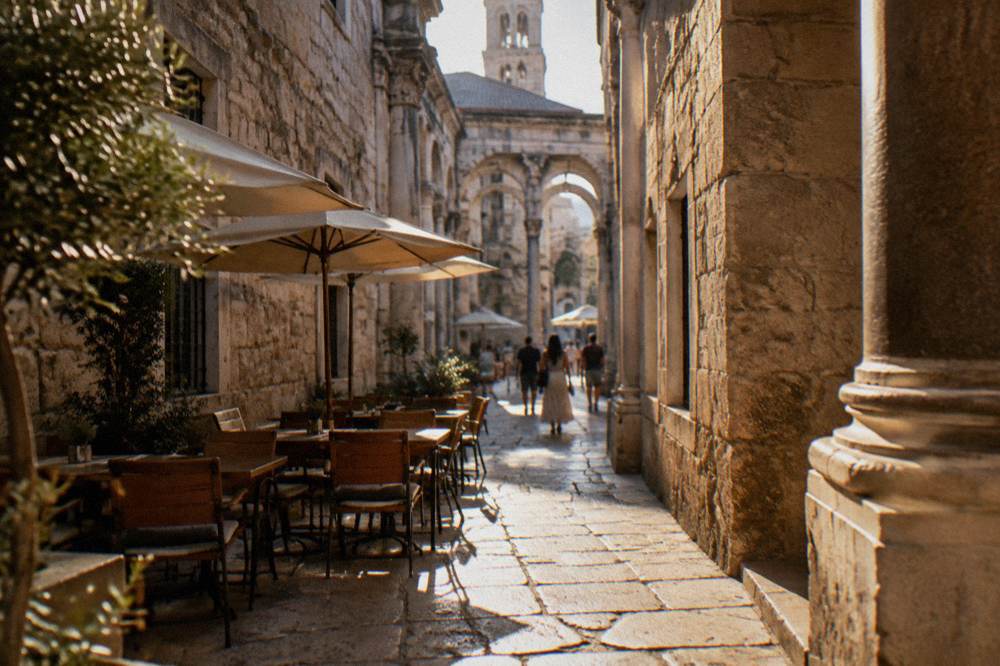
The cellars also work as an orientation tool. Exit at the southern end and you step onto the Riva. Turn back north and the exits line up with the streets that climb to the Peristyle and the Golden Gate, which makes an early-morning cellar visit a practical way to learn the palace's geometry before the lanes fill.
Is Diocletian Palace In Split Free To Enter?
Yes, in the sense that no gate, fence or general admission exists: the Peristyle, the Riva, the Prokurative, the Golden Gate, the Grgur Ninski statue, the markets, Marjan hill and the city beaches are all free public space. No ticket is listed on any official source for any of them. What charges money is entry into the enclosed monuments: the cellars, the cathedral complex, the baptistery and the museums.
This free layer is not a poor relation of the ticketed one. The Peristyle alone, with the cathedral facade, the 57 m bell tower and the Egyptian granite sphinx that stands beside the entrance to the mausoleum precinct, is one of the most photographed public spaces on the Adriatic. The Peristyle guide covers its architecture and events, and the Golden Gate and Grgur Ninski statue pages cover the northern edge, where rubbing the statue's toe is a local custom.
Around the palace, more free space waits: the Old Town lanes beyond the Roman walls, the fishing-quarter lanes of Veli Varos beneath Marjan, and the Split green market beside the eastern wall, where stalls sell produce through the morning.
| Free public spaces inside and beside the palace | Notes from official pages |
|---|---|
| Peristyle | Colonnaded court, noon guard change in season |
| Riva promenade | Seafront walk along the old southern facade line |
| Prokurative | Arcaded square beside the Riva |
| Golden Gate | North palace gate, opens to the statue square |
| Grgur Ninski statue | Bronze statue by Ivan Meštrović |
| Markets, Marjan hill, city beaches | Free public space year-round |
How Does A Guided Walking Tour Of The Palace Work?
A guided walking tour of the palace covers the Old Town and its Roman core in a small group led by a local guide, with the featured option on this site priced from 17 USD per person according to its listing. Tours meet at a central point in the Old Town, run through the Peristyle, the cellars' exterior story and the Golden Gate, and last between one and a half and several hours depending on the option chosen.
Tip-based walks also run locally, and visitors should confirm arrangements with the guide.
The listing for the featured small-group palace tour is the headline option, and a second option is a walking tour of Split and Diocletian's Palace in a small group. A guided walk earns its price on interpretation: the palace's story, from Diocletian's retirement to the medieval city that filled the shell, is not written on the walls, and a guide carries the narrative. Where this site's desk would otherwise describe the atmosphere, the sources say it plainly: the UNESCO citation lists the palace as a living historical complex, not an empty monument.
Visitors with an interest in Game of Thrones filming can extend the theme toward Klis Fortress, a Meereen location about 22 minutes' drive from the palace, and the themed walking tours cover the Split filming story inside the palace itself.
What Is Close To Diocletian Palace In Split?
Everything central in Split is within a short walk of the palace, and the ferry port, the main bus station and the railway station sit together on Obala kneza Domagoja, 500 to 600 m from the palace. Marjan hill rises to the west with its highest point Telegrin at 178 m, reached by 819 steps from Trumbićeva obala, and the beaches of Bačvice and the slopes of Marjan fringe the centre.
The near radius packs a full day. The Meštrović Gallery, reopened in April 2026 after a 15-month energy renovation, holds the sculptor's work at 12.00 EUR adult including the Crikvine-Kaštilac site. The Bačvice beach bay is the home of picigin, the shallow-water ball game protected as intangible heritage and dated to 1908. The Froggyland collection of taxidermied frogs and the Salona Roman ruins, 14 minutes' drive away, round out a museum-heavy or an archaeology-heavy day.
| Place near the palace | Distance or time from the palace | Source |
|---|---|---|
| Ferry port, bus and rail stations, Obala kneza Domagoja | 500 to 600 m | Computed from place data |
| Marjan hill, Telegrin summit | 819 steps from Trumbićeva obala, 178 m high | Marjan park society page |
| Klis Fortress | 13.9 km, 22 min driving free-flow | OSRM route data |
| Salona Roman site | 9.1 km, 14 min driving free-flow | OSRM route data |
| Meštrović Gallery | West of the centre on the Marjan slopes | Museum site |
Driving times above are free-flow route computations, not traffic estimates, and the one day in Split and two days in Split itineraries sequence all of these on foot and by local bus.
How Do You Combine The Palace With Day Trips From Split?
The palace works as a morning base and an afternoon return point for every major Dalmatian day trip: Krka National Park's Skradinski buk is 90.2 km and about 74 minutes' drive, Trogir 29.3 km and 36 minutes, Omiš 25.5 km and 38 minutes, and Plitvice Lakes 258.1 km and about 3 hours 15.
Car ferries reach Stari Grad on Hvar in about 120 minutes and Supetar on Brač in about 50, and catamarans run to Hvar town and Vis, so boat tours and park trips both leave from beside the palace.
The transport hub beside the palace is the reason Split works as a base. From 2026 the Supetar line has no off-season timetable at all, only high and low season sailings. Catamarans reach Hvar or Jelsa and Vis, and the Port of Split calls itself Croatia's busiest passenger port, with 6.05 million passengers in 2025 on its own figures.
| Day trip from Split | Driving distance and time from the palace (free-flow) | Notes |
|---|---|---|
| Salona | 9.1 km, 14 min | Combined ticket with Archaeological Museum, 10 EUR within 7 days |
| Klis Fortress | 13.9 km, 22 min | 10 EUR reported, Meereen filming location |
| Trogir | 29.3 km, 36 min | UNESCO listed 1997 |
| Omiš | 25.5 km, 38 min | Mirabela fortress 4 EUR, 6 EUR from 1 June to 30 September |
| Krka, Skradinski buk | 90.2 km, 74 min | Entry 7 / 20 / 40 EUR by season |
| Šibenik | 84.8 km, 71 min | St James cathedral, UNESCO 2000 |
| Plitvice Lakes | 258.1 km, 3 h 15 | Entry 10 / 23 / 40 EUR by season, timed online entry |
Park tickets in the table are the 2026 price-list figures: Krka charges 7 EUR from January to March and November to December, 20 EUR in April, May and October, and 40 EUR from June to September, while Plitvice charges 10, 23 and 40 EUR over the same pattern, with a 25 EUR afternoon slot at peak. Plitvice sells timed entry online and prints the visitor's name on the ticket.
For boat-based days, two tours pair naturally with a palace morning. The Blue Cave and Hvar small-group speedboat trip covers Biševo's sea cave and the Hvar side of the channel, with the Blue Cave charging 24 EUR entry in high season from 20 June to 10 September and 18 EUR in shoulder season, paid in cash on site. The Blue Lagoon three-island cruise adds lunch, wine and swimming stops off Šolta and its neighbours.
The lagoon cruise suits visitors who want a swim-first day with food on board rather than a fast offshore run to the cave.
What Rules Apply Inside The Palace And Old Town?
Split's public-order rules, published on the city's tourism site, set fines of 300 EUR for drinking alcohol in the historic centre or within 100 m of schools, 300 EUR for urinating, vomiting, climbing on monuments or bathing in fountains, 150 EUR for sleeping in public spaces and 300 EUR for taxi touting. Walking in swimwear or shirtless in the historic core is also an offence, with the amount set locally, and visitors should dress before leaving the beach. Drones may not fly over the old town.
The 2026 decision applies to the Zone A historic core, which is the palace quarter itself, and licensed terraces are exempt from the alcohol rule. A separate seasonal rule bans night-time retail alcohol sales in shops, not bars, from 1 June to 15 September. None of this affects normal sightseeing, but it explains why the lanes stay orderly through high season, and the site's page on what to avoid in Split covers the practical side.
For the enclosed monuments, the cathedral dress code applies: shoulders and knees covered. The palace streets have no dress code beyond the swimwear rule, and the cellars and museums admit visitors in normal summer clothing. The site's safety and money pages carry the rest of the practical brief, including that Croatia uses the euro since 1 January 2023 and that the emergency number is 112.
What Changes Are Coming To The Palace Quarter?
Three works are in motion around the palace: the central section of the cellars is under restoration to the end of 2026 with the passage open, the Riva's central section is set for renovation from November 2026 lasting a little over a year, and a Peristyle building is being prepared as an interpretive centre with an opening possible in summer 2027. The Hotel Marjan, a 285-unit five-star hotel on the Marjan side, is planned to open for the 2027 season.
The Riva project matters most to visitors because the promenade is the palace's seafront stage. Reporting on the tender places the works from November 2026 for slightly over a year, so partial closures on the Riva should be expected through 2027. Inside the palace, the cellars restoration does not block the through route, and the archaeology at the southern walls, running since April 2026, has its own site boundary. None of the projects closes the Old Town.
The event calendar keeps its fixed points regardless: Advent in Split runs 27 November 2026 to 7 January 2027 with the ice rink at Đardin, Sudamja, the city day of St Domnius, falls on 7 May, and Ultra Europe returns to Park Mladeži on 9 to 11 July 2027. The 72nd Split Summer Festival played 14 July to 14 August 2026, and 2027 dates had not been announced.
Common Questions About Diocletian Palace In Split
Is Diocletian Palace In Split Free?
The streets, Peristyle, Riva, Prokurative, Golden Gate, Grgur Ninski statue, markets, Marjan and the beaches are free. The cellars, the cathedral complex and the museums charge entry, with the cellars reported at 10 EUR adult and the City Museum at 10.00 EUR on its price list.
How Old Is Diocletian Palace?
The palace was built around 295 to 305 AD for Emperor Diocletian, and UNESCO inscribed the Historical Complex of Split with the Palace of Diocletian in 1979.
Can You Go Inside Diocletian Palace?
Yes, and no ticket is needed for the public streets: the palace is a living quarter. Tickets apply to the cellars, run by the Split City Museum and open Monday to Sunday, 8:30 to 20:00, and to the cathedral complex and museums.
Is Diocletian Palace The Same As The Old Town?
The Old Town grew inside and around the palace shell, so the palace forms the Roman core of the Old Town and later quarters spread beyond its walls toward Veli Varos and the Prokurative.
How Long Do You Need At Diocletian Palace?
A first visit of a few hours covers the Peristyle, Golden Gate, cellars and one monument such as the cathedral complex. A full day adds the museums, the green market and the Riva, and the site's one-day and two-day itineraries sequence it all.
Was Diocletian Palace Used For Game Of Thrones Filming?
The palace quarter appears in Split-area filming stories, and Klis Fortress above the city was a Meereen location, 22 minutes' drive away. Themed walking tours cover the Split filming locations with tickets included.
Diocletian Palace rewards exactly the kind of slow visit its Roman builders never imagined: a morning in the cellars, a noon hour on the Peristyle, an evening on the Riva, and day trips to the islands and parks leaving from a hub 500 metres from the walls. Plan the tickets in advance, dress for the cathedral, and let the free streets do half the work.
