Is Split A Party Island?
Split is a coastal city on the mainland, not an island, and its nightlife runs in seasons rather than every night. Here is what the sources say about bars, festivals, beaches and quiet corners.
Split sits on the mainland coast of Dalmatia, on the Adriatic Sea, so the first correction to make is geographic: it is not an island at all. It is a coastal city of 160,577 residents at the 2021 census, built in and around Diocletian's Palace, with the Marjan peninsula park forest on its western side and the islands of Brač, Hvar, Šolta and Vis offshore. The party reputation belongs partly to those islands and partly to a handful of loud weekends in the city calendar, and the two get conflated constantly. This page sets out what the public sources actually say about nightlife in Split, when it peaks, where it concentrates, and what the city feels like outside those windows.
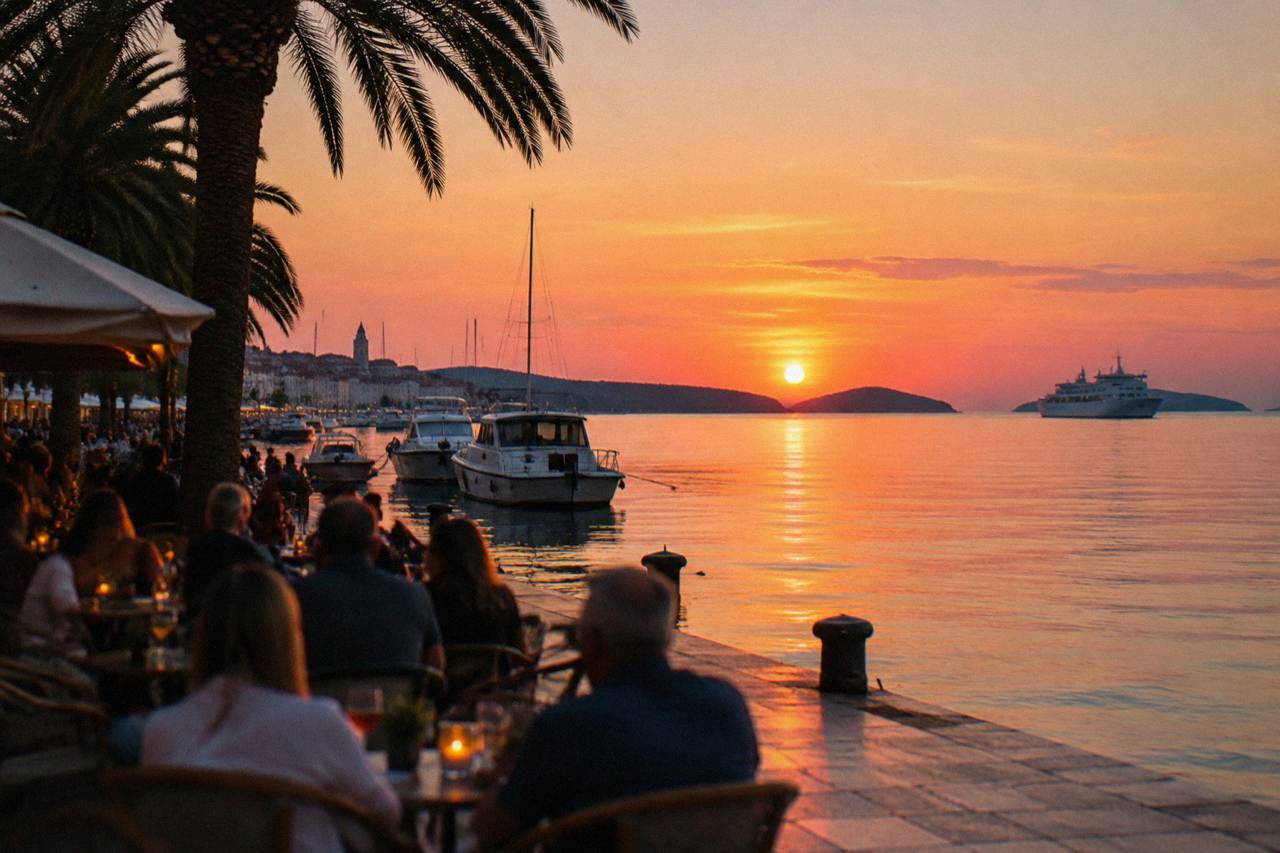
Is Split A Party Island?
No, Split is not a party island, because it is not an island: it is a coastal city on the Dalmatian mainland with a nightlife that peaks in sharp bursts, mainly around Ultra Europe in July and the summer weeks around it. The Port of Split page records 6.05 million passengers in 2025, and much of the city's evening energy follows that seasonal traffic rather than running year-round. For the rest of the year Split behaves like a regional capital: restaurants, café terraces and theatre rather than beach clubs at full volume. The party-island label fits the offshore islands better, and Hvar town in particular, which is a catamaran stop reached from Split in the season. Anyone booking a trip around the expectation of a non-stop party scene should read the Hvar nightlife question alongside this page, because the two places get mixed up more than any other pair on this coast.
The distinction matters for planning. A week in Split can absolutely include big nights: festival weekends in July, boat parties in the season, and bars inside the palace walls that run late in summer. But it can equally include quiet evenings on Marjan, where the highest point, Telegrin at 178 m, sits a 3.5 km peninsula away from the loudest streets, or a meal in a neighbourhood restaurant far from the Riva. The city supports both, and which one you get depends almost entirely on the dates.
When Does Split Get Loud, And When Is It Quiet?
The loud windows are measurable: Ultra Europe on 9 to 11 July 2027 at Park Mladeži, the summer weeks of late June through August when the sea and airport traffic peaks, and festival nights such as the Stories of Diocletian run in late August. Outside them, the DHMZ Split Marjan station table shows a city whose rhythm changes with the season, and Split's cultural calendar shifts indoors from late September. The quietest stretch on paper is November, the wettest month at 115.5 mm in the 1948 to 2024 station record, followed by a winter season framed by the Advent programme rather than nightlife. Anyone wanting calm streets should look at the months either side of summer; anyone wanting the peak should build the trip around the July festival dates and book early.
The seasonal shape shows up in the numbers that official pages publish. Split Airport counted 3,881,186 passengers in 2025, and the Port of Split recorded 487,377 cruise passengers in the same year, both concentrated in the warm half of the year. Evening life follows that flow: terrace seats fill, bars inside the palace walls stay open later, and the boat-party circuit runs. When the flow drops, the terrace season contracts with it. The best month question goes into the trade-offs month by month, including the July heat, with a station mean of 26.2 C and 18 days at 30 C or more.
| Period | What the sources show | Nightlife character |
|---|---|---|
| 9 to 11 July 2027 | Ultra Europe at Park Mladeži | Three very heavy nights, citywide crowds |
| Late June to August | Peak sea and air traffic, terrace season | Busy bars, boat parties, late nights |
| 27 Nov 2026 to 7 Jan 2027 | Advent in Split, ice rink at Đardin | Mulled-wine stalls, family format, early nights |
| 25 Sep 2026 to 14 Jun 2027 | HNK Split theatre season | Indoor cultural evenings |
| November | DHMZ station: wettest month, 115.5 mm | Quietest month on the calendar |
Where Does The Nightlife In Split Actually Concentrate?
Nightlife in Split concentrates in a compact set of places: the bars inside and around Diocletian's Palace, the café and bar terraces of the Riva promenade, the Bačvice beach area with its summer club scene, and the Žnjan seafront further east, with Marjan hill remaining the quiet counterweight on the western edge. The Peristyle, the Riva, the Prokurative and the city beaches are free public spaces, and the bar scene attaches itself to them rather than to a purpose-built strip. That compactness is why the party reputation overstates the geography: everything loud sits within roughly a kilometre of the palace, and a ten-minute walk west onto Marjan, an area 3.5 km long and 1.5 km wide, puts dense pine forest between you and the loudest terraces. A small-group orientation walk through the palace, such as the Check availability link shows, is the fastest way to learn which alley leads where before dark.
The palace bars deserve a specific note because they are what people picture. The cellars and the courtyards sit inside a UNESCO property inscribed in 1979, and the bars, restaurants and apartments around them operate inside protected historic fabric, not in a nightlife district zoned for volume. The Split City Museum runs the palace substructures, open Monday to Sunday 8:30 to 20:00, with the central part under restoration to the end of 2026 while the passage stays open. Noise rules tighten around all of this: the city's public-order decision sets a 300 EUR fine for alcohol consumption in the historic centre outside licensed terraces, and a night-time retail alcohol sales ban, applying to shops rather than bars, ran 1 June to 15 September 2026. The practical takeaway for a visitor is simple: drink on licensed terraces, not in the street, and expect posted prices and an itemised bill.
Is Split Louder Than The Islands Near It?
Split is the transport and population hub of central Dalmatia, not its party capital: the loud island reputation belongs mainly to Hvar town, reached by catamaran from Split at fares the operators list at 6.40 EUR low season and 10.00 EUR high season for foot passengers to Hvar or Jelsa, while Split itself spreads its evening trade across restaurants, terraces and a small number of clubs. The islands are the ones with the beach-club economy. Hvar's Fortica fortress charges 12 EUR for daytime visits, and the town's summer scene is the thing the phrase "party island" usually describes. Vis, by contrast, about 140 minutes away by ferry, is known in the same breath for quiet inlets. Split sits between those poles: big enough for a real bar scene, residential enough, with 160,577 people at the 2021 census, to be a working city the morning after.
Getting between them is straightforward, and the timetables shape the night. The car ferry on line 635 reaches Stari Grad on Hvar in about 120 minutes, with foot passengers paying 5.90 EUR off-season and 8.40 EUR in season, while catamarans call at Hvar town itself. From 2026 the line 631 ferry to Supetar on Brač runs with no off-season timetable, only high and low season schedules. Anyone planning a night out on an island and a bed in Split should check the last sailing, because the operator's timetable decides, and the two Hvar ports are different places: Stari Grad for cars, Hvar town for catamarans. The island hopping itinerary covers the overnight version.
Can You Visit Split And Avoid The Party Scene Completely?
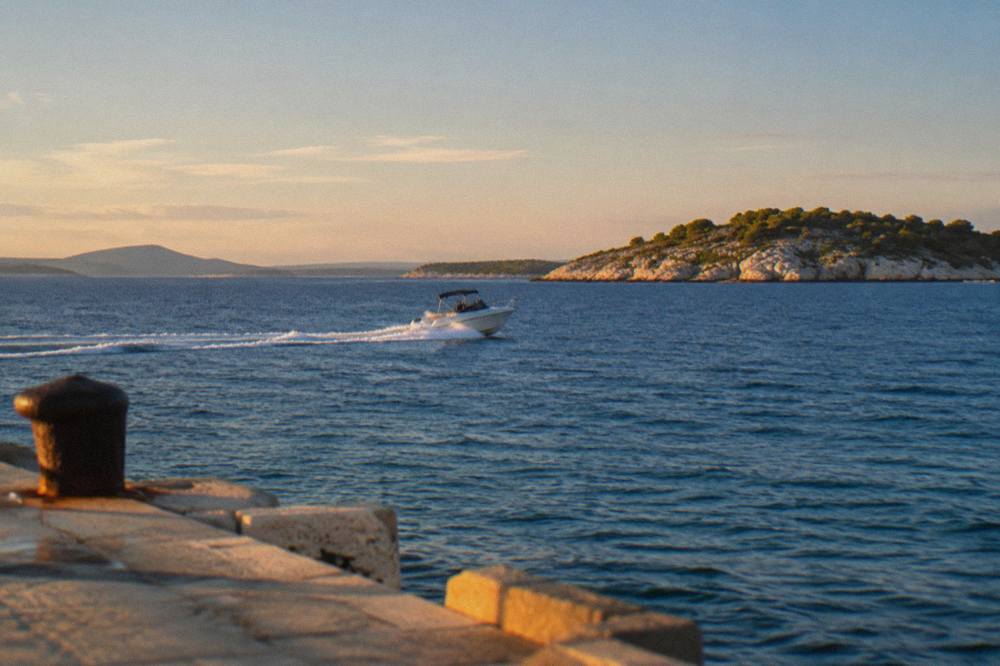
Yes, entirely: the quiet side of Split is real and easy to reach, from the 819 steps up Marjan to Telegrin at 178 m, the galleries and museums that close in the early evening, and neighbourhood restaurants in areas like Veli Varos well away from the Riva, all of which function on any date including festival weekends. The Meštrović Gallery, reopened in April 2026 after a 15-month energy renovation, charges 12.00 EUR for an adult ticket that includes Crikvine-Kaštilac. The Archaeological Museum, founded in 1820, charges 8 EUR, or 10 EUR combined with Salona within 7 days. An evening kayak trip along the coast, the illuminations tour among them, is another way to spend a night on the water rather than at a bar. Even in July, the loudest venues are geographically contained, and the 2027 festival occupies three named nights at one venue, Park Mladeži, rather than the whole city.
Choosing where to sleep does half the work. The best area to stay question breaks the neighbourhoods down, and the short version is that beds inside the palace walls put you at the centre of the terrace noise, while Meje, Veli Varos or the slopes of Marjan put a walk between you and it. One planning note cuts the other way: the Riva's central section is scheduled for renovation works from November 2026 for a little over a year, so partial closures on the waterfront are expected through 2027, which may shift terrace seating into side streets during that window.
What Should You Know About Rules And Costs On A Night Out?
The rules are specific: 300 EUR fines apply to drinking alcohol in the historic centre outside licensed terraces, to urinating in public, to climbing on monuments or bathing in fountains, and to taxi touting, while sleeping in public spaces carries a 150 EUR fine, and shops, though not bars, were banned from selling alcohol at night from 1 June to 15 September 2026. The amount of the fine for walking through the centre in swimwear is set locally and is not published on the official page, so confirm locally rather than trusting a number quoted secondhand. None of this makes Split strict; it makes the historic core a place where the party stays on the terraces. The things to avoid page collects the full set of traps, and the emergency number in Croatia is 112.
Costs behave like anywhere on the Dalmatian coast: cover charges appear on the menu if a venue charges one, and the itemised bill is the check. The tourist tax, about 2.65 EUR per person per night in high season, from 1 April to 30 September, with under-12s free and 12 to 18 at half rate, is collected by your accommodation and confirmed at booking, not by bars. Croatia has used the euro since 1 January 2023, so there is no currency arithmetic to do on a night out.
| Rule or cost | What the official sources say |
|---|---|
| Street drinking, historic centre | 300 EUR fine, licensed terraces excepted |
| Climbing monuments, fountains, public urination | 300 EUR fine each |
| Sleeping in public spaces | 150 EUR fine |
| Night shop alcohol sales | Banned 1 June to 15 Sept 2026, seasonal repeat from 1 June 2027 |
| Tourist tax | About 2.65 EUR per person per night, high season, added at accommodation |
Common Questions About Split Nightlife
Is Split a party island?
Split is not an island at all but a coastal city on the Dalmatian mainland. Its nightlife peaks around Ultra Europe on 9 to 11 July 2027 and the summer weeks, and it is far quieter outside those windows. The party-island reputation fits offshore Hvar town more closely.
Does Ultra Europe take over the whole city?
The festival runs three nights, 9 to 11 July 2027, at Park Mladeži. Hotels and bars across the city fill that weekend, but the venue itself is a single site and the rest of Split keeps functioning normally.
Can you drink alcohol in the streets of Split?
No. Drinking in the historic centre outside licensed terraces carries a 300 EUR fine under the city's public-order decision, and shops were banned from selling alcohol at night from 1 June to 15 September 2026. Drink on a terrace instead.
Which is better for nightlife, Split or Hvar?
Hvar town concentrates beach-club nightlife in a small place in summer, reached by catamaran from Split at 10.00 EUR for a foot passenger in high season. Split offers more variety, restaurants, theatre and bars, spread across a city of 160,577 people.
Is Split good for a quiet holiday?
Yes. Marjan's forest park, museums such as the Meštrović Gallery at 12.00 EUR, and neighbourhood restaurants sit minutes from the busy streets, and from late September the cultural calendar moves indoors with the HNK Split season running to 14 June 2027.
The honest summary from the Split Croatia Travel Guide desk: book Split for a city break that can turn loud on the nights you choose, and book Hvar or a boat party for the island version. Split's own evenings run from palace bars to pine forest silence, and the calendar tells you which one you are walking into.
