What Is The Best Area To Stay In Split?
The best area to stay in Split depends on what you want: the Old Town for the palace, Bačvice for the beach, Meje for quiet. This guide matches each district to a traveller.
Split sits on the Adriatic coast of central Dalmatia, Croatia, built in and around Diocletian's Palace, with the Marjan peninsula park forest on its western side and the islands of Brač, Šolta, Hvar and Vis offshore. Where you sleep matters here more than in spread-out capitals, because the city's core is small and the ferry port, the main bus station and the railway station sit together on Obala kneza Domagoja, 500 to 600 m from the palace itself. Pick the right quarter and every ferry, every market and every swim stop sits within an easy walk.
Which Area Of Split Suits Which Traveller?
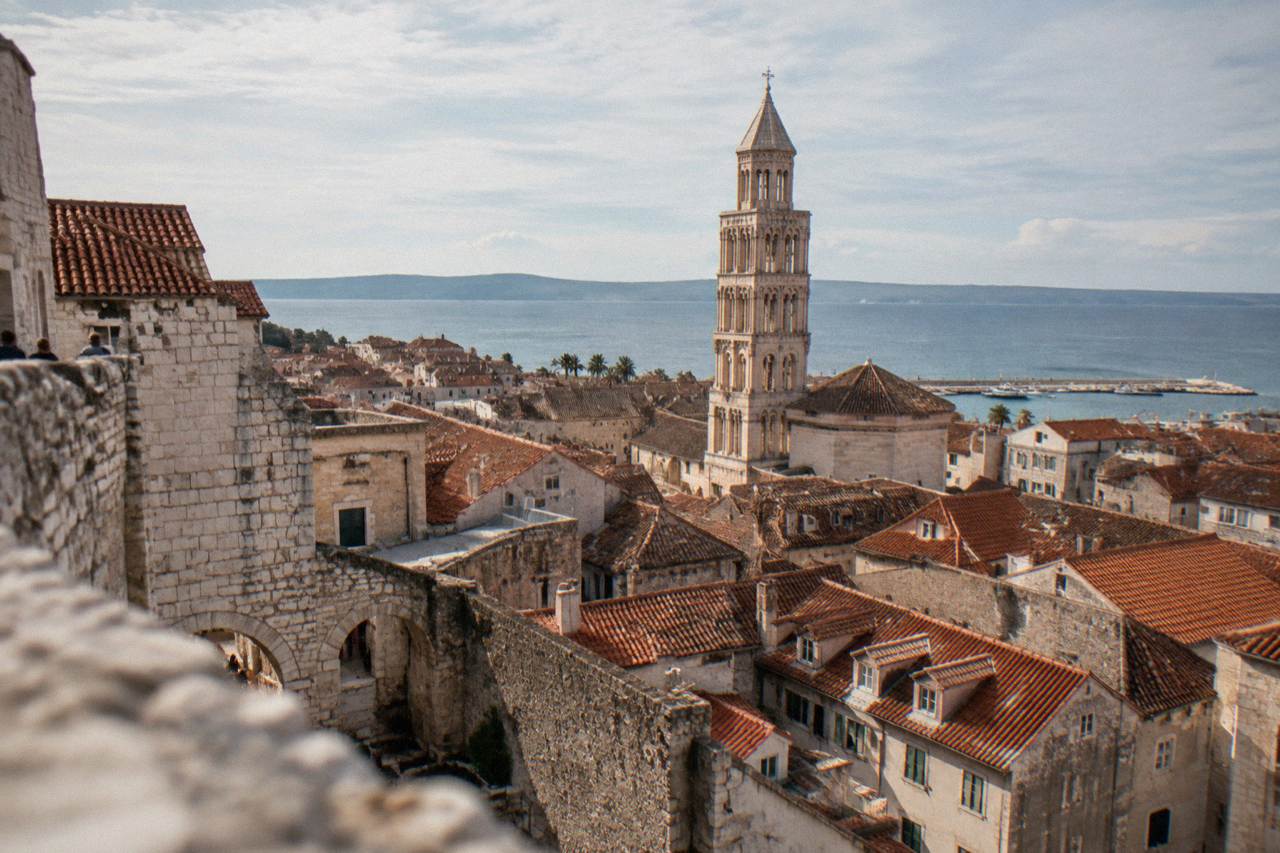
For a first visit the Old Town inside and around Diocletian's Palace is the strongest base: the Peristyle, the Golden Gate, the Riva promenade and the green market are all on foot. For a beach holiday Bačvice and Firule on the east side put sand and shallow water first. For quiet, the Meje side below Marjan and the old stone lanes of Veli Varoš trade nightlife for sleep. The choice is genuinely personal, and the city is compact enough that no pick leaves you stranded. The full district-by-district breakdown, including the hotel zones and apartment streets, sits in the Split neighbourhood guide, and the question of how long to give the city at all is covered in how many days are enough for Split.
What Is The Best Area To Stay In Split?
The best area to stay in Split is the Old Town for a first stay of one to three nights, because Diocletian's Palace, the Riva, the green market and the ferry, bus and rail hub all sit within roughly 600 m of each other. For longer beach stays, Bačvice and Žnjan on the eastern edge put the sea first. For peace and green slopes, Veli Varoš and Meje sit below Marjan on the west side. One practical point colours every other choice: the historic core is a UNESCO property of 20.8 ha, inscribed in 1979, so the streets stay busy late and the stone carries sound. The palace quarter is the most convenient bed in Dalmatia and, on a summer Saturday, the loudest.
Base yourself there and the day-trip infrastructure is at the door. Jadrolinija's route page shows line 635 to Stari Grad on Hvar taking about 120 minutes, line 631 to Supetar on Brač about 50 minutes, and the catamaran lines run to Hvar town, Jelsa and Vis. A Krka day is equally easy, and the Krka Waterfalls tour with boat cruise and swimming collects in the city and returns the same evening, Check availability if that rhythm suits your stay.
Is The Old Town The Best Place To Stay In Split?
For a short first stay, yes: the Old Town puts you inside the living fabric of the palace, steps from the Peristyle, the Grgur Ninski statue at the Golden Gate and the Riva, with the transport hub a five-minute walk. The trade-offs are real: stone streets amplify summer noise, apartments sit above bars and restaurants, and delivery and luggage wheels rattle over Roman paving from early morning. Several of the palace sights cost nothing at all, which softens the case for a room in the core, as the article is Diocletian's Palace free sets out: the Peristyle, the Riva, the Prokurative, the Golden Gate and the markets are all free to walk. The cellars, run by the Split City Museum, are open Monday to Sunday 8:30 to 20:00, and the museum's own price list shows a 10.00 EUR adult ticket at the Papalić Palace, closed Mondays. One change to know if you plan to sleep in the core: the central part of the palace substructures is under restoration to the end of 2026, with the passage staying open.
To really understand the palace you are sleeping in, book a guided Old Town walk here.
Where Should Beach Lovers And Families Stay In Split?
Bačvice and Firule on the eastern edge of the city are the beach base: Bačvice is the sandy city beach where picigin, the shallow-water ball game, has been played since 1908 and is protected intangible heritage of Croatia. Žnjan, further east along the coast, adds a concrete-and-pebble stretch with cafes and play areas. Meje, on the west side below Marjan, gives quieter swimming at Kašjuni. All the city beaches are free, and swimming in the city is realistic well into autumn: the question is answered in detail in can you swim in the sea in Split. The DHMZ Split Marjan station table, covering 1948 to 2024, gives September a mean of 21.6 C and October 17.2 C, so a September room near Bačvice buys sea days without July's crowds.
Where Should You Stay In Split For Quiet?
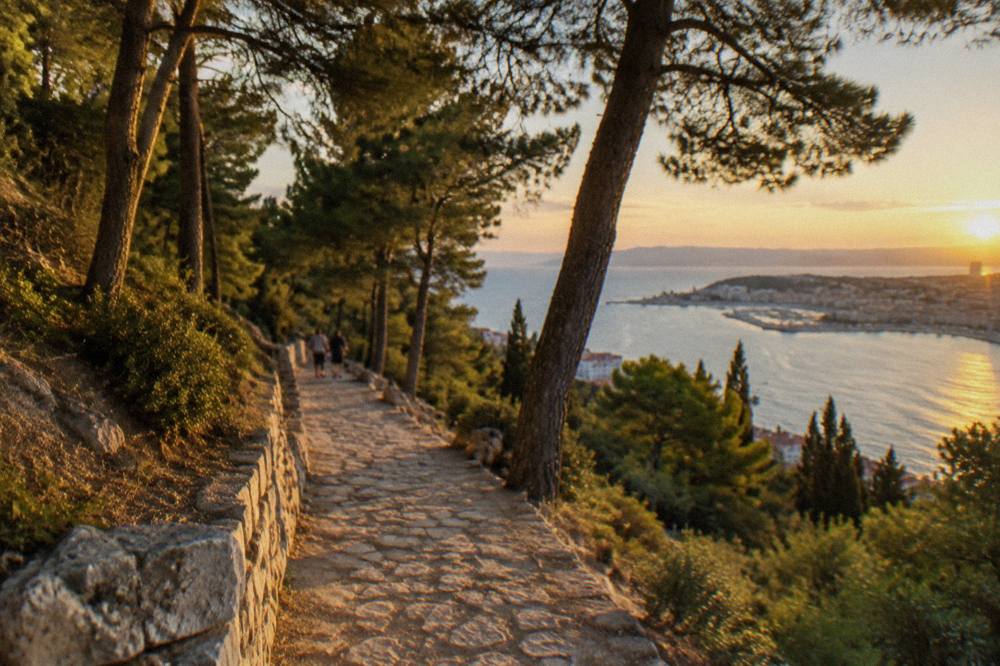
Veli Varoš and Meje are the quiet picks. Veli Varoš is the old fishermen's quarter of stone lanes on the western approach to the palace, a short walk from the core but a world away in pace. Meje stretches below Marjan toward Kašjuni, with the park forest's 819 steps from Trumbićeva obala to the Telegrin summit at 178 m as the morning climb. Marjan itself is 3.5 km long and 1.5 km wide, a protected park forest with viewpoints over the islands. Anyone sleeping on this side wakes to pine rather than bar noise. The counterweight is distance from the evening action: dinner in the Old Town is a walk back over the shoulder of the hill, so decide whether your nights or your mornings matter more.
How Far Is Each Part Of Split From The Port, The Airport And The Day Trips?
The ferry port, the main bus station and the railway station sit together on Obala kneza Domagoja, 500 to 600 m from the palace, so any Old Town or Veli Varoš bed reaches them on foot in minutes. Split Airport is farther than many expect: the airport's own pages give 20 km from Split and 6 km from Trogir, in Kaštel Štafilić, with driving from the palace at 24.9 km and about 31 minutes free-flow. The Platanus shuttle runs from the airport to the main bus station by the ferry port at 10 EUR one way and 15 EUR return, and Promet Split's city lines 37 and 38 also stop at the airport, with the fare a few euros to confirm on board. Distances from the palace to the day-trip magnets, computed as free-flow driving times, sit below.
| Destination from the palace | Distance | Free-flow drive time |
|---|---|---|
| Klis Fortress | 13.9 km | 22 min |
| Salona | 9.1 km | 14 min |
| Trogir | 29.3 km | 36 min |
| Omiš | 25.5 km | 38 min |
| Krka, Skradinski buk | 90.2 km | 74 min |
| Split Airport | 24.9 km | 31 min |
None of these requires a car from any central bed. Coaches run from the same Obala kneza Domagoja hub, and the guided Krka, Plitvice, Mostar and Dubrovnik trips collect in the city. If your stay is built around one big park day, the comparison in which is better, Plitvice or Krka is worth reading before you book a room far from the coach stands. Everything else covered here is indexed on Split Croatia Travel Guide.
What Does Staying In Split Cost, And What Taxes Apply?
Croatia has used the euro since 1 January 2023, and Split prices run in EUR throughout. A tourist tax is collected by the accommodation: about 2.65 EUR per person per night in high season, 1 April to 30 September, with under 12s free and 12 to 18s at half, confirmed at booking. No hotel rate, nightly price or city card figure belongs on this page, because those change constantly and should be checked against the listing itself. What can be said firmly is what your room buys outside its four walls. The free list in Split is long: the Peristyle, the Riva, the Prokurative, the Golden Gate, the Grgur Ninski statue, the markets, Marjan and the city beaches all cost nothing. The paid museums are modest by European standards, as the museums roundup shows: the Meštrović Gallery, reopened in April 2026 after a 15-month energy renovation, lists 12.00 EUR for adults including Crikvine-Kaštilac, and the Ethnographic Museum lists 7.00 EUR.
Timing shifts value as much as district does. The DHMZ Split Marjan station means below, for the period 1948 to 2024, show why October rooms reward the patient.
| Month | Mean temperature C | Precipitation mm |
|---|---|---|
| May | 19.2 | 57.5 |
| June | 23.4 | 49.0 |
| July | 26.2 | 26.6 |
| August | 25.9 | 41.3 |
| September | 21.6 | 70.9 |
| October | 17.2 | 77.0 |
July is the warmest month at a 26.2 C mean and the driest at 26.6 mm, with 18 days at 30 C or more; November is the wettest at 115.5 mm. The wider month-by-month case is made in the best month to visit Split.
Should You Stay In Split Or On One Of The Islands?
For a trip built around day trips, stay in Split: Krka, Plitvice, Trogir, Salona, Klis, Omiš, Mostar and Dubrovnik all start from this city, and the islands themselves are day trips from it. For a pure beach week, a room on Hvar or Brač works, but then Split becomes your transit point rather than your base. The ferry arithmetic is simple: line 635 to Stari Grad takes about 120 minutes, line 631 to Supetar about 50 minutes, line 636 to Rogač on Šolta about 60 minutes, and the Vis ferry about 140 minutes. Do not confuse Hvar town with Stari Grad: Hvar town is reached by catamaran, Stari Grad by car ferry. The comparison is argued both ways in is Hvar nicer than Split.
Whichever shore you choose, book the big boat days early in a summer stay.
Common Questions About Where To Stay In Split
What is the best area to stay in Split?
The Old Town, inside and around Diocletian's Palace, is the best area for a first stay of one to three nights, since the sights, the Riva and the ferry, bus and rail hub sit within about 600 m of each other. Bačvice and Žnjan suit beach stays, and Veli Varoš and Meje suit travellers who want quiet.
Is it better to stay in the Old Town or near Bačvice?
The Old Town wins for sightseeing, dining and ferry access; Bačvice wins for the beach and for families who want sand and shallow water at the door. The two are a short walk or one city bus apart, so the trade-off is noise versus sea.
How far is the ferry port from the Old Town of Split?
The ferry port, the main bus station and the railway station sit together on Obala kneza Domagoja, 500 to 600 m from the palace, reachable on foot from any central bed in minutes.
Do I need a car to stay in Split?
No. The centre is walkable, the islands are reached by ferry and catamaran, and the major day trips run as guided coach tours from the city. A car matters only for an independent itinerary with several inland stops.
Is Split noisy at night in summer?
The historic core can be, because apartments sit above bars and restaurants in stone streets that carry sound. Veli Varoš, Meje and the streets below Marjan are the quieter picks on the same side of the centre.
What taxes are added to a stay in Split?
A tourist tax is collected by the accommodation: about 2.65 EUR per person per night in high season, 1 April to 30 September, with under 12s free and 12 to 18s at half. The exact amount is confirmed at booking.
The short version: sleep inside the walls for a short first visit, sleep by Bačvice for the sea, sleep under Marjan for silence, and let the rest of Dalmatia come to you from the port at the end of the street.