Is There A Dress Code For Entering Diocletian's Palace?
No dress code applies to Diocletian's Palace in Split itself, but the Cathedral of St Domnius requires covered shoulders and knees. Here is what to wear and what the local rules fine.
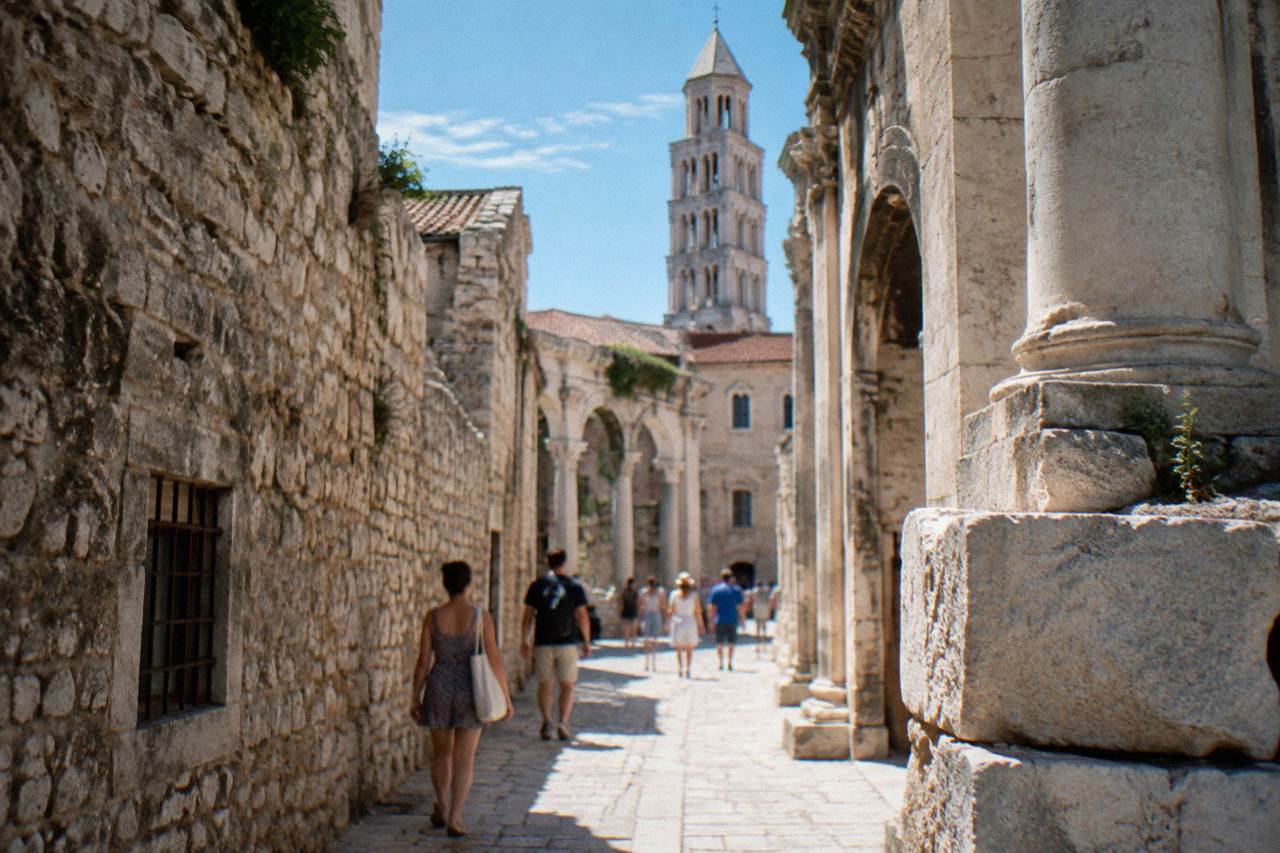
Split, on Croatia's Adriatic coast in central Dalmatia, keeps something that catches many first-time visitors off guard: Diocletian's Palace is not a museum behind a gate. Built for Emperor Diocletian around 295 to 305 AD and inscribed by UNESCO in 1979 as the Historical Complex of Split with the Palace of Diocletian, it is a working quarter where people live, eat and hang laundry over Roman walls. That single fact answers the dress question before any rule does, because a place you enter through open streets does not check your outfit at a door. The exceptions sit inside the palace walls, and they are specific: the Cathedral of St Domnius complex and the city's public-order rules.
Is There A Dress Code For Entering Diocletian's Palace?
No, there is no dress code for entering Diocletian's Palace in Split, because the palace is a lived-in city quarter entered through free public streets at any hour. The Peristyle, the Riva, the Prokurative, the Golden Gate and the Grgur Ninski statue cost nothing and impose no clothing rule. A dress rule exists only inside the Cathedral of St Domnius complex, where shoulders and knees must be covered, and it applies to the ticketed church spaces, not the palace streets.
The distinction matters because the word "palace" suggests a single guarded building. In Split it means roughly the whole Old Town core, a UNESCO property of 20.8 ha with bars, apartments and shops built into the ancient fabric. Nobody stops you at the Golden Gate in shorts and a T-shirt, and in July, when the DHMZ Split Marjan station table shows a mean of 26.2 C with 18 days at 30 C or more, that is exactly what the streets look like.
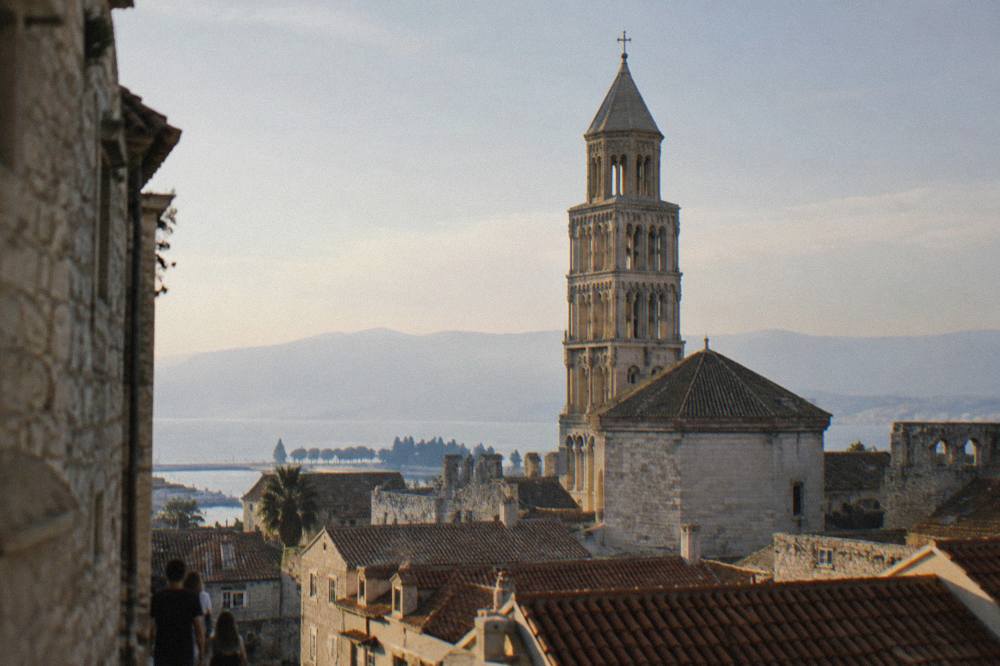
What changes is the moment you step into a consecrated or ticketed space. The Cathedral of St Domnius, the former mausoleum of the emperor, functions as an active church, and the rule there is the standard one for churches in Dalmatia: shoulders and knees covered. The same complex includes the bell tower, 57 m high, the crypt, the treasury and the baptistery in the former Temple of Jupiter. Prices on the secondary guides run from about 5 EUR for a single site up to about 15 EUR for a combined ticket, sold at the kiosk on the Peristyle, and shoulders-and-knees applies across the ticketed church spaces.
For travelers who want the layers of the palace explained rather than only walked, the palace guide page covers the layout, and a guided walk such as the Split Old Town - Diocletian's Palace Guided SMALL GROUP Tour moves through the Peristyle, the cellars and the cathedral quarter with a licensed guide.
For the palace explained by a professor of history, book a Split walking tour here.
What Should You Wear Inside The Cathedral Of St Domnius In Split?
Cover your shoulders and knees: that is the whole rule at the Cathedral of St Domnius in Split, and it applies to men and women alike across the ticketed spaces of the complex. Shorts above the knee, strappy tops and bare midriffs will stop you at the entrance. A light scarf or a longer layer in a day bag solves it, and the rule is the same at the bell tower, the crypt, the treasury and the baptistery as at the cathedral itself.
The practical fix costs nothing. A sarong or a large scarf wraps over swimwear or a tank top in seconds, and in summer it doubles as cover from the sun on the stone streets, where shade is scarce between the Peristyle and the Riva. Shoes are not an issue: the surfaces are worn stone and marble, so flat shoes with grip serve better than anything delicate, and the bell tower climb is a staircase without an elevator.
One more space inside the palace has its own ticket and its own practical clothing logic: the substructures, the cellars run by the Split City Museum, open Monday to Sunday from 8:30 to 20:00. The adult cellars ticket is 10 EUR. The vaulted halls are cool compared with the street, so a light layer is useful even in August, and the central part is under restoration to the end of 2026 with the passage kept open, which the museum's own channels confirm.
| Space in Split | Dress rule | Entry cost |
|---|---|---|
| Palace streets, Peristyle, Golden Gate, Riva | None | Free |
| Cathedral of St Domnius complex | Shoulders and knees covered | From about 5 EUR, combined tickets up to about 15 EUR |
| Bell tower, 57 m | Shoulders and knees covered | Within the cathedral ticket scheme |
| Palace substructures (cellars) | None, cool interior, light layer useful | 10 EUR adult |
| Marjan park and city beaches | None | Free |
Does The Swimwear Rule In Split Affect The Palace Quarter?
Yes, Split fines walking in swimwear or shirtless in the historic centre, and Diocletian's Palace sits at the heart of that zone, so beachwear is not just frowned upon there, it is an offence. The amount of the swimwear fine is set locally and should be confirmed on the spot. The public-order fines published by the city are 300 EUR for drinking alcohol in the historic centre, 300 EUR for climbing on monuments and 150 EUR for sleeping in public spaces.
The swimwear rule is listed among them as a finable offence without a printed amount on that page, so the safe summary is simple: come off Bačvice beach or Žnjan, put on a shirt and dry off before you walk into the palace streets. Cover-ups, sundresses and any real clothing satisfy it.
This is the point where the dress question stops being about etiquette and becomes about money, and it is the one genuinely local rule that catches beach-town visitors. Split is a coastal city where the sea is a short walk from Roman walls, and the city has drawn a clear line between the two. If a swim is on the itinerary for the same day as the cathedral, plan the church first, the beach after, and the swimwear stays in the bag until the promenade ends.
For what else the city penalises and how to stay on the right side of the rules, the things to avoid in Split page lists them all in one place, and the wider question of whether the palace costs anything is answered separately, since most of it does not.
What Should You Pack For Split's Summer Streets And Churches?
Pack light, breathable clothing plus one modest layer: that combination covers both the heat and the cathedral rule in Split. July means a station mean of 26.2 C and 18 days at 30 C or more at the DHMZ Split Marjan station for the 1948 to 2024 period, so shorts, linen and hats are right for the streets, while a scarf or a longer item in the bag handles shoulders and knees at the church. Flat shoes with grip beat anything else on the polished stone.
The climate record backs the light packing. August means 25.9 C, September still 21.6 C, and even October averages 17.2 C at the same station, so the summer wardrobe works from late spring deep into autumn. Rain is not the summer story either: July is the driest month at 26.6 mm, while November is the wettest at 115.5 mm, and the page on the best month to visit Split works through those figures month by month.
| Month in Split | Station mean C | Rain mm | What the dress answer means |
|---|---|---|---|
| July | 26.2 | 26.6 | Full summer wear, carry a church layer |
| August | 25.9 | 41.3 | Same as July, more 30 C days at 17 |
| September | 21.6 | 70.9 | Light layers still fine |
| October | 17.2 | 77.0 | Long sleeves for evenings |
| November | 12.7 | 115.5 | Warm layer, umbrella season begins |
The layer trick is the one thing worth repeating. A single scarf weighs almost nothing, satisfies the cathedral rule for any outfit, shields shoulders from sun on the Riva and adds warmth in the cellars, where the temperature drops noticeably against the street. Visitors coming straight off a boat trip, for example one of the swimming excursions around the islands, should simply keep dry clothes at hand for the walk back through the palace streets, both for comfort and for the swimwear rule above.
Do You Need Tickets For Parts Of Diocletian's Palace In Split?
No ticket is needed for the palace as a whole, because the streets, squares and gates of Diocletian's Palace in Split are free public space, but four kinds of space inside it are paid: the Cathedral of St Domnius complex from about 5 EUR, the substructures at the price the Split City Museum lists, and the museums just outside the walls. Dress rules follow the same line: free spaces have none, consecrated spaces require covered shoulders and knees.
The paid list inside or beside the palace quarter is short and clear. The cathedral complex sells single-site and combined tickets at the Peristyle kiosk, with prices from about 5 EUR up to about 15 EUR on the secondary guides that list them. The cellars run daily, and the Split City Museum at Papalić Palace charges 10.00 EUR adult for its own collection, closed Mondays. Beyond the walls, the Meštrović Gallery reopened in April 2026 after a 15-month renovation at 12.00 EUR, and the Archaeological Museum charges 8 EUR, or 10 EUR combined with Salona within 7 days.
None of those museums imposes a dress rule. The cathedral is the only space in the quarter where clothing decides entry, which is why the honest answer to this page's question is a two-part one: dress however you like for the palace, and dress for a church when the bell tower is on the route. Visitors pairing the palace with a day trip later in the week, whether to Krka or out onto the water, need nothing different: the same summer kit and the same modest layer cover every ticketed space this guide lists.
For the wider picture of what fills a first day in the city, the things to do in Split page is the place to start, and this Split Croatia Travel Guide keeps every palace, museum and beach question in one place. Dress for the heat, keep a scarf for the cathedral, and leave the swimwear for the beach side of the Riva.
Common Questions About Dress Codes In Split
Is there a dress code for entering Diocletian's palace?
No. The palace is a free, lived-in quarter of Split entered through public streets, and no clothing rule applies to its streets, gates or squares. Only the Cathedral of St Domnius complex inside it requires covered shoulders and knees.
Can you wear shorts inside the Cathedral of St Domnius?
Only if they cover the knees. The rule at the cathedral complex in Split is shoulders and knees covered, the same as in churches across Dalmatia. A scarf or a longer layer over summer clothing satisfies it.
Can you walk through Diocletian's Palace in swimwear?
No. Split fines walking in swimwear or shirtless in the historic centre, and the palace sits inside that zone. The fine amount is set locally and should be confirmed on the spot; dry off and put on real clothing before leaving the beach.
Do children need to follow the cathedral dress rule?
The shoulders-and-knees rule at the Cathedral of St Domnius applies to all visitors regardless of age. A light layer for each child is enough, and it doubles as sun cover on the stone streets outside.
Do you need covered shoulders for the bell tower?
Yes. The 57 m bell tower is part of the ticketed cathedral complex, and the same covered-shoulders-and-knees rule applies at its entrance as at the cathedral itself.
What shoes are best for the palace and Marjan?
Flat shoes with grip. The palace streets and the Peristyle are worn stone and polished marble, the bell tower is a staircase, and the path up Marjan to Telegrin at 178 m is stepped in parts, with 819 steps from Trumbićeva obala to the top.
