Is There A Hop-On Hop-Off Bus In Split?
No hop-on hop-off sightseeing bus operates in Split: here is what the city's own transport actually offers, from Promet city buses and the Platanus airport shuttle to walking, ferries and day-trip coaches.
Split, the coastal city in central Dalmatia on the Adriatic, has no hop-on hop-off sightseeing bus. Nothing in the city transport operator's published network, in the local bus station's departure lists or in the port authority's terminal information describes a tourist circuit bus with onboard commentary and re-entry rights, the format sold in larger capitals. What Split has instead is a compact pedestrian core, a municipal bus network run by Promet Split, an airport shuttle and one of the busiest ferry ports in the country, 6.05 million passengers in 2025 according to the Port of Split's own figures. This page sets out what that means in practice, and what to use in place of a hop-on hop-off bus.
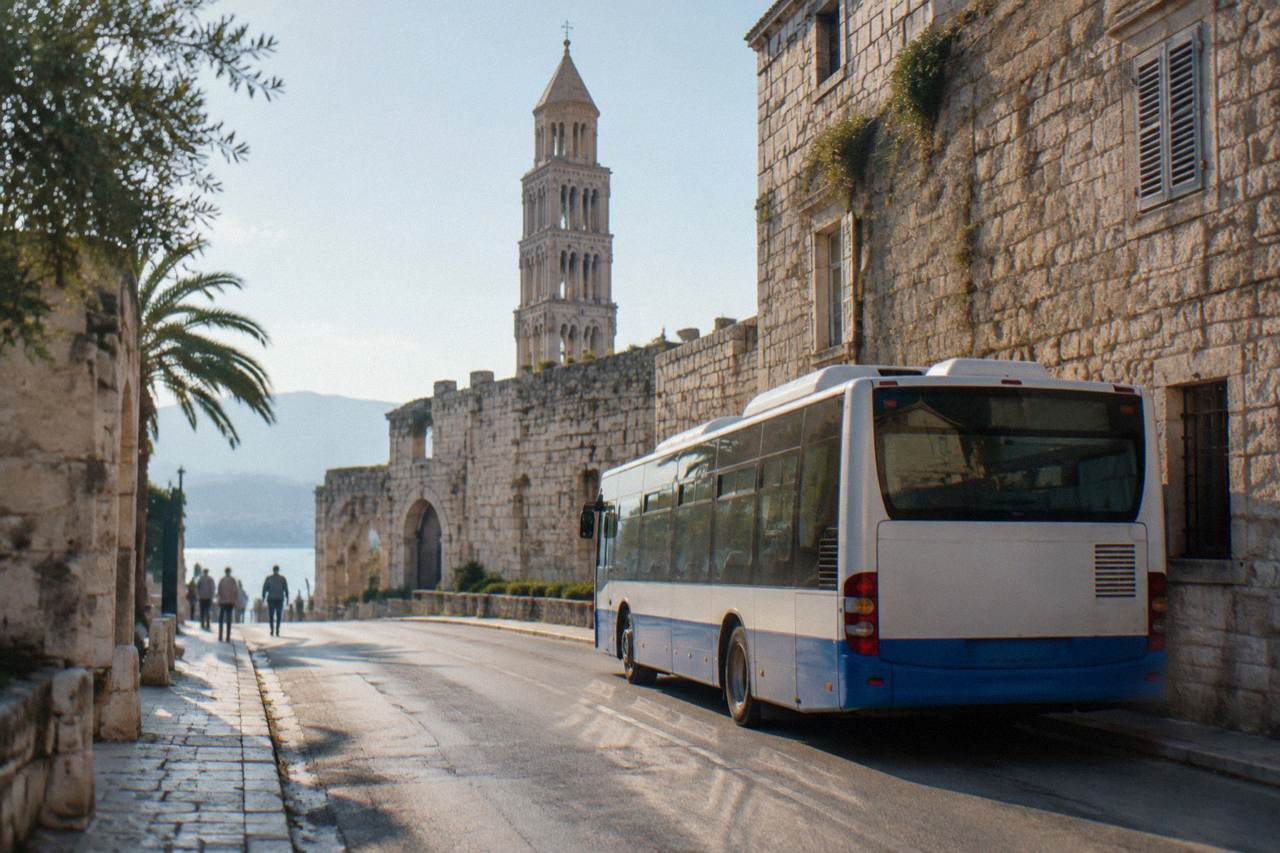
Is There A Hop-On Hop-Off Bus In Split?
No, there is no hop-on hop-off sightseeing bus operating in Split and none appears in any current published network of the city's transport operator, Promet Split, or in the departure boards of the main bus station on Obala kneza Domagoja. The reason is simple geography: the sights visitors come for sit inside or immediately around Diocletian's Palace, a UNESCO World Heritage property of 20.8 hectares inscribed in 1979, and that ground is walkable in minutes rather than bus rides.
A sightseeing circuit bus needs long sight lines and spread-out attractions. Split's layout works against that model. The Peristyle, the Golden Gate, the Grgur Ninski statue, the Riva promenade and the palace substructures all sit within a few minutes' walk of each other on streets that are largely pedestrianised, and a bus could neither reach them nor turn around near them. The Marjan park forest rises on the western side of the peninsula with its highest point, Telegrin, at 178 m, reached by 819 steps from Trumbićeva obala rather than by road from the old town.
The city does have buses, and they are ordinary scheduled services. Promet Split runs the municipal network, and its lines 37 and 38 stop at the airport in Kaštel Štafilić; the fare is a few euros, confirm on board, because the operator's own price page does not display it in plain text. For paying for local buses in general, the practical detail is explained on How You Pay For The Bus In Split, and the bus station itself is covered in the guide to Split's bus station.
What Transport Does Split Actually Have?
Split's public transport is built around three layers: Promet Split's city buses for the wider urban area, the Platanus airport shuttle linking the airport to the main bus station, and the ferry and catamaran network radiating from the port to Brač, Šolta, Hvar and Vis. The ferry port, the main bus station and the railway station sit together on Obala kneza Domagoja, 500 to 600 m from the palace, so the whole interchange is a short walk from the old town.
There is no double-decker, no open-top circuit and no audio-guide route, but the scheduled network covers what a visitor needs. City buses serve the outer districts and beaches such as Žnjan and Stobreč. The airport, which its own pages place 20 km from Split and 6 km from Trogir, is reached by the Platanus shuttle, 10 EUR one way and 15 EUR return, or by Promet lines 37 and 38. The table below compares the ground options.
| Option | Where it runs | Cost | Notes |
|---|---|---|---|
| Walking | Old town, Riva, Marjan approaches | Free | The realistic way to see the palace sights |
| Promet city buses | City districts, beaches, airport via lines 37 and 38 | A few euros, confirm on board | Ordinary scheduled services, no commentary |
| Platanus airport shuttle | Airport North parking to the main bus station | 10 EUR one way, 15 EUR return | Times align with flight arrivals, check at the terminal |
| Ferries and catamarans | Stari Grad about 120 min, Supetar about 50 min, Rogač about 60 min, Vis about 140 min | Foot passenger 5.90 to 8.40 EUR on line 635 | Depart from the port by the bus station |
Ferries deserve their own note because they do part of the job a hop-on hop-off bus does elsewhere. Jadrolinija's route pages show line 635 to Stari Grad on Hvar taking about 120 minutes and line 631 to Supetar on Brač about 50 minutes, with foot passenger fares on line 635 of 5.90 EUR off-season and 8.40 EUR in season. Catamarans reach Hvar town and Vis directly. Hvar town itself is served by catamaran and Stari Grad by car ferry, and confusing the two is the classic booking error, which is why it is worth reading where the ferry from Split to Hvar arrives before committing.
Is Split Walkable Without A Sightseeing Bus?
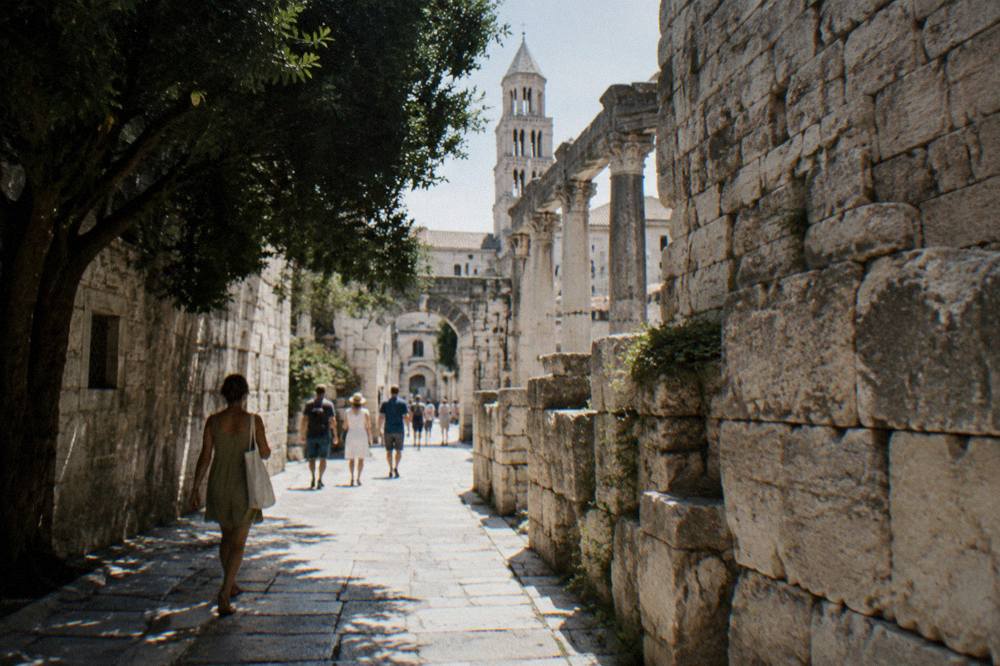
Yes, Split is walkable to a degree few visitors expect: the historic core inside and around Diocletian's Palace is entirely navigable on foot, the Riva promenade and Bačvice beach are minutes from the Peristyle, and the Marjan park forest's trail network starts at the western edge of the centre. A sightseeing bus would add nothing here, because the distances between the main sights are measured in hundreds of metres, not kilometres.
The palace itself, built for Emperor Diocletian around 295 to 305 AD, forms the old town. Its Peristyle, Golden Gate and cellars are interleaved with cafés and apartment buildings, and the Split City Museum's price list shows the substructures open Monday to Sunday from 8:30 to 20:00, with the museum itself at 10.00 EUR adult in Papalić Palace. The climb to Marjan rewards the effort with the whole channel view, and the hill park is free, like the Riva, the Prokurative and the city beaches. Everything else covered here is indexed on Split Croatia Travel Guide.
What a bus cannot reach, a guided walk can explain, and that is the real substitute for onboard commentary. A small-group guided walk of the palace and old town, such as the tour led by a Magister of History whose listing this site features, covers the same ground a circuit bus would drive past, at walking pace and with the guide answering questions. Check availability if that format appeals.
To hear the palace explained by a historian, book a small-group guided walk here.
How Do You Reach The Day Trips Without One?
Day trips from Split leave from the combined hub on Obala kneza Domagoja: long-distance coaches, island ferries and organised tours all depart within the same few hundred metres, 500 to 600 m from the palace. Coach times run about 4 hours to Dubrovnik and about 5 hours 30 to Zagreb, the train to Zagreb takes about 7 h 15 to 8 h 10, and driving distances from the palace are fixed by the road network, not by tour operators.
The driving figures below are free-flow estimates computed from the road network, and they explain why tours, not city buses, handle the big excursions. No scheduled urban service connects Split to Krka or Plitvice, so visitors choose between an organised day trip, a rental car or a self-driven route, a decision examined in detail on whether it is worth renting a car in Split.
| Destination from the palace | Driving distance | Free-flow time |
|---|---|---|
| Klis Fortress | 13.9 km | 22 min |
| Salona | 9.1 km | 14 min |
| Trogir | 29.3 km | 36 min |
| Omiš | 25.5 km | 38 min |
| Šibenik | 84.8 km | 71 min |
| Krka, Skradinski buk | 90.2 km | 74 min |
| Plitvice Lakes | 258.1 km | 3 h 15 |
Organised trips cover these routes with a coach and a schedule, and the operator's live listing carries the price, the rating and the meeting point, which is nearly always the Riva or the bus station end of it. This site's pages on Krka National Park and Plitvice Lakes set out what the park tickets themselves cost, 7, 20 or 40 EUR at Krka and 10, 23 or 40 EUR at Plitvice depending on month, figures that come from the parks' own 2026 price lists and are separate from any transport.
What About Tuk-Tuks, Scooters And Other Alternatives?
Electric tuk-tuk tours do operate in Split as a booked sightseeing ride rather than a hop-on hop-off circuit, e-scooters circulate under national rules capping them at 0.6 kW and 25 km/h with helmets mandatory for all ages, and tip-based walking tours run locally, with terms to confirm with the guide directly. None of these is a re-boarding bus pass, and each is paid per ride or per booking rather than per day.
The tuk-tuk option suits visitors who want the Marjan viewpoints and outer sights without the climb, and its listing carries the current price and schedule. E-scooter rules tightened in 2026, with proposals reported locally for registration, insurance and technical inspections on top of the existing power and helmet requirements, so treat any scooter as a short-hop tool rather than a day plan. For the practicalities of movement, the guide to getting around Split collects the modes in one place, and cruise passengers with limited hours can check whether Split is walkable from the cruise port, where the answer is yes, the dock sits at the edge of the old town.
Common Questions About Sightseeing Transport In Split
Is there a hop-on hop-off bus in Split?
No. No sightseeing circuit bus appears in Promet Split's published network or the main bus station's departures, and the city's compact pedestrian core makes one unnecessary. Walking, city buses, ferries and booked tours cover everything.
Can you get around Split without a car?
Yes. The old town, the Riva, Bačvice and the Marjan trails are all reachable on foot from the centre, city buses serve the outer districts, and the ferry port handles the islands. A car only earns its keep for multiple inland day trips.
How do you get from Split Airport to the city centre?
The airport's own pages place it 20 km from Split in Kaštel Štafilić. The Platanus shuttle runs to the main bus station by the ferry port for 10 EUR one way and 15 EUR return, and Promet lines 37 and 38 also stop at the airport, with the fare to be confirmed on board.
Are there guided alternatives to a sightseeing bus in Split?
Yes, including small-group guided walks of Diocletian's Palace with a history specialist, electric tuk-tuk sightseeing rides, and boat trips from the port. Each is booked as a single activity, with price and duration on the operator's live listing.
Do Split's city buses go to the beaches?
Promet Split's scheduled lines serve the wider city including the beach districts, and the main city beaches such as Bačvice are within walking distance of the palace. Routes and frequency are on the operator's network pages.
Split answers the hop-on hop-off question with its own geometry: a palace the size of a town centre, a port that doubles as the day-trip terminal, and hills best climbed on foot. Plan around those three facts and the missing bus stops mattering within an hour of arriving.