Is It Worth Renting A Car In Split?
A straight answer on whether a hire car makes sense for a Split trip: what the city itself demands, which day trips need wheels, and what the driving times and ferry routes say.
Split is a coastal city in Dalmatia, Croatia, built in and around Diocletian's Palace, with the ferry port, the main bus station and the railway station all sitting together on Obala kneza Domagoja, 500 to 600 m from the palace walls. That single sentence answers half of the car question before it is asked: the city's core is walked, not driven, and the islands offshore are reached by boat, not by bridge. A hire car in Split is a tool for exactly one job, the inland and long-distance day trips, and for almost nothing else. For the wider picture of the city itself, the Split Croatia Travel Guide homepage is the place to start.
Is It Worth Renting A Car In Split?
For a stay focused on Split itself and the islands, a hire car is not worth it: the Old Town is pedestrian, the beaches and Marjan are walkable, and Hvar, Brač, Šolta and Vis are served by ferries and catamarans from the port 500 to 600 m from the palace. A car becomes worth the cost only for inland day trips such as Krka, Plitvice Lakes or Mostar, or for a road itinerary continuing on to Dubrovnik or Zagreb.
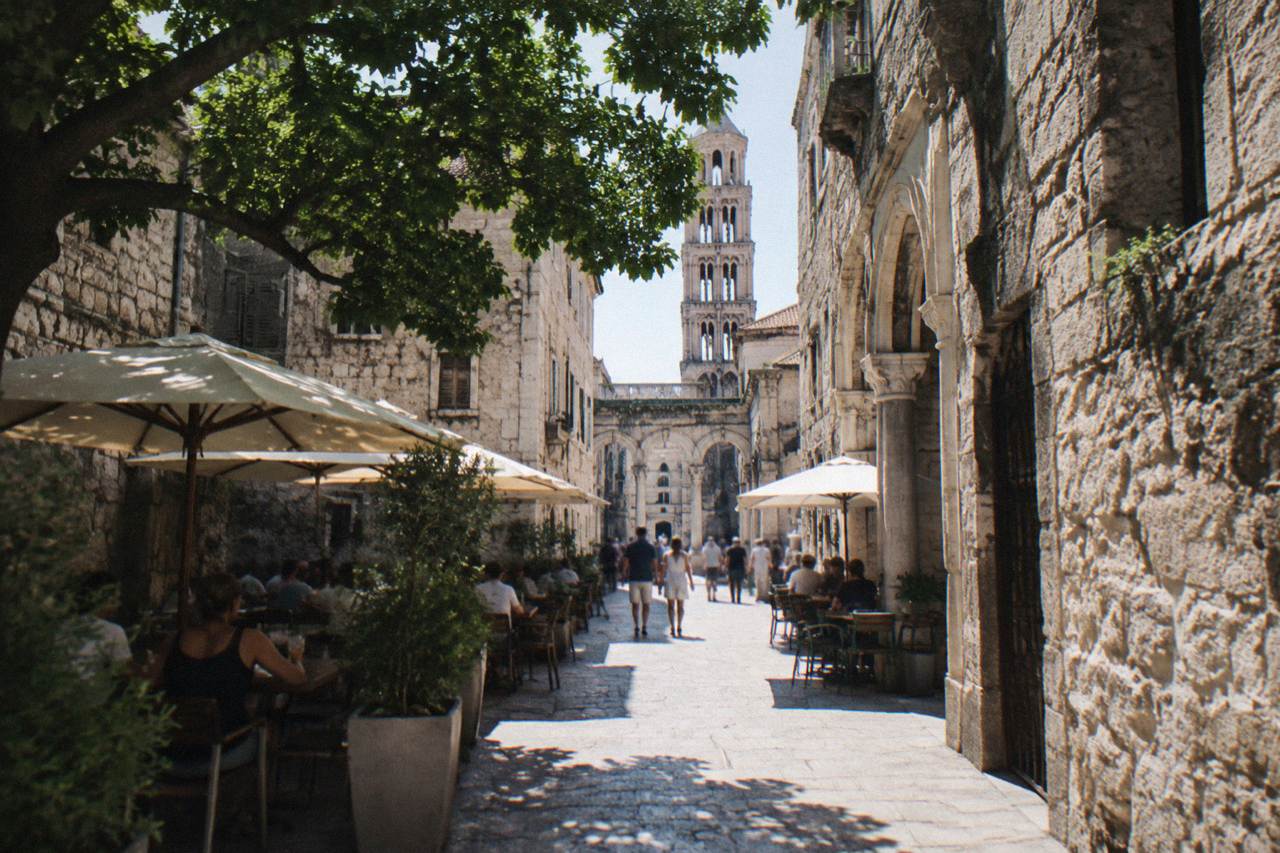
The arithmetic is lopsided. Everything a visitor comes to Split for sits either inside or on the edge of the palace footprint: the Peristyle, the Golden Gate, the Grgur Ninski statue, the Riva, the Green Market and the Cathedral of St Domnius complex, whose bell tower rises 57 m over the Peristyle. All of it is free-roaming ground with no parking anywhere near it, because the historic core is a protected UNESCO area, inscribed in 1979, where streets were laid out inside a Roman palace built c. 295 to 305 AD. Cars do not enter that world at all.
Meanwhile the port next door runs 6.05 million passengers a year, the Port of Split's own figures for 2025, making it Croatia's busiest passenger port. Jadrolinija's route pages show car ferries to Stari Grad on Hvar in about 120 minutes, to Supetar on Brač in about 50 minutes and to Rogač on Šolta in about 60 minutes, with the Vis crossing at about 140 minutes. Catamarans cover Hvar town and Vis on faster foot-passenger sailings. A car is a liability on all of these: it queues, it pays, and on the catamarans it is simply not allowed.
Do You Need A Car Inside Split Itself?
No. The Old Town, the Riva, Bačvice beach and the Marjan park forest are all reachable on foot from the palace core, and the city's main museums cluster within a short radius of it. Driving into the historic centre is restricted, parking around it is scarce, and public order rules in the core now carry fines of 300 EUR for offences such as drinking alcohol in public there.
The walkable inventory is large. The Marjan peninsula park forest, 3.5 km long and 1.5 km wide with its high point Telegrin at 178 m, rises directly west of the centre, and the Marjan park association counts 819 steps from Trumbićeva obala up to Telegrin. The Split City Museum's price list shows its Papalić Palace site at 10.00 EUR for adults, closed Mondays, and it also runs the Diocletian's Palace cellars, open 8:30 to 20:00 daily, with the central part under restoration to the end of 2026 while the passage stays open. The Meštrović Gallery, at 12.00 EUR including the Crikvine-Kaštilac site, reopened in April 2026 after a 15-month energy renovation. None of these demands a car; the gallery sits on the Marjan slope above town.
Even the airport run works without one. The airport's own pages place it in Kaštel Štafilić, 20 km from Split and 6 km from Trogir, and the Platanus shuttle runs from the airport to the main bus station beside the ferry port at 10 EUR one way and 15 EUR return. Promet Split's city lines 37 and 38 also stop at the airport; the fare is a few euros, confirm on board. Everything in one day in Split can be done without wheels, and the same holds for the itineraries in three days in Split.
The one genuine argument for wheels in the city is a base far out of the centre, in Stobreč or Žnjan say, or a family that wants the Klis Fortress, 13.9 km and about 22 minutes' drive from the palace per free-flow routing, on its own schedule rather than on a tour or a bus. That is a narrow case, and even it is eroded by the alternatives below.
Which Split Day Trips Work Best By Car?
The day trips that justify a car are the inland and long ones: Krka National Park at about 74 minutes' drive, Plitvice Lakes at about 3 h 15, Mostar at about 2 h 13 and Dubrovnik at about 3 h 21 from the palace. The coastal near trips, Trogir at 36 minutes, Salona at 14 and Omiš at 38, are short enough that buses and organised tours cover them comfortably, and the island trips are boat territory regardless.
Those driving times are free-flow estimates computed from the palace, and they are the real currency of the decision. Here is the full set:
| Destination from the palace | Distance | Free-flow drive time |
|---|---|---|
| Klis Fortress | 13.9 km | about 22 min |
| Salona | 9.1 km | about 14 min |
| Trogir | 29.3 km | about 36 min |
| Omiš | 25.5 km | about 38 min |
| Šibenik | 84.8 km | about 71 min |
| Krka National Park (Skradinski buk) | 90.2 km | about 74 min |
| Makarska | 86.1 km | about 75 min |
| Zadar | 159.5 km | about 2 h |
| Mostar | 173.2 km | about 2 h 13 |
| Plitvice Lakes | 258.1 km | about 3 h 15 |
| Dubrovnik | 234.8 km | about 3 h 21 |
| Split Airport | 24.9 km | about 31 min |
Two patterns stand out. The near belt, Salona through Omiš, is a set of half-hour hops that a car saves little time on, and Salona pairs naturally with the Archaeological Museum anyway: the museum's price list offers a combined ticket at 10 EUR covering both the Split museum and Salona within 7 days, with the museum alone at 8 EUR. The far belt, Plitvice, Mostar and Dubrovnik, is where driving buys freedom, and where the border crossing into Bosnia and Herzegovina on the Mostar route adds a variable that tour coaches handle daily.
The islands are the opposite case. Hvar town is reached by catamaran and Stari Grad by car ferry; confusing the two is the classic first-timer error. The ferry fares the Jadrolinija price list publishes, 5.90 EUR off-season and 8.40 EUR in season for a foot passenger to Stari Grad, are for people, and taking a car across costs more and needs booking ahead in summer. The Split to Hvar ferry guide covers the routes in detail, and the wider day trips from Split page ranks them all.
For anyone who would rather not drive the far belt at all, the organised options are strong, and the trio above includes one that covers Mostar, Počitelj and the Kravice waterfalls in a single day, which is a genuinely hard drive to self-organise with border queues. The Blue Cave and Hvar speedboat runs occupy the same slot on the sea side.
What Does Driving And Parking In Split Involve?
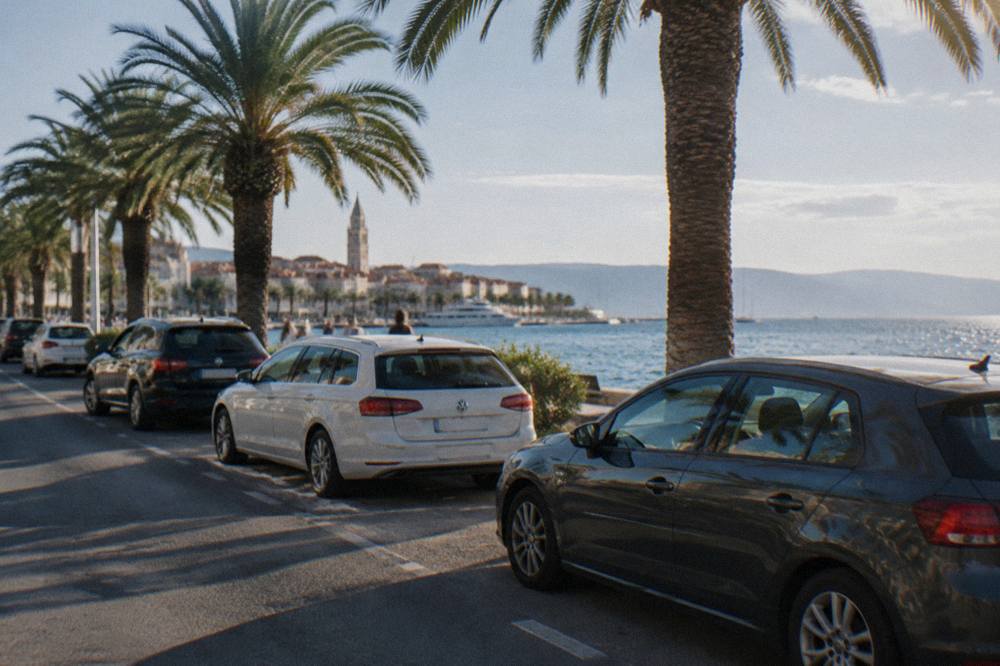
Driving in Split involves a pedestrianised historic core with no vehicle access, scarce paid parking around it whose tariffs are set by zone and should be confirmed on arrival, summer congestion on the coastal approach roads, and a 2026 public-order regime that fines 300 EUR for drinking alcohol in the historic centre or within 100 m of schools. None of that is a reason to avoid a car outright, but it is a reason not to keep one parked in the centre for a city stay.
The practical shape of a car trip is: arrive, park on the periphery, and walk. The centre offers no alternative, and the fines regime is specific. The city's published rules list 300 EUR for public alcohol consumption in the historic centre, 300 EUR for urinating, 300 EUR for climbing monuments or bathing in fountains, 150 EUR for sleeping in public spaces and 300 EUR for taxi touting. Walking in swimwear or shirtless in the centre is also fined, with the amount set locally. Beyond the centre, a night-time retail alcohol sales ban ran 1 June to 15 September 2026, affecting shops rather than bars, and it is due to repeat automatically from 1 June 2027 unless changed.
Out on the roads, Croatia has used the euro since 1 January 2023 and has been in the Schengen area since 1 January 2023, so there are no border checks heading north to Zagreb or Slovenia, only on the Mostar route into Bosnia and Herzegovina, where EES registration applies since 10 April 2026. No motorway toll figure, parking tariff or car-hire rate belongs on this page: those change by operator and by zone and should be confirmed at booking and on the meter. For the mechanics of hiring, the Split car rental guide carries the checklist.
One seasonal note worth having in advance: the DHMZ Split-Marjan station table, covering 1948 to 2024, puts July's mean at 26.2 C with 18 days at 30 C or more, and August close behind at 25.9 C with 17 such days. Air-conditioned car or not, a Plitvice run at 3 h 15 each way in that weather is a different proposition from the same run in October, when Krka's price list drops to 20 EUR and Plitvice's to 23 EUR.
When Is A Car In Split Worth It?
A car is worth renting in Split for three scenarios: an itinerary that continues to Dubrovnik, Mostar or Zagreb by road, repeated independent trips to Krka, Plitvice or the inland sights, or accommodation well outside the centre with a family in tow. For a two-to-four day city-and-islands stay, the port, the shuttle bus and your own feet do the same work for less money and no parking anxiety.
If that sounds like your trip, book a Split Airport car hire here.
The rule of thumb the figures support: count your far-belt days. One Plitvice day trip does not justify a week's hire and seven nights of peripheral parking; three far days plus a transfer onwards might. Season tilts it too. In July and August the coastal road and the Supetar ferry queue absorb whatever time a car saves, while from November to March the same roads are quiet and the Krka ticket is 7 EUR and Plitvice 10 EUR on their published price lists, a window in which a car and short days go well together. The best month to visit Split question interacts with this one directly.
Against that, the no-car case keeps compounding. The ferry port, bus station and railway station sit within 600 m of the palace; the coach to Dubrovnik takes about 4 h and to Zagreb about 5 h 30, while the train to Zagreb takes about 7 h 15 to 8 h 10. The airport is a 10 EUR shuttle away. And the sea-side day trips, from the Blue Lagoon to the Blue Cave, are simply not car questions at all.
Common Questions About Renting A Car In Split
Is it worth renting a car in Split?
Only for inland and long-distance day trips or a road itinerary onwards. The city itself is pedestrian-friendly, the islands are reached by ferry and catamaran, and a car mainly adds parking costs for a city stay.
Can you drive into Diocletian's Palace?
No. The historic core is a protected pedestrian area, inscribed by UNESCO in 1979, with no vehicle access and no parking inside it. Cars are left on the periphery and the centre is walked.
Do you need a car to get from Split Airport to the city?
No. The Platanus shuttle runs from the airport to the main bus station by the ferry port at 10 EUR one way and 15 EUR return, and Promet Split city lines 37 and 38 also stop at the airport.
Can you take a hire car to Hvar or Brač?
Car ferries serve Stari Grad on Hvar in about 120 minutes and Supetar on Brač in about 50 minutes, but foot passengers pay 5.90 EUR off-season and 8.40 EUR in season to Stari Grad, so a car costs more and needs booking ahead in summer. Hvar town itself is reached by catamaran.
Is parking difficult in Split?
Parking around the historic centre is scarce and zoned, and tariffs should be confirmed locally on arrival. No official tariff figure is published in a form visitors can rely on before travelling, so plan to park on the periphery and walk in.
What day trips from Split really need a car?
Plitvice Lakes at about 3 h 15, Mostar at about 2 h 13 and Dubrovnik at about 3 h 21 each way benefit most from independent driving, though organised coaches also run to all three. Trogir, Salona, Omiš and Klis are short hops that buses and tours cover easily.
The short version stands: rent for the far belt and the onward road trip, skip the car for the city and the sea, and let the port at the bottom of the Old Town carry the rest.