Do They Speak English In Split?
English in Split: where it works, where it thins out, menus, museums, ferries and day trips, plus a few Croatian words that help.
Split is a coastal city in Dalmatia, Croatia, whose Old Town lives inside the walls of Diocletian's Palace, and whose port moves 6.05 million passengers a year, the Port of Split's own statistics page states. A city with that volume of summer traffic builds itself around foreign visitors, and language is part of the machinery. Croatian is the official language of the country, written in the Latin alphabet, and it appears on every sign, ticket and price list. English, though, sits close behind it in the tourist economy, and the honest answer to the language question is that a visitor who speaks only English can move through Split easily in the season, with only small frictions at the edges.
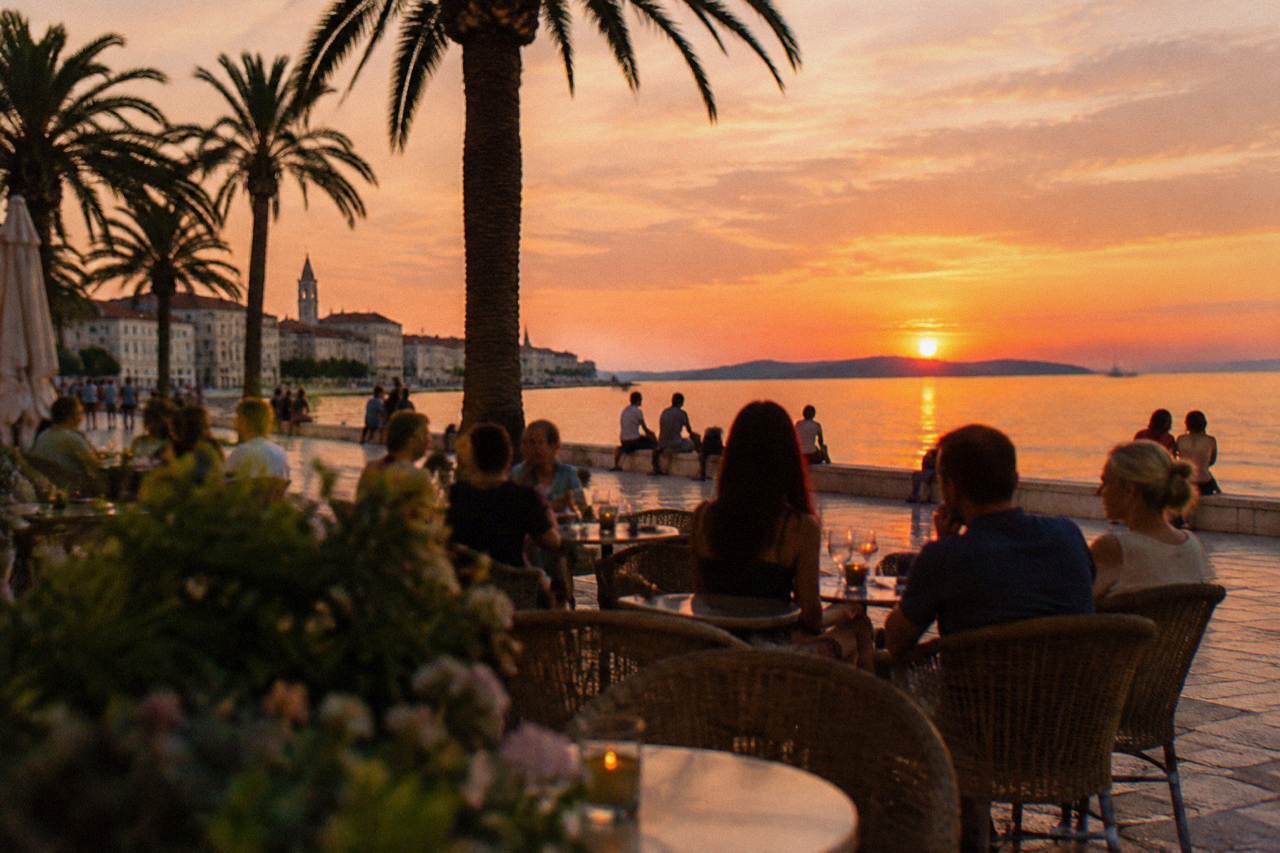
The framing matters, because "do they speak English" is really two questions. One is whether an English speaker can order, buy, ask directions and board a boat without a phrasebook. The answer to that, in the city centre, is yes for the whole visitor season and most of the shoulder months. The other is whether English is an official or first language, and it is neither: it is a widely learned second language, strongest among younger staff in hospitality and transport, thinner among older residents and outside the tourist circuits. The Split Croatia Travel Guide desk lays out both halves below, with the practical detail that actually changes a trip.
Do They Speak English In Split?
Yes, English is spoken widely enough in Split that an English-only visitor can handle hotels, restaurants, shops, museums, taxis and ferry ticket counters without Croatian, especially from spring to autumn. Croatian remains the only official language. English coverage is strongest inside the tourist economy of the Old Town, the Riva and the port area, and it weakens with age and distance from the centre, so a few Croatian words still earn goodwill.
Nobody writing for this site has been to Split, so the reporting here follows what institutions publish rather than anecdote. Croatia's tourist sector operates in English as a working default: museum price lists such as the Archaeological Museum's are published in English, Jadrolinija's ferry route pages carry full English versions, and Split Airport's own information pages are bilingual. That institutional bilingualism mirrors what staff on the ground are trained for. School English is standard across Croatia, and the tourism workforce skews young. Where gaps appear, they appear predictably: with older shopkeepers, in residential neighbourhoods away from the centre, and in the depths of winter when the tourist economy shrinks.
A useful parallel is the port itself. The Port of Split's passenger statistics, 487,377 cruise passengers in 2025 alongside the 6.05 million total, describe a city whose daily business already includes dozens of languages. A counter clerk at that port deals with English speakers as a routine case, not an exception. The same logic runs through the catamaran operators, the tour departure points and the ticket kiosks around the Peristyle. The default second language of the Dalmatian coast is English, ahead of German and Italian, both of which also appear in the hospitality sector.
Where English Works In Split And Where It Stops
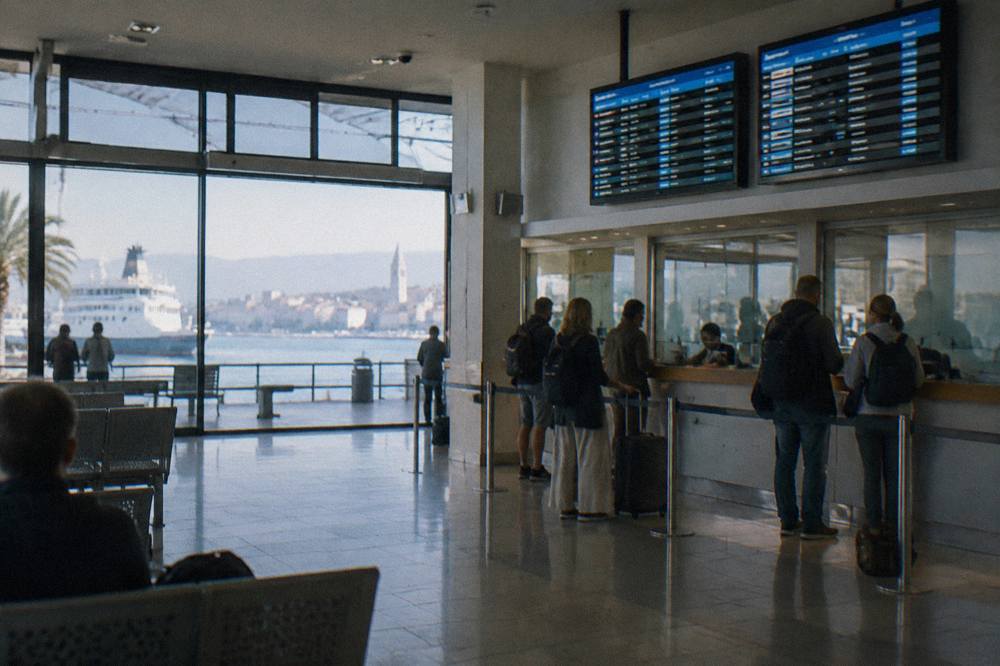
English works reliably in Split hotels, apartments, restaurants, cafes, museums, tour offices, the ferry port, the bus station and the airport, where signage and published price lists are bilingual or English-first. It becomes less reliable with older residents, in suburban shops away from the centre, at small neighbourhood markets late in the evening, and out of season, when the temporary seasonal workforce has gone home.
The pattern follows the money and the age curve. Inside Diocletian's Palace and along the Riva, nearly every business that touches a visitor has at least one English-capable person on shift, because that is the job market. The Split City Museum publishes its hours and prices in English, the Meštrović Gallery's price list runs in English, and Krka National Park posts its full 2026 price list in English on its own site. The further a task sits from that circuit, the more the visitor should slow down and keep a translation app ready.
Three practical notes sharpen the picture. First, medical and police contexts: the emergency number in Croatia is 112, and the line has English-capable operators, but a pharmacy counter in a residential suburb may not, so travel insurance with a helpline matters more than phrasebook fluency. Second, numbers: prices are in euro, Croatia's currency since 1 January 2023, and digits are the same, so a transaction rarely needs words at all. Third, tolerance: even a failed attempt at "hvala", thank you, lands well, and staff switch to English the moment a visitor struggles, usually before being asked.
| Situation | English coverage | What helps |
|---|---|---|
| Hotel or apartment check-in | Reliable, year-round | Nothing special needed |
| Old Town restaurants and cafes | Reliable in season | Menus often printed in English and Croatian |
| Museum ticket counters | Reliable, bilingual price lists | Names of museums in Croatian help |
| Ferry port and catamaran offices | Reliable, English route pages | Destination names: Stari Grad, Supetar, Rogač |
| City and suburban buses | Variable, drivers only | Know your stop name before boarding |
| Neighbourhood shops and markets | Patchy, age-dependent | Pointing, small notes, a translation app |
| Emergency services (112) | English-capable operators | State the service needed first |
The bus row deserves its own sentence, because it is the one place where confident visitors trip. City transport is a local system, not a tourist one, and a driver's English cannot be assumed; the practical fix is knowing the stop name and having the fare understood before boarding. For a wider look at the friction points that catch visitors in the historic core, including the public-order rules voted in for 2026, see what to avoid in Split.
For everything that sits outside the city, guided product does the language work for you. Departures concentrate around the Obala kneza Domagoja hub, where the ferry port, the main bus station and the railway station sit together 500 to 600 m from the palace, and where operators run bilingual departures all season.
Do Menus, Museums And Ferries Run In English In Split?
Yes, the printed infrastructure of Split runs in English to a degree that surprises first-time visitors: museum price lists, ferry and catamaran route pages, airport information and park tariffs are published in English by the institutions themselves. Restaurant menus in the centre are typically bilingual. What stays Croatian is the civic layer, bus stop signs, street names, official notices and market price tags.
Jadrolinija, the state ferry operator, maintains English route pages for the Split to Stari Grad line and the others; the Krka price list for 2026, 7 EUR in January to March and November to December, 20 EUR in April, May and October, 40 EUR from June to September, is posted in English by the park itself; Split Airport's pages give their key figures in English, including the 20 km distance from Split and 6 km from Trogir. A visitor who books online touches English at every step before leaving home.
On the ground, the pattern holds with local texture. Market stalls at the green market price by the kilo with handwritten tags, usually in Croatian, but the transaction is numbers and pointing, and stallholders in a tourist city manage it in several languages daily. Konoba menus in the centre often carry an English version with the Croatian original; further into where locals eat in Split, the English versions thin out, and the dish names do the talking: black risotto, grilled fish by the kilo, peka ordered ahead. None of this requires conversation, and Google Translate's camera mode closes the remaining gap on any handwritten board.
| Croatian | English | Say it |
|---|---|---|
| Dobar dan | Good day | DOH-bar dahn |
| Molim | Please / here you are | MOH-leem |
| Hvala | Thank you | HVAH-lah |
| Račun, molim | The bill, please | RAH-choon MOH-leem |
| Koliko košta? | How much does it cost? | KOH-lee-koh KOSH-tah |
| Gdje je...? | Where is...? | gdye yeh |
| Dvije pive | Two beers | dvye PEE-veh |
| Govorite li engleski? | Do you speak English? | goh-voh-REE-teh lee ENG-leskee |
That last row is almost never needed, but it is the polite opener that gets answered instantly in English. One caveat on menus: prices on any menu, bilingual or not, should be checked as posted, including whether a cover charge appears as a listed item, rather than assumed from a guide. A fuller discussion of eating costs sits at is it expensive to eat in Split.
Should You Learn Any Croatian Before A Trip To Split?
No Croatian is needed to visit Split, but about six words change the tone of every interaction: dobar dan for good day, molim for please, hvala for thank you, račun for the bill, and oprostite for excuse me. Croatian uses the Latin alphabet, so signs are readable, and pronunciation is phonetic, meaning each letter maps to one sound, so the words above are pronounced exactly as written.
The economics of effort are simple. Croatian is a South Slavic language with cases and genders, and a week of phrasebook study will not produce sentences, so the realistic goal is courtesy tokens, not conversation. Those tokens matter in a specific, unsentimental way: tourism is Split's largest industry, and staff serve thousands of foreign guests a season, so a greeting in Croatian signals a guest who sees the server as a person rather than a service. The response is usually a warm switch into fluent English.
Two situations justify slightly more preparation. The first is any self-guided travel into the interior or onto the less-visited islands, where an English menu is not guaranteed; downloading the Croatian pack for an offline translator before leaving covers it. The second is reading civic information: parking signs, the 2026 public-order notices for the historic core, and bus timetables are Croatian-first, and understanding the few words on them, zabranjeno for prohibited, zatvoreno for closed, otvoreno for open, prevents real confusion.
Does English Help On Split Day Trips?
Yes, English carries the standard day trips from Split, whether guided or independent, because the operators serving Krka, Plitvice, Hvar, Trogir and Dubrovnik run English-language departures as their default product. On independent trips, English holds at ferry counters and park entrances, where tariffs and route information are published in English, and becomes less predictable in village shops and with older drivers inland.
The guided market is built for English speakers. A Dubrovnik day trip from Split, for instance, pairs the long drive, 3 h 21 of free-flow driving each way by the OSRM-computed route, with a guide who narrates in English and handles the logistics; the Check availability link shows the operator's live listing, and the same tour has its own page at the Dubrovnik Day Tour from Split or Trogir. Independent travel works too: Jadrolinija's route pages in English cover the Split to Stari Grad ferry, about 120 minutes, and the catamaran lines to Hvar town, so buying a foot-passenger ticket is a counter transaction in English at the port.
Cross-border trips add one wrinkle. Mostar lies in Bosnia and Herzegovina, outside the European Union, so a passport or EU identity card travels on that trip, and the border police routine runs in English well enough for a tourist coach. Nothing about the language changes the document requirement, which is worth separating from the language question: English solves communication, not paperwork. For whether the cities reward the travel time at all, the comparison pages at what is prettier, Split or Dubrovnik and is Hvar nicer than Split do that work.
Out-of-season travel flips the equation slightly. Winter departures to the islands and parks reduce in number, the seasonal workforce returns to university towns, and the ratio of Croatian to English on the ground shifts. Even then, Split's institutions keep their English pages live: Advent in Split runs 27 November 2026 to 7 January 2027 with the ice rink at Đardin, and the tourism calendar publishes in English. A winter visitor with the seven words above and an offline dictionary is fully equipped.
Common Questions About Speaking English In Split
Do they speak English in Split?
Yes. Croatian is the official language, but English is spoken widely across Split's hotels, restaurants, museums, tour offices, ferry port and airport, especially during the visitor season. Coverage thins with older residents and outside the tourist circuits, so a few Croatian words help.
Can you visit Split without speaking any Croatian?
Yes. Museums publish English price lists, ferry operators run English route pages, and menus in the centre are typically bilingual. Translation apps cover handwritten market tags and any Croatian-first civic signs.
Is English spoken on the islands near Split?
At ferry counters, catamaran offices and the main towns such as Hvar town and Supetar, yes, English is a working second language. Smaller villages and family shops are less predictable, particularly out of season.
What language is spoken in Croatia besides Croatian?
Croatian is the sole official language. English is the leading second language in tourism, with German and Italian also present in the Dalmatian hospitality sector.
Do Split taxi and ride drivers speak English?
Many drivers in the tourist economy speak functional English, but coverage varies by driver and cannot be assumed; having your destination written down or shown on a map map keeps the ride simple regardless of language.
What Croatian words should a visitor learn for Split?
Dobar dan, good day; molim, please; hvala, thank you; racun, the bill; oprostite, excuse me; and gdje je, where is. Croatian is written in the Latin alphabet and pronounced as spelled, so these read exactly as they look.
Language is the least of Split's obstacles. The city's port, its museums and its tour industry already publish and operate in English, the friction points are few and predictable, and a handful of Croatian words converts transactions into greetings. Arrive with dobar dan and hvala, keep a translator offline for the edges, and the language question answers itself within an hour of landing.
