Split Airport
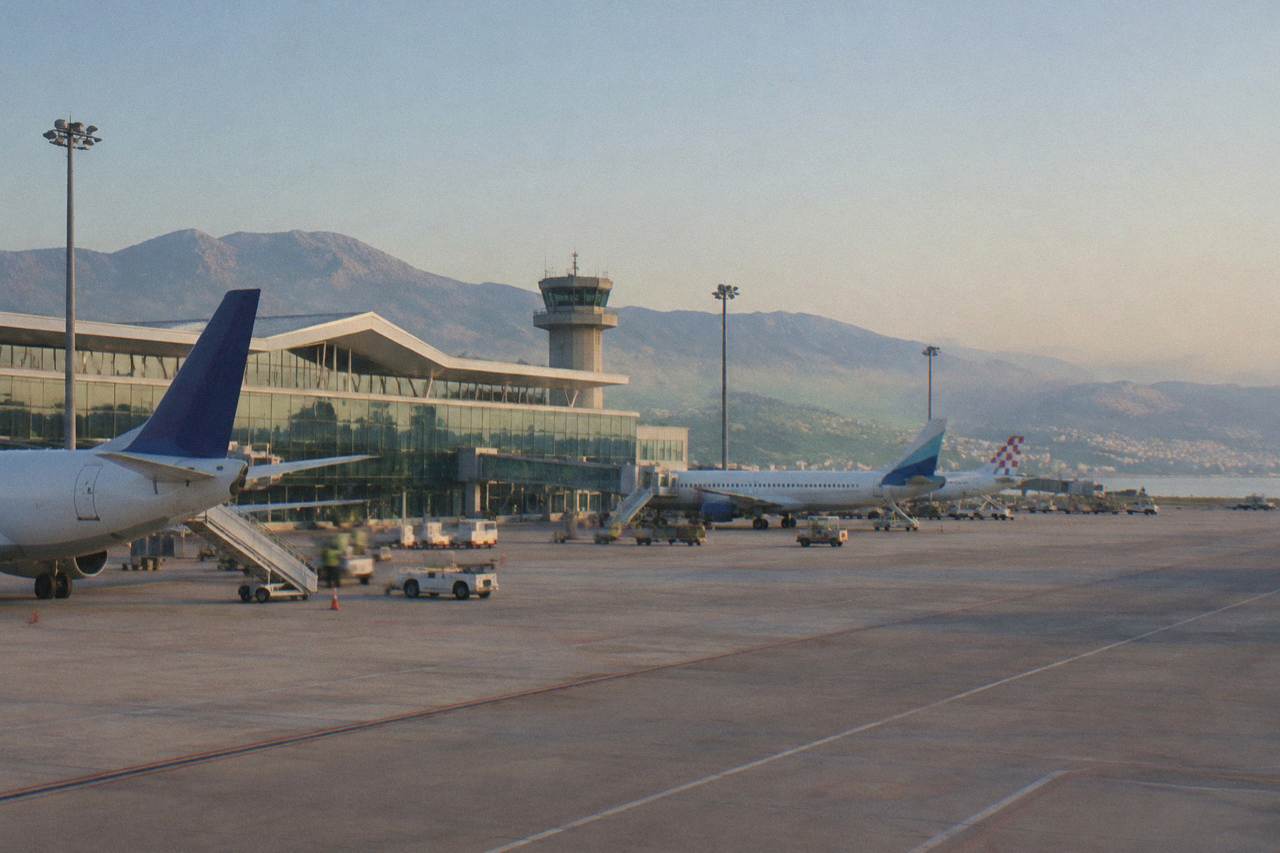
Split Airport served 3,881,186 passengers in 2025 and sits 20 km from the city it is named after, in Kaštel Štafilić on the Kastela riviera. This guide covers the shuttle, the bus lines, car hire, the flight network and how the airport connects to the ferry port.
Short answer
Split Airport (SPU) is in Kaštel Štafilić in Kastela, 20 km from Split and 6 km from Trogir. The Platanus shuttle runs to the main bus station by the ferry port for 10 EUR one way or 15 EUR return, and Promet Split city bus lines 37 and 38 also stop at the airport.
Split Airport, coded SPU on tickets, is the gateway to central Dalmatia and one of the busiest airports in Croatia, with the airport's own statistics page recording 3,881,186 passengers in 2025 and 3,376,272 in the first nine months of 2026. Despite its name, the terminal is not in Split at all: it stands in Kaštel Štafilić in the Kastela riviera, 20 km from Split and 6 km from Trogir, and the airport's own information page gives those distances. This guide walks through the ground transfer options, the flight network, car hire, the drive to the coast's day-trip destinations, and what to do near the terminal if your flight lands early in the day.
Where Is Split Airport And How Far Is It From Split?
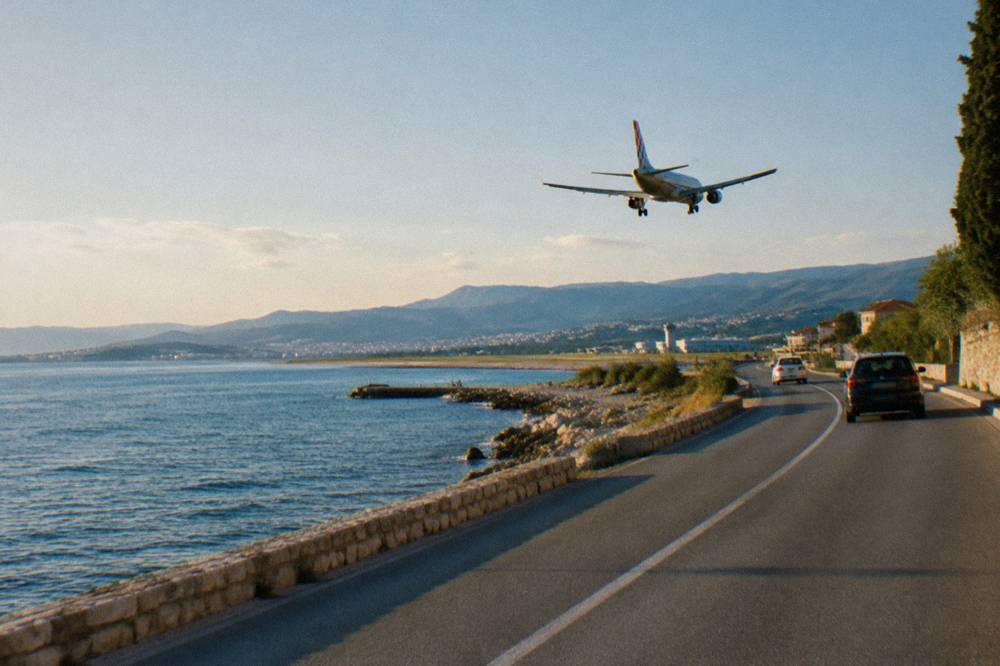
Split Airport stands in Kaštel Štafilić in the Kastela riviera, 20 km from Split and 6 km from Trogir, according to the airport's own general information page. Driving from Diocletian's Palace to the terminal covers 24.9 km and takes about 31 minutes in free-flow traffic. The Trogir old town is the nearest major sight, and the runway sits between the Kastela villages and the sea.
The location surprises first-time visitors who assume the airport sits on the edge of the city it serves. It does not. The terminal serves a strip of coast that runs from Trogir in the west through the seven Kastela villages to Split in the east, and the 20 km between the airport and the city is genuine suburban driving, not a quick hop. The often-repeated claim that the airport is 6 km or 10 minutes from the city confuses the Trogir distance with the Split distance, and the airport's own page settles it.
What that location buys you is proximity to two places at once. Trogir, a UNESCO World Heritage old town since 1997, is 6 km away, close enough that a long layover or an early landing can absorb a stroll through it before you ever reach Split. The Kastela riviera itself is a string of waterfront villages with fortress houses along the shore road. If your flight lands in the morning, the things to do in Split list is not going anywhere, and the coast between the terminal and the city is worth the drive on its own.
| Airport fact | Figure | Source note |
|---|---|---|
| IATA code | SPU | airport's own page |
| Location | Kaštel Štafilić, Kastela | airport's own page |
| Distance to Split | 20 km | airport's own page |
| Distance to Trogir | 6 km | airport's own page |
| Drive from Diocletian's Palace | 24.9 km, about 31 min free-flow | route computation |
| Passengers 2025 | 3,881,186 | airport statistics page |
| Passengers Jan to Sep 2026 | 3,376,272 | airport statistics page |
How Do You Get From Split Airport To Split City Centre?
The Platanus airport shuttle runs from the terminal's north parking area to Split's main bus station beside the ferry port, costing 10 EUR one way and 15 EUR return, per the operator's own page. Promet Split city bus lines 37 and 38 also stop at the airport. Taxis and ride services operate at the terminal, with fares agreed by meter rather than a published flat rate.
The shuttle is the workhorse option. Platanus took over the airport shuttle service, and its own page gives the 10 EUR single and 15 EUR return fares between the airport's north parking and the main bus station on Obala kneza Domagoja. That station matters more than its name suggests: the ferry port, the main bus station and the railway station sit together on the same waterfront, 500 to 600 m from Diocletian's Palace, so a single shuttle ride puts you within a short walk of the Old Town and within the same complex as the boats to Hvar, Brac, Solta and Vis.
The city bus is the local alternative. Promet Split lines 37 and 38 stop at the airport on their routes along the Kastela coast, and the fare is a few euros, confirm on board or at the driver, because the exact tariff is not stated on a page this desk can cite. The buses run into central Split but with more stops along the way than the shuttle. For a fuller breakdown of every option, including how the transfer lines up with ferry departures, see the site's dedicated Split Airport to city centre guide.
Two practical notes shape the choice. If you are catching a same-day ferry, the shuttle's terminus at the main bus station is the right landing point, since Jadrolinija's docks are a few minutes on foot. If you are staying inside Diocletian's Palace, the streets near the palace are pedestrian-first, so whichever vehicle you choose, the last 300 m is on foot with luggage. The where to stay in Split guide maps the neighbourhoods against the walk from the transport hub.
| Transport | Route | Cost | Notes |
|---|---|---|---|
| Platanus shuttle | Airport north parking to main bus station | 10 EUR one way, 15 EUR return | operator's own page |
| Promet Split bus 37 | Kastela coast via airport into Split | a few euros, confirm on board | fare not published on an official page |
| Promet Split bus 38 | Kastela coast via airport into Split | a few euros, confirm on board | fare not published on an official page |
| Taxi or ride service | Airport to central Split | metered, confirm before departure | no official flat fare exists |
Which Airlines Fly To Split And Can You Fly Direct From The United States?
United Airlines flies seasonal direct service from Newark in the New York area to Split, operating from 30 April 2026 into early September, the first transatlantic route in the airport's history. Beyond it, the airport handles an extensive seasonal European network in summer and a thinner winter schedule, so the month of travel changes the nonstop map considerably.
The Newark route is the headline change for North American travellers. Reported by Croatia Week in January 2026, the United service ran three times weekly on Boeing 767-300ER aircraft through the summer, meaning a Split holiday no longer requires a connection through Zagreb or a European hub during the season it operates. Outside those months, transatlantic flyers connect through a European city, and the flights to Split guide tracks the route map in detail.
The seasonal rhythm is the thing to understand. Summer brings dense frequency from across Europe, and the airport's passenger figures show it: nearly 3.9 million people passed through in 2025, a volume concentrated between April and October. In winter the network contracts sharply, and some routes pause entirely, which is one reason the winter visitor counts on this coast drop as steeply as they do. Check your specific route and month against the airport's own destination list before committing to an itinerary.
Entry formalities deserve a line too. Croatia is a full Schengen member since 1 January 2023, so there is no separate border when arriving from another Schengen country. For visitors from outside the zone, the European Entry/Exit System (EES) is fully operational at external Schengen borders since 10 April 2026, recording biometrics at first entry. ETIAS, the travel authorisation for visa-exempt nationals, was not live and has no fixed start date, so nothing needs to be purchased for it yet.
Is Renting A Car At Split Airport A Good Idea?
Renting a car at Split Airport makes sense if your itinerary leans on the Dalmatian hinterland or long drives to Krka, Plitvice Lakes, Mostar or Dubrovnik, because the terminal puts you on the coast road immediately. It is a poor fit if you plan to stay inside Split and island-hop by ferry, where the car sits parked and the old-town streets are closed to through traffic.
The arithmetic is trip-shaped. Split itself is walkable, with the palace, the Riva, Marjan and the beaches all reachable on foot or by local bus, and a car inside the old town is somewhere between useless and impossible. But the region's biggest draws are scattered along the coast and inland: Krka's Skradinski buk is 74 minutes' drive from the palace, Plitvice Lakes 3 hours 15, Mostar 2 hours 13. A rental converts those from coach-tour dependency into your own timetable.
Two cautions to keep in mind. Parking tariffs in Split are not published in any figure this site can cite, so budget for them as an unknown and confirm with your accommodation whether a space comes with the room. And if islands are on the list, remember the car ferry distinction: line 635 carries cars to Stari Grad on Hvar, while the catamarans to Hvar town and Jelsa take foot passengers only, a trap the Split to Hvar ferry guide unpacks. The full hire-desk picture, including when to book, is in the Split car rental guide.
For travellers who want one adventure day with wheels rather than a whole rental, a guided quad safari covers the Dalmatian interior with a picnic and a swim stop, and Check availability on the operator's live listing if that shape of day appeals. It pairs well with a car-free stay, since transport logistics sit with the operator rather than with you.
How Early Should You Arrive At Split Airport For A Departure?
Arrive at Split Airport around two hours before a European departure and closer to three in the July and August peak, when the terminal processes its densest traffic of the year. The building is compact rather than vast, but summer queues at check-in and security are real, and the road from Split can add time if the coast road is slow.
The airport's own numbers explain the seasonal squeeze. With 3.9 million annual passengers funnelled into a summer-heavy schedule, a July Saturday at SPU behaves nothing like a February Tuesday, and the departure hall fills and empties in waves tied to the flight bank. The 31-minute free-flow drive from the palace can stretch in season, and the shuttle and bus 37 and 38 share the same coast road, so the margin belongs in the front of the journey, not the terminal. The wider set of guides lives on Split Croatia Travel Guide.
On the airside, the terminal is small enough that gates are a short walk from security, and the shopping and eating options are proportionate to a seasonal mid-sized airport rather than a major hub. Two dated facts from 2026 are worth carrying: EES biometric registration applies at external Schengen borders for non-EU nationals on departure as on arrival, and Croatia's euro, adopted 1 January 2023, means no currency step at the coffee counter. The emergency number throughout the country is 112.
What Is There To Do Near Split Airport?
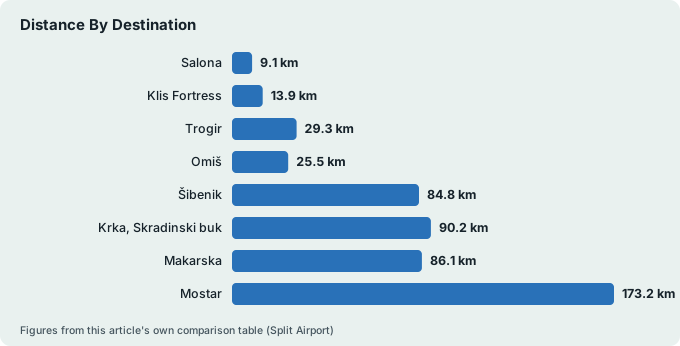
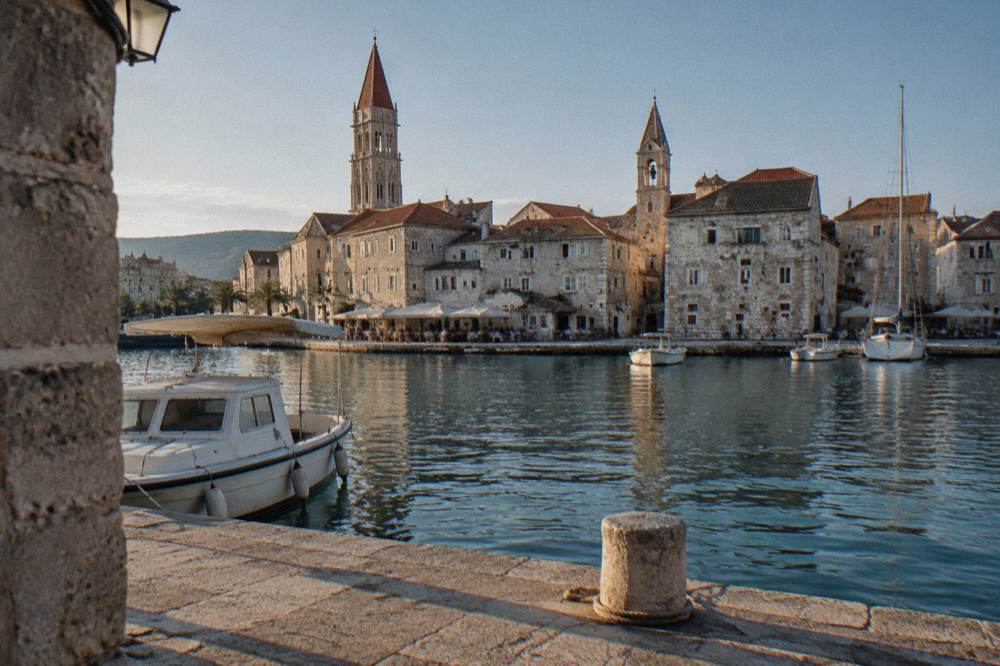
The nearest major sight to Split Airport is Trogir, 6 km away, a UNESCO-listed old town on its own small island, reachable in a few minutes by road. The Kastela riviera runs the seven fortress villages along the shore, and Salona, the Roman site 9.1 km and 14 minutes' drive from the palace, sits on the airport side of the bay.
Trogir is the obvious layover answer. Its old town has been on the UNESCO list since 1997, and the drive from the terminal is shorter than the drive into Split itself. If a flight lands at midday and hotel check-in is late afternoon, Trogir absorbs two hours comfortably: the waterfront, the stone lanes, and the cathedral whose ticket price is not stated in any figure this site can verify, so confirm at the door. The dedicated Trogir guide carries the full picture.
The Kastela villages are the unsung stretch. Seven settlements line the shore road between Trogir and Split, each with a fortified castle at its heart from the period of Ottoman-era raiding, though this site's record does not carry individual castle histories or hours, so treat them as a scenic drive with stops rather than a ticketed circuit. Beaches sit along the same coast, described in the Split beaches guide's wider coverage of the whole bay.
Salona is the archaeology option on the correct side of the bay for airport-bound travellers. The Roman capital of the province, its ruins are run by the Archaeological Museum in Split, whose price list gives an 8 EUR adult ticket for the museum and a 10 EUR combined ticket covering both the museum and Salona within seven days. At 14 minutes' drive from the palace and even less from the airport side, it suits a first afternoon or a last morning before departure.
| Sight near the airport | Distance from airport | Driving time from Diocletian's Palace | Entry |
|---|---|---|---|
| Trogir old town | 6 km | 36 min | old town free, cathedral price on site |
| Kastela fortress villages | along the shore road west of the terminal | on the route | exteriors viewable |
| Salona Roman site | short drive east | 14 min | 10 EUR combined with Archaeological Museum |
| Kastela waterfront | immediate | on the route | free |
| Klis Fortress | inland of Split | 22 min | 10 EUR adults, per the local price sheet |
How Does The Airport Connect To Ferries And Day Trips From Split?
The Platanus shuttle terminates at Split's main bus station beside the ferry port, so a single transfer links the terminal to boats for Hvar, Brac, Solta and Vis. Car ferry line 635 reaches Stari Grad in about 120 minutes, line 631 reaches Supetar on Brac in about 50 minutes, and catamarans serve Hvar town and Vis, with fares from 5.90 EUR on the car ferry.
This chain is why Split works as a hub. The transport spine of the city, ferries, buses and rail on Obala kneza Domagoja, sits 500 to 600 m from the palace, and the airport shuttle delivers you straight into it. Foot passengers on line 635 to Stari Grad pay 5.90 EUR off-season and 8.40 EUR in season, per Jadrolinija's price list, and the crossing runs about 120 minutes. Catamarans reach Hvar town or Jelsa for 6.40 EUR low season and 10.00 EUR high, and Vis for 7.20 and 10.00, per the same operator documents.
A timetable note matters for 2026 onward: Jadrolinija removed the off-season period from the Split to Supetar line, which now runs only high-season and low-season timetables, one of five Croatian lines organised that way. The wider picture, including the Krilo, TP Line and Bura Line catamarans that also serve Split, is laid out in the ferries from Split guide, and the island options are compared in Split day trips.
If the plan is a boat day rather than an island stay, guided trips cover the logistics for you. A full-day catamaran run to Hvar and the Pakleni islands with food and drinks served on board is a fixed feature of the Split summer season, and Check availability at the listing if you would rather not wrestle a ferry timetable on day one. The Split boat tours guide compares the formats.
| Ferry or catamaran line | Route | Crossing | Foot passenger fare |
|---|---|---|---|
| Jadrolinija 635 | Split to Stari Grad (Hvar), car ferry | about 120 min | 5.90 EUR off-season, 8.40 EUR season |
| Jadrolinija 631 | Split to Supetar (Brac), car ferry | about 50 min | on the operator's price list |
| Jadrolinija 636 | Split to Rogac (Solta) | about 60 min | on the operator's price list |
| Catamaran 9603 | Split, Bol, Stari Grad, Jelsa | staged stops | Hvar or Jelsa 6.40 / 10.00 EUR |
| Catamaran 9602 | Split, Milna, Hvar, Vis | staged stops | Vis 7.20 / 10.00 EUR |
What Are The Driving Times From Split Airport To The Region's Day Trips?
Driving from the palace, Krka National Park's Skradinski buk entrance is 74 minutes away, Plitvice Lakes 3 hours 15 minutes, Mostar 2 hours 13 minutes and Dubrovnik 3 hours 21 minutes in free-flow conditions, per computed routing. The airport sits west of the city, so Trogir-bound and Krka-bound trips start 20 km closer than those figures suggest.
The coast road and the inland motorway do the work. Klis Fortress, a Game of Thrones Meereen location with a 10 EUR adult ticket per the local price sheet, is 22 minutes from the palace. Omiš and the Cetina river canyon sit 38 minutes south. Šibenik, whose St James Cathedral has been UNESCO-listed since 2000, is 71 minutes, and Makarska 75. These figures are free-flow computations, and summer Saturdays on the coastal road are not free flow, so pad them in season.
The long ones justify either an early start or an overnight. Plitvice Lakes at 3 hours 15 each way is a big day by any measure, and its timed online entry with the visitor's name on the ticket rewards pre-booking rather than arriving on spec. Mostar, in Bosnia and Herzegovina, carries a border crossing and a different currency, and the Old Bridge area has been UNESCO-listed since 2005 with the bridge rebuilt in 2004. Both are covered in the site's dedicated Mostar and Dubrovnik guides.
| Destination | Driving time from Diocletian's Palace | Distance | Entry note |
|---|---|---|---|
| Salona | 14 min | 9.1 km | 10 EUR combined with museum |
| Klis Fortress | 22 min | 13.9 km | 10 EUR adults |
| Trogir | 36 min | 29.3 km | old town free |
| Omiš | 38 min | 25.5 km | Mirabela 4 EUR, 6 EUR in summer |
| Šibenik | 71 min | 84.8 km | cathedral price on site |
| Krka, Skradinski buk | 74 min | 90.2 km | 7 / 20 / 40 EUR by month |
| Makarska | 75 min | 86.1 km | town free |
| Mostar | 2 h 13 | 173.2 km | border crossing, convertible marks |
| Plitvice Lakes | 3 h 15 | 258.1 km | 10 / 23 / 40 EUR by month, timed entry |
| Dubrovnik | 3 h 21 | 234.8 km | walls 40 EUR in 2026 |
When Is The Best Time To Fly Into Split?
July and August are the busiest and warmest months to fly into Split, with DHMZ Split-Marjan station data for 1948 to 2024 showing a July mean of 26.2 C, 18 days at 30 C or more in July and 17 in August. May, June and September combine warm means of 19.2 C, 23.4 C and 21.6 C with thinner terminal crowds, while November is the wettest month at 115.5 mm.
The climate record from the DHMZ Split-Marjan station shapes the whole decision. July brings 353.3 hours of sunshine and just 26.6 mm of rain, the driest month of the year, but it also brings the peak flight load and peak prices across the coast. December drops to 120.8 sunshine hours with 103.7 mm of rain, which is why the winter schedule thins out. The full monthly breakdown lives in the Split weather and best time to visit Split guides.
Late October and the winter months trade warmth for empty terminals, and the city's Advent season, running 27 November 2026 to 7 January 2027 with the Đardin ice rink, gives a cold-weather arrival a reason to exist. The Split on a budget guide tracks how costs move with the same curve.
What Should You Know About Split Airport Before You Land?
Split Airport uses the euro, as Croatia adopted the currency on 1 January 2023, sits inside the Schengen area with no internal borders from other Schengen states, and applies EES biometric registration at external borders since 10 April 2026. Croatia's emergency number is 112, and the tourist tax of about 2.65 EUR per person per night in high season is collected by your accommodation.
A handful of practical facts smooth the arrival. Money first: no exchange drama, the euro is the currency everywhere, and cards are accepted as widely as anywhere in the region, with details in the site's money and cards coverage. The tourist tax of about 2.65 EUR per person per night in high season, free under 12 and half rate from 12 to 18, is settled through wherever you stay, so the amount is confirmed at booking rather than at the airport.
Behaviour rules are enforced in Split's historic core and are worth knowing before the first evening walk. The city's posted rules carry fines of 300 EUR for drinking alcohol in the historic centre, urinating, vomiting or climbing on monuments, and 150 EUR for sleeping in public spaces. Walking through the centre in swimwear or shirtless is likewise fined, with the amount set locally rather than published on the official page, so pack a cover-up for the walk back from the beach. The what to avoid in Split article lists the rest.
One more orientation note saves confusion at arrivals. The terminal signs and the shuttle destination say "main bus station," and that station is the transport hub on Obala kneza Domagoja, not a distant stop on the edge of town. From its kerb, the ferry check-in, the catamaran piers, the rail station and the western gate of Diocletian's Palace are all within roughly 600 m, which is why almost every onward journey in this guide begins at the same point.
Common Questions About Split Airport
How far is Split Airport from the city centre?
The airport's own page gives 20 km from Split and 6 km from Trogir, with the terminal in Kaštel Štafilić. Driving from Diocletian's Palace covers 24.9 km, about 31 minutes in free-flow traffic.
How much is the airport shuttle in Split?
The Platanus shuttle charges 10 EUR one way and 15 EUR return between the airport's north parking and Split's main bus station beside the ferry port, per the operator's own page.
Is there a city bus from Split Airport?
Yes. Promet Split lines 37 and 38 stop at the airport on their Kastela coast routes into Split. The fare is a few euros, confirm on board, as no official fare page states it.
Can you fly direct to Split from the United States?
United Airlines flew seasonal direct Newark to Split service from 30 April 2026 into early September, the airport's first transatlantic route. Outside that window, North American travellers connect through a European hub.
Which is closer to Split Airport, Split or Trogir?
Trogir, at 6 km. Split is 20 km east of the terminal, which is why a Trogir stop on arrival day is a common plan.
Do I need a visa to enter Croatia through Split Airport?
Croatia is a Schengen member, so Schengen rules apply. EES biometric registration operates at external Schengen borders since 10 April 2026. ETIAS was not live and has no fixed start date.
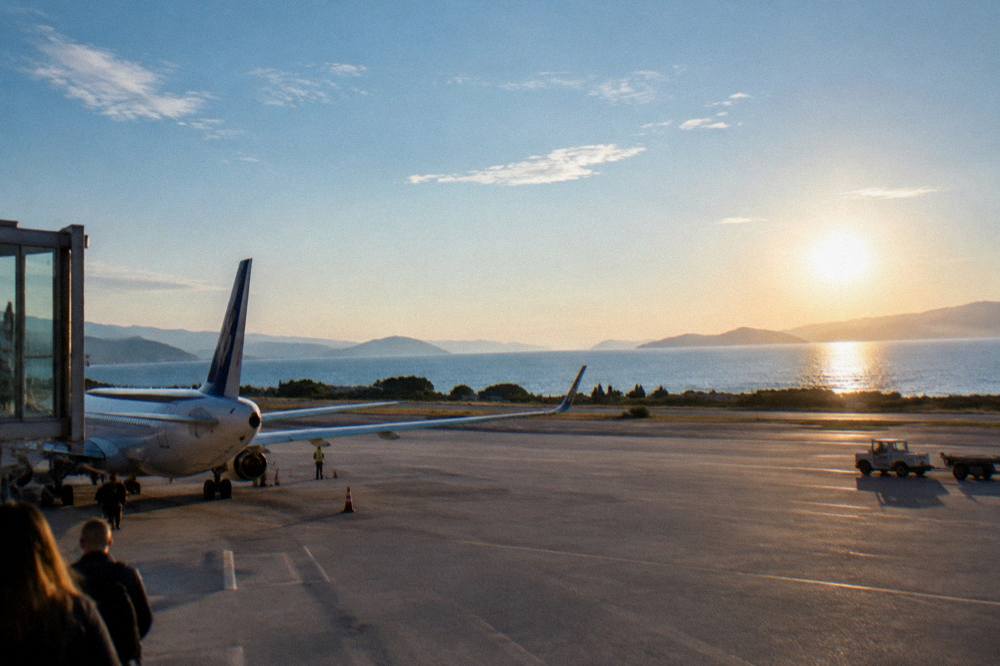
The airport is the least romantic part of any Dalmatian trip, but it is a well-placed one: a 20 km hop from the palace, a 6 km hop from Trogir, and a shuttle terminus that lands you inside the ferry-and-bus hub that makes the rest of the coast reachable. Plan the transfer, mind the summer queues, and the journey between runway and Riva takes care of itself.