Why Is Split Called Split?
The name Split explained with what the primary sources actually say: the Roman palace the city grew from, the UNESCO listing that names it, and the record behind one of the Adriatic's best known city names.
Split is a coastal city in Dalmatia, Croatia, on the Adriatic Sea, and its name is one of the shortest of any major European city. Four letters cover a Roman palace, a medieval town that grew inside it, a busy passenger port and a modern city of 160,577 people at the 2021 census. The question of where those four letters come from gets answered, confidently, all over the internet, and much of that confidence outruns the sources. What follows is what the primary record supports: the palace, the UNESCO listing, the port and the city as they are documented today.
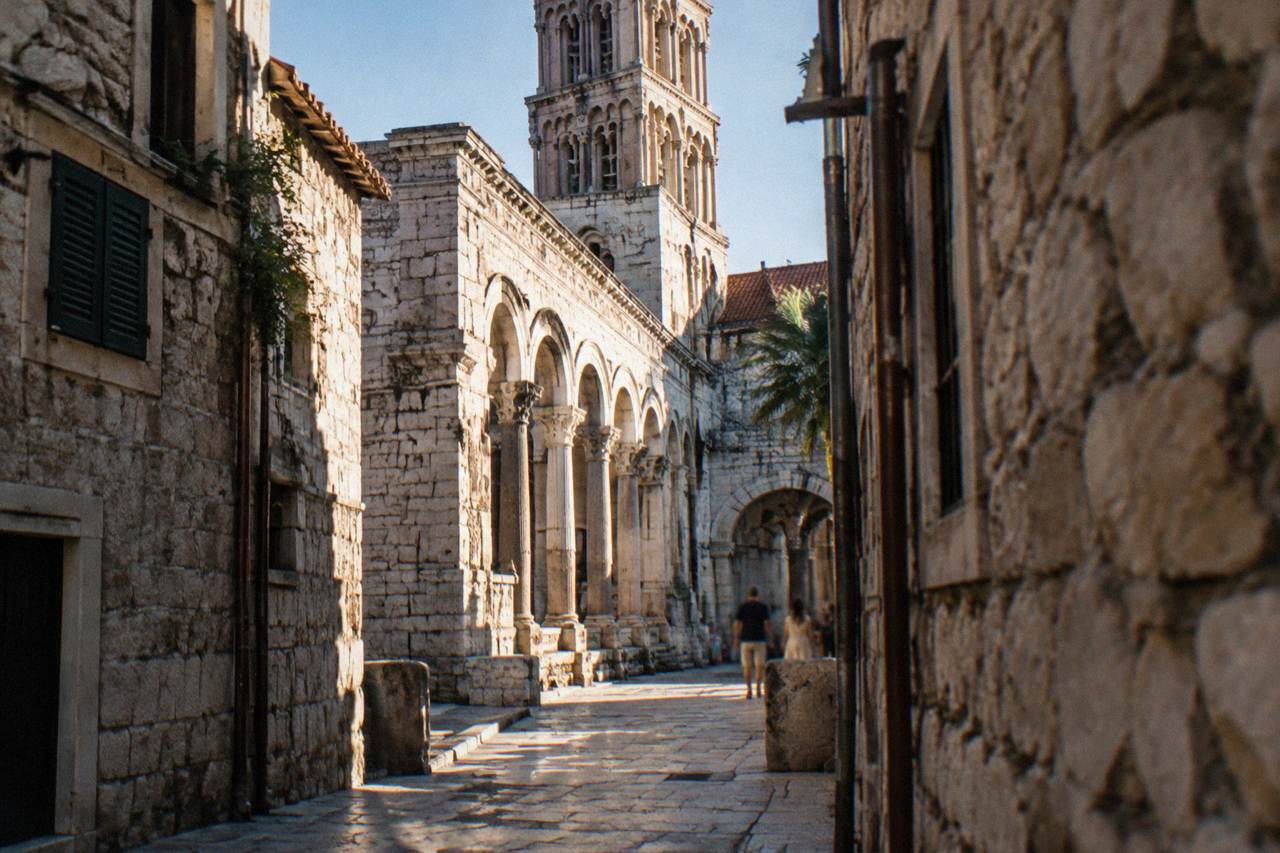
Why Is Split Called Split?
The Croatian name of the city is Split, and the documented history of the place begins with the palace Emperor Diocletian built here around 295 to 305 AD, but the city's own tourism pages and the UNESCO listing record no derivation of the name itself. Any confident story about where the word Split comes from should therefore be treated with caution and checked against a primary source before being repeated.
That answer is deliberately narrower than the ones you will meet elsewhere. The UNESCO World Heritage listing, inscribed in 1979, names the property the "Historical Complex of Split with the Palace of Diocletian" and describes the palace and the town that developed within and around it, but it offers no etymology of "Split". The city's own pages at visitsplit.com cover the palace, the museums, the festivals and the beaches, and they do the same. For everything the record does hold about Split, its palace and its surroundings, start with things to do in Split and work outward from there.
The practical consequence is simple. A tour guide or a plaque may tell you a story about the name, and some of those stories circulate widely. Enjoy them, but hold them lightly. The hard facts about Split are plentiful and well documented, and they are more interesting than a shaky etymology: a retirement palace for a Roman emperor, a cathedral bell tower 57 m high, a park-forest peninsula with 178 m of height above the sea, and a port that handled 6.05 million passengers in 2025, which the Port of Split's own page describes as Croatia's busiest passenger port.
To hear the documented story from a historian in person, book a history walking tour here.
What Actually Predates The Name: Diocletian's Palace?
The oldest documented structure in Split is Diocletian's Palace, built around 295 to 305 AD for the emperor who retired here, a walled complex of about 20.8 hectares as measured for its 1979 UNESCO inscription. Everything recognizable about modern Split, including the Old Town streets, the Peristyle and the cathedral complex, sits inside or immediately beside those Roman walls.
The palace is the reason the city exists where it does. After the Roman period, people moved into the shell of the building and never really moved out. Houses were fitted into the substructures, temples were converted, and a living town accumulated inside the walls. That process is why Split feels the way it does: a city where a Roman peristyle sits at a medieval street crossing, and where the Temple of Jupiter is now the Baptistery of St John, ticketed inside the cathedral scheme.
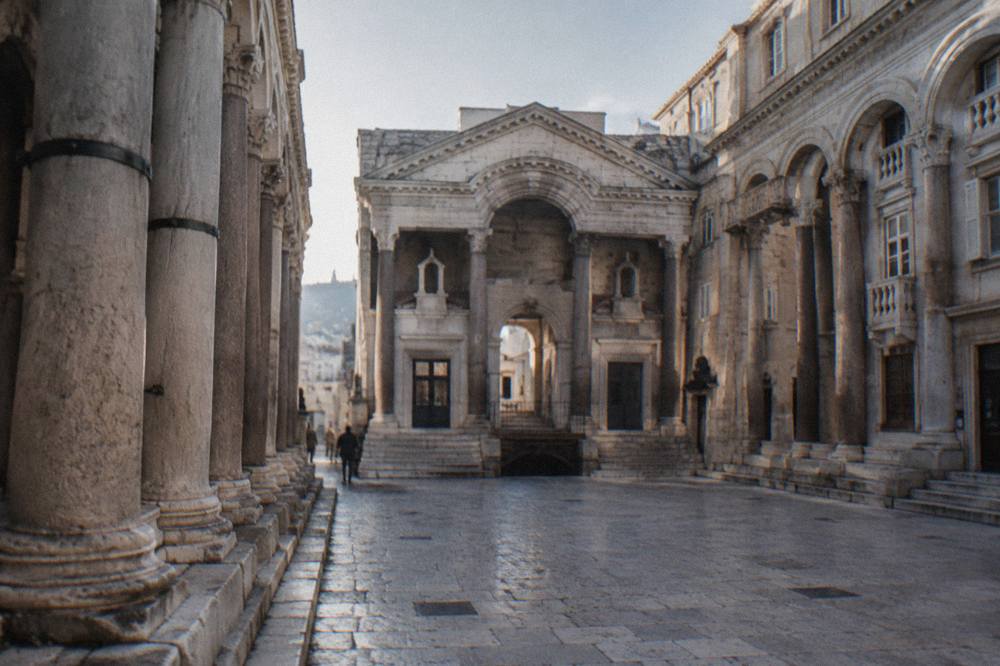
Here is the documented backbone of the city, with the figures and the dates the sources give:
| Documented fact | Figure | Source basis |
|---|---|---|
| Palace built for Emperor Diocletian | c. 295 to 305 AD | UNESCO description of the property |
| UNESCO inscription, "Historical Complex of Split with the Palace of Diocletian" | 1979 | UNESCO World Heritage list |
| Property area | 20.8 ha | UNESCO listing |
| Cathedral bell tower | 57 m | Visitsplit page on the cathedral |
| City population | 160,577 (2021 census) | Croatian census results |
| Port passengers in 2025 | 6.05 million | Port of Split statistics |
| Marjan highest point, Telegrin | 178 m | Marjan park-forest society data |
Reading the palace on the ground takes a day or two, not an afternoon. The substructures, the cellars that carried the emperor's apartments, are run by the Split City Museum and open Monday to Sunday from 8:30 to 20:00, with the museum's price list showing a 10.00 EUR adult ticket for its own collections at Papalić Palace. The central part of the cellars is under restoration to the end of 2026, and the passage stays open while the work runs. For the full picture of the complex, see the guide to Diocletian's Palace.
How Did A Palace Become A City Called Split?
A town grew inside the palace walls after the Roman period, reusing the emperor's buildings as houses, churches and workshops, until the walled complex became the city core itself. The name Split attaches to that town in the Croatian language, while the UNESCO listing of 1979 still carries the full historical description, "Historical Complex of Split with the Palace of Diocletian", pairing the city name with the building that made it.
This is the part of the story the stones tell without any etymology at all. The cathedral of St Domnius occupies what was the emperor's mausoleum, and its bell tower, 57 m high, rises directly off that Roman shell. None of this requires knowing where the word came from. The city is legible as a palace that filled up with people.
The modern city has long since spilled over the walls. Marjan, the park-forest peninsula on the western side, is 3.5 km long and 1.5 km wide, with 819 steps leading from Trumbićeva obala up to Telegrin at 178 m. The ferry port, the main bus station and the railway station sit together on Obala kneza Domagoja, 500 to 600 m from the palace, which is why Split works so well as a base for the islands and the inland day trips. If you are weighing the city against its neighbours, the comparison pieces are what is prettier, Split or Dubrovnik and is Hvar nicer than Split.
One way to grasp how small the palace core is against the city around it is to get out on the water. The guided kayak trip along Split's coast paddles out from the city beaches and looks back at the whole urban amphitheatre, the peninsula on one side and the islands of Brač, Šolta and Hvar on the other. The kayak tour's own page covers what the trip includes. Back on land, the palace walking tours are the standard first move, and tip-based walks also run locally; if you take one, confirm the arrangement with the guide directly.
What Names And Numbers Does Split Carry Today?
Today the city's name appears on a UNESCO property of 20.8 ha, on Croatia's busiest passenger port with 6.05 million passengers in 2025, and on an airport that handled 3,881,186 passengers in the same year, figures that all come from the institutions' own statistics pages. The name is Croatian, the currency is the euro since 1 January 2023, and the country has been in the Schengen area since 1 January 2023.
The institutional footprint of the name is worth listing, because it is what a search usually omits. The Port of Split's own page records the 2025 passenger total and 487,377 cruise passengers in the same year, with cruise ships calling since 2002. Split Airport, in Kaštel Štafilić, gives 20 km from Split and 6 km from Trogir on its own pages, and its statistics section lists 3,881,186 passengers in 2025. The Meštrović Gallery, reopened in April 2026 after a 15-month energy renovation, and the Archaeological Museum, founded in 1820, both carry the city's name on their own price lists. Everything else covered here is indexed on Split Croatia Travel Guide.
Here are the entry figures the 2026 price lists actually publish:
| Site in Split | Adult price 2026 | Notes from the source |
|---|---|---|
| Split City Museum, Papalić Palace | 10.00 EUR | 8.00 reduced, family 18.00, closed Mondays |
| Archaeological Museum | 8.00 EUR | Combined with Salona 10.00 EUR within 7 days |
| Meštrović Gallery | 12.00 EUR | Includes Crikvine-Kaštilac |
| Ethnographic Museum | 7.00 EUR | Vestibule 2.00 EUR |
| Cathedral of St Domnius complex | from about 5 EUR | Combined tickets up to about 15 EUR, kiosk on the Peristyle |
How Far Is Split From The Places Around It?
Split sits at the centre of a day-trip web: Trogir is 36 minutes away by car from the palace, Klis Fortress 22 minutes, Salona 14 minutes, Krka National Park's Skradinski buk 74 minutes and Plitvice Lakes 3 hours 15, all free-flow driving times computed from the palace. The islands of Brač, Hvar, Šolta and Vis sit offshore on regular ferry and catamaran lines from the port 500 to 600 m from the Old Town.
The name may be short, but the reach is long. These are the documented distances:
| Destination from Diocletian's Palace | Driving time | Driving distance |
|---|---|---|
| Salona | 14 min | 9.1 km |
| Klis Fortress | 22 min | 13.9 km |
| Split Airport | 31 min | 24.9 km |
| Trogir | 36 min | 29.3 km |
| Omiš | 38 min | 25.5 km |
| Šibenik | 71 min | 84.8 km |
| Krka, Skradinski buk | 74 min | 90.2 km |
| Makarska | 75 min | 86.1 km |
| Zadar | 2 h | 159.5 km |
| Mostar | 2 h 13 | 173.2 km |
| Plitvice Lakes | 3 h 15 | 258.1 km |
| Dubrovnik | 3 h 21 | 234.8 km |
The sea connections matter as much as the roads. Jadrolinija's route pages give the Stari Grad car ferry on line 635 at about 120 minutes, with foot passenger fares of 5.90 EUR off-season and 8.40 EUR in season, the Supetar line 631 at about 50 minutes and the Rogač line to Šolta at about 60 minutes. Note the distinction that trips up even careful planners: Hvar town is reached by catamaran, Stari Grad by car ferry. If you are planning around the calendar rather than the map, what is the best month to visit Split breaks down the DHMZ Split Marjan station figures month by month.
What Should You Do With Your First Days In Split?
Spend the first day inside the palace walls, the Peristyle, the cellars and the cathedral complex, and the second day on or beside the water, either on Marjan's 819 steps or on one of the boat trips to the islands, because the city's name and its whole character come from that pairing of Roman stone and open sea. The Roman guard change on the Peristyle at noon ran from 28 May to 27 September 2026, and the Riva, the markets and the beaches are free to walk.
The deeper you go, the more the name question fades behind the place itself. Whether a week is too much or too little depends on what you want from the islands, and how many days is enough for Split works through that arithmetic. What the record supports is this: a palace of about 20.8 hectares built around 295 to 305 AD, a town that grew inside it, a UNESCO listing in 1979 that still names both, and a Croatian city of 160,577 people that answers to four letters. The derivation of those letters is the one story the primary sources decline to tell, and Split loses nothing by it.
Common Questions About The Name Split
Why is Split called Split?
The Croatian name of the city is Split, but the city's own pages and the UNESCO listing record no derivation of the name. The documented history starts with Diocletian's Palace, built here around 295 to 305 AD, inside which the town developed. Treat any etymology story a guide tells you as local colour and check it against a primary source.
Is Split named after Diocletian?
No primary source makes that link. The palace carries the emperor's name, and the UNESCO property inscribed in 1979 is called the "Historical Complex of Split with the Palace of Diocletian", which names the city and the building together without deriving one from the other.
What was Split called in Roman times?
The record this site works from documents the palace of c. 295 to 305 AD and the town that later developed within it. The city's own pages do not carry a Roman-era name for the settlement, so nothing is stated here beyond the palace itself.
Does the name have a Greek or Latin origin?
Etymology is exactly the territory where confident internet answers outrun the sources. Neither the UNESCO listing nor the city's tourism pages derive the word Split.
Is Split the same place as Diocletian's Palace?
The palace is the core of the city, not all of it. The Old Town sits inside and around the Roman walls of about 20.8 hectares, while the modern city of 160,577 people spreads across the mainland and up Marjan, with the port 500 to 600 m from the palace.
