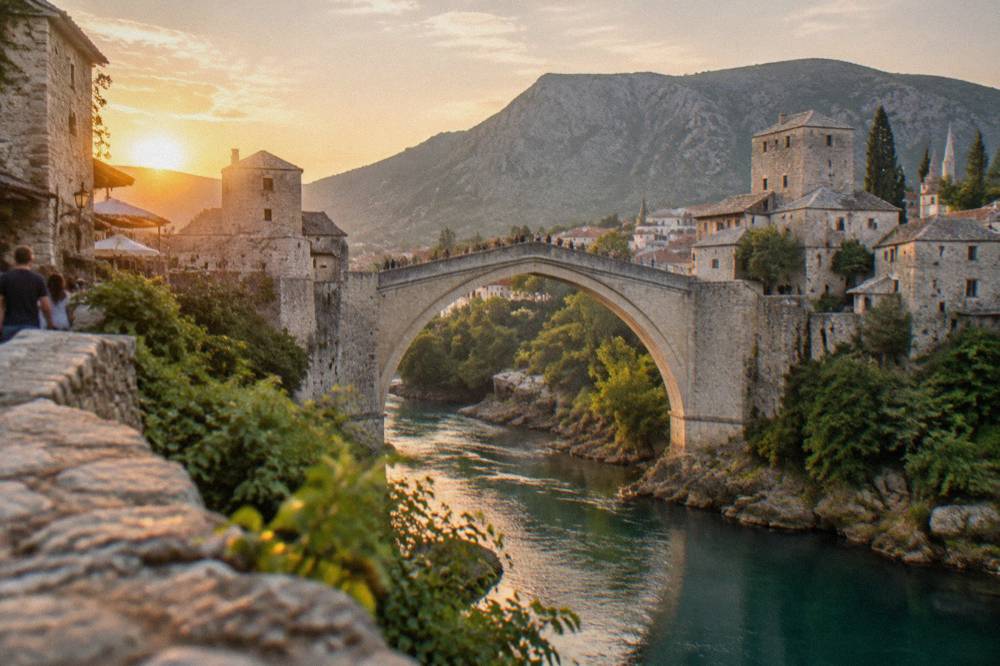
Mostar From Split
Mostar sits 173.2 km from Diocletian's Palace, about 2 hours 13 minutes of free-flow driving each way, across a border that leaves the European Union at Metković. This guide lays out the route, the border reality, the UNESCO facts and the practical choices for the day.
Short answer
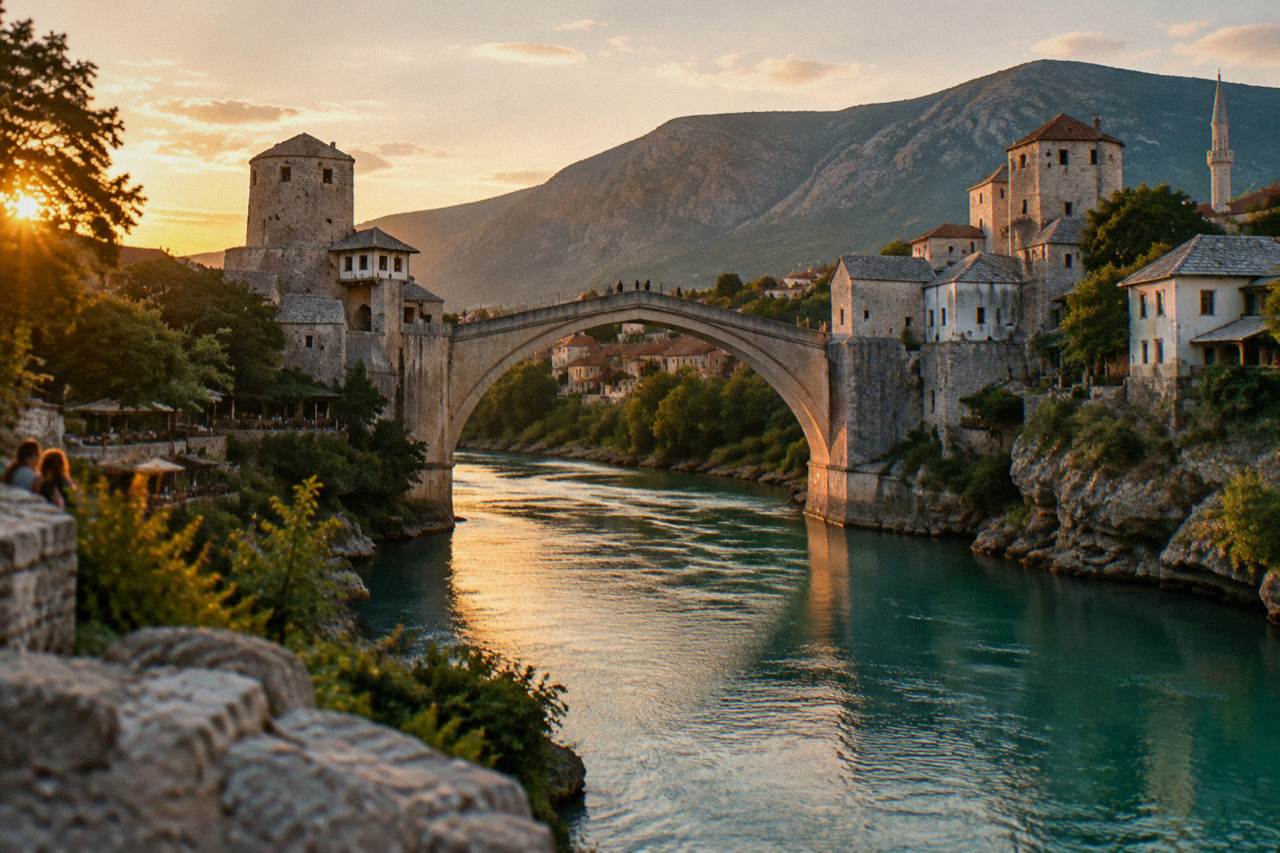
Mostar is 173.2 km from Split by road, about 2 hours 13 minutes free-flow, in Bosnia and Herzegovina, outside the euro and outside the EU. Its Old Bridge Area is UNESCO-listed since 2005, and the bridge itself was rebuilt in 2004. Day trips run daily from Split in the high season; check the operator's live listing for the current price.
Mostar is the day trip from Split that changes country. The road leaves the Adriatic coast at Opuzen, crosses into Bosnia and Herzegovina, and follows the Neretva river valley inland to a city whose stone bridge has become one of the most photographed spans in the Balkans. The driving distance from Diocletian's Palace is 173.2 km, computed at about 2 hours 13 minutes free-flow, and the reward is a skyline of minarets, a bazaar street and a river that runs cold and turquoise under the Old Bridge. This guide, from the Split Croatia Travel Guide editorial desk, sets out what the sources say about the route, the border, the UNESCO facts and the ways to book the day.
Where Is Mostar, And How Far Is It From Split?
Mostar lies 173.2 km by road from Diocletian's Palace in Split, a drive computed at about 2 hours 13 minutes without traffic, inland in Bosnia and Herzegovina on the Neretva river. The route runs down the Adriatic coast towards Dubrovnik for roughly two thirds of the way, turns inland at the Neretva delta, and crosses the international border near Metković before climbing to the city.
Those figures come from a free-flow route computation, which means the real time depends on the season, the border queue and the coast road traffic. In July and August the coastal stretch out of Split carries heavy traffic, and the border crossing itself adds time that no schedule can promise. The city sits at the edge of the Dinaric Alps, which is why the last part of the drive leaves the sea behind entirely: this is a mountain-valley city, not a coastal one, and the weather can differ from Split's on the same day.
The distance matters for planning. At 173.2 km each way, Mostar is farther from Split than Zadar, which the same route computation puts at 159.5 km and 2 hours, though closer than Dubrovnik at 234.8 km and 3 hours 21. A day trip is comfortably possible, but it is a long day, and the organised tours that run it account for that in their schedules. Anyone preferring a shorter outing can compare the alternatives in Trogir, 36 minutes away or the Krka National Park day trip, both of which stay inside Croatia.
How Do You Get From Split To Mostar?
The practical options are an organised day tour by coach or minivan, a self-drive hire car, or a self-arranged bus journey; there is no train and no ferry, because Mostar is inland. The tour operators collect in central Split, cross the border at Metković and return the same evening, while self-drivers follow the coastal road to Opuzen and then the M17 up the Neretva valley. Driving yourself takes about 2 hours 13 minutes each way free-flow.
The organised option is the one the tour pages on this site cover. Several Mostar tours depart from Split, some also collecting in Trogir or Omiš, and several pair Mostar with Počitelj and the Kravice waterfalls on the same day. What each tour includes, its live price and its current rating sit on the operator's live listing rather than in prose here; the picks band below shows three options across the site's range, and the inline availability links open the live pages.
If the organised route sounds easier, book a Mostar and Kravice day trip here.
Self-driving brings the border into your own hands. Croatia is in the European Union and Bosnia and Herzegovina is not, so the crossing is an external border with passport control in both directions; expect to show passports or ID cards, and allow buffer time on the return, when coach and car traffic can bunch up in the afternoon. Hire-car drivers should confirm with the rental company that the vehicle's insurance covers taking the car into Bosnia and Herzegovina, because not every policy does, and this is a check to make at the desk before leaving Split.
The bus is the third way, with coaches running from the main bus station on Obala kneza Domagoja, 500 to 600 m from the palace, where the ferry port and the railway station also sit. There is no rail option for the day-tripper.
| Day trip from Split | Distance by road | Free-flow drive |
|---|---|---|
| Trogir | 29.3 km | 36 min |
| Omiš | 25.5 km | 38 min |
| Šibenik | 84.8 km | 71 min |
| Krka (Skradinski buk) | 90.2 km | 74 min |
| Makarska | 86.1 km | 75 min |
| Zadar | 159.5 km | 2 h |
| Mostar | 173.2 km | 2 h 13 |
| Dubrovnik | 234.8 km | 3 h 21 |
| Plitvice Lakes | 258.1 km | 3 h 15 |
What Is The Old Bridge, And Why Is It UNESCO-Listed?
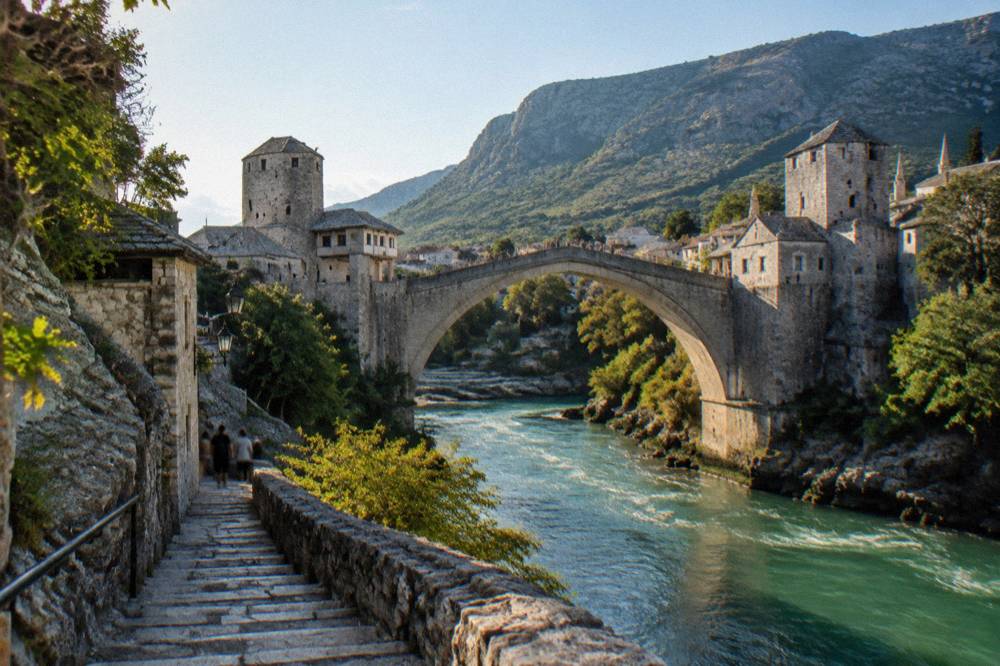
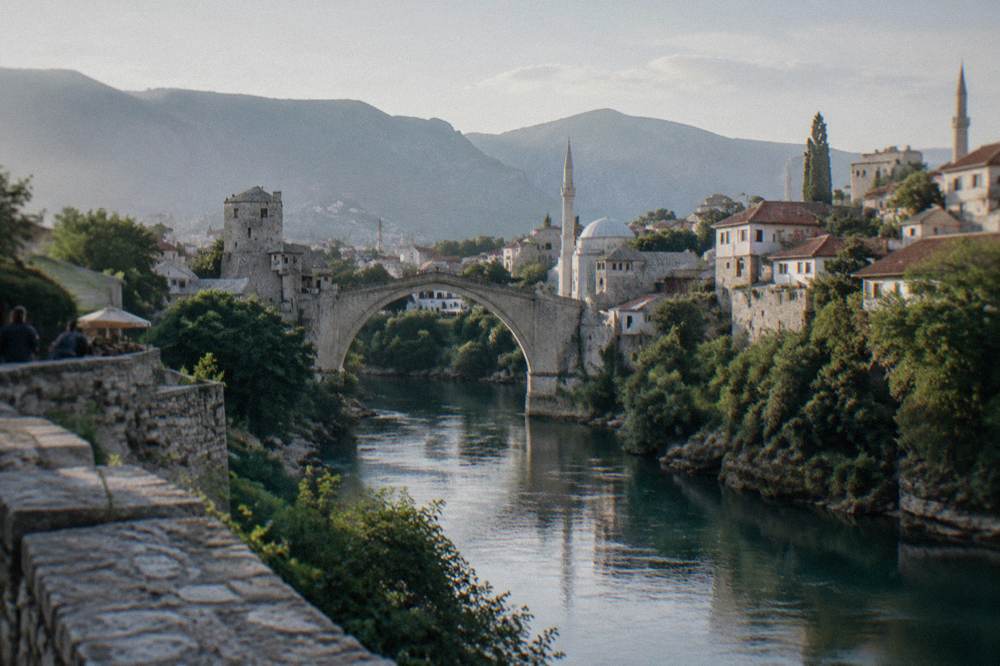
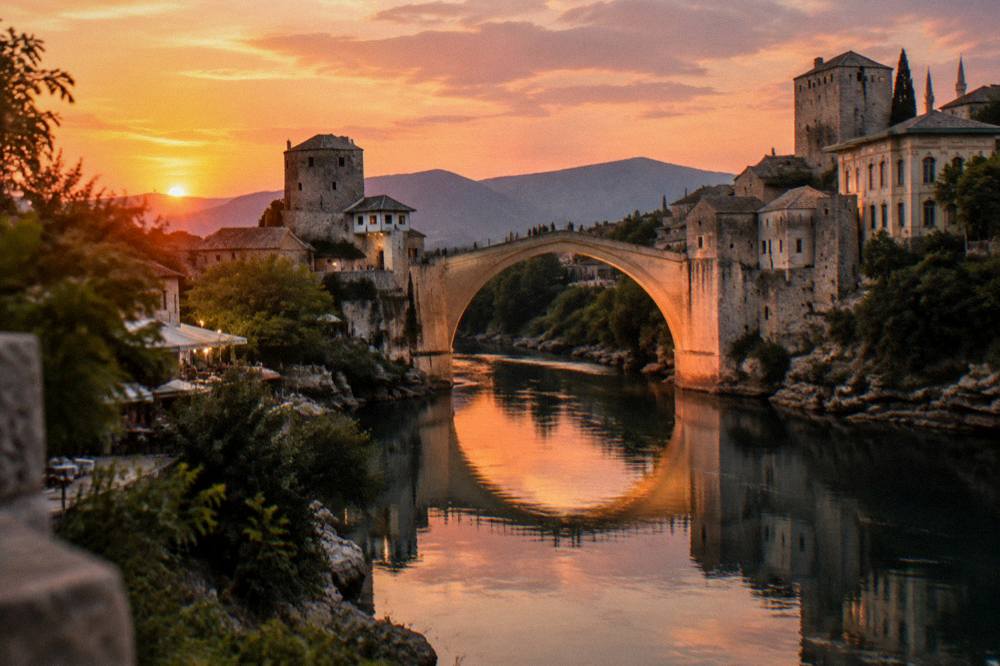
The Stari Most, the Old Bridge of Mostar, gives its name to the Old Bridge Area of the Old City of Mostar, inscribed on the UNESCO World Heritage List in 2005. The bridge that stands today was rebuilt in 2004 after the original stone arch was destroyed in the 1990s conflict; the UNESCO citation covers the surrounding old town, its towers and its bazaar street as one historic area.
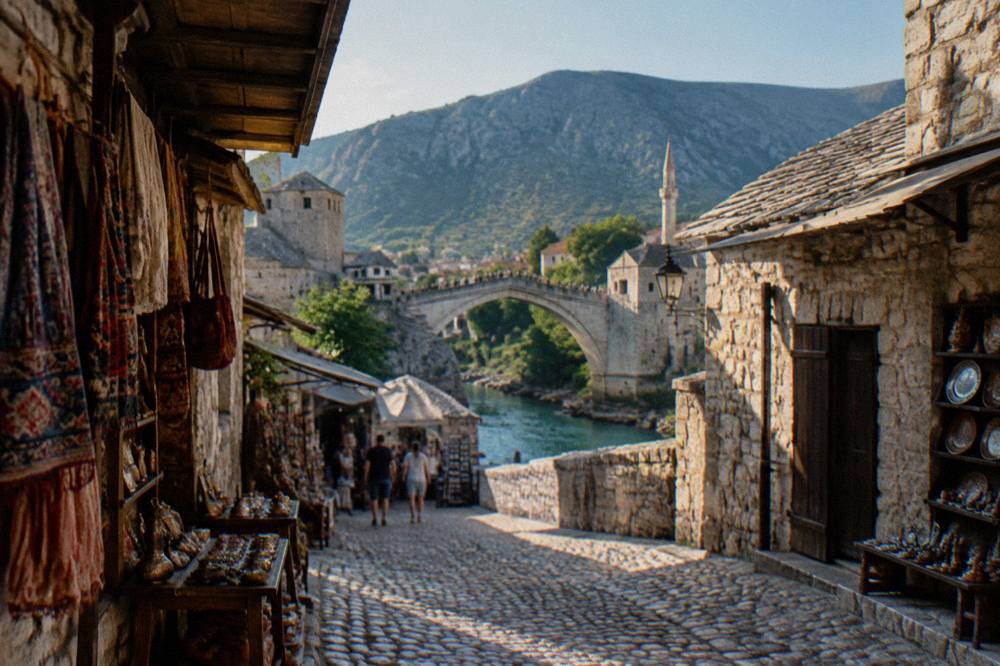
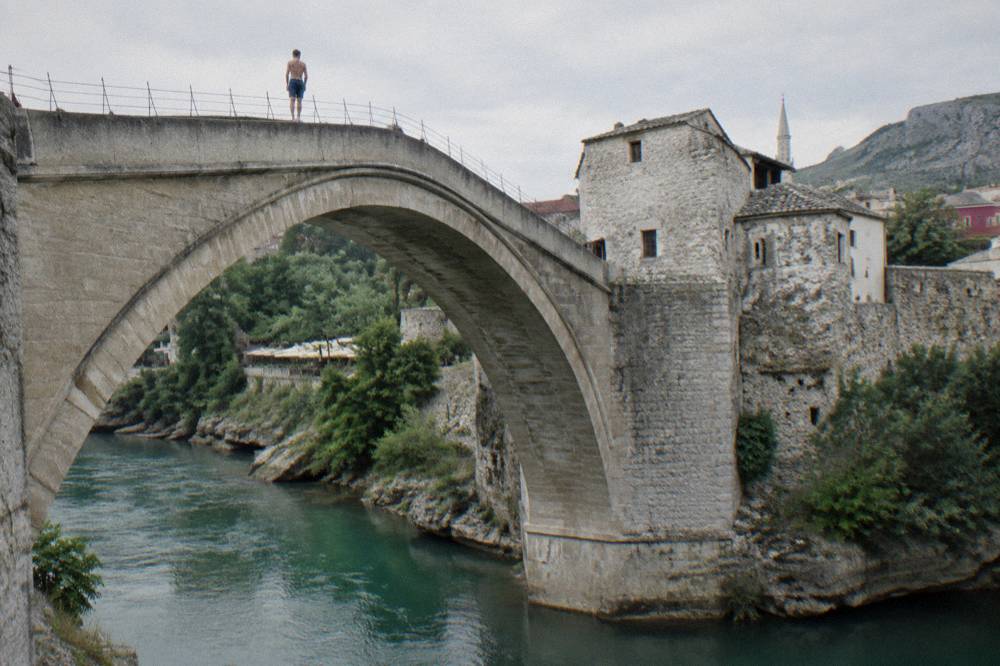
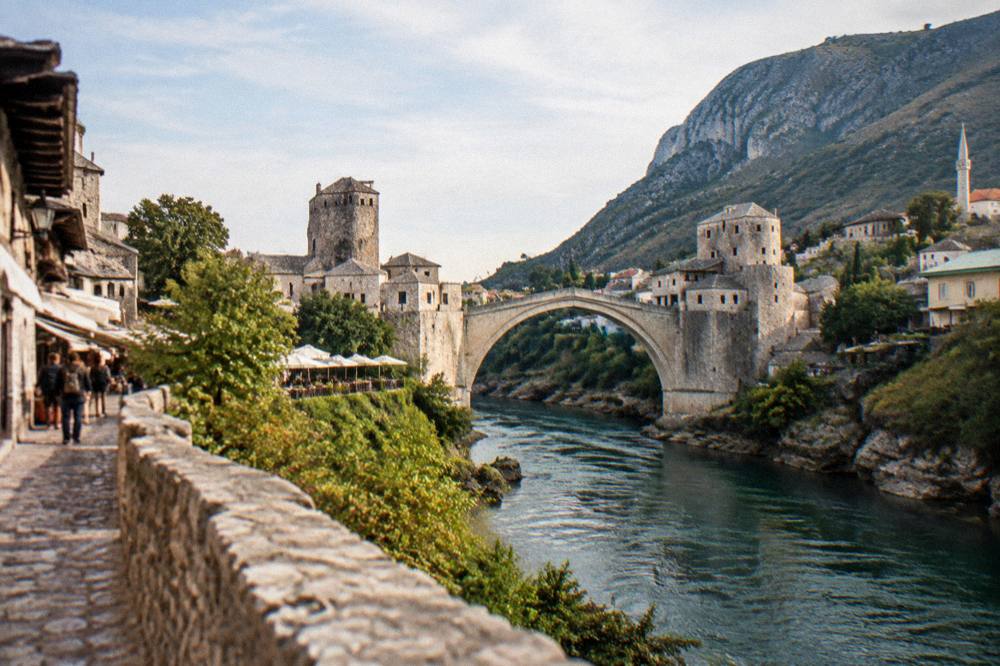
Under the site's editorial rules, those are the dated facts the sources carry: inscription in 2005, reconstruction completed in 2004. What a visitor sees is a single stone span arching about 20 m over the Neretva, with the fortified towers at each end and Kujundžiluk, the cobbled bazaar street, running down to the near bank. The river below stays cold through the summer because it drains the Dinaric highlands, and divers jump from the bridge's crest into the green water, a local tradition with its own club and training.
The bridge anchors the whole day. Everything a day-tripper wants to see sits within a few minutes' walk of it: the towers, the bazaar, the mosques of the old town and the viewpoints along both banks. The organised tours build their free time around this core, which is why the standard advice is to use the guided portion for the history and the free hours for the bridge itself, the viewing terraces and the craft shops of Kujundžiluk. Readers planning a wider Balkans-and-coast week can pair this page with Hvar or the Blue Cave and Vis trip for the sea days either side of the inland one.
| Day-trip UNESCO site near Split | Country | Year inscribed |
|---|---|---|
| Historical Complex of Split with the Palace of Diocletian | Croatia | 1979 |
| Historic City of Trogir | Croatia | 1997 |
| Cathedral of St James, Šibenik | Croatia | 2000 |
| Old Bridge Area of the Old City of Mostar | Bosnia and Herzegovina | 2005 |
Do You Need A Passport For A Mostar Day Trip From Split?
Yes, a valid passport or accepted ID document is needed, because the trip leaves the European Union at the Croatia to Bosnia and Herzegovina border. Croatia has been a full Schengen member since 1 January 2023, so this crossing functions as an external Schengen border with passport checks both ways, and since 10 April 2026 the EU's Entry Exit System records biometric entry and exit data for non-EU short-stay visitors at exactly this kind of border.
The EES point matters for British, American, Australian and other visa-exempt nationals, whose fingerprints and facial image are now taken at first registration at an external border and then matched on later crossings. EU and Schengen citizens can generally use national ID cards, subject to each country's rules, and should still carry them. The separate ETIAS travel authorisation for visa-exempt visitors was not live and has no fixed start date, so nothing needs to be applied for yet on that front.
Two further checks belong to this section. First, currency: Bosnia and Herzegovina does not use the euro, and many day-trip prices in the old town are quoted in the local currency even when euros are accepted, so check the posted price and the change you receive, or ask before paying. Second, the organised tours handle the border formalities for the group, but every passenger still needs their own document, and a tour will refuse travel without one; the listing for each tour states its document requirement.
How Long Should You Spend In Mostar?
A day trip gives Mostar roughly three to four hours on the ground after about 2 hours 13 minutes of driving each way plus border time, and that is enough for the bridge, the old town, the towers and a slow lunch. An overnight adds the evening light on the bridge, when the day crowds have gone, plus the Kravice waterfalls and Počitelj at a human pace the next morning before the drive back to the coast.
The arithmetic is the deciding factor. Door to door, the day trip commits ten to twelve hours even before delays, which is a long day with children or in high heat, and the same road twice in a day is the price of the convenience. The organised Kravice-and-Mostar combinations spread this differently, giving the waterfalls stop in the morning and the bridge in the afternoon, and several also include Počitelj, the walled hill settlement above the Neretva. What each option covers is listed on its live page: the inline links below open the current details.
For travellers who would rather not leave the sea at all, the related cruise on this page keeps the whole day on the water, calling at Hvar, Brač and the Pakleni islands with lunch and drinks served on board, and you can Check availability for its live dates. It is the mirror image of the Mostar day: islands instead of mountains, salt instead of bazaar dust.
What Do The Mostar Tours From Split Include?
The tours on this site pair Mostar with Počitelj and the Kravice waterfalls or run Mostar alone, all with hotel or central pickup in Split and some collecting in Trogir or Omiš as well; a licensed local guide and the coach transport are standard, while entry fees, lunch and the bridge dives are not, so the inclusion list on the live listing is the deciding document. Prices and ratings render on the tour pages, not in this prose.
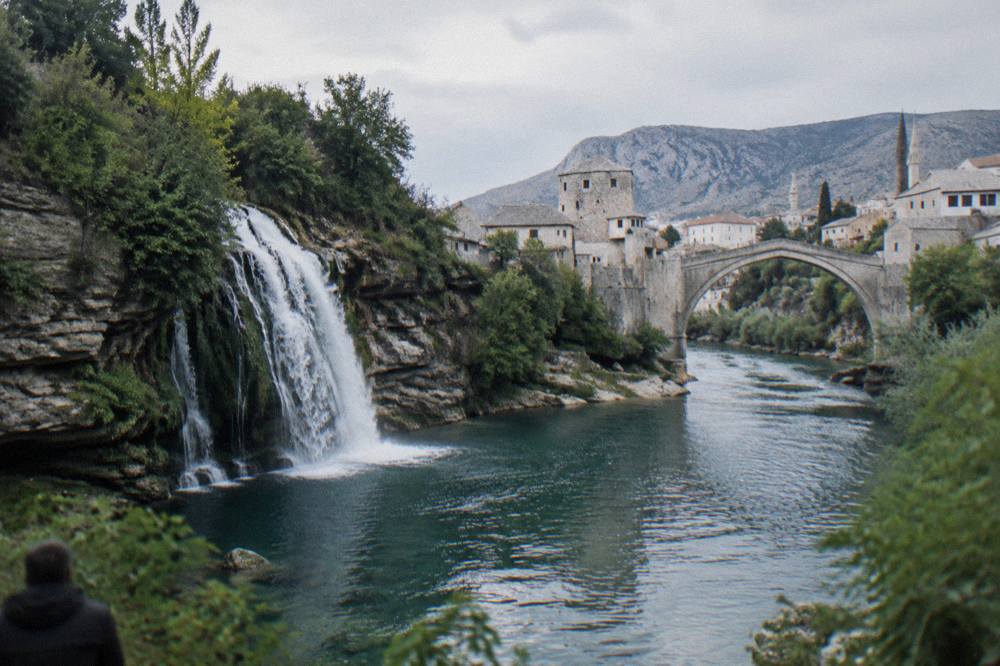
Three versions dominate the category. The classic Mostar-and-Kravice day trip runs to the waterfalls first, then Počitelj, then Mostar with free time, and returns to Split in the evening. The second runs the same route with pickup points spread wider along the coast. The third concentrates on Mostar itself with more hours in the old town. Kravice, a horseshoe of waterfalls on the Trebižat river, is the swimming stop on several of these itineraries, subject to local rules on the day; Počitelj is a photo and walking stop below its hilltop tower.
The checks worth making before booking are the pickup point, the border-document requirement, what food is included and whether free time in Mostar is measured in hours or minutes.
| Question to ask | Why it matters |
|---|---|
| Where exactly is pickup? | The main bus station sits 500 to 600 m from the palace, but some tours use other stops |
| Is the Kravice stop swimmable that day? | Swimming areas are subject to local rules and conditions |
| Is lunch included or paid locally? | Inclusion differs between otherwise similar tours |
| How long is the Mostar free time? | Itinerary order changes the hours on the ground |
| Which documents are required? | External Schengen border; every passenger needs their own |
When Is The Best Time Of Year For A Mostar Day Trip?
Late spring and early autumn give the best balance for this trip: the Neretva valley is green, the border queues are shorter than in July and August, and the coast road out of Split carries less traffic. Midsummer brings heat inland that the coast rarely sees, along with the season's thickest coach traffic, while winter trips are possible but the mountain section can carry snow and reduced daylight shortens the day.
The climate figures this site carries are for Split itself, from the DHMZ Split-Marjan station over 1948 to 2024: July has a mean of 26.2 C and 18 days at 30 C or more, August 25.9 C with 17 such days, and the wettest month is November at 115.5 mm. Mostar's inland valley runs warmer than those coastal means in summer, so a July day trip lands in the strongest heat of the itinerary; water, a hat and shade matter more on the bazaar street than on the Riva. April, May, September and October are the months the route computation and the season calendars both favour.
Event timing cuts the other way for one weekend: Ultra Europe 2027 runs 9 to 11 July at Park Mladeži in Split, and that weekend's coastal traffic and accommodation pressure argue for shifting a Mostar day either side of it. The best time to visit Split guide carries the fuller seasonal breakdown for the coast side of the trip.
Is A Mostar Day Trip Worth It Compared With An Island Day?
It depends on the shape of the week: Mostar offers the only change of country, a UNESCO old town, a mountain river and a bazaar, in exchange for about 5 hours of driving and two border crossings, while an island day from the same ferry port 500 to 600 m from the palace trades that for swimming, lunch on deck and a return in time for dinner on the Riva. A week of three or more days can hold one of each.
That is the honest framing rather than a verdict. Travellers who care about history and the contrast between the Adriatic coast and the Ottoman-era inland town rate Mostar among the region's strongest days out; travellers whose holiday is built on swimming and boats will find the coach hours a cost too high. Families with small children and anyone who dislikes long drives fall on the island side of the ledger. Split's port, Croatia's busiest passenger port with 6.05 million passengers in 2025, makes the sea version unusually easy, with car ferries to Stari Grad on Hvar in about 120 minutes and catamarans to Hvar town.
The sea-side options are covered elsewhere on this site in depth: Hvar, Brač and Zlatni Rat and the Blue Lagoon and Šolta trips each have their own guides. The picks below show the current sea-day trio alongside the tuk-tuk city tour for a lighter day in Split itself.
What Should You Know Before You Go?
Bring a passport or accepted ID for the external Schengen border, euros for the tour but a plan for local currency in the old town, comfortable shoes for cobbles and bridge steps, and more water than the coast day would need. Confirm the pickup point and time against the listing the evening before, because the schedule of a border day can shift with traffic, and pack for valley heat if travelling between June and September.
A few specifics earn their place. Dress codes in the old town's religious buildings ask for shoulders and knees covered, the same standard applied at Split's own Cathedral of St Domnius. Photography from the bridge towers and the viewing terraces is the standard sightseeing loop, but drones are a different matter: the rules this site carries flag no-fly zones over populated old-town areas and bans inside national parks, and cross-border drone rules add complication that makes leaving it at the hotel the simpler choice. The emergency number 112 works in both countries on this itinerary.
Money last, because it is the quiet trap: the euro is not the local currency in Bosnia and Herzegovina, card acceptance in the bazaar is patchy, and change given back in local coins is a known end-of-trip nuisance. Small euro notes are the practical workaround the listing reviews repeatedly mention. Anyone wanting the sea-day instead, or as well, can Check availability on the cruise page.
Common Questions About Mostar From Split
How far is Mostar from Split?
Mostar is 173.2 km by road from Diocletian's Palace in Split, a drive computed at about 2 hours 13 minutes free-flow, in Bosnia and Herzegovina.
Do you need a passport for a Mostar day trip from Split?
Yes. Bosnia and Herzegovina is outside the European Union, and the crossing functions as an external Schengen border, with passport checks in both directions and, since 10 April 2026, Entry Exit System biometric registration for non-EU short-stay visitors.
Why is the Mostar Old Bridge famous?
The Old Bridge, the Stari Most, anchors the Old Bridge Area of the Old City of Mostar, inscribed by UNESCO in 2005. The standing bridge was rebuilt in 2004 after the original stone arch was destroyed in the 1990s conflict.
Can you visit Kravice waterfalls and Mostar in one day from Split?
Yes, several organised tours from Split combine the Kravice waterfalls, Počitelj and Mostar in a single day; the inclusion list and live price sit on the operator's listing for each tour.
Is the euro used in Mostar?
No, Bosnia and Herzegovina uses its own currency, though euros are accepted in many tourist-facing businesses; check the posted price and the change you receive, or ask before paying.
Is a self-drive day trip to Mostar realistic?
It is, at about 2 hours 13 minutes each way free-flow, but hire-car insurance must be confirmed with the rental company for cross-border use, and the border crossing times on the return leg can stretch in the afternoon.