Can You Catch A Train From Split To Dubrovnik?
No train runs from Split to Dubrovnik. Here is what the timetables and road distances actually show, and the coach, car and tour options that connect the two cities.
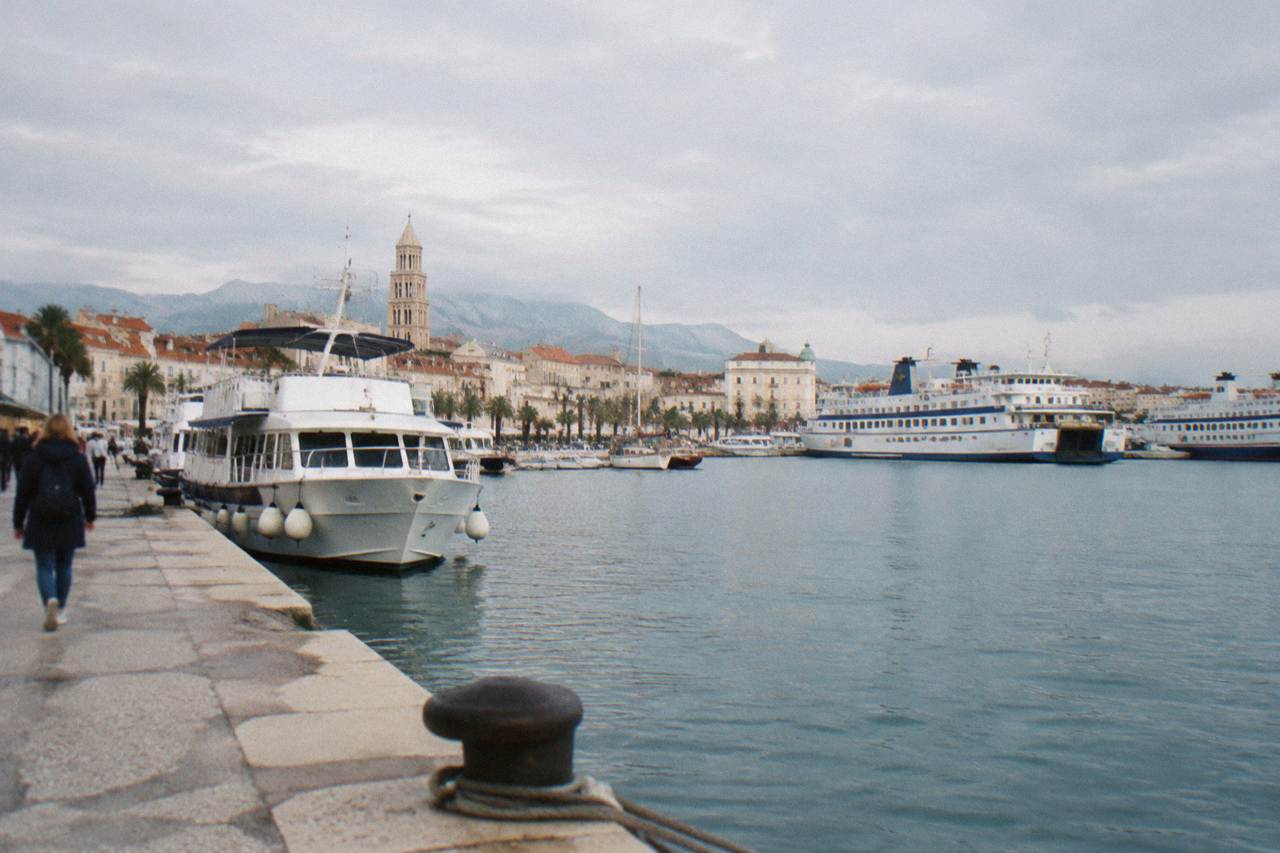
Split sits on the Adriatic coast in central Dalmatia, and its railway station, ferry port and main bus station share one strip on Obala kneza Domagoja, 500 to 600 m from Diocletian's Palace. Dubrovnik lies 234.8 km down the coast to the south-east, and the question of a train between the two comes up again and again in trip planning. The short answer is that no train runs between them, and this page explains what the rail network actually covers, what connects the two cities instead, and how the timings compare.
Can You Catch A Train From Split To Dubrovnik?
No, there is no train from Split to Dubrovnik, and there never has been a direct line. Dubrovnik has no railway station at all, because the Croatian rail network ends well north and east of the city. The train from Split runs inland to Zagreb, a journey of about 7 h 15 to 8 h 10, and anyone heading to Dubrovnik travels the final stretch by coach or by car.
Split's railway station is real and working, but its only long-distance passenger line runs north to Zagreb, with a journey time of about 7 h 15 to 8 h 10 according to secondary timetable sources. That line serves inland destinations between the two cities, none of them on the coast road to Dubrovnik. The coastal strip south of Split, through Omiš, Makarska, the Pelješac peninsula and into Dubrovnik, has no rails on it, so a rail journey between the two cities is not a matter of booking early or changing at an interchange: the tracks do not exist.
Dubrovnik's own passenger transport runs on rubber tyres and on water. Its long-distance coach station handles arrivals from Split and from Zagreb, its small port at Gruž takes ferries and cruise ships, and its airport at Čilipi sits south-east of the city. A traveller who insists on using a train for part of the journey could ride Split to Zagreb and then find a coach from Zagreb down to Dubrovnik, but that is a detour of several hundred kilometres in the wrong direction and nobody plans a Dalmatian itinerary that way.
The practical comparison is therefore between the coach, a hire car or private transfer, and an organised day trip or multi-day tour. The table below sets out what the figures show for each option.
| Option | Split to Dubrovnik time | Notes |
|---|---|---|
| Train | Not possible | No railway serves Dubrovnik; the Split line runs to Zagreb, about 7 h 15 to 8 h 10 |
| Coach | About 4 h | Runs from the main bus station on Obala kneza Domagoja, by the ferry port |
| Car | 3 h 21 free-flow | 234.8 km from Diocletian's Palace, per OSRM route calculation |
| Organised day tour | Long day, by road | Operators run round trips from Split and from Trogir |
The coach figure of about 4 h is the standard published estimate and real journeys run longer with border and rest stops. The driving time of 3 h 21 is a free-flow route calculation from Diocletian's Palace, not a promise: summer traffic on the coastal road and the border crossing at Neum, where the road briefly leaves Croatia, can add a great deal. No bus fare, toll or transfer price is printed here, because none is verified; fares are confirmed at the ticket desk or with the operator.
How Do You Get From Split To Dubrovnik Instead?
The coach is the standard public connection, taking about 4 h from Split's main bus station on Obala kneza Domagoja, 500 to 600 m from Diocletian's Palace. Driving covers 234.8 km in about 3 h 21 free-flow, and organised tours run the route as a day trip or as part of a longer itinerary. There is no rail alternative and no ferry substitute for this stretch of coast.
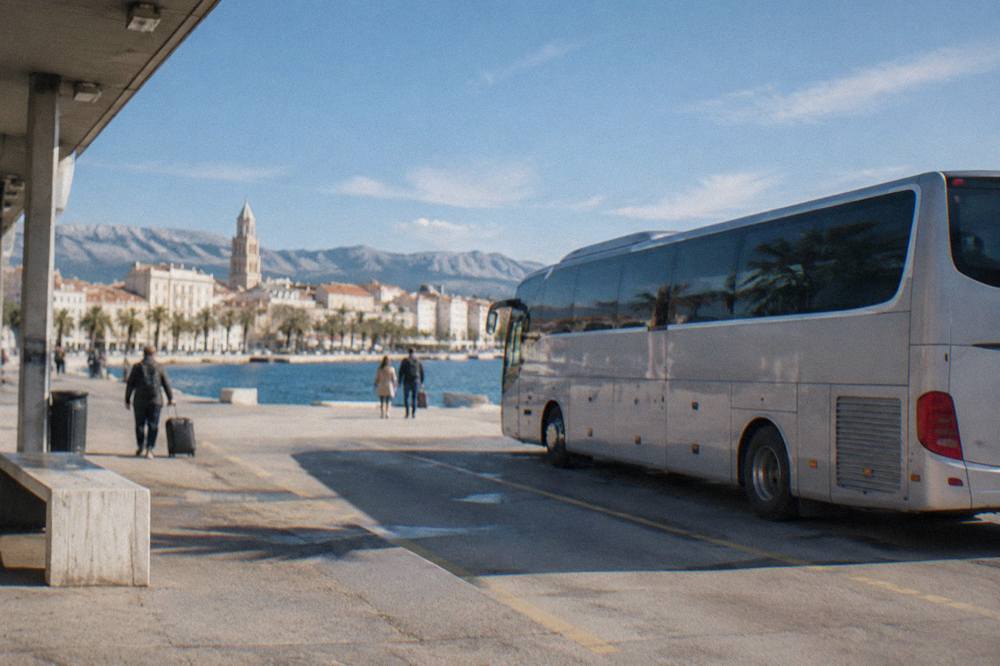
The coach station's position is the quiet advantage here. Because the ferry port, the bus station and the railway station sit together on the same waterfront strip, a traveller arriving in Split by ship or by train walks a few hundred metres to the Dubrovnik departure bays. Coaches run south along the coast through Omiš and Makarska country before reaching Dubrovnik, and tickets are bought at the station or in advance through the operator's own channels. Confirm the fare and the departure bay locally, because neither is published in a form this site can stand behind.
Driving gives more freedom and, at 3 h 21 without traffic, a faster paper time than the coach. The route from the palace measures 234.8 km. The complication is the Neum corridor, where the road passes through a short stretch of Bosnia and Herzegovina: since Croatia joined the Schengen area on 1 January 2023 this has been a Schengen external border, and the entry/exit system (EES) has been fully operational at those borders since 10 April 2026, with biometric checks for non-EU short-stay visitors. Croatia also uses the euro since 1 January 2023, so no currency change is needed for a coffee stop at Neum, but a passport or ID card is. The Pelješac bridge route now allows drivers to stay inside Croatia the whole way, at the cost of some extra distance.
The organised option suits travellers who do not want the logistics at all. Day tours from Split and Trogir run to Dubrovnik by road, with time in the city and the return leg the same evening, and longer itineraries pair Dubrovnik with Mostar, whose Old Bridge Area is UNESCO-inscribed (2005, the bridge rebuilt in 2004) and which lies 2 h 13 by road from Split. The full comparison of the two cities, from beaches to atmosphere, sits in the Split versus Dubrovnik guide, and the road connections in both directions are covered in the Split to Dubrovnik transport guide.
Rather leave the driving to someone else? Book a small-group Dubrovnik day trip here.
For travellers weighing where to base themselves, the question of which city deserves the nights is worth settling before the transport: which one is prettier depends on what you want from stone and sea, and the airport choice has its own answer.
Is The Train From Split Worth Riding At All?
Yes, but only for Zagreb and the inland destinations on that line, not for anything on the Dalmatian coast. The Split to Zagreb journey takes about 7 h 15 to 8 h 10, and the railway station sits on Obala kneza Domagoja beside the ferry port and main bus station, 500 to 600 m from Diocletian's Palace. It is a scenic mountain line, and it is the only rail option Split has.
The station's address is its whole pitch. A traveller staying inside the palace walls can walk to the platform with a coffee still warm, and the line climbs inland through the Dinaric mountains toward the capital. The times, about 7 h 15 to 8 h 10, come from secondary timetable sources and should be confirmed against the operator's own schedule before any connection is planned, especially where a flight or a ferry departure depends on it. The full index of guides sits on Split Croatia Travel Guide.
What the train cannot do is serve the coast. Omiš, at 38 minutes by road, Makarska at 75 minutes, and Dubrovnik at 3 h 21 all lie off the rail network, and the islands of Brač, Hvar, Šolta and Vis obviously lie beyond it. For every coastal and island destination the answers are the bus station and the ferry terminals, which is why the three transport hubs being in one place matters so much to an itinerary built on Split.
This is also why Split works so well as a single base. The day trips radiate out by road and by sea: Krka's waterfalls at 74 minutes by road, Trogir at 36, Salona at 14, Klis Fortress at 22, Omiš at 38. The full list of day trips from Split sets out the driving times, and the question of how many days is enough for Split usually resolves itself once those times are on the table.
Should You Day Trip To Dubrovnik Or Stay Overnight?
A day trip is workable because the drive is 234.8 km, about 3 h 21 each way free-flow, and tours run the route from Split and Trogir, but it gives you a short slice of a city that repays an evening. An overnight or a two-city split, coach one way in about 4 h, lets you see the walls and the old town without watching the clock, and the question of which city deserves more nights has its own answer on this site.
The arithmetic is the thing. Two legs of roughly 3 h 21 free-flow, longer in real summer traffic, plus the Neum border or the Pelješac detour, plus parking or a drop-off, leaves a single day with a few hours inside Dubrovnik's walls. The walls ticket itself runs at about 40 EUR in 2026 including Lovrijenac, per secondary sources, and walking the circuit plus the old town lanes takes that time seriously. For a one-off visit on a tight schedule the day trip delivers; for anything deeper, the coach connection of about 4 h makes a two-centre trip straightforward.
The comparison pages help settle it. Beyond prettiness, whether the beaches are better in Split or Dubrovnik and whether to spend longer in Split or Dubrovnik both feed the same decision, and the Dubrovnik day trip guide covers the practical route from the Split end.
What Else Should You Know Before Travelling Between The Two Cities?
Croatia is in the Schengen area and has used the euro since 1 January 2023, and the Neum corridor between Split and Dubrovnik crosses an external Schengen border, where biometric entry/exit checks have applied to non-EU visitors since 10 April 2026. Carry a passport or ID card, allow extra time in summer, and confirm coach tickets and tour pickups at booking.
The border point surprises travellers who assume the two Dalmatian cities sit in one unbroken stretch of Croatia. The Neum corridor belongs to Bosnia and Herzegovina, roughly 9 km of road, and even though Croatia's Schengen membership and the euro make the rest of the journey frictionless, that short stretch is a genuine international border with passport control. ETIAS, the pre-travel authorisation for visa-exempt visitors, is not live and has no confirmed start date, so nothing needs to be applied for beyond a normal passport, but the document itself must be carried.
| Journey fact | Figure |
|---|---|
| Split to Dubrovnik by road | 234.8 km, about 3 h 21 free-flow from Diocletian's Palace |
| Split to Dubrovnik by coach | About 4 h, from the main bus station on Obala kneza Domagoja |
| Split to Zagreb by train | About 7 h 15 to 8 h 10 |
| Split to Mostar by road | 173.2 km, about 2 h 13, on the same southern corridor |
| Dubrovnik city walls ticket | About 40 EUR in 2026, including Lovrijenac, secondary source |
Summer timing matters as much as the border. July in Split averages 26.2 C and August 25.9 C on the DHMZ Split-Marjan station record for 1948 to 2024, with 18 days at 30 C or more in July and 17 in August, so a midday queue at a border post or a parking search inside Dubrovnik's heat is a real cost. The same record shows July as the driest month at 26.6 mm and November the wettest at 115.5 mm, which is one reason shoulder-season travel on this corridor runs more smoothly.
While Split is your base, the adventures that start close to home deserve the days the Dubrovnik road does not consume. The Cetina river near Omiš, 38 minutes from the palace, carries rafting and canyoning trips, and the Check availability link beside the rafting, cliff jumping and cave tour page shows the operator's live listing. The things to do in Split index holds the wider picture.
Common Questions About Trains From Split To Dubrovnik
Can you catch a train from Split to Dubrovnik?
No. Dubrovnik has no railway station, and the only long-distance passenger line from Split runs to Zagreb, taking about 7 h 15 to 8 h 10. Travel between Split and Dubrovnik is by coach, about 4 h, or by road, 234.8 km and about 3 h 21 free-flow.
Why is there no railway to Dubrovnik?
The Croatian rail network never reached the far southern coast. The line from Split runs inland to Zagreb, and the coastal strip through Omiš, Makarska and the Pelješac region to Dubrovnik has no tracks, so the coach station and the airport carry all of Dubrovnik's land arrivals.
Can you take a train part of the way and a bus the rest?
Only in a technical sense. The train from Split serves inland stations toward Zagreb, which runs away from Dubrovnik, so a rail-bus combination would add hundreds of kilometres. The direct coach from Split's main bus station is the practical public connection.
Do you cross a border between Split and Dubrovnik?
Yes, on the standard coastal road. The Neum corridor is a short stretch of Bosnia and Herzegovina, and Croatia's Schengen membership since 1 January 2023 makes it an external Schengen border, with biometric entry/exit checks applying to non-EU visitors since 10 April 2026. Carry a passport or ID card.
Is driving from Split to Dubrovnik better than the coach?
Driving measures 234.8 km, about 3 h 21 free-flow, against about 4 h for the coach, but summer traffic, the border and city parking eat the difference. The coach leaves from Obala kneza Domagoja beside the ferry port, 500 to 600 m from Diocletian's Palace, which removes the parking question entirely.
Is a Dubrovnik day trip from Split realistic?
Workable but long, with roughly 3 h 21 of driving each way free-flow and longer in practice. Organised tours run the route from Split and Trogir and handle the border and parking. An overnight, using the about 4 h coach one way, gives the city an evening it earns.
The train from Split to Dubrovnik does not exist, but the coach, the coast road and the tour coaches all do the job well, and the station strip on Obala kneza Domagoja puts every one of them within a short walk of the palace.