One Day In Split
Split, a coastal city on the Adriatic in central Dalmatia, packs a Roman palace, a forested peninsula and a working ferry port into a walkable strip, and one well-planned day covers the core of it.
Short answer
Spend the morning inside Diocletian's Palace and the cathedral complex, walk the Riva after lunch, climb Marjan hill in the late afternoon, and finish on Bačvice or at a konoba as the sun goes down.
Split, a coastal city on the Adriatic Sea in central Dalmatia, Croatia, is one of the few places in Europe where a full day on foot genuinely covers the historic core, a hill-and-forest park and a swimmable city beach. The Old Town sits inside and around Diocletian's Palace, built for the Emperor Diocletian around 295 to 305 AD and inscribed by UNESCO in 1979 as the Historical Complex of Split with the Palace of Diocletian, a property of 20.8 hectares. The ferry port, the main bus station and the railway station share one strip on Obala kneza Domagoja, 500 to 600 m from the palace, which is why so many day trips to Krka, Trogir, Hvar and beyond start here. If your stay stretches past a single day, the two-day Split itinerary and the three-day version add the islands and the longer park trips.
What Can You Realistically See In One Day In Split?
One day in Split covers the palace and its cathedral complex in the morning, the Riva and the Green Market around lunch, Marjan hill in the mid-afternoon, and a swim at Bačvice or Kašjuni before dinner, all without a car or a bus. The distances are short: the palace to the Riva is a two-minute walk, the Riva to the first Marjan steps is about ten minutes on foot, and the ferry port hub is 500 to 600 m from the palace itself.
The plan works because Split compresses everything into a rectangle roughly a kilometre and a half deep. The palace occupies the eastern half of the Old Town, the Marjan peninsula rises to the west, and the Riva promenade runs between them along the water. Every step of this itinerary, except the optional evening speedboat or the lookout detour to Klis Fortress, stays inside that rectangle.
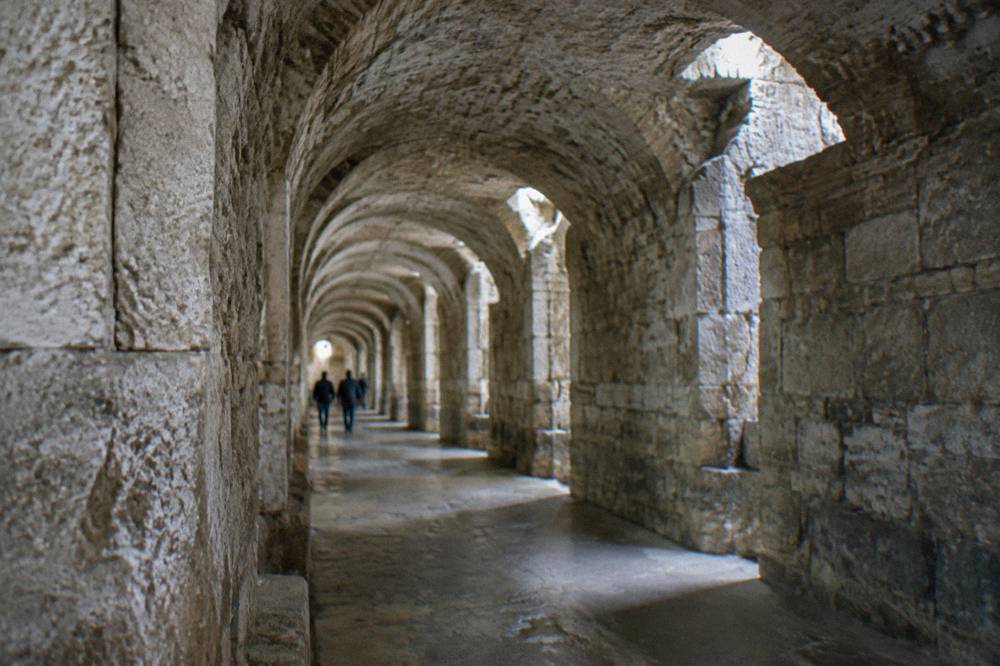
A realistic shape for the day looks like this. Start at the Peristyle when the square is still quiet, buy the cathedral combination ticket at the Peristyle kiosk, then descend into the palace substructures while the morning light comes through the vaults. Emerge onto the Riva, eat close to the market streets, and let the warmest hours pass under trees on Marjan before dropping down to a beach for a swim. The evening belongs to the Riva again, because that is when the promenade fills and the palace walls catch the last light. The Roman guard change on the Peristyle at noon ran from 28 May to 27 September 2026, so confirm locally whether it operates on the day you visit.
| Time of day | Where | What you do | Why it fits |
|---|---|---|---|
| Early morning | Peristyle and cathedral | Cathedral, bell tower, baptistery, crypt | Fewer people, cooler stone streets |
| Mid-morning | Palace substructures | Cellars visit, Split City Museum if time allows | Hours are 8:30 to 20:00 daily |
| Around noon | Riva and Green Market | Lunch, coffee, market stalls | Market streets sit minutes from the Riva |
| Mid-afternoon | Marjan hill | Climb to Telegrin, 178 m | Shade, sea views on both sides |
| Late afternoon | Bačvice or Kašjuni | Swim and rest | Both are city beaches, free |
| Evening | Riva and Old Town | Dinner, palace walls at dusk | The Riva is the evening promenade |
One planning note from the fresh record: the Riva's central section is set for renovation works planned from November 2026, lasting a little over a year, so partial closures along the promenade are expected through 2027. The walk stays possible, but a section may be hoarded. The deeper background on the whole waterfront is in the Riva promenade guide, and the wider set of options is on the things to do in Split page.
Where Should The Morning Go Inside Diocletian's Palace?
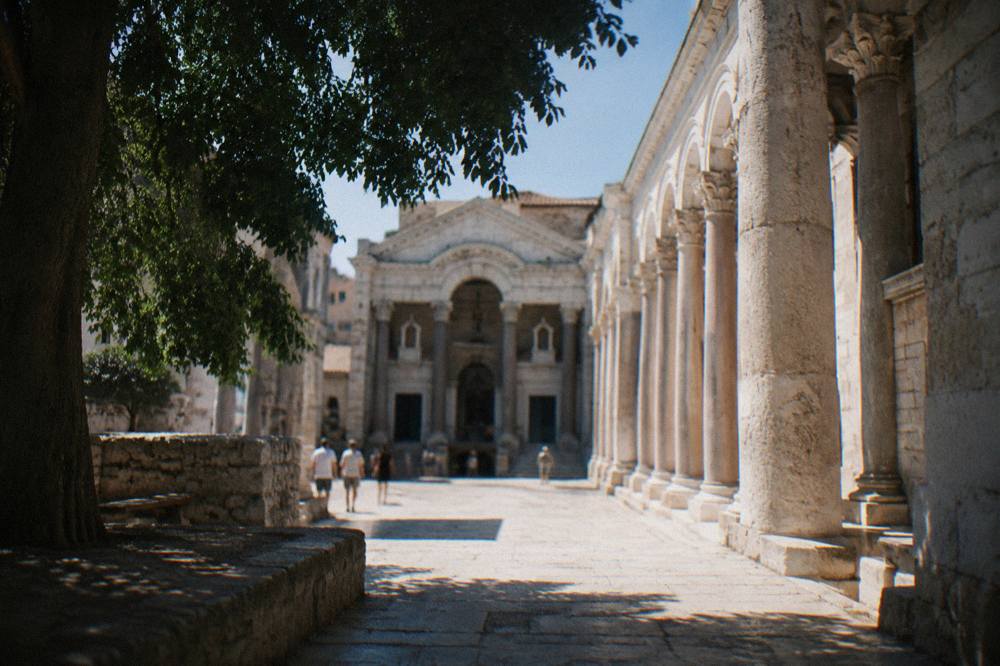
The morning belongs to Diocletian's Palace: start on the free Peristyle square, then buy the cathedral combination ticket at the Peristyle kiosk, climb the 57 m bell tower, see the former Temple of Jupiter, now the Baptistery of St John, and finish in the substructures, the cellars run by the Split City Museum and open 8:30 to 20:00 every day. The Peristyle, the Golden Gate, the Grgur Ninski statue and the Prokurative all cost nothing.
The palace is not a museum with one entrance, it is a living quarter of the city, and that shapes the morning. The free parts, the Peristyle, the Prokurative, the Golden Gate and the Grgur Ninski statue, need no ticket and no queue. The ticketed parts hang off the cathedral complex. The bell tower rises 57 m and gives the single clearest view over the palace grid and the islands, which is why it earns its place even on a one-day visit.
For the ticketed sites, write the numbers the sources give and no others. The cathedral complex sells five single-site tickets and colour-coded combinations from about 5 EUR for the cathedral up to about 15 EUR for the full five-site combination, according to the secondary guide that reports the kiosk prices. The Split City Museum's own price list shows the museum at Papalić Palace at 10.00 EUR adult, 8.00 EUR reduced and 18.00 EUR for a family, closed Mondays. The cellars under the palace follow the museum's management and the same price list; the central part is under restoration to the end of 2026, with the passage staying open. Shoulders and knees must be covered inside the cathedral.
A guided walk sharpens the morning, because the palace rewards explanation. The small-group walk led by a Magister of History is one of the options below, alongside a zip line trip for the afternoon or the following day and the Mostar and Kravice day trip if your one day stretches into two. Tip-based walks also run locally; confirm arrangements directly with the guide.
The palace is a dense subject, and the dedicated pages go deeper than one morning allows: the Diocletian's Palace guide, the cellars page, the Peristyle and the Cathedral of St Domnius each carry the full detail.
| Site | Adult price | Hours the sources give |
|---|---|---|
| Cathedral of St Domnius, single | about 5 EUR | Confirm at the Peristyle kiosk |
| Cathedral complex, full combination | up to about 15 EUR | Confirm at the Peristyle kiosk |
| Bell tower, single | about 7 EUR | Confirm at the Peristyle kiosk |
| Palace substructures (cellars) | 10 EUR, per the museum price list | Monday to Sunday, 8:30 to 20:00 |
| Split City Museum, Papalić Palace | 10.00 EUR, reduced 8.00, family 18.00 | Tue to Sun 9:00 to 20:00, closed Mondays |
| Peristyle, Golden Gate, Prokurative | Free | Always open |
What About Lunch, The Riva And The Market Streets?
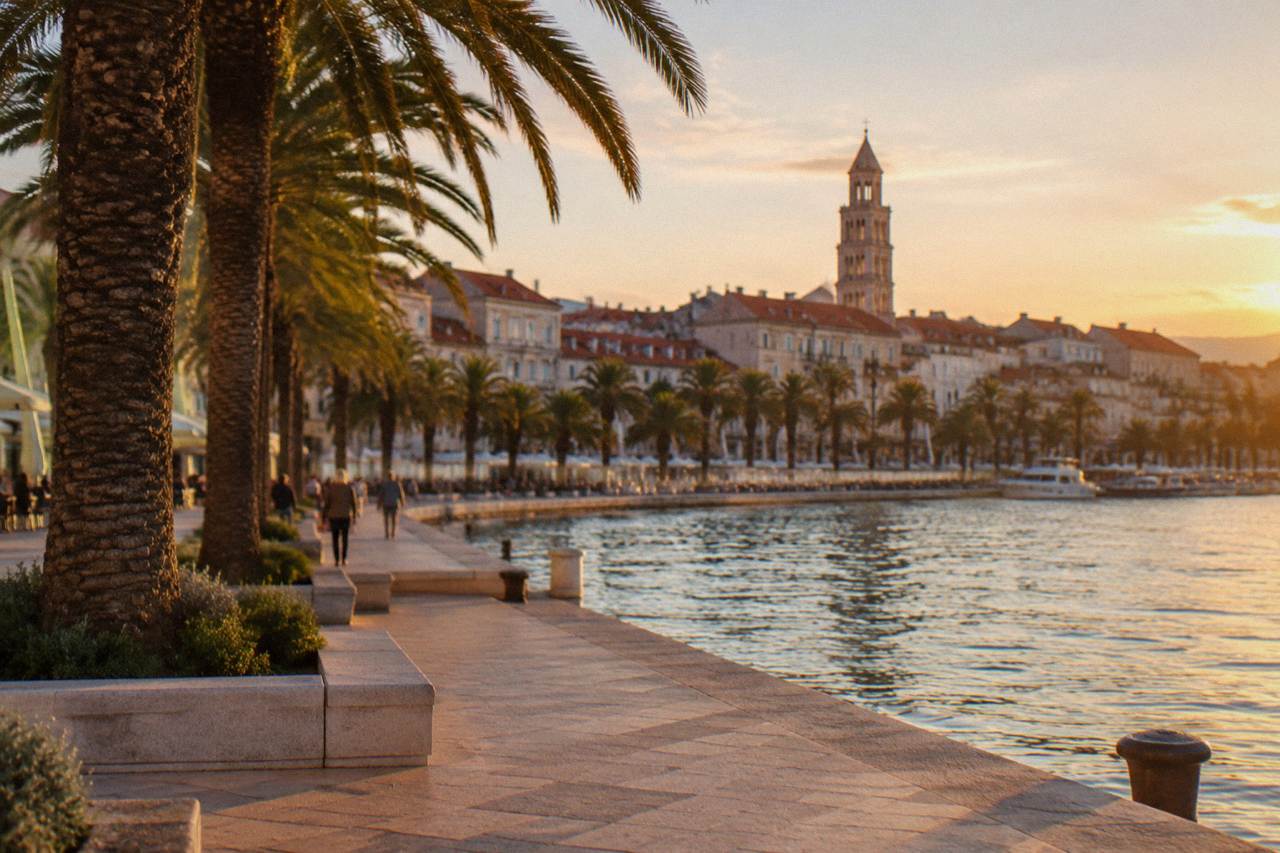
Lunch on a one-day Split visit is best taken in the market streets north and east of the palace, around the Green Market and the lanes of the Old Town, followed by a flat walk along the Riva, the palm-lined waterfront promenade that runs the length of the palace's southern wall. The market, the Riva, the Prokurative square and the Vestibule all cost nothing, so the middle of the day spends time, not money.
Split's food identity sits in its green market and its konobas, the informal taverns serving grilled fish, Adriatic prawns and local ham and cheese. The Split food guide and the restaurants pages carry the detail; for a single day, the practical advice is to eat within a few streets of the market, where the produce comes from, and to check the menu the way you can verify things yourself: posted prices, an itemised bill and any cover charge printed on the menu. No single street or dish needs naming for the day to work.
After lunch the Riva is the natural spine of the walk. The promenade faces south over the harbour, with the ferry piers to the east and the Marjan peninsula closing the view to the west. The Port of Split's own figures call it Croatia's busiest passenger port, 6.05 million passengers in 2025, and 487,377 of them arrived on cruise ships, so the promenade doubles as a working waterfront. Ferries to Stari Grad on Hvar, Supetar on Brač and Rogač on Šolta leave from these piers, which makes the Riva also the place to stand and watch the islands come and go. The Old Town guide covers the lanes behind the Riva, including Veli Varos, the old fishermen's quarter under Marjan that appears later in this itinerary.
| Ferry or catamaran line | Route | Sailing time | Foot passenger fare |
|---|---|---|---|
| Line 635 car ferry | Split to Stari Grad, Hvar | about 120 minutes | 5.90 EUR off-season, 8.40 EUR in season |
| Line 631 car ferry | Split to Supetar, Brač | about 50 minutes | Confirm with Jadrolinija |
| Line 636 car ferry | Split to Rogač, Šolta | about 60 minutes | Confirm with Jadrolinija |
| Catamaran, line 9603 | Split, Bol, Stari Grad, Jelsa | Route time varies | 6.40 EUR low, 10.00 EUR high, to Hvar or Jelsa |
| Catamaran, line 9602 | Split, Milna, Hvar, Vis | Route time varies | 7.20 EUR low, 10.00 EUR high, to Vis |
One distinction matters if your one day involves an island: Hvar town itself is reached by catamaran, while the car ferry lands at Stari Grad on the same island. The Hvar day trip page and the ferry guides separate the two properly. From 2026 the Split to Supetar line runs with no off-season timetable at all, only high-season and low-season schedules, which Jadrolinija credits to year-round island demand.
How Does Marjan Hill Fit Into A One-Day Plan?
Marjan, the forested peninsula on Split's western edge, fits a one-day plan as the mid-afternoon block: the highest point Telegrin stands 178 m, reachable by 819 steps from Trumbićeva obala, and the whole peninsula measures 3.5 km long and 1.5 km wide, so a climb to the top and back takes a slow hour or two with shade the entire way. Entry is free, there is no ticket and no gate.
The hill is the counterweight to the palace. Where the morning is stone and crowds, Marjan is pine shade and silence, with the sea on both sides once you gain height. The Društvo Marjan park association publishes the numbers: Telegrin at 178 m, the peninsula's dimensions, and the 819-step count from the waterfront to the top. The steps are stepped stone, uneven in places, so shoes matter more than fitness; the climb is steady rather than steep.
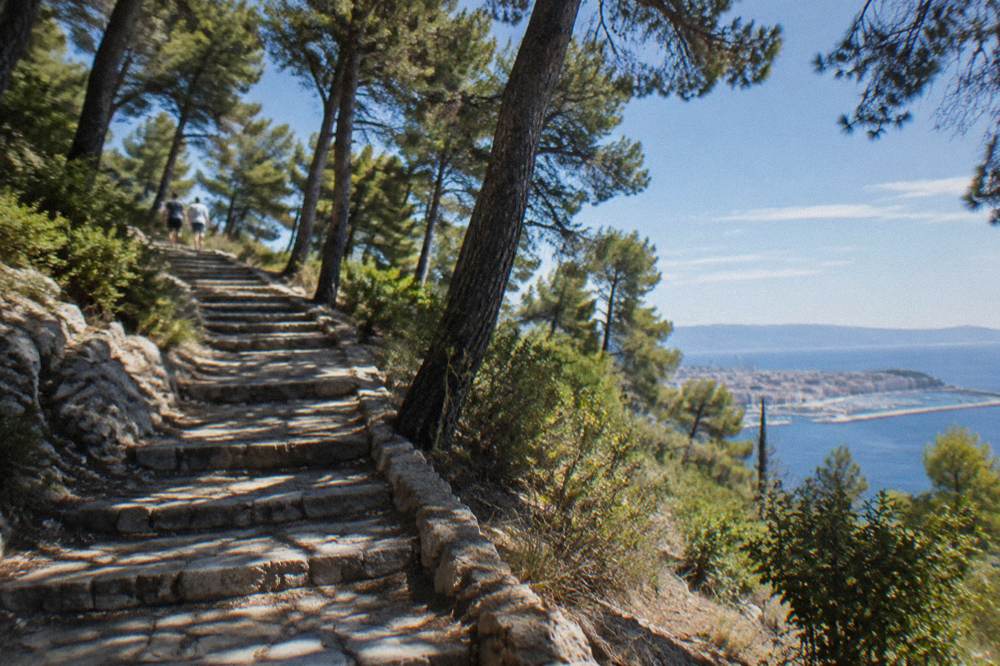
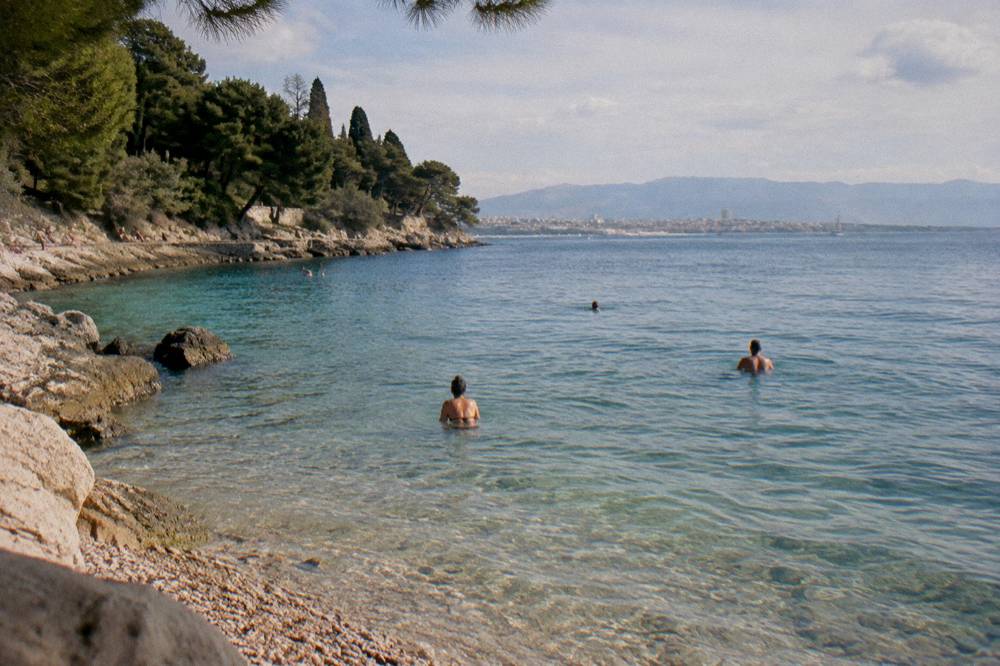
Two descent routes end the Marjan block. Dropping north lands you at Kašjuni, the pebble beach on the sheltered northern shore of the peninsula, quiet and free. Dropping east returns you toward the city and Bačvice, the sandy city beach where picigin, the shallow-water ball game, was born in 1908 according to the account the city repeats, and where the game is still played on summer evenings. Picigin is protected intangible heritage of Croatia. The Marjan hill guide, the Bačvice beach page and the Veli Varos page expand each of these.
The climate record explains why the hill belongs in the afternoon slot. The DHMZ Split-Marjan station table, monthly means for the period 1948 to 2024, shows July at a mean of 26.2 C with 353.3 hours of sunshine and 18 days reaching 30 C or more, and August close behind at 25.9 C with 17 days at 30 C or more. The stone streets of the palace hold that heat; the pines on Marjan do not. November is the wettest month at 115.5 mm and July the driest at 26.6 mm, so from late spring through summer the afternoon climb is dry far more often than not, and the swim afterwards is the reward.
| Marjan number | Figure | Source |
|---|---|---|
| Highest point, Telegrin | 178 m | Društvo Marjan park association |
| Steps from Trumbićeva obala to Telegrin | 819 | Društvo Marjan park association |
| Peninsula length | 3.5 km | Društvo Marjan park association |
| Peninsula width | 1.5 km | Društvo Marjan park association |
| Entry | Free | No ticket on any official source |
| July mean temperature | 26.2 C | DHMZ Split-Marjan, 1948 to 2024 |
| July sunshine | 353.3 hours | DHMZ Split-Marjan, 1948 to 2024 |
Can You Squeeze A Day Trip Into A One-Day Visit?
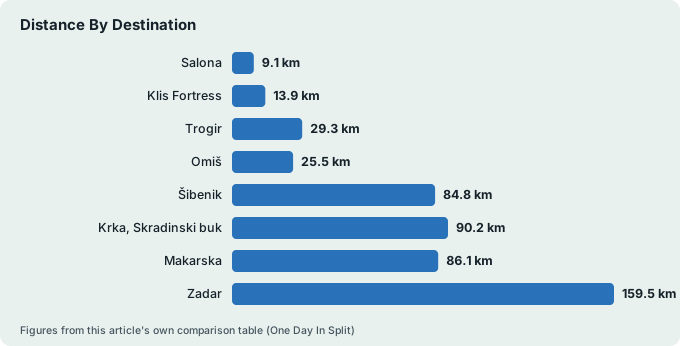
A day trip fits a one-day Split visit only if the trip replaces the city sightseeing, because the big excursions, Krka at about 74 minutes' drive, Plitvice at about 3 hours 15, Mostar at 2 hours 13 and Dubrovnik at 3 hours 21, each way from the palace, take the whole day. If Split itself is the purpose, the realistic squeeze is Klis Fortress at 22 minutes or Salona at 14 minutes by car, or a half-day speedboat to the Blue Lagoon.
The driving times come from OSRM free-flow routing computed from the palace, so they assume clear roads. Krka's Skradinski buk entrance is 90.2 km away, about 74 minutes; Šibenik, 71 minutes; Makarska, 75; Zadar, 2 hours; Mostar, 2 hours 13; Dubrovnik, 3 hours 21; Plitvice, 3 hours 15. Klis Fortress, 13.9 km and 22 minutes, and Salona, 9.1 km and 14 minutes, are the two exceptions that genuinely fold into a Split day, and both carry real weight: Klis is a 10 EUR fortress with Game of Thrones Meereen connections, per the visitsplit listing, and Salona's Roman ruins are covered by the Archaeological Museum's combined ticket at 10 EUR, valid within 7 days alongside the museum itself at 8 EUR.
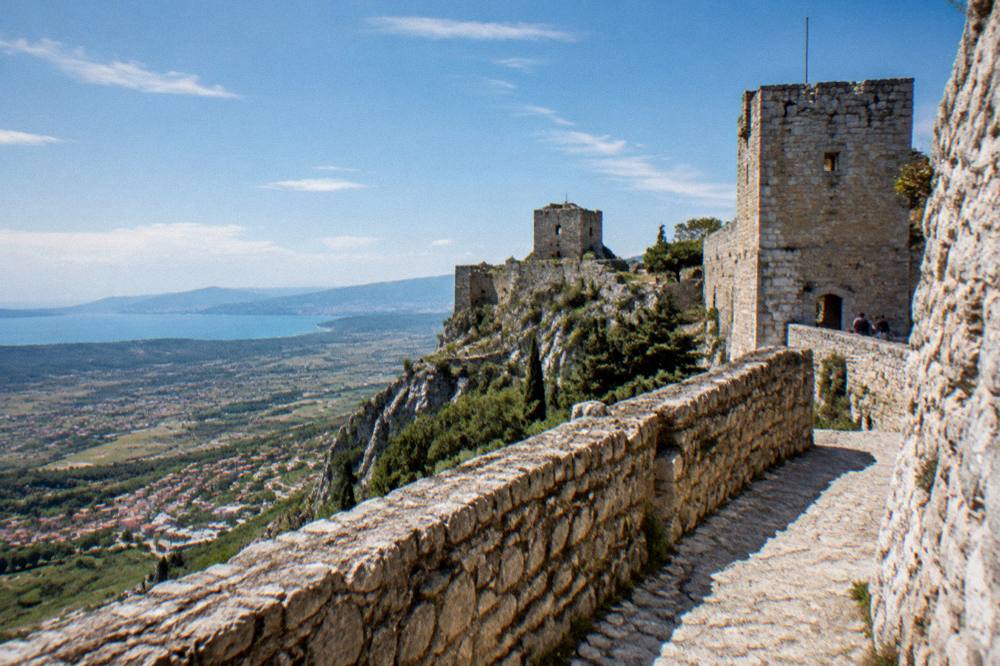
For cruise passengers the arithmetic differs again, and the cruise port day itinerary is built for that case. For visitors deciding between the two national parks, the Plitvice or Krka comparison lays out the seasonal prices side by side: Krka at 7, 20 or 40 EUR and Plitvice at 10, 23 or 40 EUR depending on month, with a 25 EUR afternoon slot at Plitvice in peak season. Both parks now list the lower autumn and winter prices that took effect on 1 October 2026. The day trips overview collects everything reachable from the city.
| Destination | Driving time from the palace | Distance | Works in one city day? |
|---|---|---|---|
| Salona | 14 minutes | 9.1 km | Yes, short detour |
| Klis Fortress | 22 minutes | 13.9 km | Yes, half a day |
| Trogir | 36 minutes | 29.3 km | Yes, with planning |
| Omiš | 38 minutes | 25.5 km | Yes, half a day |
| Šibenik | 71 minutes | 84.8 km | Borderline, full day |
| Krka, Skradinski buk | 74 minutes | 90.2 km | Full day only |
| Makarska | 75 minutes | 86.1 km | Full day only |
| Zadar | 2 hours | 159.5 km | No, stay over |
| Mostar | 2 hours 13 | 173.2 km | Full day only |
| Plitvice Lakes | 3 hours 15 | 258.1 km | Full day only |
| Dubrovnik | 3 hours 21 | 234.8 km | Full day, coach about 4 h |
The tours below cover the three directions a one-day visitor actually debates: the Mostar and Kravice waterfalls run to Bosnia and Herzegovina, the history walk stays inside the palace walls, and the Cetina canyon zip line sits above Omiš, down the coast.
What Does One Day In Split Cost?
A one-day Split budget on the sights alone runs to about 25 EUR per adult at 2026 prices: roughly 15 EUR for the full cathedral combination ticket, 10 EUR for the palace cellars or the Split City Museum, and free entry to the Peristyle, the Riva, Marjan and every city beach. Add about 2.65 EUR per person per night in tourist tax in high season, collected by your accommodation, and food on top.
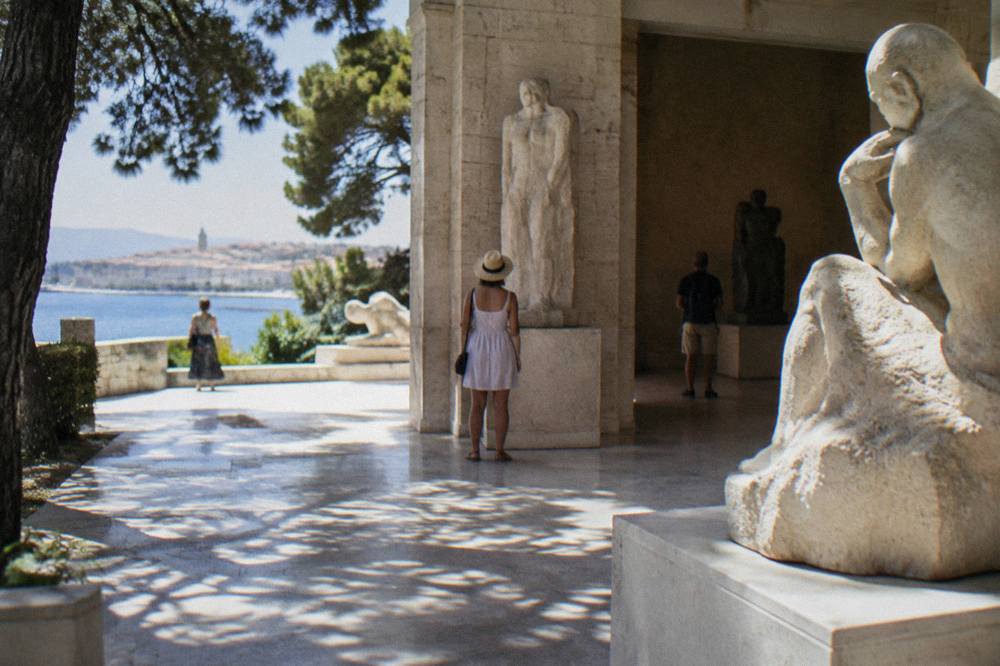
The museum ticket prices are the fixed floor of the day, and they are printed by their own institutions: the Split City Museum at 10.00 EUR, the Meštrović Gallery at 12.00 EUR including its Crikvine-Kaštilac site, the Ethnographic Museum at 7.00 EUR, the Archaeological Museum at 8 EUR with the Salona combination at 10 EUR. The cathedral complex prices come from a secondary guide rather than an official page, so treat them as "about" figures and confirm at the Peristyle kiosk. What is genuinely free is not a small list: the Peristyle, the Riva, the Prokurative, the Golden Gate, the Grgur Ninski statue, the markets, Marjan and the city beaches all charge nothing, and the free things page is built around them.
The tourist tax deserves its own sentence: the county figure is about 2.65 EUR per person per night in high season, 1 April to 30 September, with under-12s free and 12 to 18 at half rate, and the exact amount is confirmed at booking because the accommodation collects it. Croatia uses the euro since 1 January 2023 and has been in the Schengen area since 1 January 2023, which is why there are no border formalities arriving from most of Europe. The emergency number is 112.
| Sight | 2026 adult price | Notes |
|---|---|---|
| Peristyle, Riva, Marjan, beaches | Free | No ticket on any official source |
| Cathedral full combination | up to about 15 EUR | Secondary source, confirm at kiosk |
| Palace cellars | 10 EUR | Split City Museum price list |
| Split City Museum | 10.00 EUR | Reduced 8.00, family 18.00 |
| Meštrović Gallery | 12.00 EUR | Includes Crikvine-Kaštilac |
| Ethnographic Museum | 7.00 EUR | Vestibule 2.00 EUR |
| Archaeological Museum | 8 EUR | With Salona 10 EUR, within 7 days |
| Klis Fortress | 10 EUR | Per the visitsplit listing |
What Rules Should You Know Before Walking Split For A Day?
Split enforces a set of public-order fines in and around the historic core: 300 EUR for drinking alcohol in public in the centre, 300 EUR for urinating, climbing on monuments or bathing in fountains, 150 EUR for sleeping in public spaces and 300 EUR for taxi touting, under the city decision in force since 2026. Walking in swimwear or shirtless in the historic centre is also an offence with a locally set fine, so change before you re-enter the Old Town from the beach.
The swimwear fine amount is not on the official page, so confirm locally rather than expecting a published figure. Two further rules shape a summer day: shops in the centre may not sell alcohol at night during the seasonal ban window, though bars and restaurants serve as normal, and drones may not fly over the old town or the airport zone, with national parks closed to them entirely.
Practical transport rules complete the picture. Croatia's borders run on the EES system, fully operational since 10 April 2026, recording biometric entry and exit for non-EU short-stay visitors; ETIAS is not live and has no confirmed start date, so no travel authorisation fee applies yet for visa-exempt visitors. E-scooters in Croatia are limited to 0.6 kW and 25 km/h, with helmets mandatory for all ages and under-14s prohibited from riding. The Split safety coverage expands the everyday precautions.
| Rule or system | What applies | Amount or status |
|---|---|---|
| Public alcohol, historic centre | Banned outside licensed terraces | 300 EUR fine |
| Urinating, climbing monuments, fountain bathing | Banned | 300 EUR fine |
| Sleeping in public spaces | Banned | 150 EUR fine |
| Taxi touting | Banned | 300 EUR fine |
| Swimwear or shirtless in the centre | Banned | Fine set locally |
| Night retail alcohol ban, shops only | Seasonal window | Business fines up to 39,810 EUR |
| EES border system | Live at Schengen borders | Fully operational since 10 April 2026 |
| ETIAS | Not yet in force | No fixed start date |
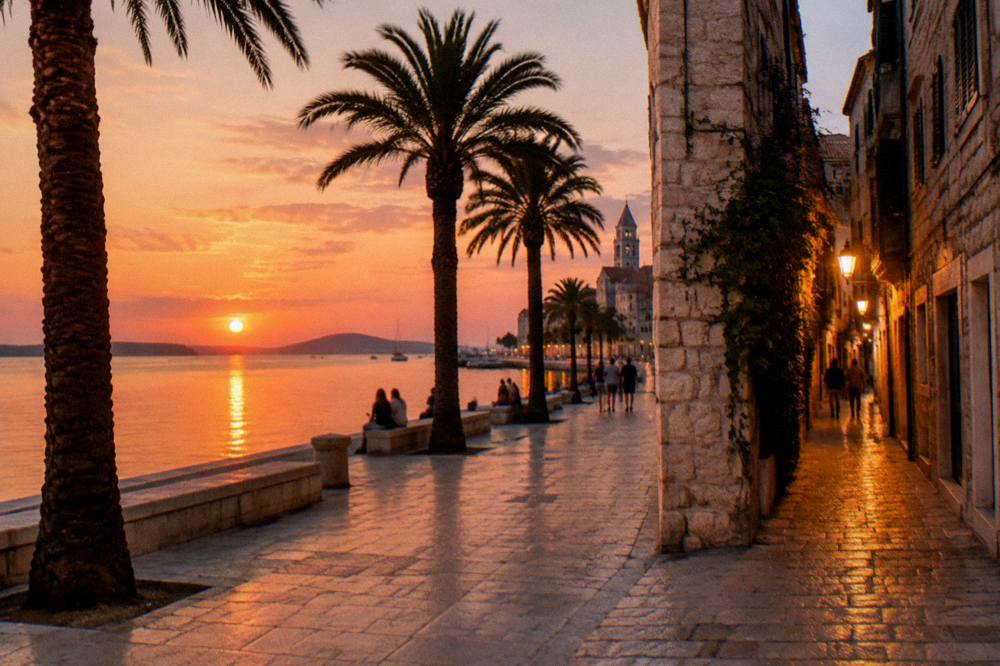
The evening closes the loop this itinerary opened. The palace walls glow after sunset, the Riva fills, and picigin players are sometimes still in the water at Bačvice. If one day has proven too short, the island-hopping week plan and the Split with kids itinerary both start from exactly this same walkable core, and Split Croatia Travel Guide holds the rest.
Common Questions About One Day In Split
Is One Day In Split Enough?
One day covers the palace, the cathedral complex, the Riva, Marjan hill and a swim, because everything sits within a kilometre and a half of walking. It is not enough for Krka, Plitvice or Dubrovnik, which each take a full day of travel and visiting.
What Is The Best One-Day Route Through Diocletian's Palace?
Start on the free Peristyle square, buy the cathedral combination ticket at the Peristyle kiosk, climb the 57 m bell tower, visit the Temple of Jupiter, now the Baptistery of St John, then descend into the substructures, open 8:30 to 20:00 daily. Exit south onto the Riva. The Golden Gate and the Grgur Ninski statue sit on the north side, both free.
Can You Swim In Split With Only One Day?
Yes, and without leaving the city. Bačvice is the sandy city beach where picigin has been played since 1908, and Kašjuni lies on the quiet northern shore of the Marjan peninsula. Both are free. The DHMZ Split-Marjan station gives no official monthly sea-temperature normal, so check the live reading rather than a printed figure.
How Do You Get From Split Airport To The Old Town?
The airport sits in Kaštel Štafilić, 20 km from Split and 6 km from Trogir by the airport's own pages, about 31 minutes' free-flow drive from the palace. The Platanus shuttle runs from the airport to the main bus station by the ferry port at 10 EUR one way and 15 EUR return. City bus lines 37 and 38 also stop at the airport; confirm the fare on board.
What Happens If It Rains On Your One Day?
The rainy-day plan moves indoors: the palace cellars, the Split City Museum, the Meštrović Gallery at 12.00 EUR and the Archaeological Museum at 8 EUR fill the hours. The DHMZ Split-Marjan table shows November as the wettest month at 115.5 mm and July the driest at 26.6 mm, so summer days rarely need the backup. The full indoor plan is on the rainy-day itinerary page.
Do You Need To Book Anything Ahead For One Day?
Book nothing inside the city: the cathedral kiosk and the museums sell on arrival. The exceptions are the full-day trips, Krka, Plitvice, Mostar and the Blue Cave speedboat runs, where Plitvice operates timed online entry with the visitor's name on the ticket, and boat trips fill in July and August, when the station table shows 18 days at 30 C or more in July. The rainy-day plan and the Dubrovnik day trip page help if plans change.
