Split Food: What To Eat, Where To Eat It, And What It Costs
Split eats the way a port city eats: fish off the morning boats, olive oil from the hills behind the city, and tables packed into the stone streets of Diocletian's Palace.
Short answer
Split food is Dalmatian coastal cooking: grilled fish, shellfish, pršut, cheese, peka, and local wine, eaten in and around Diocletian's Palace, at the green market, and along the Riva and city beaches. The green market, Marjan and the beaches are free to enjoy, public drinking in the historic centre carries a 300 EUR fine, and guided food walks cover the palace and the market in one loop.
Split, the coastal city in Dalmatia on the Adriatic, eats from two larders at once: the sea in front of it and the rocky agricultural belt behind it. The Old Town sits inside Diocletian's Palace, built around 295 to 305 AD, and its ground floors have been food shops, wine cellars and konobas for as long as the building has been a city. The ferry port, the bus station and the railway station sit together 500 to 600 m from the palace, which means the fish market, the green market and the Riva are all within a short, flat walk of where travellers arrive. This guide covers what to order, where to eat it, what the local rules around food and drink actually say, and how to pair the city's food with a walk through the streets it grew up in.
What Is Split Food, And Why Does The Coast Set The Menu?
Split food is Dalmatian coastal cooking: grilled and baked fish, shellfish, air-dried pršut, sheep cheese, olive oil, peka cooked under a metal dome of embers, and wine from hills a short drive inland. The menu follows the Adriatic and the seasons rather than a fixed list, the preparation is grilling and slow roasting rather than heavy sauces, and the city's position as Croatia's busiest passenger port, with 6.05 million passengers in 2025, keeps the supply of fresh fish moving through its markets every morning.
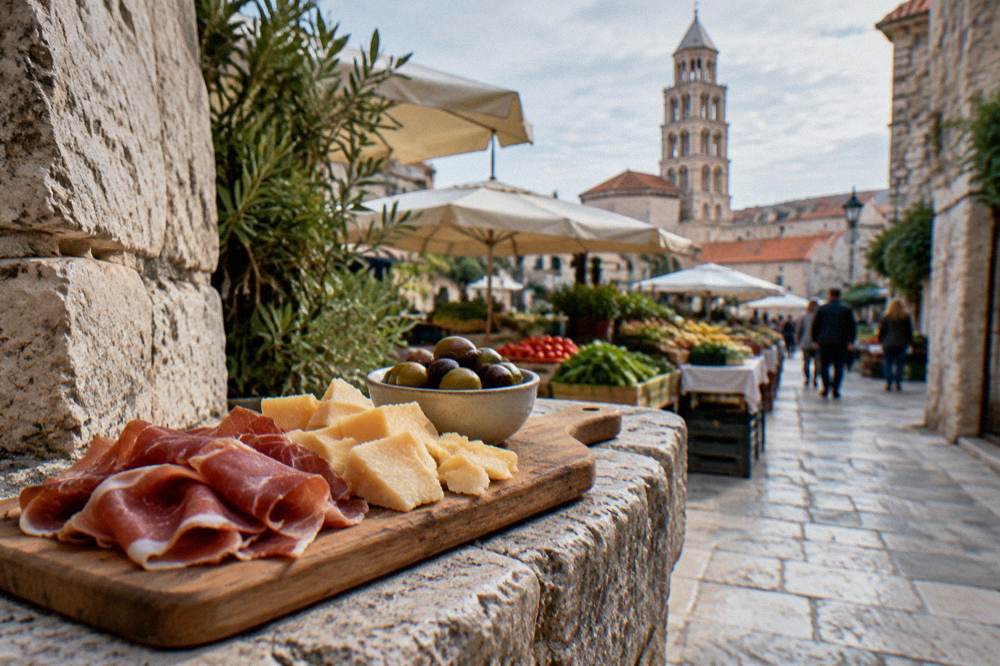
The style is deliberately simple. Fish is graded by weight at the market and priced accordingly, so the question at a konoba is less "what is the dish" than "what came in today". Meat cooking centres on peka, a mix of meat or octopus with potatoes cooked under a domed lid covered with hot embers, which needs ordering ahead because it takes hours. Charcuterie and cheese open meals: pršut, the Dalmatian air-dried ham, with local sheep cheese and olives is the standard start.
Two habits worth knowing before the first meal. Bread and covers are often itemised on the bill rather than hidden in prices, so the charge appears as a listed line. And service runs late by northern European habits, with dinner tables filling well after 20:00, which suits a city whose July mean temperature, at the DHMZ Split Marjan station for 1948 to 2024, is 26.2 C.
What Should You Order In Split First?
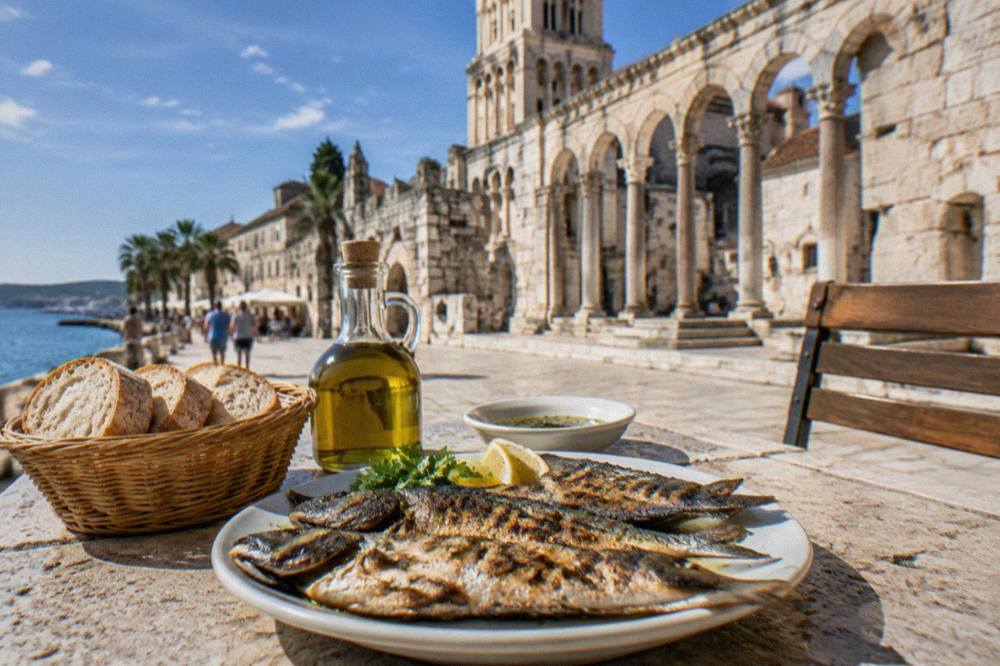
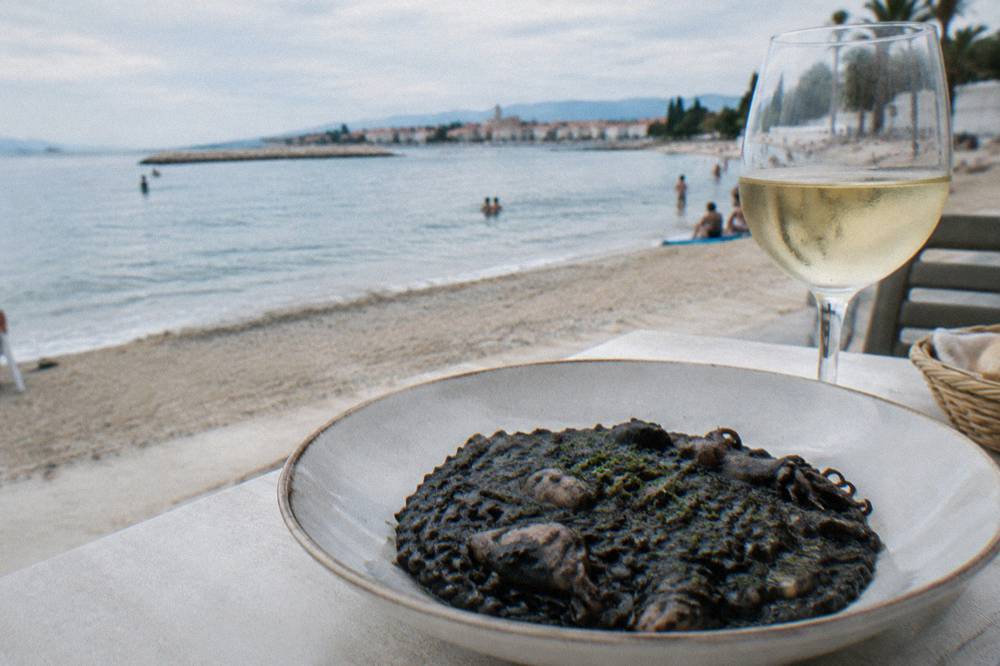
Order a grilled whole fish priced by the kilo, black risotto made with cuttlefish ink, a peka of octopus or lamb ordered in advance, and a starter board of pršut with sheep cheese and olives. Follow it with pašticada, a slow-braised beef dish, if the restaurant lists it, because it is the region's festive dish and appears on menus rather than as a constant.
For street eating, look for soparnik-style chard pies and the burger stands and bakeries around the Green Market, where food is sold to be eaten on the move.
The ordering logic is about freshness and honesty. A fish priced by the kilo is weighed and charged openly, and the bill should show the weight. Black risotto and grilled squid are the safest tests of a kitchen, because neither survives a lazy cook: the risotto must be deep black and the squid tender. Peka is the commitment option, and the honest restaurants state plainly that it needs hours and notice.
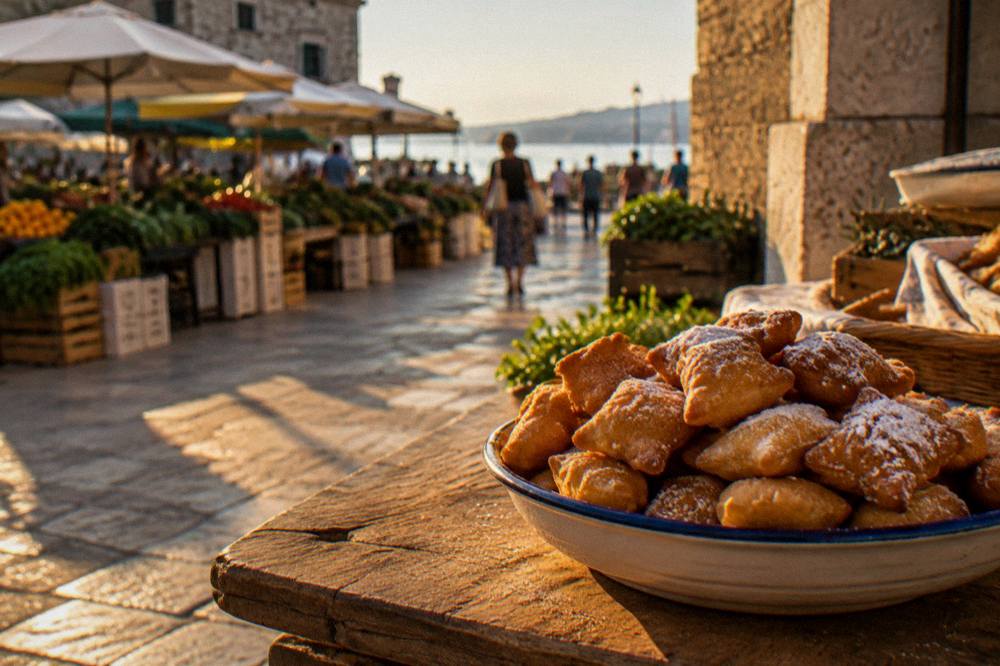
Sweets are simpler than the savoury cooking. Rosata, a rose-scented custard from the island of Vis tradition, fritule and kroštule in the winter season, and ice cream by the scoop sold everywhere along the Riva. Split's version of the Dalmatian sweet repertoire appears in the ice cream shops that line the waterfront, and the Riva itself is free to stroll with a cone.
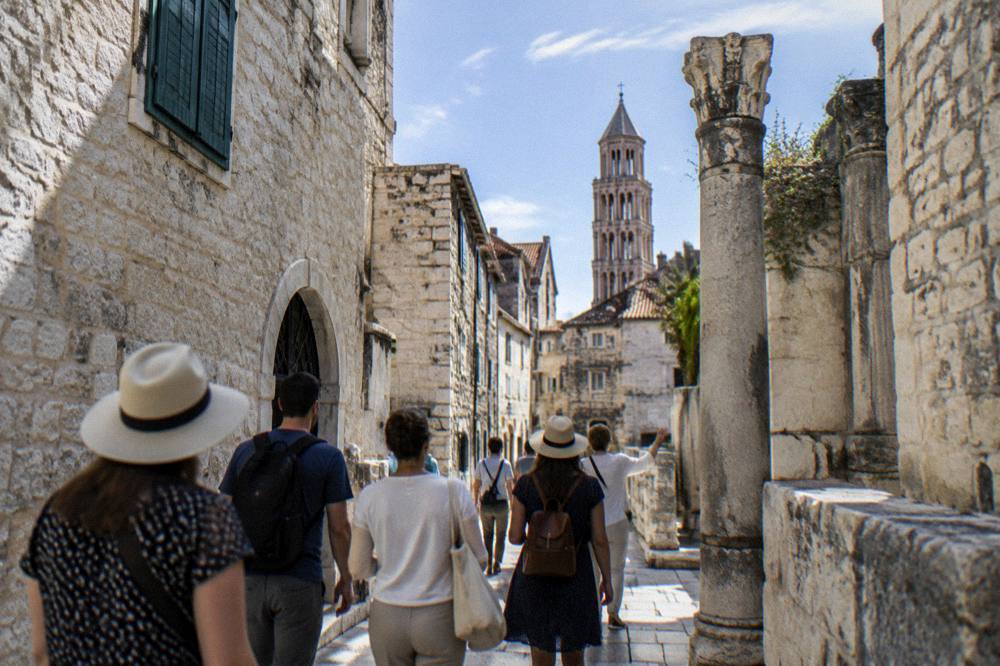
For many travellers the food and the history land in the same streets, and pairing them works well: a guided walk that explains the palace, followed by a meal in the lanes the walk covered. The Walking Tour With History Professor is the natural first choice for that pairing, and Check availability sits beside it at the planning stage. History-led and food-led walks of the city between them cover the ground:
What Does Eating Out In Split Look Like Day To Day?
A eating day in Split runs coffee standing at a bar in the morning, market fruit and bakery bread at midday, a plated lunch or a beach snack in the afternoon, and dinner from 19:00 onward, often after 20:00 in summer. Breakfast as a restaurant meal is not the local pattern: bars sell coffee and pastry, the Green Market sells fruit and cheese, and the first big seated meal for many locals is lunch.
The Riva and the palace lanes fill with evening tables, and reservations matter for Friday and Saturday nights in July and August, when the DHMZ Split Marjan table shows 18 days at 30 C or more.
Coffee culture is its own institution. A macchiato or espresso standing at the counter costs less than at a table, and the bar prices are posted by law on a visible list, so a quick check of the posted tariff settles any doubt before ordering. Bakeries open early and sell savoury and sweet pastry through the morning.
Lunch splits into two tracks. Visitors staying near the palace eat at the konobas and pizzerias in and around the Old Town, or pick up market food for the beach. The city's beaches are free, and Bačvice, the sandy bay closest to the centre, is the home of picigin, the shallow-water ball game born there in 1908 and now protected intangible heritage of Croatia, so eating on the sand there comes with a permanent free show.
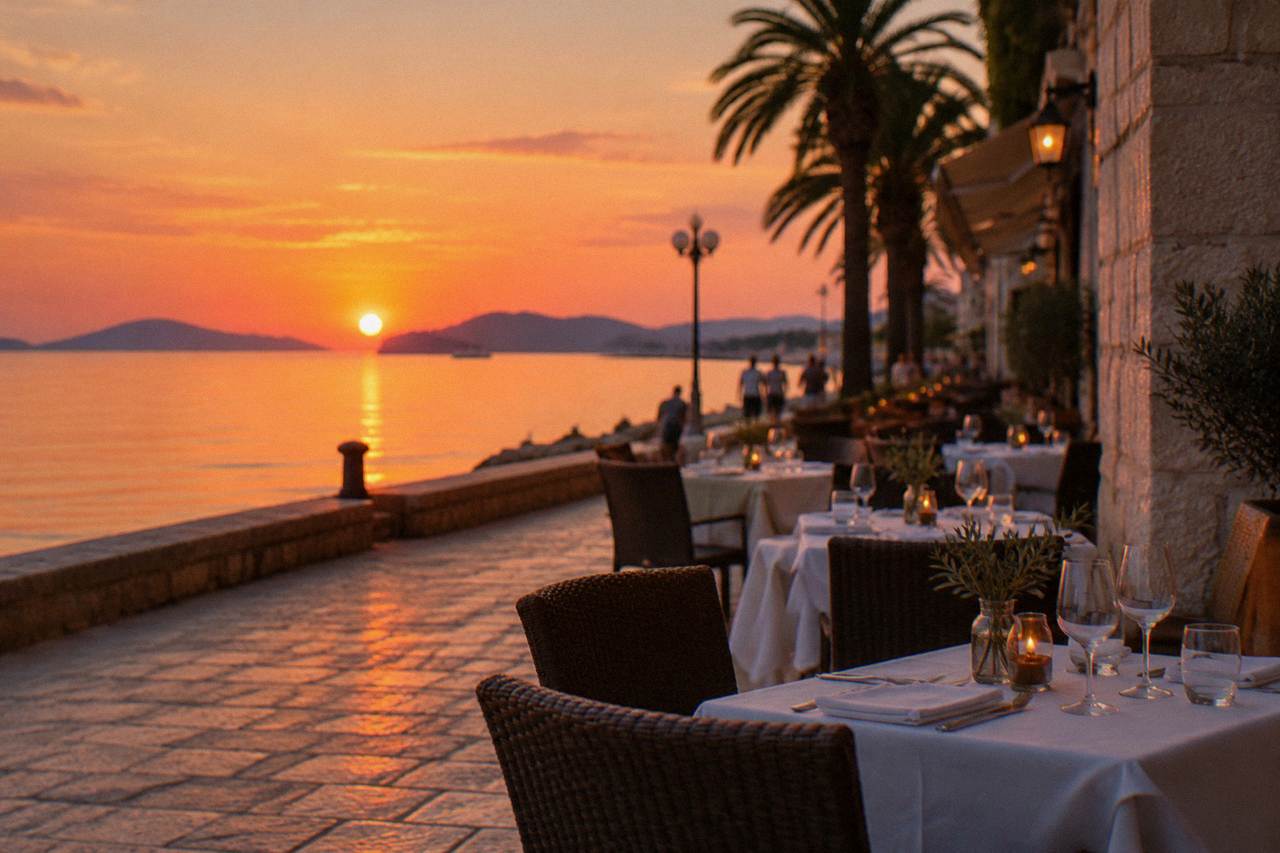
Dinner is the main event, and the pace is unhurried. A table in the palace lanes, a starter of pršut and cheese, a grilled fish weighed at the table, a carafe of local white, and a walk along the Riva afterwards is the shape of the evening. For the broader restaurant map, including where to book in high season, see the dedicated Split restaurants guide.
| Meal | Local pattern | Where it happens | What to expect on the bill |
|---|---|---|---|
| Morning coffee | Standing at a bar counter | Bars throughout the Old Town and Riva | Posted price list, cheaper at the counter |
| Midday | Market fruit, bakery bread, cheese | Green Market and bakeries near the palace | Items priced and paid per piece |
| Lunch | Seated plated meal or beach snack | Konobas in the palace lanes, beach kafics | Fish priced by kilo with weight shown |
| Dinner | Main seated meal, from 19:00 | Old Town lanes, Riva terraces, Bačvice | Itemised cover and bread lines |
| Late evening | Ice cream and a walk | Riva and Prokurative | Free to stroll, ice cream by the scoop |
A first evening in the city combines well with a walk first, and the question heading this section is exactly the one the CTA box below answers for planning purposes.
Where Do You Eat Well In Split Without Overpaying?
Eat one street back from the Peristyle and the Riva front line, check that prices are posted outside before sitting down, and treat the itemised bill as normal rather than a scam: posted menus, itemised covers and prices per kilo for fish are the checks a visitor can make at every single table in the city.
The areas around the Green Market, Veli Varoš west of the palace, and the streets behind Prokurative hold the neighbourhood konobas, while the palace's showcase squares carry the prime-rent prices that location commands anywhere.
The honest signal is the posted menu. Croatian catering law requires prices to be displayed, so a menu board at the door with prices by the dish, and a fish display with a price per kilo, are visible before anyone commits. A bill that lists bread, covers and service as separate printed lines is the local norm, not an invented charge.
Distance from the postcard views does the rest of the work. The lanes five minutes from the Golden Gate, the squares behind the fish market, and the Veli Varoš quarter under Marjan all serve the same cooking at neighbourhood prices. The walk is flat and short: the whole palace core is compact, and the ferry, bus and rail hub is 500 to 600 m from the palace itself. Travellers watching the budget should also read the Split on a budget guide for the wider picture, including free sights.
| Area | Character | Price feel | Notes |
|---|---|---|---|
| Peristyle and palace squares | Showcase terraces in stone surroundings | Highest, location-driven | Best for a drink with the view |
| Riva front line | Waterfront terraces facing the harbour | High, view-driven | Partial closures expected through 2027 during renovation works |
| Green Market streets | Market eating, bakeries, fast counters | Low to mid | Best for lunch on the move |
| Veli Varoš | Neighbourhood konobas under Marjan | Mid | A short walk west of the palace |
| Prokurative back streets | Local restaurants behind the squares | Mid | Posted menus standard |
Can You Shop And Picnic Like A Local In Split?
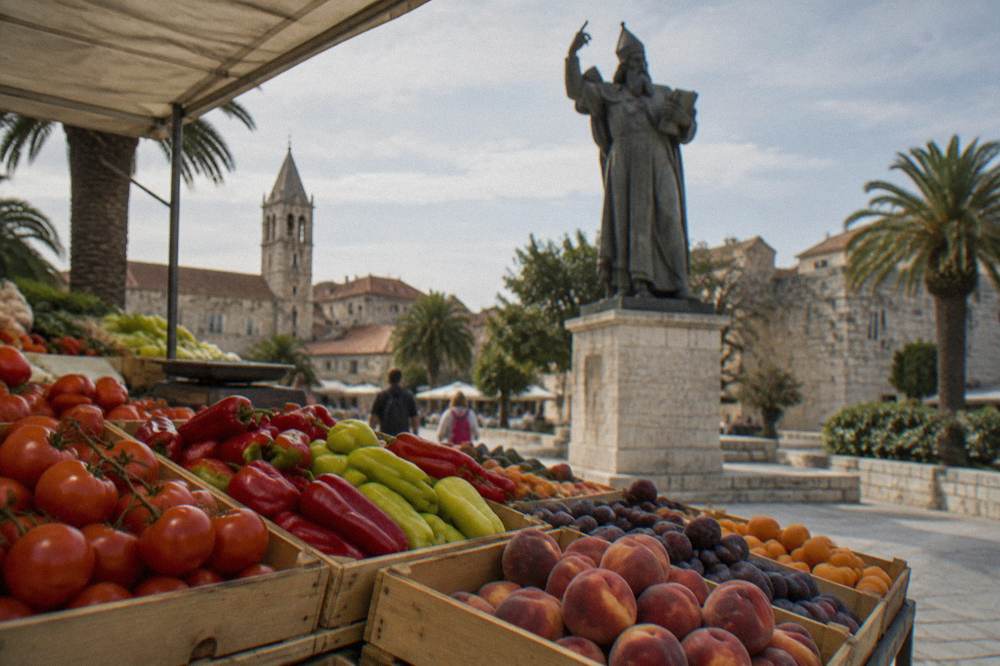
Yes, and the Green Market is the centre of it: a free, open-air market a few minutes from the palace where growers sell fruit, vegetables, cheese, honey and eggs through the morning, with the fish market nearby for the catch. Picnic settings cost nothing, since Marjan, the Riva, the city beaches and the Prokurative square are all free public spaces, so a market basket, a bakery loaf and a bottle of water make a full day's eating for the price of the ingredients.
Confirm market days and stall hours locally, as opening times vary by season.
The market rhythm matters. Stalls are at their fullest early, and the best cheese and honey sell out before noon in high summer. Sellers are the growers for much of the produce, so questions about what to do with a particular vegetable usually get a direct answer, in Croatian or in the English that the city's tourism trade makes common.
Picnic logistics are simple because the free settings are close together. Marjan, the park-forest peninsula west of the centre, rises to Telegrin at 178 m, with 819 steps from Trumbićeva obala to the top, and its shaded viewpoints make the classic picnic destination. The beaches of Bačvice and the long Riva promenade handle the flatter options. The tourist tax, collected by your accommodation at about 2.65 EUR per person per night in high season with under 12s free and 12 to 18s half price, is confirmed at booking and does not touch market shopping at all.
| Picnic setting | Setting type | Cost | Notes |
|---|---|---|---|
| Marjan park-forest | Wooded hill with sea views | Free | 819 steps from Trumbićeva obala to Telegrin at 178 m |
| Riva promenade | Seafront walk | Free | Partial closures expected through 2027 during renovation |
| Bačvice beach | Sandy city beach | Free | Home of picigin since 1908 |
| Prokurative | Grand open square west of the palace | Free | Shade on the colonnade sides |
| Green Market approach | Market streets near the palace | Free to browse | Produce, cheese and honey sold by stall |
For travellers who want the market explained rather than decoded alone, a gastro walk that includes the Green Market in its route does that work:
What Are The Rules Around Drinking In Split?
Drinking alcohol in public spaces in the historic centre is banned and fined 300 EUR, under the public-order rules the city published for the 2026 season, with licensed terraces the exception, so drinks belong at a bar or restaurant table rather than on the street. Shops and supermarkets in the city cannot sell alcohol at night, from 21:00 to 06:00, between 1 June and 15 September, while bars and restaurants serve as normal.
The fines by name: 300 EUR for drinking in the historic centre or within 100 m of schools, 300 EUR for urinating, 300 EUR for climbing on monuments or bathing in fountains, and 150 EUR for sleeping in public spaces.
The night-time rule is the one that surprises visitors, because it targets retail, not hospitality. A shop cannot sell alcohol during those summer night hours, but a terrace on a square can serve wine until its licence hours. The practical effect: buy picnic beer in daylight, and drink it at the apartment or a licensed table, never on the Riva steps.
The swimwear rule matters to food travellers walking between beach and dinner. Walking in swimwear or shirtless in the historic centre is an offence with a fine whose amount is set locally, so the routine is to dress before leaving the beach for the Old Town. Public transport, market shopping and restaurant entry all expect the same.
| Rule | Detail | Penalty or limit |
|---|---|---|
| Public drinking, historic centre | Banned except licensed terraces | 300 EUR fine |
| Night retail alcohol sales | Shops only, 1 June to 15 September, 21:00 to 06:00 | Businesses face fines, repeat from 1 June 2027 |
| Urinating in public | Listed offence | 300 EUR fine |
| Climbing monuments, bathing in fountains | Listed offence | 300 EUR fine |
| Sleeping in public spaces | Listed offence | 150 EUR fine |
| Swimwear or shirtless in the historic centre | Offence, amount set locally | Confirm locally, no verified amount |
What Should You Drink With Split Food?
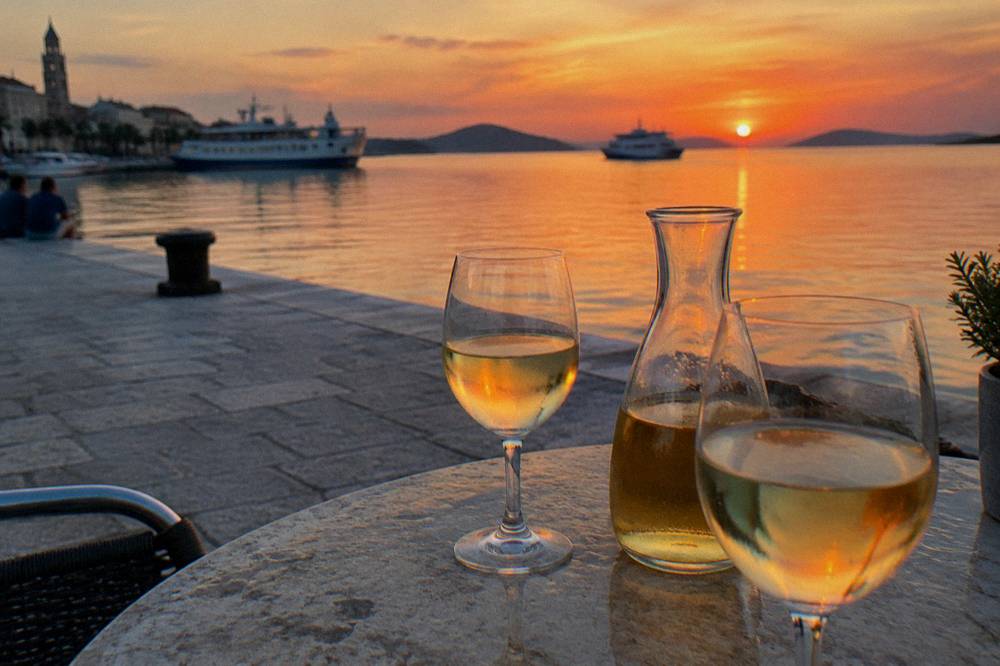
Drink the local whites first: Pošip and Grk from Korčula, Plavac Mali red from the vineyards south and east of Split, and the simple carafe wine that many konobas still pour by the litre or half litre. The Dalmatian wine list runs island by island, so the useful move is to ask what is local and by the carafe before reading the bottle list, and to end with rosata or a herb-based digestif rather than an imported spirit.
Water is safe from the tap, coffee is espresso-based, and the beer is standard Croatian lager.
Plavac Mali is the region's signature red, grown on the steep slopes of the Dalmatian coast and islands, and it stands up to the grilled meat and peka end of the menu. The whites, above all Pošip and Grk, match the fish, and the cheaper carafe versions of both are often the best value on a konoba list. Korčula, the island of those white wines, is covered in its own day trips guide for travellers who want to see where the bottles begin.
Coffee is a short, strong order: espresso, macchiato or a milk coffee, priced lower at the counter than at a table. In summer the granita-style iced coffee and the fresh orange juice sellers along the Riva handle the afternoon. The drinking culture sits late and social, and it runs into the city's Split nightlife scene after dinner, which centres on the bars inside the palace walls and along the waterfront.
Which Food And Walking Tours Explore Split's Food Scene?
Guided food walks in Split run a loop of the palace lanes and the Green Market with tastings at a series of stops, and history-led walks cover the same streets without the food but with the story; the options below mix a history-professor-led walk, a Mostar and Kravice day trip for travellers combining food with a border crossing, and a small-group walk led by a magister of history.
Prices, ratings and durations for each render on the tour pages, so compare them there rather than on any printed figure, and check the cancellation terms before booking.
The value of a food walk is decoding, not transport. A guide who explains which stalls at the Green Market belong to growers, what the fish market's grading means, and which konoba dishes are festive rather than everyday saves the trial and error of the first two days. History walks do the same for the architecture around the tables, which in Split is the point: the dining rooms are Roman walls, medieval lanes and Venetian-era squares.
To have the konoba menu decoded over a full meal, book a Split food tour here.
The history-first option for that second layer is the professor-led walk linked above, and the small-group magister-led walk below covers similar ground in a smaller group. The Mostar option belongs on the list for a different reason: a day trip that crosses into Bosnia and Herzegovina pairs Dalmatian cooking with the hercegovacka grill tradition, and Mostar's Old Bridge Area has been on the UNESCO list since 2005, with the bridge rebuilt in 2004.
The full range of food-led options runs deeper than the trio, and gastro walks with a market visit suit travellers who want the produce explained:
For a shorter tasting loop built around a full meal and drinks, this variant covers the same ground:
| Tour type | What it covers | Best for |
|---|---|---|
| History-led palace walk | Diocletian's Palace streets and story | Context before eating in the lanes |
| Gastro walk with Green Market | Market stalls plus palace-lane tastings | First-time visitors decoding the produce |
| Full-meal food walk | Multiple stops ending in a seated meal | Travellers replacing dinner with the tour |
| Mostar and Kravice day trip | Border crossing, Mostar old town, waterfalls | Combining Dalmatian and Bosnian food in one day |
When Is The Best Time To Eat Your Way Through Split?
Eat your way through Split between May and October, when the market is at its fullest, the Adriatic weather supports long outdoor meals, and the calendar adds food events, though July and August bring 18 and 17 days at 30 C or more respectively at the DHMZ Split Marjan station, and the highest-season crowds to match.
Advent in Split, from 27 November 2026 to 7 January 2027 with the ice rink at Đardin, is the winter counter-season for mulled wine and fritule, and 7 May, Sudamja, the city day of St Domnius, fills the centre with a religious and street festival.
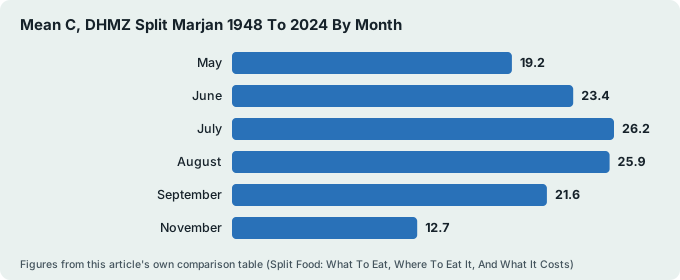
The seasonal logic is straightforward. The DHMZ Split Marjan table, covering 1948 to 2024, puts July at a 26.2 C mean and 26.6 mm of rain, the driest month, with November the wettest at 115.5 mm. That makes the shoulder months, May, June, September and October, the comfortable eating months: warm enough for terraces, wet enough for the market to be generous, and thin enough in crowds to walk into a konoba without a reservation. For the full weather picture, see the Split weather guide and the best time to visit Split.
| Month | Mean C, DHMZ Split Marjan 1948 to 2024 | Rain mm | Eating angle |
|---|---|---|---|
| May | 19.2 | 57.5 | Terraces open, market filling, Sudamja on 7 May |
| June | 23.4 | 49.0 | Peak-season start, 7 days at 30 C or more |
| July | 26.2 | 26.6 | Driest month, 18 days at 30 C or more, Ultra Europe 9 to 11 July 2027 |
| August | 25.9 | 41.3 | 17 days at 30 C or more, festive season crowds |
| September | 21.6 | 70.9 | Sea still warm, crowds thinning |
| November | 12.7 | 115.5 | Wettest month, Advent opens 27 November 2026 |
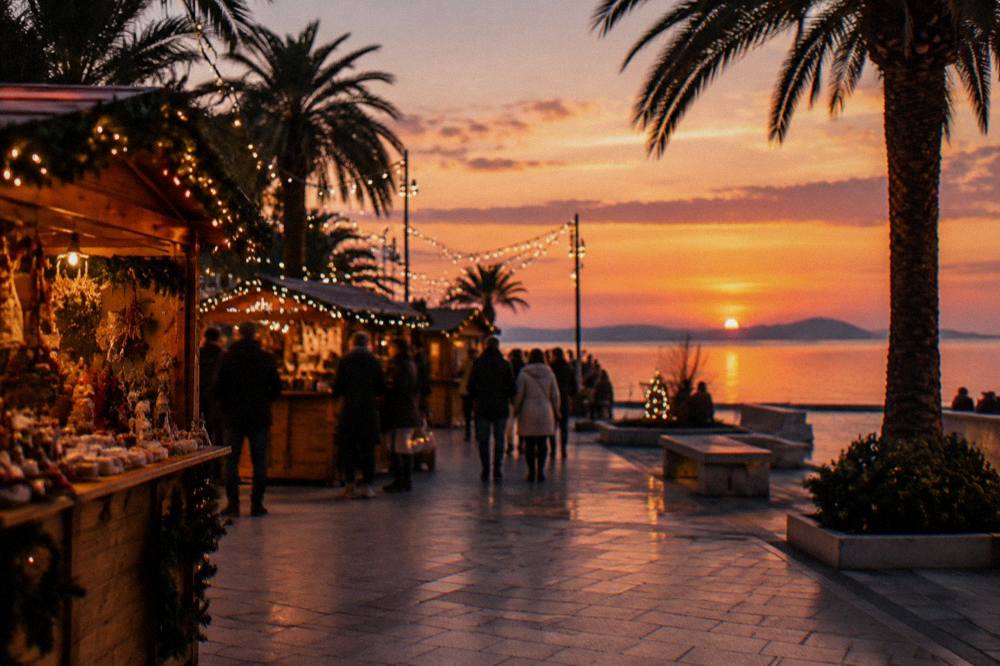
Event eating is worth planning around. Advent in Split, running 27 November 2026 to 7 January 2027 with the Đardin ice rink, is the standout: the stalls sell fritule, mulled wine and roast chestnuts, and the whole programme is walkable from the palace. In summer, Ultra Europe, set for 9 to 11 July 2027 at Park Mladeži, fills the city, and the Croatian National Theatre's season runs 25 September 2026 to 14 June 2027 for a dinner-and-show evening. The things to do in Split page rounds out the calendar.
For a second tour_picks band near the end of the planning, here is the trio again for comparison:
Common Questions About Split Food
The questions below cover the practical details of eating in Split, from the cost of a meal to the drinking rules in the historic centre, with answers drawn from the same public sources as the guide above, including the city's posted public-order rules, the DHMZ Split Marjan climate table, and the ticket and fare lists already cited. Each answer is short, and where an exact figure is not published, the answer says what to confirm locally instead of guessing a number.
Is Split food expensive?
Split covers the full range: market picnics and bakery lunches sit at the low end, neighbourhood konobas in Veli Varoš and around the Green Market sit mid-range, and the showcase terraces on the Peristyle and the Riva carry prime-location prices. Fish is priced by the kilo with the weight shown on the bill, so the total is visible before you commit. For the budget picture, see the Split on a budget guide.
What is the most famous food in Split?
Grilled fish priced by the kilo, black cuttlefish risotto, peka of octopus or lamb cooked under embers, and a starter of pršut with sheep cheese and olons define the local list. Pašticada, the slow-braised beef dish, is the festive classic. Sweets run to rosata and, in winter, fritule.
Can you drink alcohol in public in Split?
No. Drinking in public spaces in the historic centre carries a 300 EUR fine, with licensed terraces the exception. Shops cannot sell alcohol from 21:00 to 06:00 between 1 June and 15 September, while bars and restaurants serve normally.
Where should first-time visitors eat in Split?
Start at the Green Market for produce and bakery bread, eat lunch at a konoba one or two streets back from the Peristyle, and take dinner in the palace lanes or Veli Varoš. Check that the menu is posted outside with prices, and expect bread and covers to appear as itemised lines on the bill.
Is the Green Market free to visit?
Yes, the market is a free public space a few minutes from the palace, and browsing costs nothing. Stalls are fullest in the morning, and the best cheese and honey can sell out before noon in high summer.
Do you need to book restaurants in Split in summer?
For Friday and Saturday nights in July and August, yes, booking ahead is wise, especially for any restaurant serving peka, which must be ordered in advance because it cooks for hours under embers. Midweek and shoulder-season tables are usually walk-in.
Eating in Split is a walkable pleasure: the market, the palace lanes, the Riva and the beaches sit within a compact core, the posted prices and itemised bills make costs legible, and the seasons do the rest. Plan the first meal for a Tuesday, order the fish by the kilo, and let the Split Croatia Travel Guide handle the rest of the itinerary.