Split Nightlife
Split after dark runs from the Riva promenade to the beaches of Bačvice, with a festival calendar that peaks at Ultra Europe and a set of public-order rules that every visitor should read before the first drink.
Short answer
Split nightlife centres on the Old Town inside Diocletian's Palace, the Riva promenade and Bačvice beach, with the main festival weekend, Ultra Europe 2027, set for 9 to 11 July 2027 at Park Mladeži.
Split after dark is a waterfront affair. The city of roughly 160,577 people (2021 census) empties its beaches at sunset and refills the stone lanes of Diocletian's Palace, the Riva promenade and the bars around Bačvice, and the whole rhythm of the evening is set by the Adriatic on one side and a UNESCO-listed Roman palace on the other. This guide lays out where the night actually happens, what the rules now say about drinking in the historic centre, when the big festival weekends fall, and what a night out costs in the parts that publish prices. The Split Croatia Travel Guide desk writes it from what the city, the port and the meteorological station publish, not from a night out.
What Is Split Nightlife Really Like?
Split nightlife is a warm-month, walkable scene concentrated in three zones: the lanes and cellars around Diocletian's Palace, the Riva promenade along the harbour, and the bars at Bačvice beach, all within about a kilometre of each other. The season peaks in July and August, when the DHMZ Split-Marjan station averages 26.2 C and 25.9 C, and the headline event is Ultra Europe on 9 to 11 July 2027 at Park Mladeži.
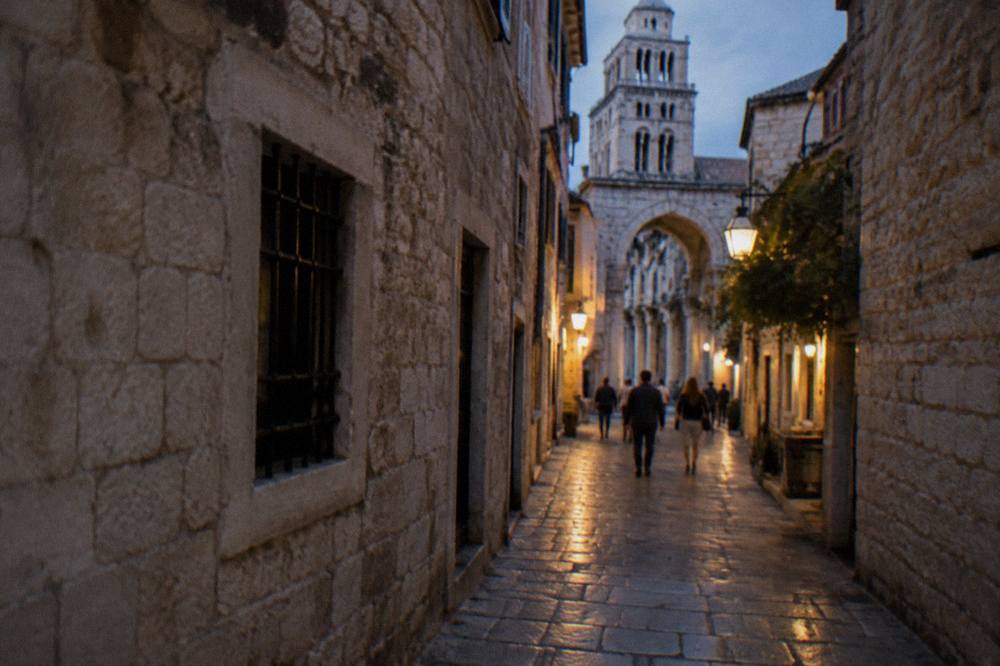
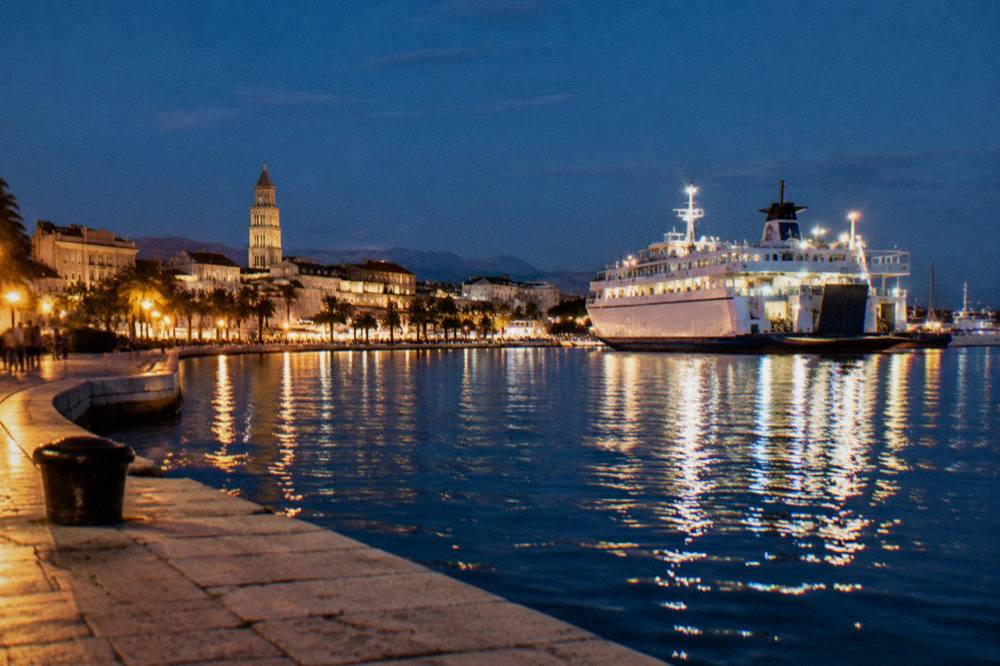
The character of the night follows the layout of the city. The palace, built c. 295 to 305 AD for Emperor Diocletian, is a rectangle of stone streets that hold bars in converted cellars and courtyards, and the whole complex is open to walk through at night, because the Peristyle, the Riva and the city streets around them are public space with no ticket. The ferry port, the main bus station and the railway station sit together on Obala kneza Domagoja, 500 to 600 m from the palace, which means the walk from a late ferry or bus into the going-out area is short.
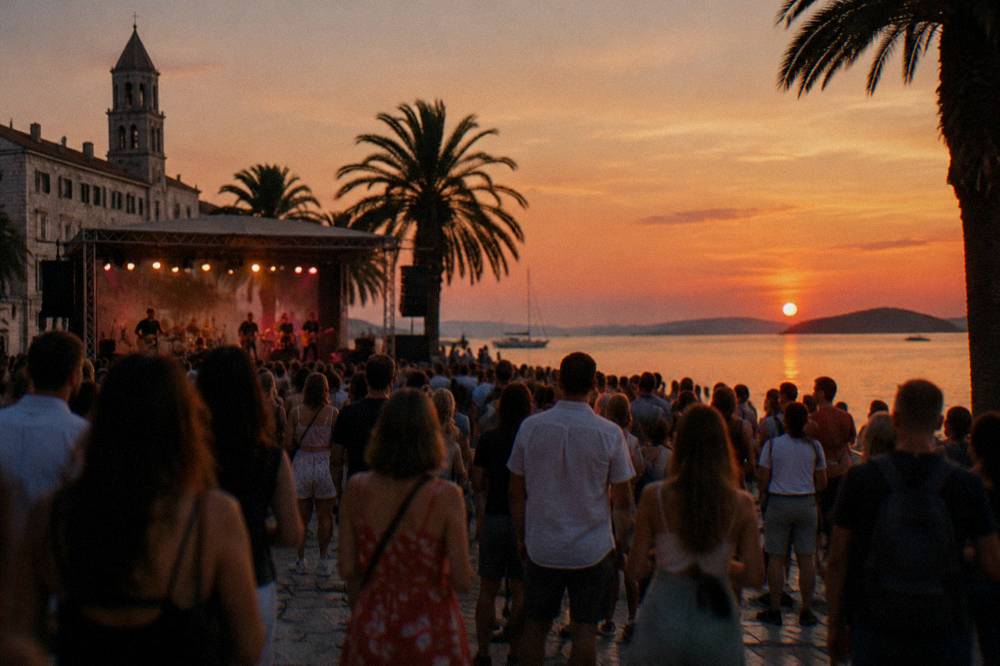
Two things shape the calendar more than anywhere else in Dalmatia. The first is Ultra Europe, the electronic music festival confirmed by its own site for 9 to 11 July 2027 at Park Mladeži, which fills the city for the weekend around it. The second is Advent in Split, running 27 November 2026 to 7 January 2027 with the ice rink at Đardin, which turns the winter evening into a market-and-rink affair rather than a club scene. Between those poles, the theatre season at the Croatian National Theatre runs 25 September 2026 to 14 June 2027.
Where Do People Go Out In Split At Night?
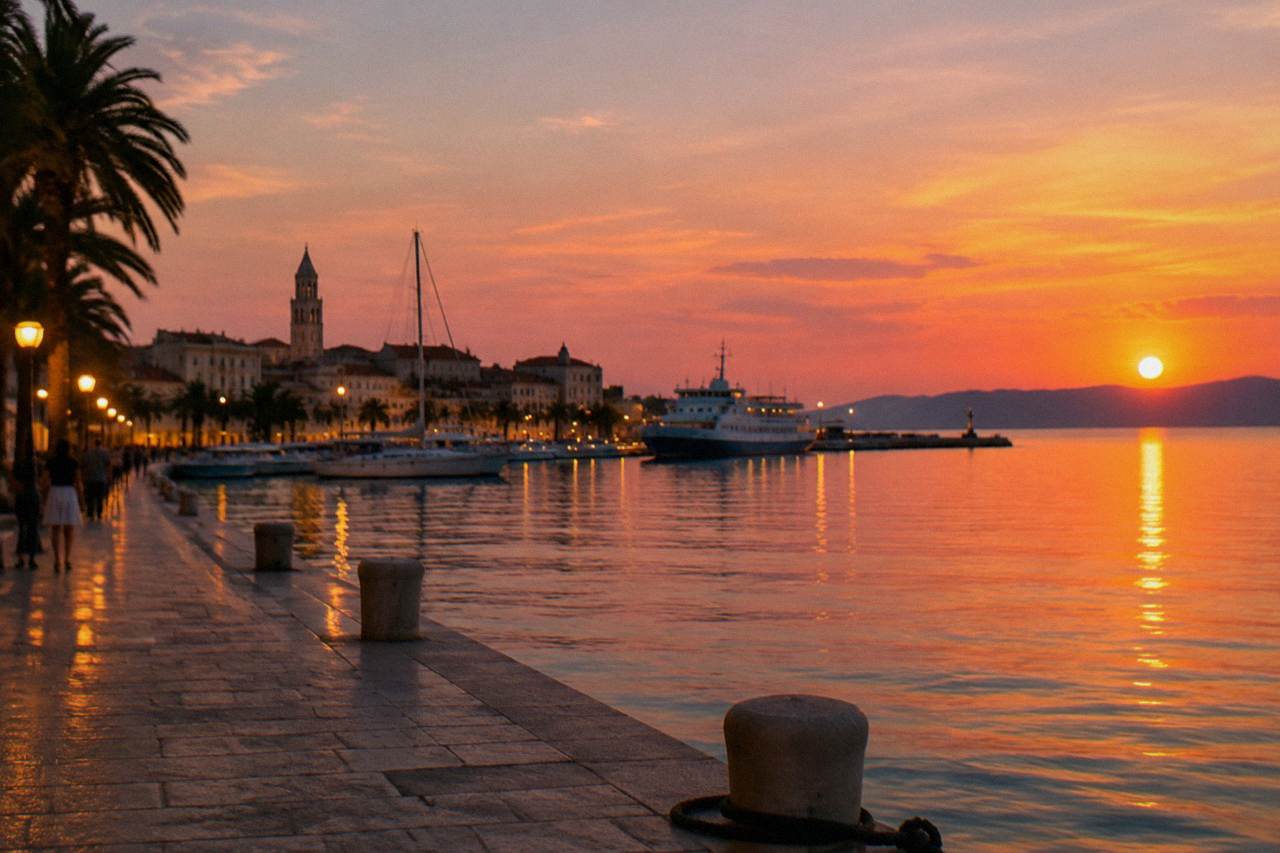
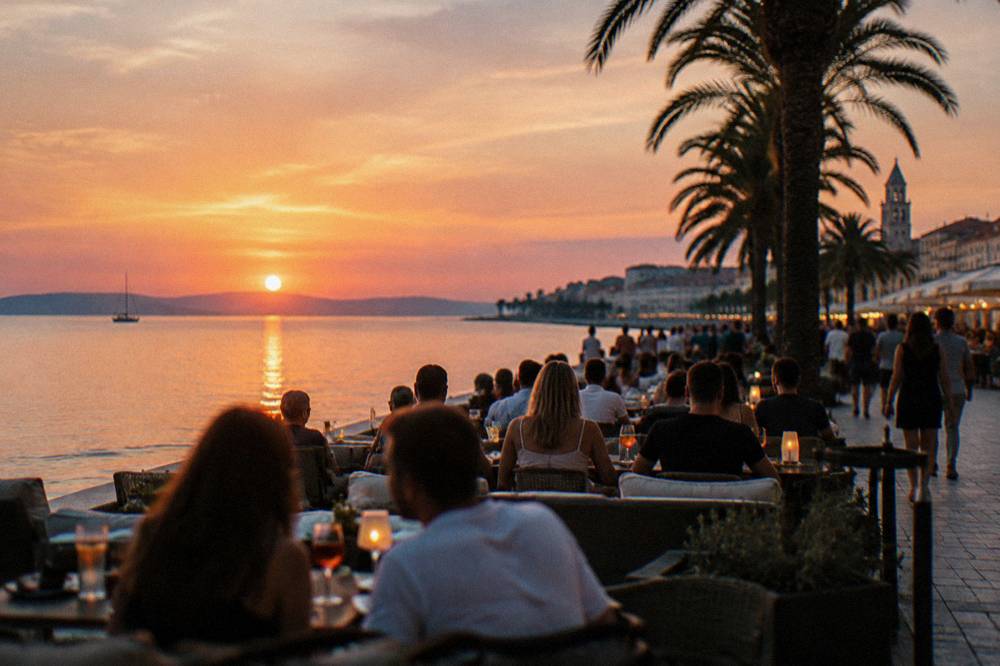
The four going-out zones of Split are the palace lanes around the Peristyle, the Riva promenade, the Bačvice beach strip and the Žnjan side east of the harbour, each a walkable distance from the next, with the palace and the Riva carrying the late evening and Bačvice carrying the warm-month bar scene. None of these areas charges an entry fee to be in at night, because all four are public space.
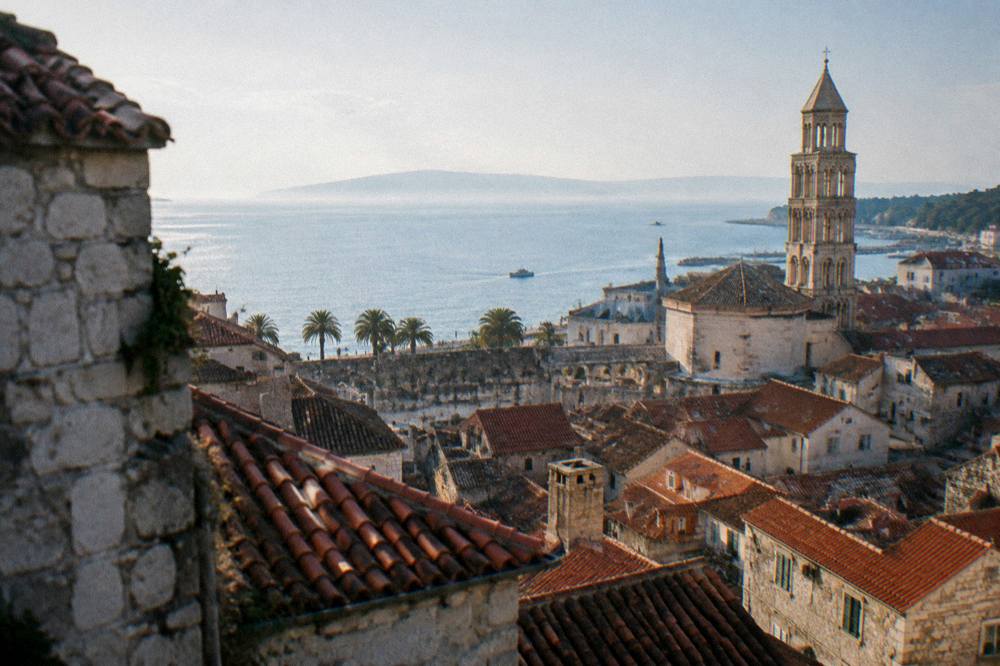
The palace core is where the evening starts for nearly every route through the city. Bars occupy vaulted spaces that were once parts of the Roman substructure, and the Split City Museum runs the cellars with hours of 8:30 to 20:00 daily, so the substructures themselves close before the night begins but the lanes above them stay full. The Golden Gate, the Grgur Ninski statue and the Prokurative square are all free, open at night, and sit within a few minutes' walk of one another.
The Riva is the seaward promenade, and one practical note matters for 2026 and 2027: the central section is scheduled for renovation from November 2026 for a little over a year, so partial closures on the Riva are expected through 2027. The walk stays open around the works, but the layout of terraces and kiosks in the middle stretch may change as the project advances. Bačvice, the sandy city beach where picigin, the local shallow-water ball game, has been played since 1908 and is protected intangible heritage of Croatia, sits ten minutes east of the palace end of the Riva and turns into the beach-bar zone in summer. Žnjan, further east again, is the newer concrete-and-beach-club stretch.
What the port does publish is the scale of the night-time footfall: the Port of Split page shows 6.05 million passengers in 2025, making it Croatia's busiest passenger port, and a share of those arrivals step off evening ferries and catamarans straight into the going-out area.
What Does A Night Out In Split Cost?
The parts of a Split night that publish prices are the cultural ones: the Split City Museum charges 10.00 EUR adult with 8.00 EUR reduced and an 18.00 EUR family ticket, the Meštrović Gallery charges 12.00 EUR including Crikvine-Kaštilac, and the Archaeological Museum charges 8 EUR or 10 EUR combined with Salona within 7 days. Bar and club prices are not published by the city, so check the menu and the cover charge before ordering.
The honest answer on drinks is that no official price list exists for Split bars, and this desk does not print a figure that no source publishes. What a visitor can do is read the posted prices, which Croatian venues are required to display, and check whether the menu carries a cover charge, because that item is legitimate when it is printed on the menu. The bill should arrive itemised; if it does not, asking for the itemised version is normal practice.
For the paid cultural evening, the ticketed sites around the palace publish their figures. The cathedral complex, sold at the kiosk on the Peristyle, runs from about 5 EUR for a single site up to about 15 EUR for a combined ticket covering all five parts, including the crypt, the baptistery in the former Temple of Jupiter, the cathedral, the treasury and the 57 m bell tower. Shoulders and knees must be covered inside.
| Ticketed evening-adjacent site | Adult price | Notes from the price list |
|---|---|---|
| Split City Museum, Papalić Palace | 10.00 EUR | 8.00 EUR reduced, 18.00 EUR family, closed Mondays |
| Diocletian's Palace cellars | Hours 8:30 to 20:00 daily | Run by the Split City Museum, central part under restoration to end of 2026, passage open |
| Meštrović Gallery | 12.00 EUR | Includes Crikvine-Kaštilac, reopened April 2026 after renovation |
| Archaeological Museum | 8 EUR | Combined with Salona 10 EUR within 7 days |
| Ethnographic Museum | 7.00 EUR | 4.00 EUR reduced, Vestibule 2.00 EUR |
| Cathedral of St Domnius complex | From about 5 EUR | Combined tickets up to about 15 EUR, kiosk on the Peristyle |
The other cost that touches a night out is the tourist tax, collected by the accommodation, not by any venue: about 2.65 EUR per person per night in high season, 1 April to 30 September, with under 12s free and 12 to 18s paying half, and the exact amount is confirmed at booking. Croatia has used the euro since 1 January 2023, so there is no currency exchange to plan for.
Which Season Has The Best Split Nightlife?
The strongest Split nightlife months are July and August, when the DHMZ Split-Marjan station, measuring 1948 to 2024, averages 26.2 C and 25.9 C, Ultra Europe lands on 9 to 11 July 2027 at Park Mladeži, and the city records 18 and 17 days at 30 C or more in those two months. May, June and September are quieter and still warm, at 19.2 C, 23.4 C and 21.6 C monthly means.
The station table is worth reading in full, because it explains both the season and the timing of an evening out. November is the wettest month at 115.5 mm and December follows at 103.7 mm, so the late-autumn night is an indoor affair, and July is the driest at 26.6 mm with 353.3 hours of sunshine against 120.8 hours in December. Sunshine over the year runs at about 2,600 hours.
| Month | Mean temperature, DHMZ Split-Marjan 1948 to 2024 | Precipitation mm |
|---|---|---|
| Jan | 8.0 C | 77.8 |
| Feb | 8.5 C | 65.2 |
| Mar | 10.8 C | 63.2 |
| Apr | 14.4 C | 62.0 |
| May | 19.2 C | 57.5 |
| Jun | 23.4 C | 49.0 |
| Jul | 26.2 C | 26.6 |
| Aug | 25.9 C | 41.3 |
| Sep | 21.6 C | 70.9 |
| Oct | 17.2 C | 77.0 |
| Nov | 12.7 C | 115.5 |
| Dec | 9.4 C | 103.7 |
The festival calendar stacks on top of the weather. Ultra Europe 2027 runs 9 to 11 July at Park Mladeži, and the city's accommodation fills around it, so anyone whose trip is not about the festival should check the dates before booking. The 72nd Split Summer Festival ran 14 July to 14 August 2026 with opera, ballet and drama across venues including the Peristyle; the 2027 edition has not been announced. Sudamja, the city day for St Domnius, falls on 7 May every year, and Advent in Split runs 27 November 2026 to 7 January 2027 with the ice rink at Đardin. More dates sit on the Split events and Ultra Europe pages, and the best time to visit guide works through the same table month by month.
What Are The Drinking Rules In Split At Night?
Drinking alcohol in public in Split's historic centre is banned, with a fine of 300 EUR, and the same 300 EUR fine applies to urinating in public, vomiting, climbing on monuments or bathing in fountains. Sleeping in public spaces carries a 150 EUR fine and taxi touting 300 EUR. Walking in swimwear or shirtless in the centre is also fined, at an amount set locally. Licensed bar and restaurant terraces are exempt from the alcohol ban.
These figures come from the city's own Enjoy Respect rules for public spaces, voted in for the 2026 season, and they are enforced in Zone A, the historic core. A second rule targets shops rather than drinkers: retail sale of alcohol at night, between 21:00 and 06:00 in its main form, is banned from 1 June to 15 September, with fines for businesses, and the ban repeats automatically from 1 June 2027 unless the city changes it. Bars and restaurants are not covered, so the terrace scene runs as normal.
| Public-order rule in Split | Fine |
|---|---|
| Drinking alcohol in public, historic centre or within 100 m of schools | 300 EUR |
| Urinating in public | 300 EUR |
| Vomiting in public | 300 EUR |
| Climbing monuments or bathing in fountains | 300 EUR |
| Sleeping in public spaces | 150 EUR |
| Taxi touting | 300 EUR |
| Swimwear or shirtless in the historic centre | Fined, amount set locally |
None of this makes Split a strict city. It makes it a city where the night happens on licensed terraces and in venues rather than with supermarket cans on the church steps, and where the dress rule matters if the route from the beach to the bar passes through the centre. Practical reading on the same theme sits in the what to avoid in Split guide roundup of the city's visitor rules, and the Split safety guide covers the late-evening practicalities.
Is Split A Party Island Destination?
Split is a mainland city, not an island, and its nightlife is a city scene rather than a resort strip: it peaks around Ultra Europe on 9 to 11 July 2027, it is walkable between the palace, the Riva and Bačvice, and it sits beside an island nightlife in Hvar town that visitors reach by catamaran for 6.40 EUR low season or 10.00 EUR high season one way. Hvar town itself is reached by catamaran; the car ferry lands at Stari Grad.
The comparison the desk can actually source is the transport one. Catamaran line 9603 runs Split, Bol, Stari Grad and Jelsa, and line 9602 runs Split, Milna, Hvar and Vis, with Split to Hvar or Jelsa at 6.40 EUR low and 10.00 EUR high season, and Split to Vis at 7.20 and 10.00 EUR. The Stari Grad car ferry, line 635, takes about 120 minutes with foot passengers paying 5.90 EUR off-season and 8.40 EUR in season. A night out on another island means checking the last return sailing, because a missed catamaran means a night there, not a boat home.
For visitors whose night energy is better spent in daylight, the Omiš and Cetina canyon country west and east of the city runs a different kind of adrenaline, and the desk's featured pick there is the Cetina Canyon zipline adventure from Omiš, with Check availability on the operator's live listing. Omiš is 25.5 km and about 38 minutes' drive from the palace when traffic is free-flowing.
What Can You Do In Split At Night Besides Bars?
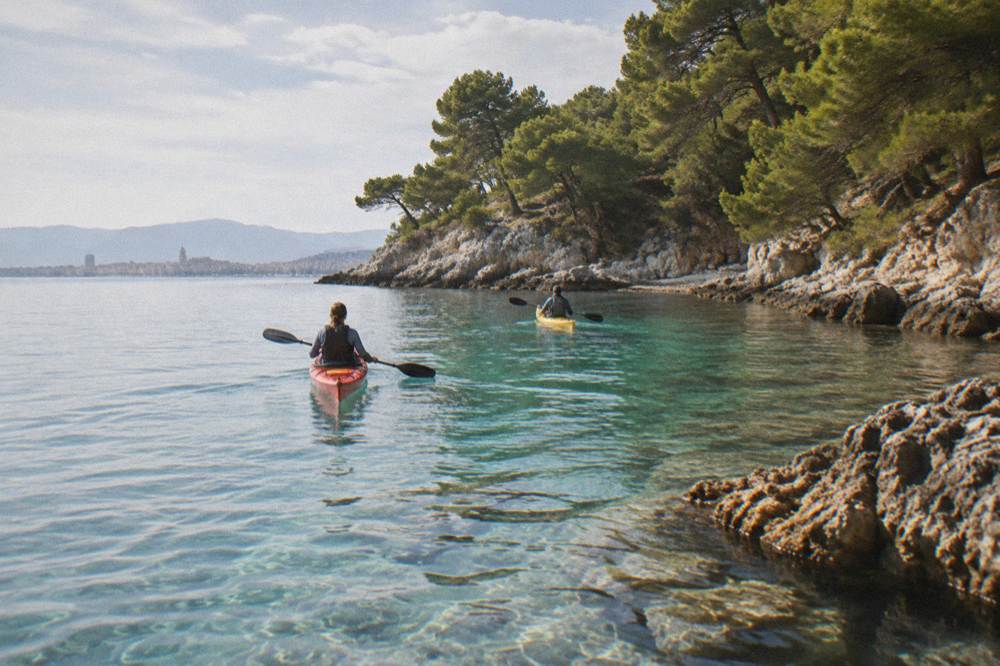
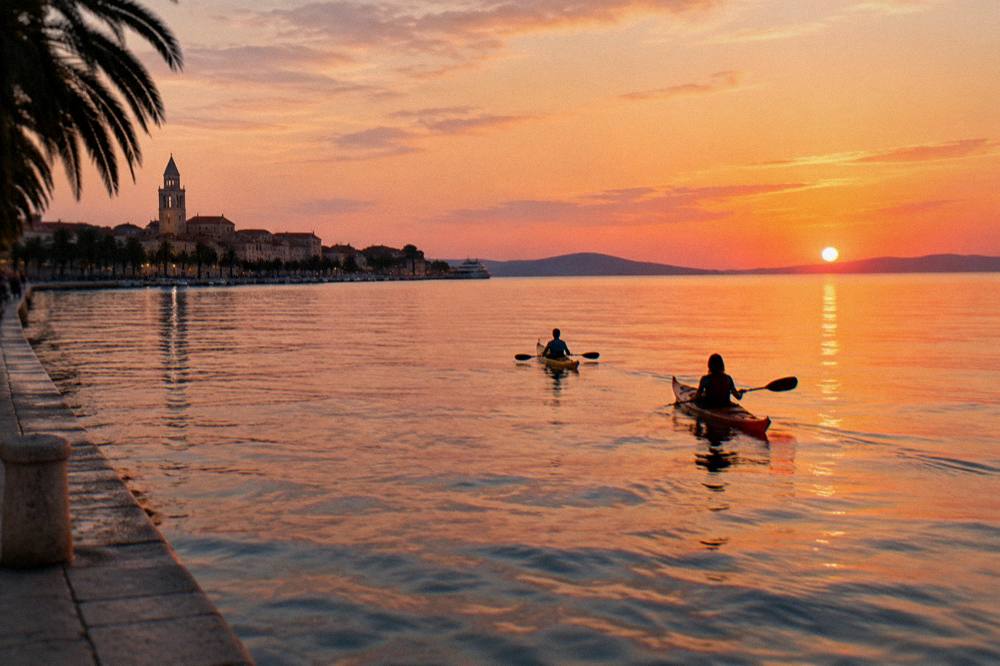
Besides bars, Split offers an illuminated sea-kayak tour on the Adriatic, an evening walk through the free palace streets and up Marjan to Telegrin at 178 m by way of 819 steps from Trumbićeva obala, the Croatian National Theatre season running 25 September 2026 to 14 June 2027, and the Advent ice rink at Đardin from 27 November 2026 to 7 January 2027. The Roman guard change at noon on the Peristyle, by contrast, ran 28 May to 27 September 2026 and is a daytime show.
Marjan at dusk is the city's free viewpoint. The park forest peninsula is 3.5 km long and 1.5 km wide, its highest point Telegrin stands at 178 m, and the stair route from Trumbićeva obala counts 819 steps, so the walk is a real outing rather than a stroll, and the descent lands you back at the Riva. The evening kayak option covers the same coastline from the water, and the desk's pick for it renders below. For the theatre evening, the HNK Split season runs to 14 June 2027, and tickets are bought from the theatre's own channels.
The museum evening is limited by closing times: the City Museum at Papalić Palace keeps 9:00 to 20:00 Tuesday to Sunday and closes Mondays, and the cellars close at 20:00, so a museum night ends early and hands the visitor back to the streets. The free list at night is long: the Peristyle, the Riva, the Prokurative, the Golden Gate, the Grgur Ninski statue, the markets' squares, Marjan and the city beaches all cost nothing to walk through after dark.
For a fuller itinerary that folds the evening into the day, the three days in Split itinerary is the desk's template, and Split with kids has its own evening-friendly options. The day-trip hinterland, from Krka at 90.2 km to Klis Fortress at 13.9 km and 22 minutes from the palace, all sits close enough that a morning adventure and a night in the city fit in one day.
How Do You Get Home After A Night Out In Split?
The walk home covers nearly everything, because the palace, the Riva, Bačvice and the main transport hub sit within a kilometre of each other, with the ferry port, bus station and railway station together on Obala kneza Domagoja 500 to 600 m from the palace. For late island returns, the catamaran lines 9602 and 9603 are the sailings to check, since a missed last boat means staying the night on the island.
No verified taxi fare, night bus fare or ride-hailing price exists in the city's published material, so the desk prints none: confirm the fare before the ride. The airport is a different question, and it is not close: Split Airport's own pages put it in Kaštel Štafilić, 20 km from Split and 6 km from Trogir, and the Platanus shuttle runs between the airport's north parking and the main bus station by the ferry port at 10 EUR one way and 15 EUR return. The Split airport guide covers the full transfer picture.
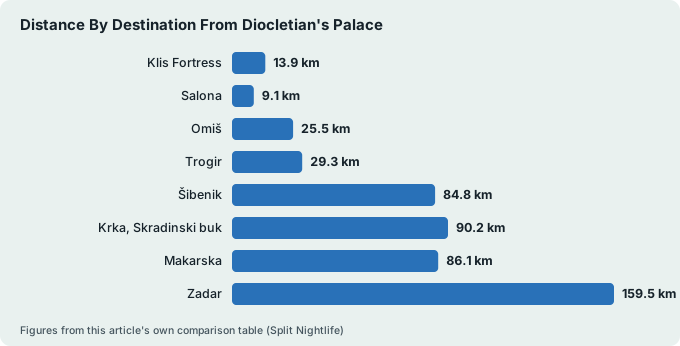
The distances below are the free-flow driving times from Diocletian's Palace, computed on the road network, and they show how tightly the night-time city and the day-trip region sit together.
| Destination from Diocletian's Palace | Distance | Free-flow driving time |
|---|---|---|
| Klis Fortress | 13.9 km | 22 min |
| Salona | 9.1 km | 14 min |
| Omiš | 25.5 km | 38 min |
| Trogir | 29.3 km | 36 min |
| Šibenik | 84.8 km | 71 min |
| Krka, Skradinski buk | 90.2 km | 74 min |
| Makarska | 86.1 km | 75 min |
| Zadar | 159.5 km | 2 h |
| Mostar | 173.2 km | 2 h 13 |
| Dubrovnik | 234.8 km | 3 h 21 |
| Plitvice Lakes | 258.1 km | 3 h 15 |
Where Should You Stay To Be Near Split Nightlife?
Staying inside or beside Diocletian's Palace puts every going-out zone of Split within a walk, with the Riva 500 to 600 m from the transport hub and Bačvice a few minutes further east, but the historic core is also where the public-order rules and the late-evening footfall concentrate. Quieter base areas sit toward Marjan on the Meje side and east at Žnjan, both still walkable to the palace.
One structural fact matters for anyone booking accommodation in the old core: the moratorium on new short-term rental registrations in the UNESCO buffer area around the palace has been extended through 2026, so the stock of apartments inside it is fixed, and national rules from the EU short-term rental regulation and a planned Hospitality Act add a unique registration number per unit from the 2027 framework. The where to stay in Split guide maps the areas in detail, and the Split hostels and Split luxury hotels pages cover both ends of the budget.
A practical note for light sleepers: the same stone lanes that make the palace atmospheric at night carry sound, and the terraces run late in July and August, when the station shows 18 days at 30 C or more, meaning open windows. Rooms facing a courtyard rather than a main lane solve it, and the tourist tax of about 2.65 EUR per person per night in high season, collected by the accommodation and confirmed at booking, applies across all of it.
Common Questions About Split Nightlife
Is Split Good For Nightlife?
Split is good for nightlife in the warm months, with the palace lanes, the Riva and Bačvice all walkable within about a kilometre, Ultra Europe on 9 to 11 July 2027 at Park Mladeži, and July and August means of 26.2 C and 25.9 C on the DHMZ Split-Marjan record for 1948 to 2024. Winter evenings shift to Advent, 27 November 2026 to 7 January 2027, with the ice rink at Đardin.
Can You Drink Alcohol On The Street In Split?
No. Drinking alcohol in public in the historic centre, or within 100 m of schools, carries a 300 EUR fine under the city's Enjoy Respect rules. Licensed bar and restaurant terraces are exempt. Shops may not sell alcohol at night from 1 June to 15 September, a ban that repeats from 1 June 2027 unless changed.
What Time Do Bars Close In Split?
No official closing-time figure is published by the city, so confirm the venue's own hours. What is published is the seasonal pattern: the scene runs latest in July and August and tapers through the shoulder months, and the night-time retail alcohol ban, 1 June to 15 September, means late bottle sales happen in bars, not shops.
Is Split A Party Island?
Split is a mainland coastal city, not an island. Its nightlife is a city scene around the palace, the Riva and Bačvice. The island party reputation belongs to Hvar town, reached from Split by catamaran at 6.40 EUR low season or 10.00 EUR high season one way; the car ferry lands at Stari Grad, not Hvar town.
When Is Ultra Europe 2027 In Split?
Ultra Europe 2027 runs 9 to 11 July 2027 at Park Mladeži in Split, according to the festival's own site. Book accommodation early for that weekend, and if the festival is not the reason for the trip, check the dates against your travel plans before booking anything.
Is It Safe To Walk Around Split At Night?
Split is a compact, walkable city whose going-out areas sit within a short walk of one another, and the emergency number in Croatia is 112. The published safety-related rules concern behaviour rather than crime: 300 EUR fines for public drinking, urinating, vomiting and climbing monuments, and 150 EUR for sleeping in public spaces. The Riva's central section will see partial closures through 2027 as renovation works run from November 2026.
A night in Split ends the way it starts, on foot: out of a palace lane, along the water, and past the last terrace lights on the way to wherever the morning ferry, the airport shuttle or the stair path up Marjan is waiting.