Split Weather
Split sits on the Adriatic coast of Dalmatia, and its climate record, kept by the DHMZ Split Marjan station over the period 1948 to 2024, shows a Mediterranean pattern: mild winters, warm dry summers and a wet peak in November. Here is what that record says, month by month.
Short answer
Split has a Mediterranean coastal climate. The DHMZ Split Marjan station table for 1948 to 2024 gives a January mean of 8.0 C and a July mean of 26.2 C. July is the driest month at 26.6 mm of rain and November the wettest at 115.5 mm, with about 2,600 hours of sunshine a year.
Split is a coastal city in central Dalmatia, on the eastern shore of the Adriatic Sea, and its weather follows the Mediterranean pattern you would expect at that latitude: dry, bright summers, mild and showery winters, and short shoulder seasons in between. Everything numerical on this page comes from one place, the DHMZ (Croatian national meteorological service) Split Marjan station, whose monthly means cover the period 1948 to 2024. That is a station record, not a forecast, and it is the honest basis for planning a trip: it tells you what a month in Split does on average, not what any given week will do.
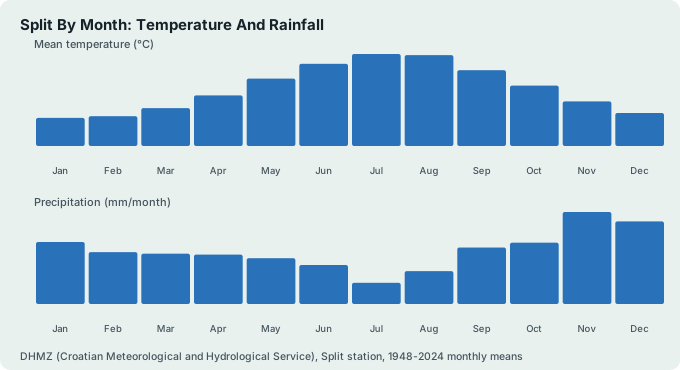
One point the station table settles immediately: the rain in Split is not spread evenly through the year. July records 26.6 mm on average, November 115.5 mm, nearly four and a half times as much. Anyone deciding between a July beach week and a November city break is choosing between two genuinely different climates, and the sections below give the month-by-month detail for that choice. For a broader planning view that weighs crowds and prices alongside the weather, the best time to visit Split guide collects the whole picture.
What Is The Weather Like In Split Through The Year?
Split has a Mediterranean climate with a mild winter, a warm dry summer and most of its rain falling between October and January. The DHMZ Split Marjan station means for 1948 to 2024 put January at 8.0 C, July at 26.2 C and August at 25.9 C, with 26.6 mm of rain in July against 115.5 mm in November, and about 2,600 hours of sunshine a year.
The full monthly table from the station record is below. It reads the way the coast feels: temperatures climb steadily from March, hold above 21 C as means from June through September, and drop back through a mild autumn. Rainfall does almost the opposite, bottoming out in July and building to its November peak before easing through spring.
| Month | Mean temp (C) | Rain (mm) |
|---|---|---|
| Jan | 8.0 | 77.8 |
| Feb | 8.5 | 65.2 |
| Mar | 10.8 | 63.2 |
| Apr | 14.4 | 62.0 |
| May | 19.2 | 57.5 |
| Jun | 23.4 | 49.0 |
| Jul | 26.2 | 26.6 |
| Aug | 25.9 | 41.3 |
| Sep | 21.6 | 70.9 |
| Oct | 17.2 | 77.0 |
| Nov | 12.7 | 115.5 |
| Dec | 9.4 | 103.7 |
Two structural facts sit inside those numbers. Autumn, taken as September to November, delivers 263.4 mm of rain in total, slightly more than winter's 246.7 mm, so the wettest stretch of the Split year begins in October, not January. And sunshine tracks the temperature curve: the station record gives 353.3 hours of sunshine in July against 120.8 hours in December, which is the difference between roughly eleven bright hours a day and four.
When Is Split Warmest, And How Hot Does It Get?
July is the warmest month in Split at a mean of 26.2 C, with August close behind at 25.9 C and June at 23.4 C. The DHMZ Split Marjan station table counts 18 days at 30 C or more in July, 17 in August and 7 in June, and July also brings 353.3 hours of sunshine, the highest monthly figure in the record.
A mean of 26.2 C deserves unpacking, because a monthly mean absorbs cool nights. When a month averages that, its afternoons are running well above it, and the days-at-30 C count is the clearest way to see that: in a typical July, 18 separate days reach 30 C or higher. Rain almost disappears in the same window, 26.6 mm across the whole month, so summer heat in Split is dry heat, moderated by the sea on three sides of the city.
| Month | Mean temp (C) | Days at 30 C or more | Sunshine (hours) |
|---|---|---|---|
| Jun | 23.4 | 7 | high, rising toward July |
| Jul | 26.2 | 18 | 353.3 |
| Aug | 25.9 | 17 | just below July |
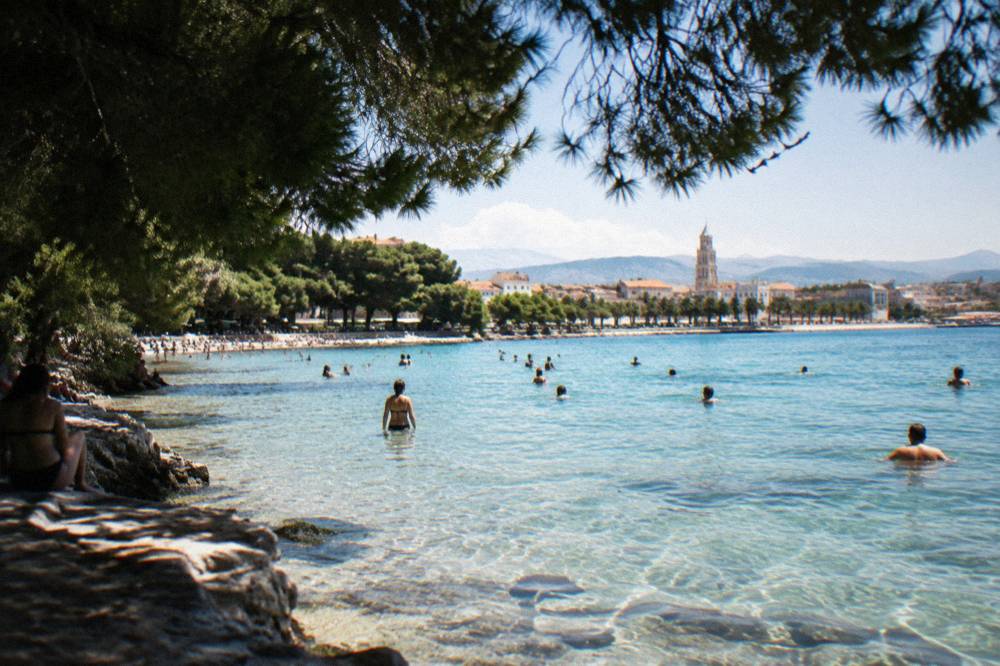
Daytime heat shapes what is comfortable in July and August. The stone lanes of the Old Town hold heat into the evening, and the sensible summer rhythm is the local one: out early, shade or water through the early afternoon, back out after about 17:00. The city's beaches, covered in the Split beaches guide, sit close to the centre, so a swim break costs almost no travel time. Evening plans move outdoors too, and the Split nightlife scene runs late precisely because July nights stay warm.
Summer is also the season when the big day trips run at full frequency. The islands, the Blue Cave and Krka all draw heavily in this window, and the standard advice holds: book ahead for anything on a boat.
How Much Rain Does Split Get, And When Should You Expect It?
Split averages 809.7 mm of rain a year at the DHMZ Split Marjan station, but it arrives very unevenly: November is the wettest month at 115.5 mm and December follows at 103.7 mm, while July gets just 26.6 mm and June 49.0 mm. October and September, at 77.0 mm and 70.9 mm, already mark the turn toward the wet half of the year.
The practical reading is that rain in Split is a late-autumn and winter story. From November through February the monthly totals sit between 65.2 and 115.5 mm, and showers, rather than all-day rain, are the typical form a Mediterranean wet spell takes. Spring dries out steadily, with every month from March to June below 63 mm.
| Season (station months) | Monthly rain (mm) | Wettest month | Driest month |
|---|---|---|---|
| Autumn (Sep to Nov) | 70.9 / 77.0 / 115.5 | Nov, 115.5 | Sep, 70.9 |
| Winter (Dec to Feb) | 103.7 / 77.8 / 65.2 | Dec, 103.7 | Feb, 65.2 |
| Summer (Jun to Aug) | 49.0 / 26.6 / 41.3 | Aug, 41.3 | Jul, 26.6 |
A rain plan for Split barely needs to be a plan. The palace cellars, run by the Split City Museum and open 8:30 to 20:00, the Split City Museum itself at Papalić Palace, closed Mondays, and the Meštrović Gallery, which reopened in April 2026 after a fifteen-month renovation, all sit within a short walk or a simple bus ride of the centre. The rainy day in Split options are in practice museum-dense because the city's core is compact and roofed in places by buildings that are seventeen centuries old.
Can You Swim In The Sea Around Split?
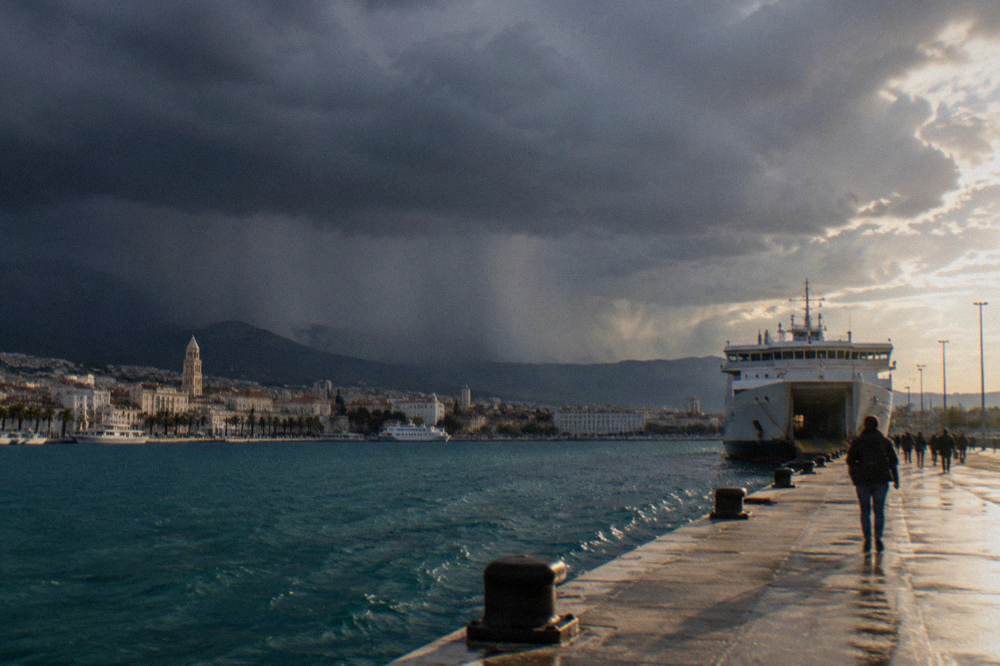
Yes, and from late spring well into autumn, though no official monthly sea-temperature normal exists for Split, so no monthly sea figure is printed here. The DHMZ publishes a live sea reading for Split: on 12 October 2026 it stood at 20.4 C, which gives a fair idea of the water in mid-autumn after a full summer of warming.
That live reading is the only sea-temperature number the national service actually publishes for Split, and it is a measurement of one morning, not a climate average. What can be said from the air-temperature record is structural: June through September all have means above 21 C, so the sea is warming for months before it peaks and cools slowly after. Swimmers who want confidently warm water aim for July through September, and the beaches guide linked above covers where to go, from Bačvice inside the city to coves under Marjan.
Beach weather and boat weather are related but not identical. A 30 C afternoon with a light mistral is perfect for a speedboat to the Blue Lagoon, while a strong southerly can cancel small-boat departures even in warm air. For anything on the water, the operator's go or no-go call on the morning is the one that matters, and the Split boat tours guide explains how those decisions typically work.
What Is Split Weather Like In Spring?
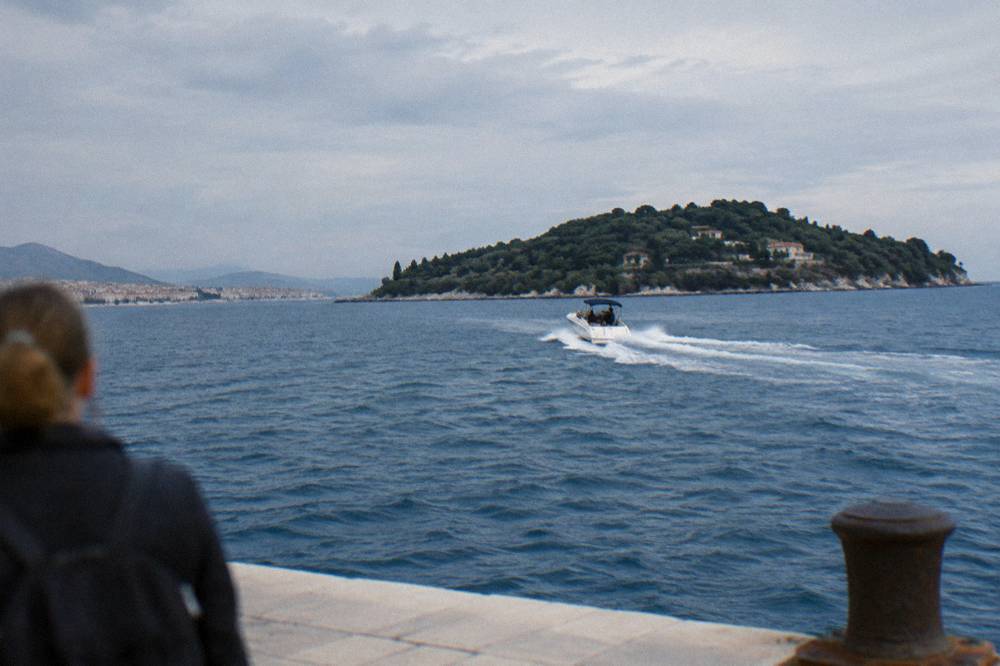
Spring in Split warms quickly, from a March mean of 10.8 C to 14.4 C in April and 19.2 C in May, while rainfall falls only gently, from 63.2 mm in March to 57.5 mm in May. By May, afternoons regularly feel summer-like, and the station's June figure of 23.4 C shows how short the genuine shoulder window is.
March is the month locals use to reclaim the Riva: sunny spells are frequent, but the sea is still cold and the air can swing back toward winter within a day. April is the first month that behaves like a travel month, warm enough for long walks on Marjan, where the highest point, Telegrin at 178 m, is reached by 819 steps from Trumbićeva obala, and dry enough that a shower rarely ruins a day. May is close to summer in feel, with rain still around 57.5 mm but falling in shorter bursts. More of these guides are collected on Split Croatia Travel Guide.
Spring suits the walking side of Split. The palace, the Peristyle, the Golden Gate and the Grgur Ninski statue are all open-air and free, and the free things to do in Split round-up leans heavily on exactly these. It also suits the early ferry season: the ferries from Split run year-round to Stari Grad and Supetar, and the island timetable thickens as spring goes on.
What Is Split Weather Like In Autumn?
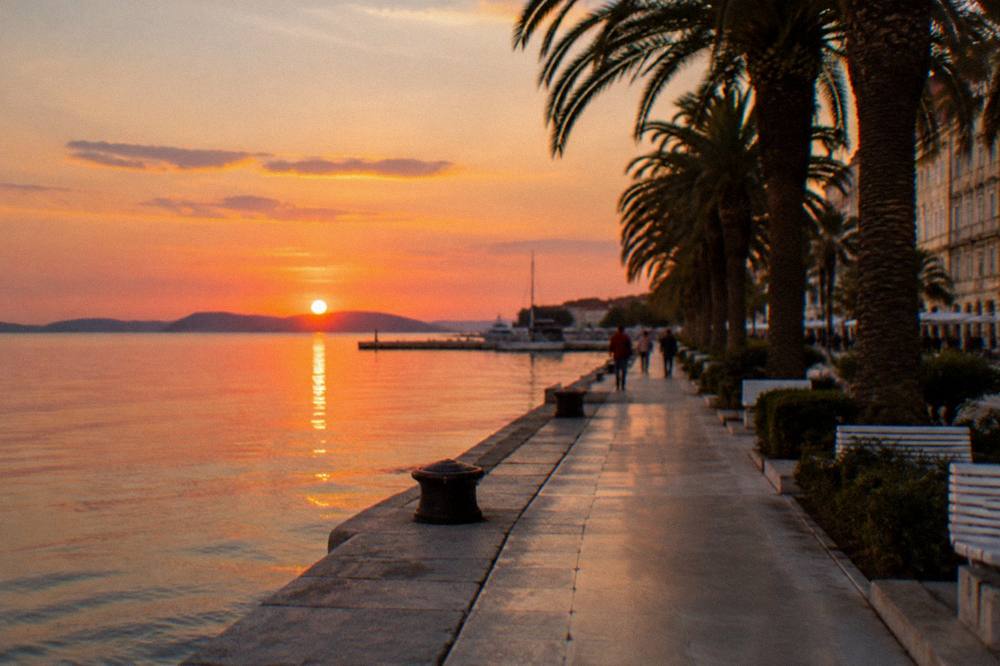
Autumn is the sharpest transition of the Split year: September still averages 21.6 C, October falls to 17.2 C and November to 12.7 C, while rainfall climbs from 70.9 mm in September to 115.5 mm in November, the wettest month in the station record. Early October often still feels like a warm late-summer month, late November like winter.
September is arguably the best-kept secret in the table. The mean of 21.6 C is only 1.8 C below June's, the sea has absorbed a whole summer of heat, and the July and August pressure on ferries and day trips has eased. The catch is the rain line: 70.9 mm is nearly triple July's total, so September trades a little certainty for space and warmth. October sits on the fence, mild at 17.2 C on average but with the wet season now arriving. By November the pattern has flipped fully, and the city turns to its indoor calendar.
Autumn is also the season when the national parks drop their prices. From 1 October 2026, Krka's adult ticket is 20 EUR, falling to 7 EUR from November, and Plitvice is 23 EUR in October and 10 EUR from November, against 40 EUR for both in the June to September peak. A dry late-autumn day at either park costs roughly half to a quarter of its summer price, and the Split day trips guide maps the routes, with Krka's Skradinski buk about 74 minutes' drive from the palace.
What Is Split Weather Like In Winter?
Winter in Split is mild rather than cold, with station means of 8.0 C in January, 9.4 C in December and 8.5 C in February, but it is the grey, wet quarter: December records 103.7 mm of rain and only 120.8 hours of sunshine, roughly four bright hours a day against July's eleven.
Snow in Split is rare enough to be an event, and frost is a morning exception rather than a rule, because the sea moderates the city. What defines a Split winter is the change of light and rhythm: 120.8 sunshine hours in December means short, often overcast days, and the outdoor café life of the Riva retreats behind awnings and heaters. Rain arrives mostly as showers, with December and January both above 77 mm.
The city compensates with a winter calendar. Advent in Split runs from 27 November 2026 to 7 January 2027, with the ice rink at Đardin, and the Croatian National Theatre's season runs from 25 September 2026 to 14 June 2027. Sudamja, the city day on 7 May, marks the point at which winter programming hands over to summer. For anyone weighing a winter city break against a beach week, the honest summary is that winter Split is a museum, theatre and café city with occasional brilliant clear days, not a beach destination.
How Should You Pack For Split Weather By Season?
Pack for heat and sun from June to August, when means run 23.4 to 26.2 C with up to 18 days at 30 C or more and almost no rain, for layers in the shoulder months, April, May, September and October, when means span 14.4 to 21.6 C and showers are routine, and for mild wet weather from November to March, when means sit between 8.0 and 12.7 C and monthly rain tops out at 115.5 mm.
The table below turns the station record into a packing shorthand. It is deliberately conservative, based on means rather than best days, because a mean already contains the good afternoons.
| Months | Mean range (C) | Rain pattern | Packing core |
|---|---|---|---|
| Jun to Aug | 23.4 to 26.2 | 26.6 to 49.0 mm a month | Sun gear, swimwear, light layers for stone interiors |
| Apr, May, Sep, Oct | 14.4 to 21.6 | 57.5 to 77.0 mm a month | Mixed wardrobe, light rain layer, warm evenings early and late |
| Nov to Mar | 8.0 to 12.7 | 63.2 to 115.5 mm a month | Warm layers, waterproof, shoes for wet stone |
Two Split-specific notes. First, the Old Town is polished limestone and marble, which becomes slippery in rain, so sole grip matters more here than in most cities. Second, the historic centre's public-order rules fine walking in swimwear or shirtless in the centre, so swimwear belongs at the beach and a cover layer for the walk back, whatever the temperature.
Does The Weather Affect Ferries And Day Trips From Split?
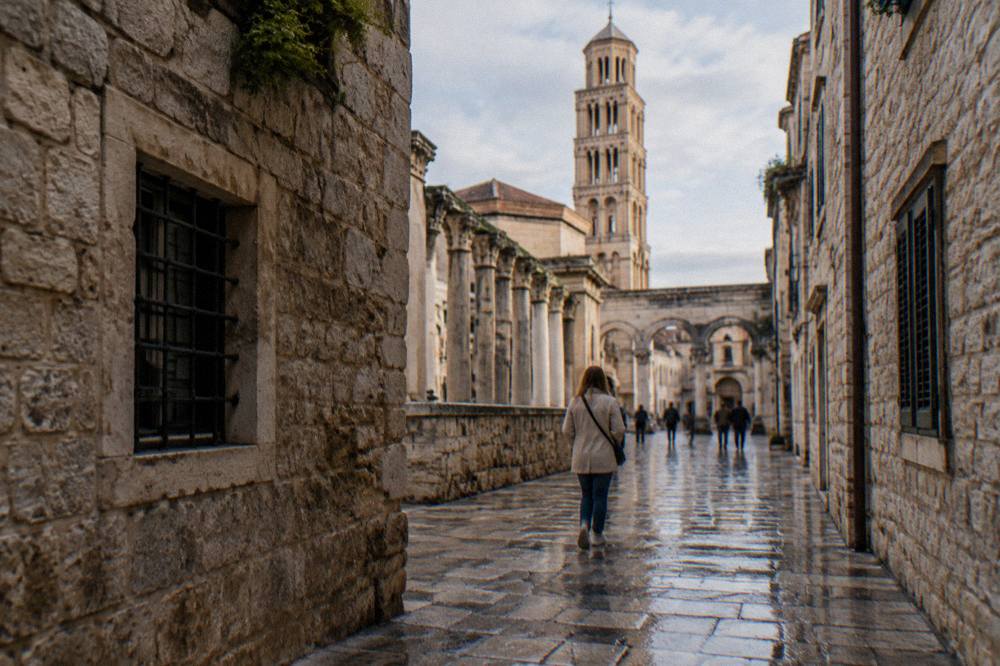
Yes, mainly between late autumn and early spring: strong wind is the single factor that delays or cancels Split's ferries and catamarans, while summer weather rarely stops them. The car ferry to Stari Grad takes about 120 minutes and the catamaran to Hvar town about the same order of crossing, all of it open water that operators will not sail in a serious storm, and small speedboat tours are the first to be called off.
The structural fact behind this is that Split's port is Croatia's busiest passenger port, 6.05 million passengers in 2025, and its summer island network is dense: line 635 to Stari Grad on Hvar, line 631 to Supetar on Brač, line 636 to Rogač on Šolta, plus catamarans to Hvar town, Jelsa and Vis. In July and August those services run whatever the Mediterranean summer throws at them, which is to say, almost nothing. From October to March, departure counts thin out and the wind sensitivity rises, so winter island plans should always carry a fallback day.
| Service | Crossing (about) | Weather sensitivity |
|---|---|---|
| Ferry line 635, Split to Stari Grad | 120 min | High in winter storms |
| Ferry line 631, Split to Supetar | 50 min | Moderate |
| Ferry line 636, Split to Rogač, Šolta | 60 min | Moderate |
| Ferry to Vis | 140 min | High in winter storms |
| Speedboat island tours | Various | Highest, operator call on the day |
For booked day trips the rule is simple: the operator decides. Boat trips to the Blue Cave and the Blue Lagoon are cancelled or rerouted when the sea state is poor, and reputable operators offer rebooking or refunds, so a weather call is rarely a lost call. The Split to Hvar ferry guide covers the Hvar routes in detail, and the Split boat tours page explains what changes when a departure is cancelled.
Common Questions About Split Weather
Which month is warmest in Split?
July, with a mean of 26.2 C from the DHMZ Split Marjan station record for 1948 to 2024. August is a close second at 25.9 C, and July also records 18 days at 30 C or more, the highest count of any month.
What is the rainiest month in Split?
November, at 115.5 mm on average from the DHMZ Split Marjan station table, followed by December at 103.7 mm. July is the driest month at 26.6 mm.
Can you swim in the sea in Split?
Yes, from late spring into autumn. No official monthly sea-temperature normal is published for Split, so no monthly figure can be stated, but the live DHMZ reading of 20.4 C on 12 October 2026 indicates the water still holds summer warmth well into October.
Is Split warm in winter?
Mild rather than warm: station means are 8.0 C in January, 8.5 C in February and 9.4 C in December, with December sunshine at just 120.8 hours. Expect showers and short days rather than freezing temperatures.
How many hours of sunshine does Split get?
About 2,600 hours a year, with 353.3 hours in July and 120.8 hours in December from the DHMZ Split Marjan record for 1948 to 2024.
Does bad weather stop the ferries from Split?
Occasionally, mainly between late autumn and early spring when strong wind can delay or cancel crossings. Summer services run almost without weather interruption, and small speedboat tours are always subject to the operator's call on the morning of departure.
The weather record for Split, read straight from the DHMZ Split Marjan station table, describes a city with two long seasons and two short ones: a dry, bright, hot stretch from June through August, a mild wet stretch from November through February, and brief, pleasant transitions in between. Choosing a month is really choosing between those four regimes, and the rest of the planning, ferries, beaches, day trips and packing, follows from it.
