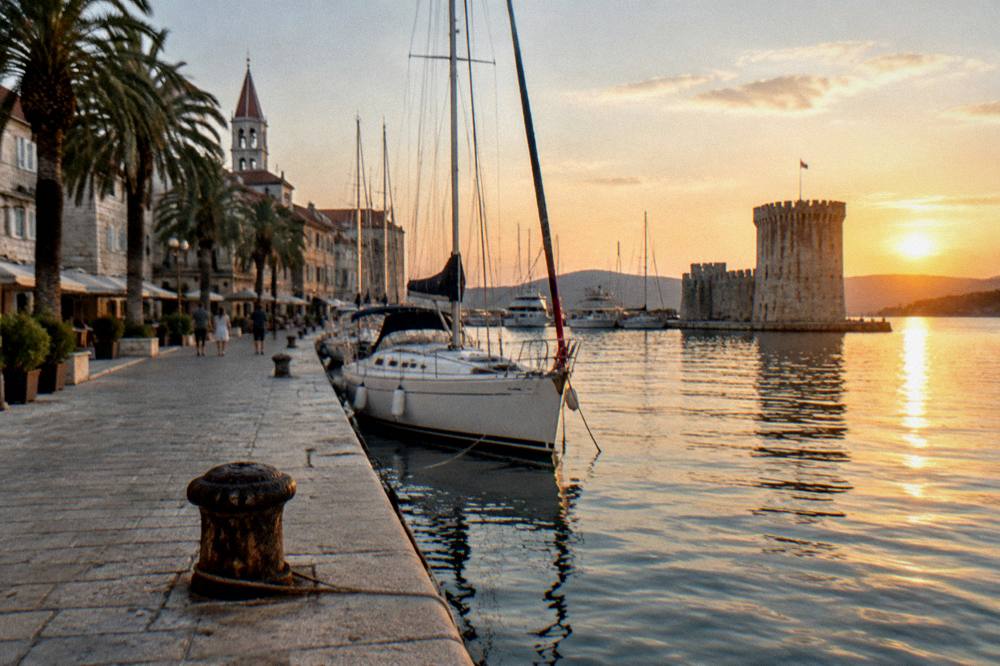
Salona Ruins
Salona, 9.1 km from Diocletian's Palace in Split, was the Roman capital of Dalmatia and the city Diocletian himself retired beside. The site is run by the Archaeological Museum in Split, and a 10 EUR combined ticket covers both.
Short answer
The Salona ruins sit at Solin, about 14 minutes by car from Split. Entry is via the Archaeological Museum's combined ticket at 10 EUR for adults, valid for the museum and Salona within 7 days. In summer, 1 June to 30 September, the site is open daily 9:00 to 20:00.
Salona, today the town of Solin on the northern edge of Split in Dalmatia, was the Roman capital of the province of Dalmatia and the settlement that gave birth to the city next door. Diocletian, the emperor who built the palace that is now the core of Split, was born in this region, and the medieval town that grew inside his walls was seeded by refugees from Salona. The ruins sit 9.1 km from Diocletian's Palace, about 14 minutes by car, and they are run by the Archaeological Museum in Split, whose price list sells a combined ticket covering both the museum on Zrinsko Frankopanska and the Salona site.
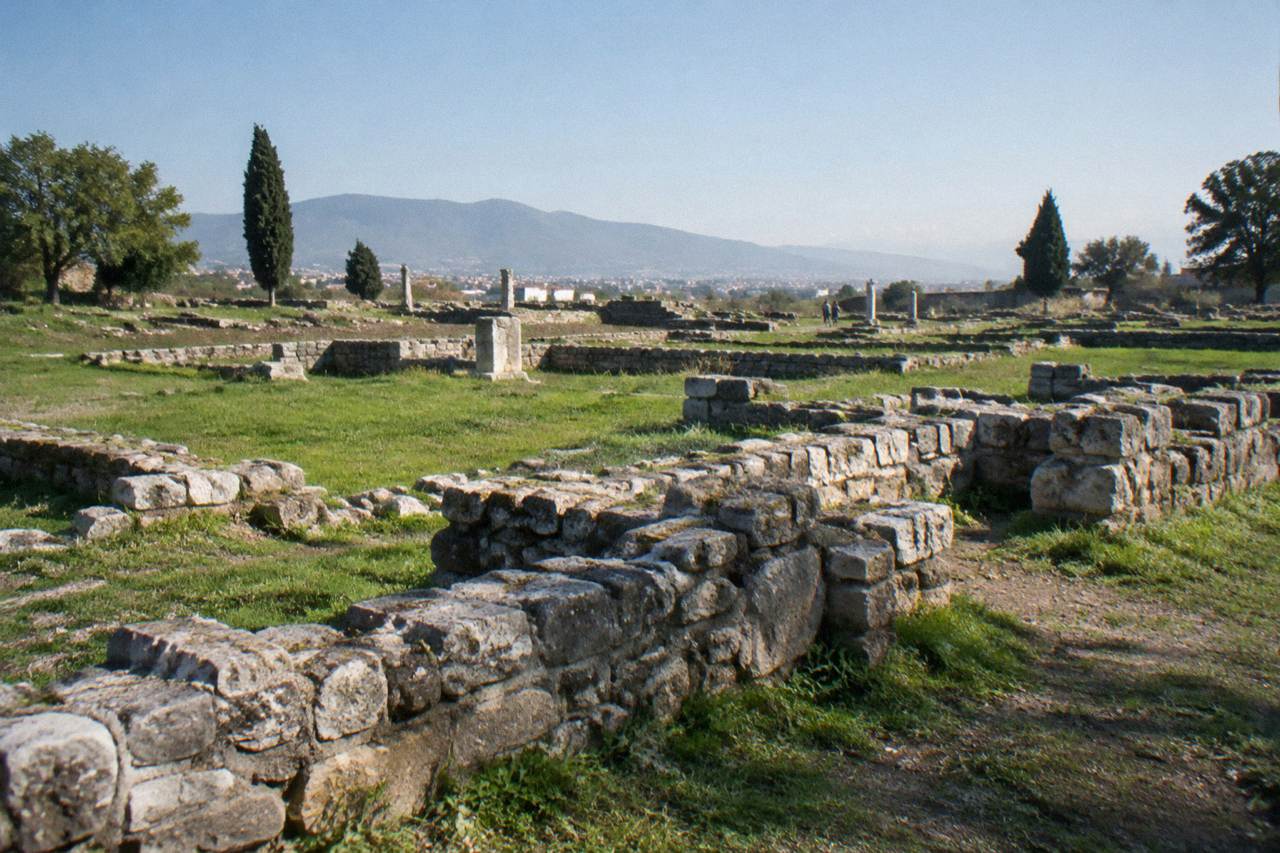
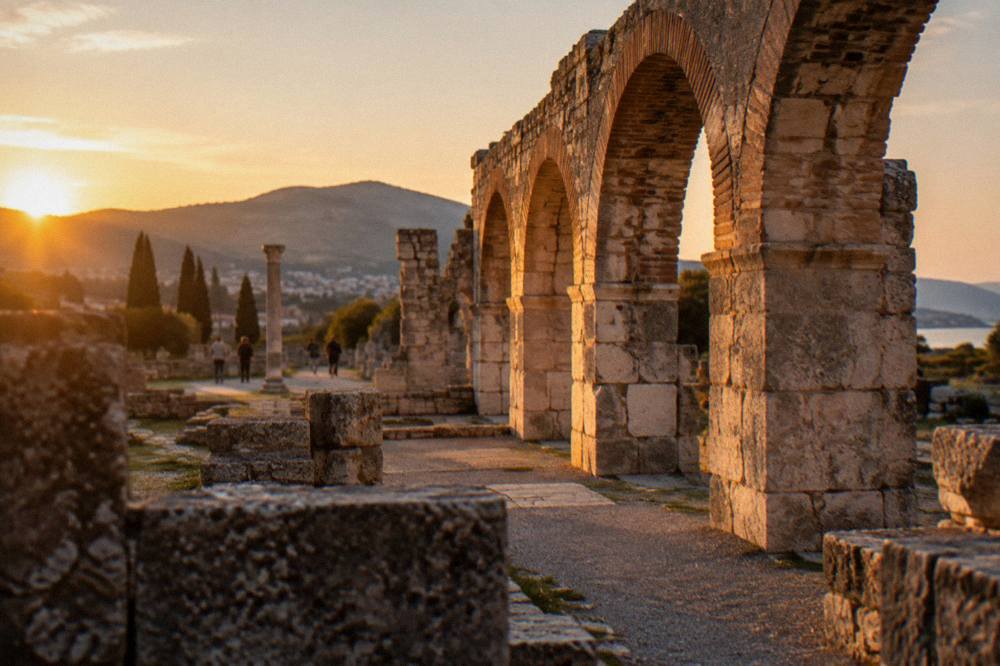
What survives above ground is spread across a wide site: the amphitheatre shell, stretches of city wall with towers, early Christian basilicas, a aqueduct arch, bath foundations and graveyards along the old roads. The Archaeological Museum, founded in 1820, grew out of the excavation of exactly these fields, and its galleries in Split hold the mosaics, sarcophagi and inscriptions the site produced.
What Are The Salona Ruins And Why Do They Matter To Split?
Salona was the largest Roman city on the eastern Adriatic shore of this region and the administrative capital of the province of Dalmatia, and its collapse in late antiquity is the direct reason Split exists at all. When Salona fell, its population moved into and around Diocletian's Palace, and the town that became Split grew from that refuge. The two sites are one story cut in two halves.
The palace in central Split was built c. 295 to 305 AD as a retirement residence for Diocletian, an emperor of Dalmatian origin whose power base lay in Salona's orbit. Excavation from 1820 onward exposed the walls, the burial grounds along the roads out of the city, and the amphitheatre on the northwestern edge.
For a visitor coming from the palace, the interest runs both ways. The substructures you can walk through at Diocletian's Palace cellars show how the imperial residence was engineered, while Salona shows the ordinary provincial capital it sat beside. The Archaeological Museum in Split, founded in 1820, exists because of Salona: its collection is substantially the finds from these excavations, and the museum and the ruins are today visited on one combined ticket. The cathedral of St Domnius in the palace, itself a converted imperial mausoleum, closes the same loop, since its earliest bishops came from Salona's church.
The site is not a single building but a belt of ruins several kilometres long, following the line of the ancient roads and cemeteries. That shape matters for planning. You do not "do" Salona in the way you walk a museum: you walk between areas, some shaded, some fully exposed, and in July and August the middle of the day is the hardest part. The DHMZ Split Marjan station table, covering the period 1948 to 2024, puts the July mean at 26.2 C with 18 days at 30 C or more, so water, a hat and early or late timing are practical matters at this site more than at almost any other in the city.
How Much Do Salona Tickets Cost And What Do They Cover?
An adult ticket to Salona is sold by the Archaeological Museum in Split as a combined ticket at 10 EUR, covering both the Salona site and the museum galleries in Split when used within 7 days of each other. The museum alone is 8 EUR for adults, and children, students and retirees pay 4 EUR at the museum price list. There is no standalone verified Salona-only price beyond that combined scheme, so confirm at the entrance.
The museum's price list, effective from 7 January 2026, gives the 8 EUR adult museum ticket, 4 EUR for children, students and retirees, and the 10 EUR combined Museum plus Salona ticket valid across 7 days. That structure rewards exactly the trip this page describes: the museum on one day, with its Salona finds displayed in cases, and the ruins on another, when the stones you saw in the gallery are standing in the ground they came from.
| Ticket | Adult | Reduced (children, students, retirees) |
|---|---|---|
| Archaeological Museum Split only | 8.00 EUR | 4.00 EUR |
| Combined museum and Salona, within 7 days | 10.00 EUR | price on the museum price list |
| Klis Fortress (nearby, separate operator) | 10.00 EUR | 3.00 EUR children |
The Klis Fortress row is there because the two sites pair naturally: Klis is 13.9 km from the palace, and Salona is on the way. Klis is a separate operator with its own 10 EUR adult ticket, daily 9:00 to 17:00, and it is known to Game of Thrones viewers as a Meereen filming location. A car-free traveller can do both on organised transport, and that is where the day tours earn their place: the Guided Tour of Trogir, Salona, Olive Museum and Klis Fortress strings the four stops together without any of the bus connections between them, and Check availability if that shape suits your dates.
If Klis has won you over, book a Klis Fortress sunset tour here.
For independent visitors, the practical reading of the price list is simple: if you are visiting Salona at all, the extra 2 EUR over the museum-only ticket is the best value on any desk in Split, because the museum galleries are where the mosaics and inscriptions lifted from the site are displayed. In summer, 1 June to 30 September, Salona is open daily 9:00 to 20:00, so a late-afternoon arrival after the museum closes its day is a real plan, and the light on the stones is better for it.
How Do You Get To Salona From Split Without A Car?
Salona is 9.1 km from Diocletian's Palace, about 14 minutes by car, and the site sits at Solin on the north side of Split, reached by local bus along the Solin road or by any organised excursion heading to Klis or Trogir. The ferry port, bus station and railway station sit together on Obala kneza Domagoja, 500 to 600 m from the palace, so surface transport out of the city starts from one hub.
The driving figures come from route calculations measured from the palace itself, and they make Salona the closest of the major day-trip sites around Split: 14 minutes against 22 for Klis, 36 for Trogir and 38 for Omiš. The practical car-free options are local city buses toward Solin, whose exact fare and stop layout you should confirm locally, or a tour vehicle. No verified fare for the local bus to Solin is printed here, so ask at the driver or the station.
| Destination from Diocletian's Palace | Distance | Free-flow driving time |
|---|---|---|
| Salona (Solin) | 9.1 km | about 14 min |
| Klis Fortress | 13.9 km | about 22 min |
| Trogir | 29.3 km | about 36 min |
| Omiš | 25.5 km | about 38 min |
| Šibenik | 84.8 km | about 71 min |
| Krka National Park, Skradinski buk entrance | 90.2 km | about 74 min |
Cyclists and walkers should treat the distance honestly: the route out of Split follows the Kaštela coastline road, and while the distances are short, the road is a working suburban artery rather than a leisure path. A rented bike is a reasonable way to reach Solin in the morning and be back at Bačvice beach by the afternoon, but the middle hours of a July day, with a 26.2 C monthly mean at the DHMZ Split Marjan station, are not the hours to choose for it.
The organised alternative removes the transport question entirely. The excursion that covers Salona also stops at Klis Fortress and Trogir in one loop, which is the combination that makes sense geographically: all three lie northwest of the city on the same side of the peninsula, so a self-drive or tour circuit of the three is a clean half day. The trade-off is time at each stop, and readers who want to linger over the epigraphic stones at Salona should weigh a self-guided morning at Solin against a fixed itinerary.
What Will You Actually See At Salona?
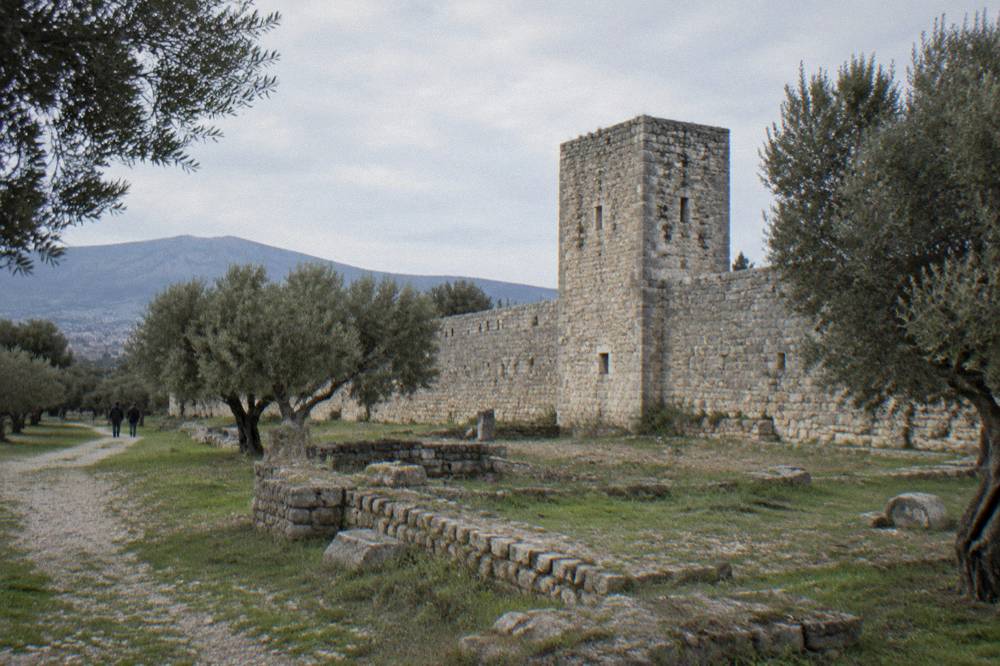
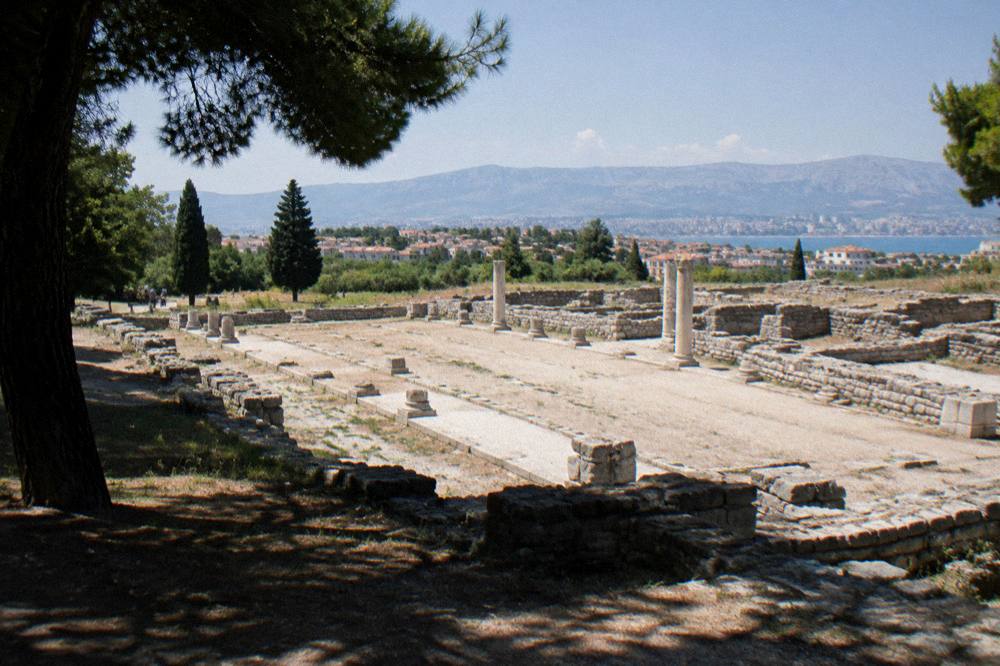
The visible site splits into an amphitheatre, long stretches of defensive wall with projecting towers, the remains of large early Christian basilicas including the episcopal complex at Manastirine, bath buildings, an aqueduct arch, and two roadside necropolises where sarcophagi still stand in rows. It is a walking site of separate fields, not one roofed building, and the stones are largely unlabelled in place, which is why the museum half of the ticket matters.
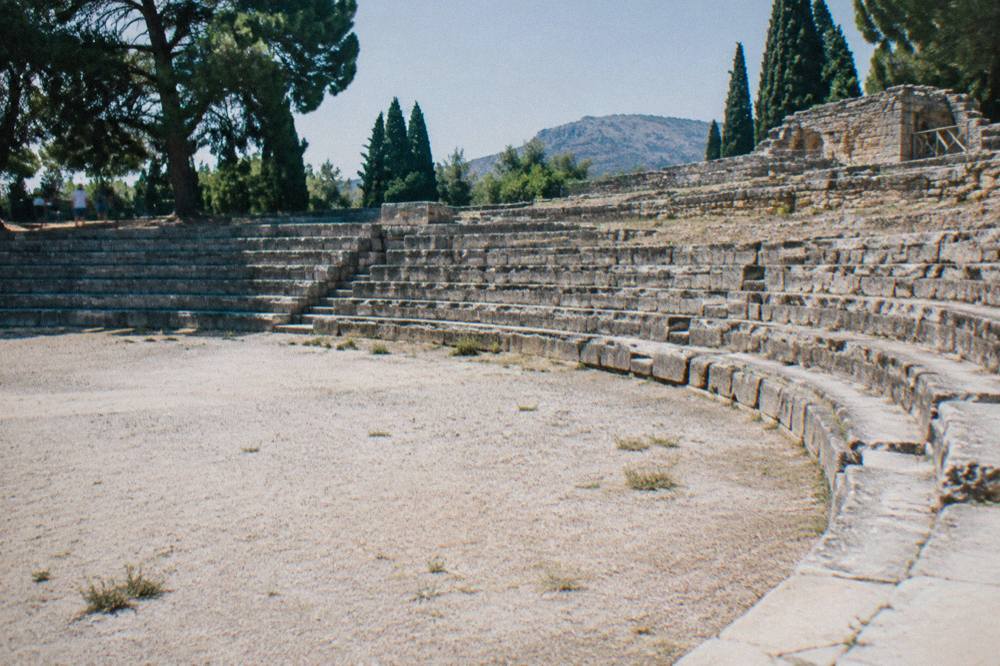
The amphitheatre sits at the northwestern edge of the ruins. Its arena and lower seating arc survive, stripped of the upper tiers, and its outline alone explains the scale of the Roman city: this was the entertainment block of a provincial capital, not a garrison outpost. From there the wall circuit runs southeast with towers along its length, and the line of it can be followed on foot between the shaded stretches.
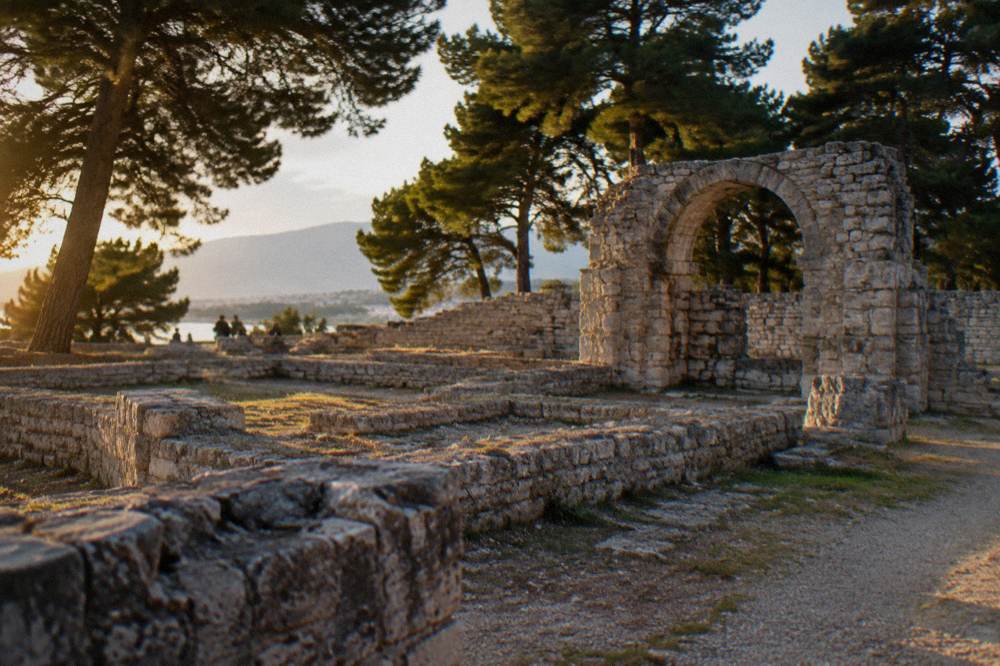
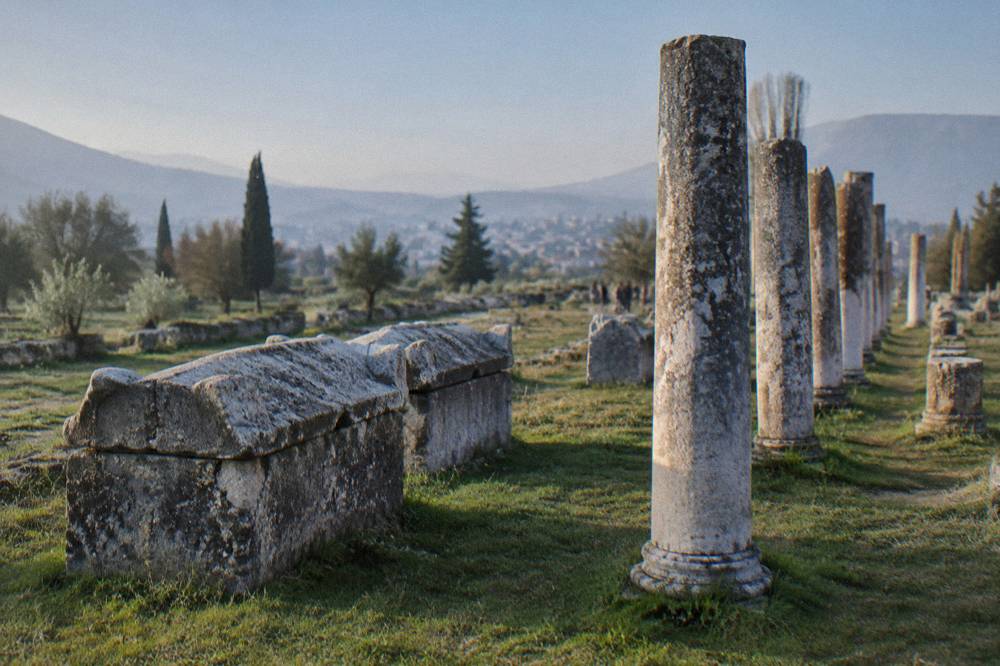
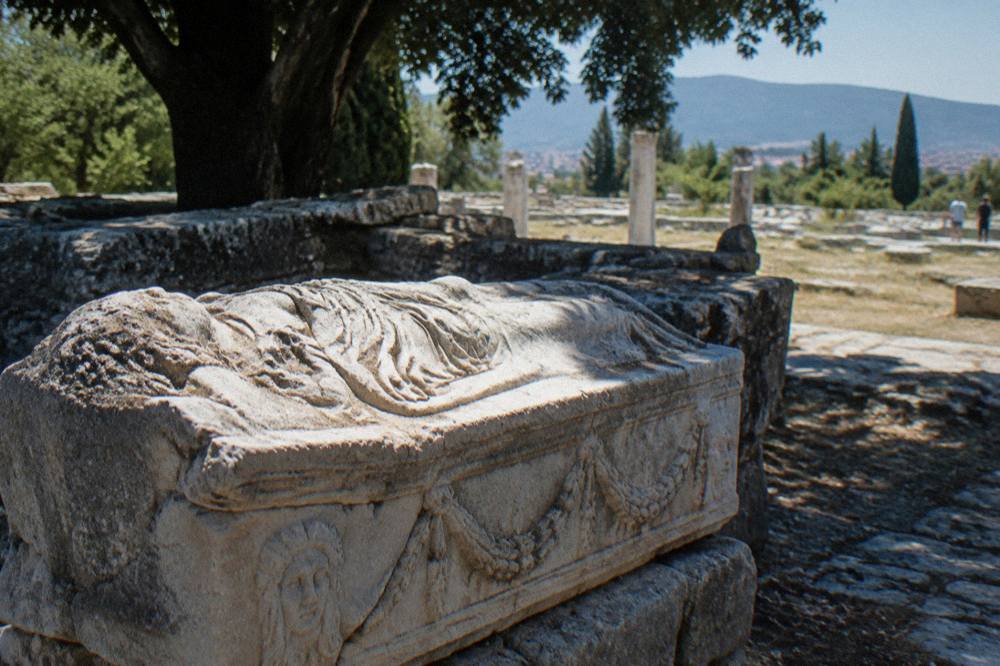
South of the walls lie the basilicas. The episcopal complex with its baptistery, the five-aisled urban basilica and the memorial churches at the cemeteries are the reason Salona matters to church historians: this was one of the significant early Christian centres of the Adriatic, and the floor mosaics recovered from these buildings are in the Archaeological Museum's galleries in Split. At Manastirine and the other necropolis along the roads, sarcophagi stand where they were excavated, many with lids displaced, and the density of them gives the clearest sense of the city's population.
The practical reading of all this: give Salona two unhurried hours rather than a drive-by photo, and put the museum either before or after within the 7-day combined ticket window so the loose stones resolve into mosaic floors and inscriptions. Visitors pairing the palace with Salona in one day should reverse the usual order, ruins in the cooler morning, Peristyle and the palace lanes in the evening when the Old Town comes alive, and the Roman guard change on the Peristyle at noon, which ran 28 May to 27 September 2026, sits exactly between the two.
Can You Combine Salona With Klis Fortress And Trogir In One Day?
Yes, and it is the most efficient hinterland loop from Split: Salona at 9.1 km and 14 minutes, Klis Fortress at 13.9 km and 22 minutes, and Trogir at 29.3 km and 36 minutes from the palace all sit on the same side of the city, so a single morning circuit of the three is straightforward with a car or an organised tour. The tour that covers the trio adds an olive museum between the stones.
Timing works like this. Salona opens 9:00 in summer and the first hours are the cool ones, with the DHMZ Split Marjan table showing a July mean of 26.2 C. Klis is open daily 9:00 to 17:00 and is a hilltop site, so its slopes are best climbed before the afternoon builds. Trogir, a UNESCO World Heritage town listed in 1997, rewards the late afternoon and early evening, when day visitors thin out and the katedrala close is the day's end. Self-drivers can run that arc in either direction.
| Stop | Adult entry | Hours |
|---|---|---|
| Salona (combined with museum, within 7 days) | 10.00 EUR | 1 Jun to 30 Sep daily 9:00 to 20:00 |
| Klis Fortress | 10.00 EUR | daily 9:00 to 17:00 |
| Archaeological Museum Split | 8.00 EUR | on the museum price list |
| Trogir old town streets | free | always walkable |
| Cathedral of St Domnius, Split | from about 5 EUR, combined tickets up to about 15 EUR | hours not published officially |
The one caution is the middle of the day in peak summer. There is little shade at Klis and none to speak of across Salona's fields, and the 18 days at 30 C or more the Split Marjan station records for July are concentrated exactly in the hours a tight three-stop itinerary would spend outdoors. Build a long lunch in Trogir or Solin into the plan, or take the organised version where the schedule already accounts for it.
For travellers who prefer the sea to a third ruin, the same day can be bent differently: Salona in the morning, then back to the coast for an afternoon on the water. The half-day sea kayak adventure runs from the city's own shoreline, and pairing a morning of Roman stones with an afternoon paddling under Marjan is a full day that uses Split's two faces, hinterland and coast, without a long transfer between them.
When Is The Best Time Of Day And Year To Visit Salona?
Summer gives Salona its longest hours, daily 9:00 to 20:00 from 1 June to 30 September, but also its hardest midday heat, with a July mean of 26.2 C and 18 days at 30 C or more in the DHMZ Split Marjan record for 1948 to 2024. The best hours inside that window are the first two after opening and the last two before close, when the low sun also flatters the stonework.
The climate table for the city bears directly on a wide, unshaded archaeological site. July and August, at 26.2 C and 25.9 C monthly means, are the demanding months; June at 23.4 C and September at 21.6 C are gentler and keep the long opening hours. October, at a 17.2 C mean, is comfortable, though the site's summer schedule may no longer apply, so confirm hours locally outside the stated summer window.
| Month | Mean temperature (DHMZ Split Marjan, 1948 to 2024) | Precipitation mm |
|---|---|---|
| April | 14.4 C | 62.0 |
| May | 19.2 C | 57.5 |
| June | 23.4 C | 49.0 |
| July | 26.2 C | 26.6 |
| August | 25.9 C | 41.3 |
| September | 21.6 C | 70.9 |
| October | 17.2 C | 77.0 |
| Month | Mean temperature | Precipitation mm |
|---|---|---|
| November | 12.7 C | 115.5 |
| December | 9.4 C | 103.7 |
| January | 8.0 C | 77.8 |
| February | 8.5 C | 65.2 |
| March | 10.8 C | 63.2 |
November, the wettest month at 115.5 mm, and December, at 103.7 mm, are the months when a grassy ruin site is at its least rewarding, though the museum half of the combined ticket is an indoor proposition at any time of year and pairs well with rainy day options in the city. Rainfall across autumn, September to November, totals 263.4 mm against 246.7 mm across the winter months in the same station record, so there is no dry season trick to exploit beyond the July minimum of 26.6 mm.
Is Salona Worth It If You Have Only One Or Two Days In Split?
If your stay is one day, Salona is the wrong call: the palace, the Riva, Marjan and the sea belong to that day, and the ruins need half a day of their own. From two days onward Salona becomes a strong morning, especially for anyone with an interest in Roman history, because it is the closest major site to the city at 9.1 km and it explains the palace you will already have walked through.
The honest trade-off is between depth and variety. A traveller with two days who takes Salona on the second morning gives up a boat morning or a beach afternoon to do it, and the combined ticket at 10 EUR makes the museum an included part of that choice rather than an extra. A traveller with three or more days can give Salona its full morning and still take a Krka or islands day, and the three days in Split itinerary leaves room for exactly that.
For cruise passengers the arithmetic is tighter still. Ships dock beside the Old Town, and the cruise port day plan has to choose between the palace on foot and any hinterland site by vehicle. Salona plus Klis is a feasible shore excursion shape for a ship with a late departure, but it trades away the city itself, and Split's own Roman core is the rarer thing for a one-day visitor.
What Else Is Near Salona Worth Pairing With It?
The immediate hinterland around Split holds Klis Fortress at 13.9 km, the Meštrović Gallery at 12.00 EUR adult entry on the Marjan side of the city, and the green market and museum quarter inside the palace area, all reachable inside a half-day loop by car or a full day by bus and foot. Trogir at 29.3 km extends the loop toward the airport.
The gallery deserves the mention because it is the same price band as the ruin sites and a complete contrast: Ivan Meštrović's sculpture in a villa he designed, reopened in April 2026 after a 15-month energy renovation, with the 12.00 EUR adult ticket including the Crikvine-Kaštilac chapel site across the hill. The Meštrović Gallery pairs with Salona as stone-carving across two eras, Roman quarry columns and the sculpture of Ivan Meštrović from the same Dalmatian limestone tradition.
| Site | Distance from Diocletian's Palace | Adult ticket |
|---|---|---|
| Salona | 9.1 km | 10.00 EUR combined with museum |
| Klis Fortress | 13.9 km | 10.00 EUR |
| Meštrović Gallery | within Split | 12.00 EUR, includes Crikvine-Kaštilac |
| Ethnographic Museum | within Split | 7.00 EUR |
| Split City Museum, Papalić Palace | within Split | 10.00 EUR |
Back in the city, food completes the day. The green market inside the palace belt is where Solin and Kaštela growers sell in the morning, and the gastro walking tours that use the market as their starting pantry make a soft landing after a morning of stones. The historical and gastro treasures tour with green market is the version that keeps one foot in the history and one at the tasting table.
How Much Time Do You Need At Salona And What Should You Bring?
Two hours walks the main areas at a steady pace, and three allows the amphitheatre, the walls, the basilica complex and one necropolis with time to read stones; the museum in Split wants another hour on a separate day inside the 7-day ticket window. Bring water, a hat and closed shoes, because shade is scarce across the fields and the paths are a mix of gravel and worn Roman paving.
The site's layout rewards a little preparation more than a fixed route. Starting at the amphitheatre and walking southeast through the wall line toward the basilicas covers the core in about an hour and a half of actual walking; adding Manastirine and the roadside cemeteries stretches it toward three. Anyone with a special interest in early Christian archaeology should simply give it a half day and buy the combined ticket without hesitation.
What not to bother carrying: heavy guidebooks, since the museum displays carry the interpretation, and drones, since the old town of Split and its airport zones are restricted for flying and national parks ban drones outright, so an aerial plan at an archaeological site should be checked against current rules before any flight. Photography from the ground is unrestricted in the open site by its nature as a walkable ruin field.
Common Questions About The Salona Ruins
How Much Does It Cost To Visit The Salona Ruins?
Salona is sold on the Archaeological Museum in Split's combined ticket at 10 EUR for adults, covering the museum and the Salona site within 7 days. The museum alone is 8 EUR, with 4 EUR for children, students and retirees. Confirm current prices at the entrance before your visit.
How Far Is Salona From Split?
Salona is 9.1 km from Diocletian's Palace in the centre of Split, about 14 minutes by car in free-flow traffic. The site sits at Solin, the town immediately north of Split, and is also reachable by local bus toward Solin.
What Are Salona's Opening Hours?
In summer, from 1 June to 30 September, Salona is open daily 9:00 to 20:00. Outside that window, confirm hours locally, since the published schedule covers the summer season.
Can You Visit Salona And Klis Fortress On The Same Day?
Yes. Klis Fortress is 13.9 km from the palace, about 22 minutes by car, and Salona lies on the way, so the two combine naturally in a half-day loop. Klis is open daily 9:00 to 17:00 with a 10 EUR adult ticket.
Is Salona Worth Visiting Compared With Diocletian's Palace?
The two tell one story. The palace in Split is the imperial residence, built c. 295 to 305 AD, and Salona was the provincial capital beside it; when Salona fell in late antiquity its people moved into the palace walls. Visitors with an interest in Rome get far more from each site after seeing both, and the combined museum ticket makes the pairing cheap.
Do You Need A Guide For Salona?
The site is largely unlabelled in place, so a guide or a museum visit first adds real interpretation, and an organised tour covering Salona, Klis Fortress and Trogir removes the bus connections between them. Independent visitors can walk the ruins alone with the museum's displays as the explanation.
Salona remains the quiet half of Split's Roman story, a 14-minute drive from the palace crowds, priced at 10 EUR on a combined ticket that includes the museum built from its own stones, and best walked in the first or last hours of a summer day. For more ways to build a stay around it, see the things to do in Split overview or the Split Croatia Travel Guide home page.