Peristyle Split
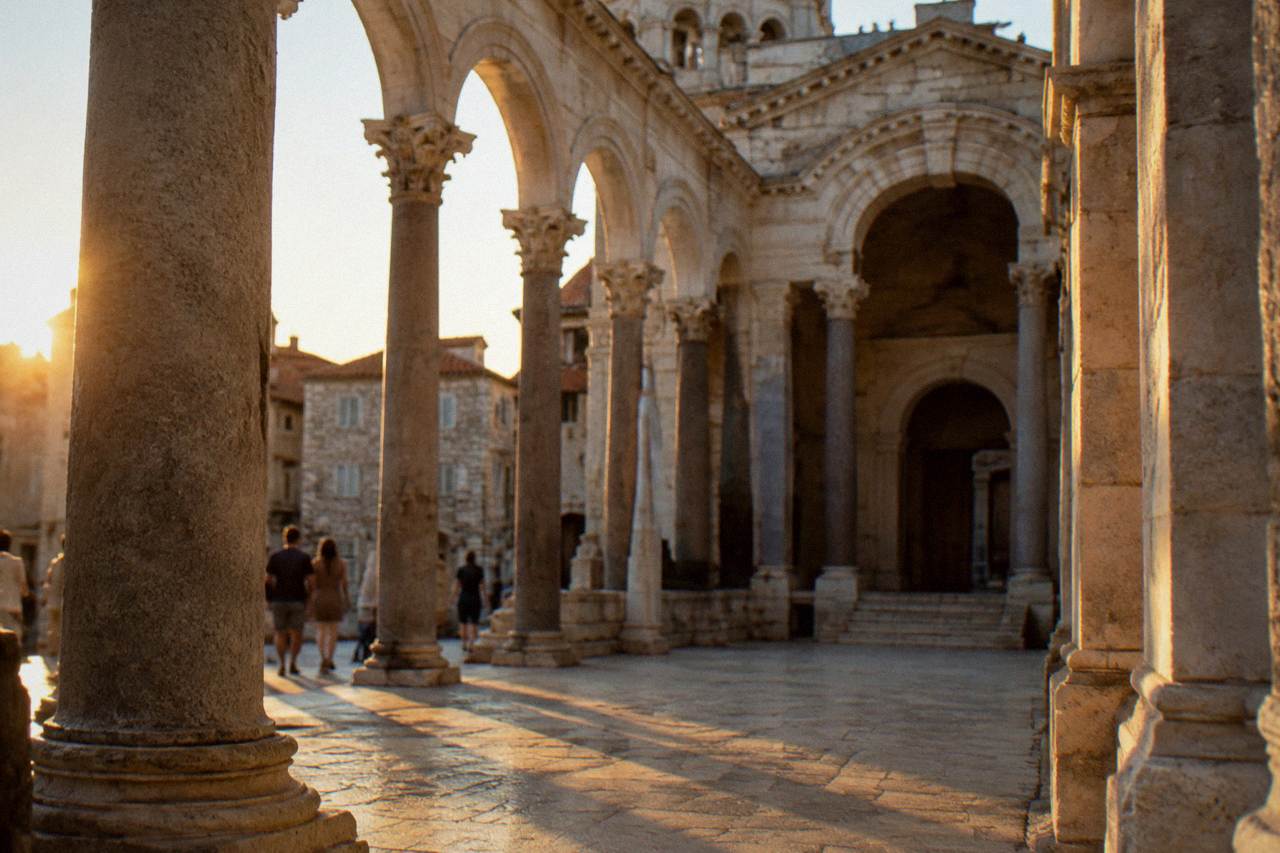
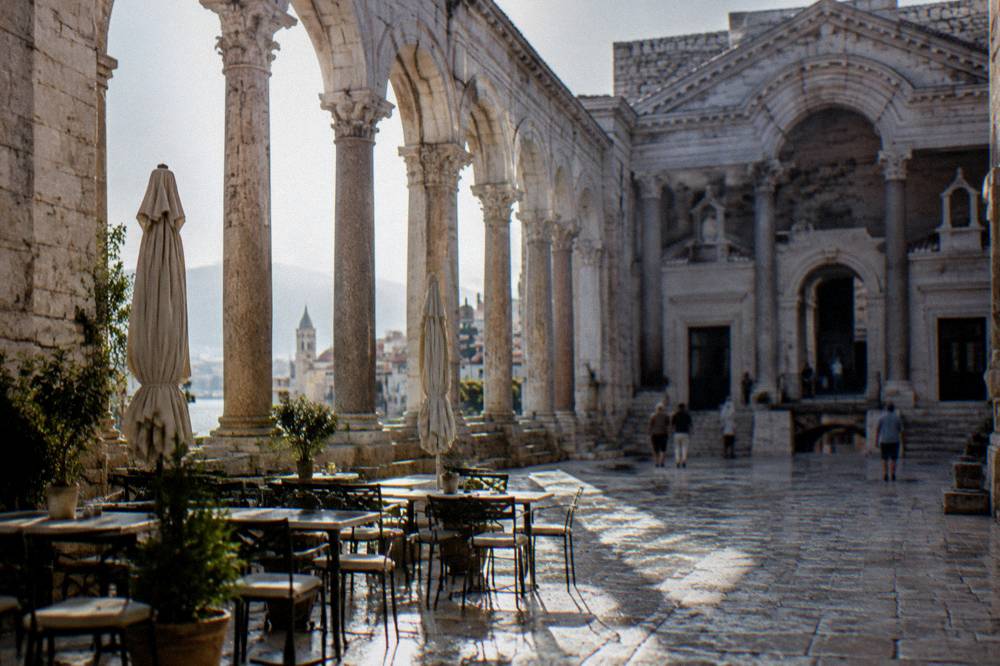
The Peristyle in Split is the main square of Diocletian's Palace: a free Roman courtyard where the emperor once appeared, where the cathedral and its 57 m bell tower now stand, and where the Roman guard change takes place at noon through the summer.
Short answer
The Peristyle is the central courtyard of Diocletian's Palace in Split, built around c. 295 to 305 AD. Entry is free at any hour. It opens onto the Cathedral of St Domnius, the Temple of Jupiter and the cellars, and hosts the Roman guard change at noon, which ran daily from 28 May to 27 September 2026.
The Peristyle in Split is the open, colonnaded heart of Diocletian's Palace, the Roman residence built for Emperor Diocletian around c. 295 to 305 AD and now the core of a UNESCO-listed historic centre inscribed in 1979. It is a square you walk into without a ticket, without a gate and without an opening hour, because the palace is not a monument fenced off from the city: the city lives inside it. Cafés, ticket kiosks and cathedral entrances sit directly on stones laid in the Roman period, and the whole complex sits on Split's Adriatic waterfront with the Marjan peninsula rising to the west.
Around the Peristyle, everything in central Split is within a few minutes on foot. The ferry port, the main bus station and the railway station sit together on Obala kneza Domagoja, 500 to 600 m from the palace, which is why cruise passengers, island hoppers and day-trippers all end up passing through this one square. For the wider picture of the palace itself, see the Diocletian's Palace attraction guide, and for the plan of a whole day built around it, the one day in Split itinerary.
What Is The Peristyle In Split?
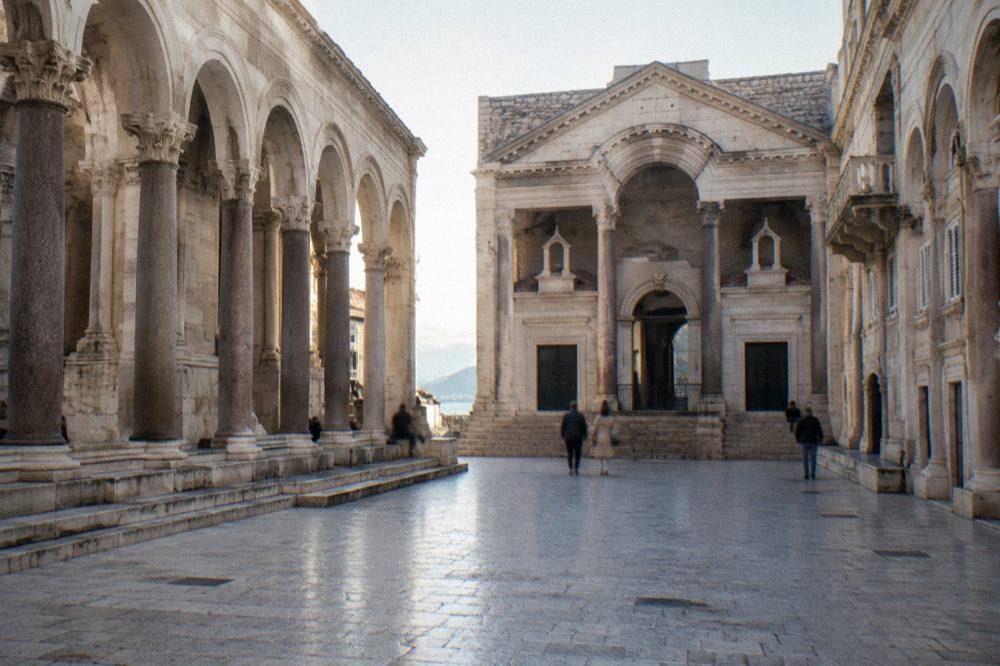
The Peristyle is the main courtyard of Diocletian's Palace in Split, a rectangular open square ringed by colonnades on three sides, built as the ceremonial entrance court of the emperor's residence around c. 295 to 305 AD. It is free to enter at any time, it connects the cellars below, the emperor's mausoleum, which is now the Cathedral of St Domnius, and the Temple of Jupiter, and it is the single most concentrated piece of Roman architecture in the city.
The layout has barely changed in function for seventeen centuries. In the Roman plan, a visitor arriving by sea would climb from the southern waterfront facade into the basement halls, emerge onto the Peristyle, and face the raised platform where the emperor appeared. On the eastern side stood the Temple of Jupiter, on the western side the mausoleum. Both survive: the temple is now the Baptistery of St John, ticketed inside the cathedral scheme, and the mausoleum is the Cathedral of St Domnius with its 57 m bell tower still standing over the square.
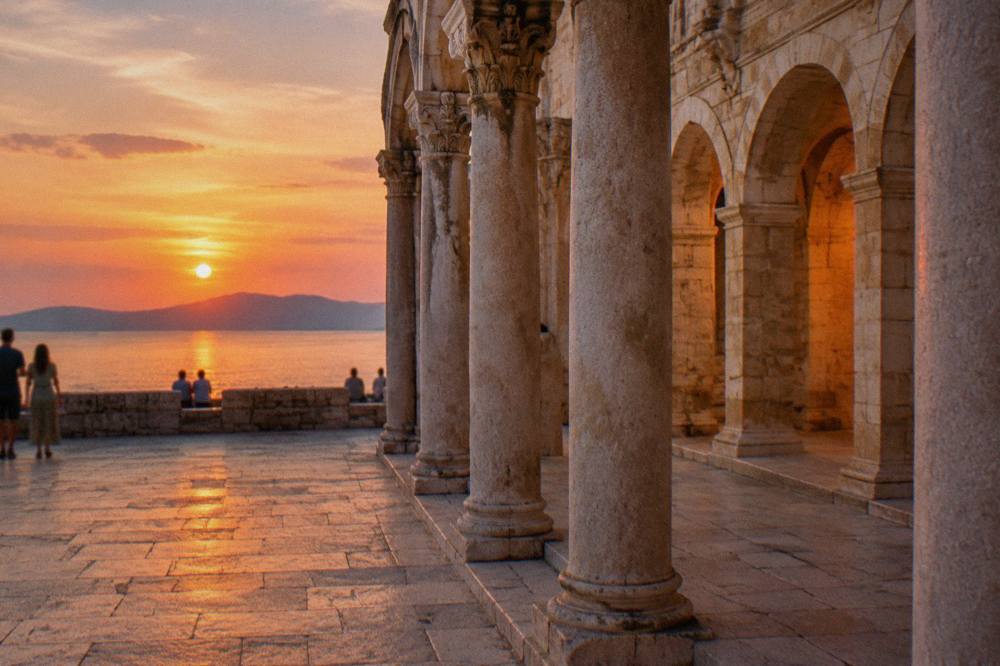
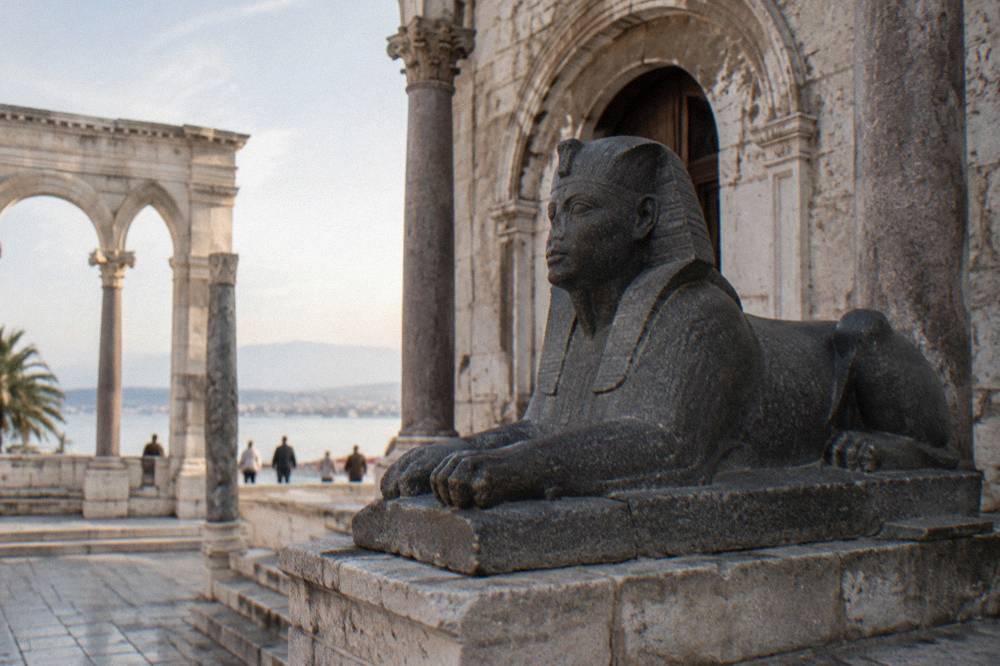
Today the square works as Split's natural meeting point. The northern arcade holds cafés with tables on the Roman paving, a ticket kiosk for the cathedral complex stands on the square itself, and the stepped street of Decumanus runs off toward the Silver Gate and the people's gate toward the Golden Gate. Two of the four Egyptian sphinxes the palace claims survive sit on the Peristyle or beside its approaches, and the black granite sphinx near the entrance to the Vestibule is the one everyone photographs. The Split Croatia Travel Guide covers the rest of the palace quarter area by area, including the Riva promenade directly to the south.
What Can You See From The Peristyle Square?
From the Peristyle you can see the facade and bell tower of the Cathedral of St Domnius, the entrance to the Temple of Jupiter, now the Baptistery of St John, the arched Vestibule that led to the emperor's apartments, the carved Roman portals, the surviving sphinx, and the café terraces set into the northern arcade, all within a space you can cross in under a minute. Every one of these except the cafés belongs to the original palace plan.
The square is small, and that is the point. Diocletian's Palace was built as a fortified residence, and the Peristyle was designed to compress arriving visitors into a single controlled view of imperial power. The colonnade carries the first-floor arcade of the southern wing, the west side is dominated by the mausoleum that became the cathedral, and the east side by the temple that became a baptistery. Between them, a monumental staircase once led up to the Vestibule, the round antechamber of which still opens off the square.
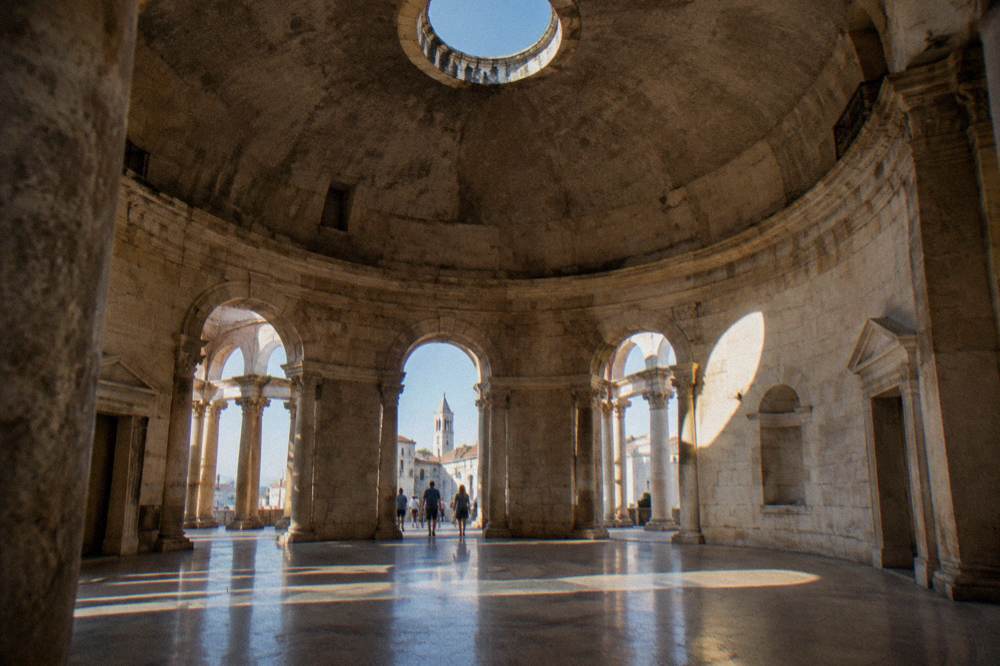
Three sites accessed from the Peristyle or within a minute of it carry tickets, and the rest are free.
| Site | What it is | Entry |
|---|---|---|
| Peristyle square | Open palace courtyard | Free |
| Vestibule | Round antechamber of the imperial apartments | Free |
| Cathedral of St Domnius complex | Mausoleum, crypt, baptistery, treasury, bell tower | From about 5 EUR, combined tickets up to about 15 EUR |
| Diocletian's Palace cellars | Substructure halls below the square, run by the Split City Museum | About 10 EUR |
| Temple of Jupiter, Baptistery of St John | Former Roman temple | Ticketed inside the cathedral scheme |
The Split City Museum's own price list gives the City Museum at Papalić Palace, a short walk north, at 10.00 EUR adult, 8.00 reduced, family 18.00, closed Mondays, and the cellars run daily 8:30 to 20:00. For the cathedral, the ticket prices come from a secondary guide rather than an official price page, so check at the Peristyle kiosk; shoulders and knees must be covered inside. The cathedral of St Domnius guide and the temple of Jupiter guide cover each building in detail, and the cellars guide explains what the restoration of the central section, running to the end of 2026, means for a visit: passage stays open throughout.
When Is The Roman Guard Change On The Peristyle?
The Roman guard change takes place on the Peristyle at noon, and in 2026 it ran every day from 28 May to 27 September. The performance is free to watch, it lasts through the midday hour, and it is organised as part of the city's programme of costumed historical events alongside the Stories of Diocletian festival, which was held from 27 to 30 August 2026.
Costumed legionaries of Legio VII Pia Fidelis march from the Golden Gate through the palace streets to the Peristyle, accompanied by the emperor and his retinue, and the ceremony plays out against the colonnade. The dates shift a little each season, so check the Visit Split events calendar before planning a morning around it. Out of season the square is quieter, and the same stones stand there without costumes.
The wider events calendar touches the Peristyle and its immediate surroundings through the year. The Split Summer Festival, whose 72nd edition ran from 14 July to 14 August 2026, stages opera, ballet and drama on venues including the Peristyle stage. Advent in Split runs from 27 November 2026 to 7 January 2027 with the ice rink at Đardin, a few minutes' walk north. And HNK Split's season runs from 25 September 2026 to 14 June 2027.
| Event | Dates given | Status |
|---|---|---|
| Roman guard change, Peristyle, noon daily | 28 May to 27 September 2026 | Programme ended for 2026 |
| Stories of Diocletian | 27 to 30 August 2026 | Past |
| Split Summer Festival, 72nd edition | 14 July to 14 August 2026 | Past, 2027 not announced |
| Advent in Split, Đardin ice rink | 27 November 2026 to 7 January 2027 | Scheduled |
| HNK Split season | 25 September 2026 to 14 June 2027 | Running |
Is The Peristyle In Split Free To Visit?
Yes, the Peristyle itself is free, with no ticket, no gate and no closing time, because it is a public square inside a lived-in palace. The Split City Museum lists the Peristyle among the palace's free elements alongside the Riva, the Prokurative, the Golden Gate, the Grgur Ninski statue, the markets, Marjan and the city beaches. Only the buildings off the square, the cathedral complex, the baptistery and the cellars, carry tickets.
This is the detail that reshapes a Split budget. A walk that takes in the Peristyle, the Vestibule, the Golden Gate with the Grgur Ninski statue, the Prokurative square, the green market and the whole of the Old Town costs nothing, and a full free-day plan exists on the site. The paid layer, the cathedral, the cellars, the museums, is entirely optional and can be added piece by piece.
For museum-goers, the ticketed sites around the palace at the museums' own published prices:
| Museum or site | Adult ticket | Notes |
|---|---|---|
| Split City Museum, Papalić Palace | 10.00 EUR | 8.00 reduced, family 18.00, closed Mondays |
| Archaeological Museum | 8 EUR | Combined with Salona 10 EUR within 7 days |
| Ethnographic Museum | 7.00 EUR | 4.00 reduced, Vestibule 2.00 |
| Meštrović Gallery | 12.00 EUR | Includes Crikvine-Kaštilac, reopened April 2026 |
| Klis Fortress | 10 EUR | Game of Thrones Meereen location, 9:00 to 17:00 |
The Meštrović Gallery reopened on 20 April 2026 after a 15-month energy renovation, with an exhibition on the sculptor's house and life, and its ticket includes the Crikvine-Kaštilac site across the hill. The Meštrović Gallery guide covers both.
How Old Is The Peristyle In Split?
The Peristyle was built as part of Diocletian's Palace between about 295 and 305 AD, which places it in the late 3rd and early 4th century, at the end of Diocletian's reign and after his retirement to the Dalmatian coast. The UNESCO listing that protects it, the Historical Complex of Split with the Palace of Diocletian, was inscribed in 1979 and covers a property of 20.8 hectares.
No superlative is needed: the dates do the work. The bell tower above the square belongs to the medieval layer rather than the Roman one.
The palace was never abandoned and then rebuilt as a monument; a town grew inside it, which is why streets, shops and apartments sit in the Roman fabric. The three days in Split itinerary is long enough to read those layers at walking pace, from the substructure halls to the medieval and Venetian additions on top.
To have those layers explained by a historian, book a history walking tour here.
What Is Within Walking Distance Of The Peristyle?
Everything in central Split is within walking distance of the Peristyle: the Golden Gate and the Grgur Ninski statue are about two minutes north through the palace streets, the Riva waterfront is immediately south, Marjan's 178 m Telegrin summit and its 819 steps are about 30 minutes west, Bačvice beach is about 15 minutes east, and the ferry port, bus station and railway station sit together 500 to 600 m away on Obala kneza Domagoja.
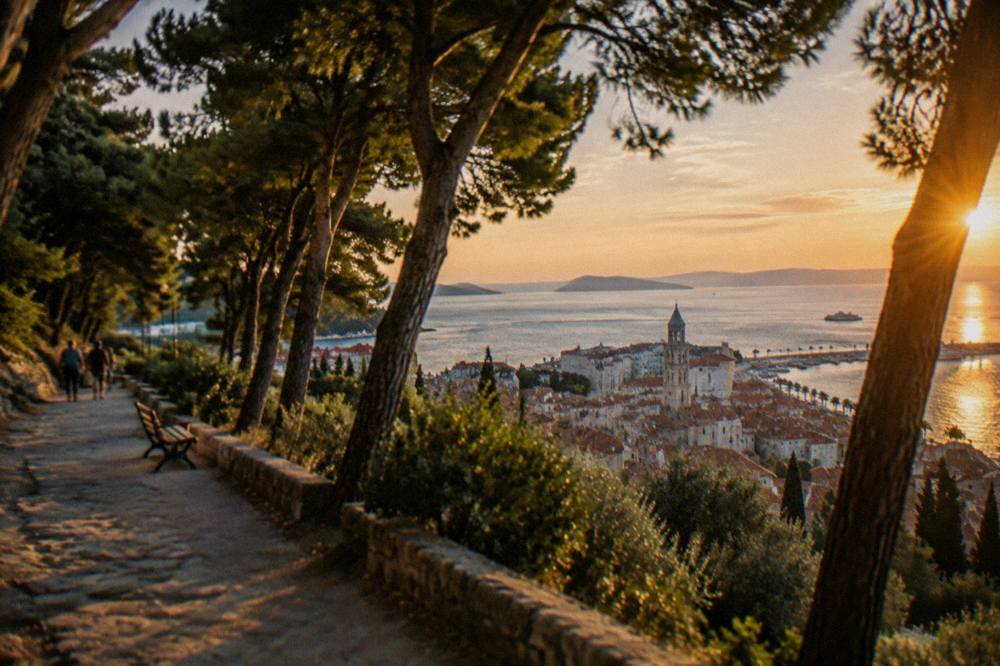
Split is compact and walkable, and the palace sits at the centre of it. The Golden Gate is the palace's north entrance, where the giant bronze Grgur Ninski statue stands and where costumed guards gather before the noon ceremony. South of the square, the Vestibule passage drops onto the Riva, the palm-lined promenade facing the port and the islands. West, the Veli Varos quarter climbs toward Marjan hill, whose park forest covers a peninsula 3.5 km long and 1.5 km wide. East, past the Prokurative and the green market, the shoreline path runs to Bačvice beach, the home of picigin, the ball game protected as intangible heritage.
Day trips beyond the city, with driving times from the palace computed by OSRM at free-flow conditions:
| Destination | Driving time from the palace | Type |
|---|---|---|
| Salona | 14 min | Roman ruins |
| Klis Fortress | 22 min | Fortress |
| Trogir | 36 min | UNESCO town |
| Omiš | 38 min | Cetina river town |
| Šibenik | 71 min | UNESCO cathedral |
| Krka, Skradinski buk | 74 min | National park |
| Makarska | 75 min | Coastal town |
| Zadar | 2 h | Coastal city |
| Mostar | 2 h 13 | Bosnia and Herzegovina |
| Plitvice Lakes | 3 h 15 | National park |
| Dubrovnik | 3 h 21 | UNESCO city |
Which Day Trips From Split Pair Well With The Peristyle?
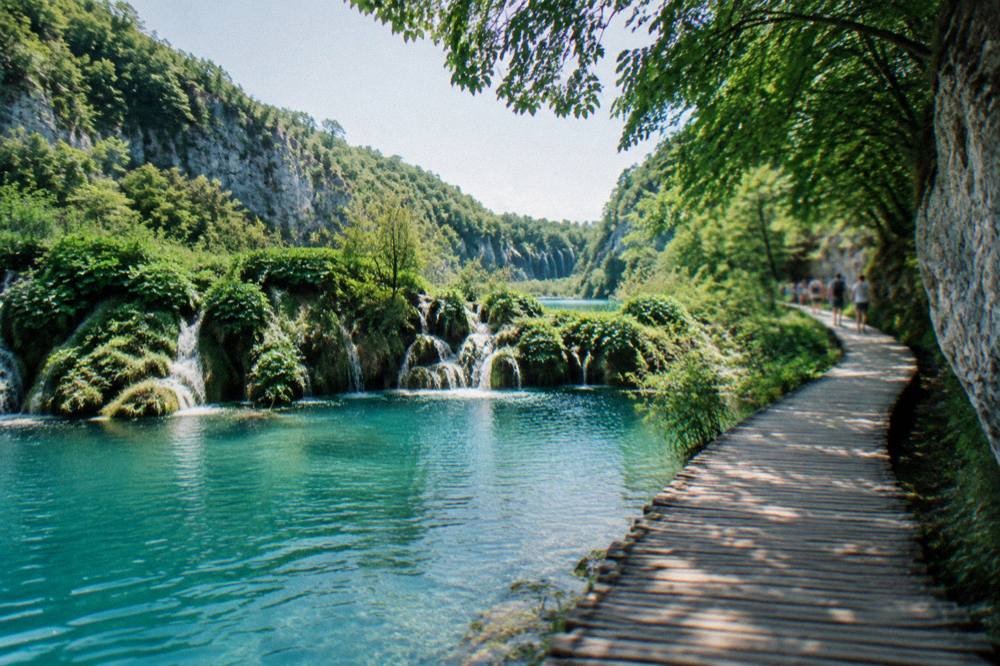
The day trips that pair best with a Peristyle morning are the national park tours, because they leave from the bus station by the ferry port 500 to 600 m from the square and return in time for an evening on the Riva. Plitvice Lakes sits 3 h 15 of driving from the palace and Krka 74 min, and guided tours from Split handle the transport, the guide and, on some departures, the entry tickets, while the palace itself needs no more than a morning.
The palace-first logic is simple. The Peristyle, the cathedral, the cellars and the Old Town lanes fill half a day at walking pace; the other half-day or the alternate day belongs to the parks, the islands or the Cetina canyon. The Krka National Park guide covers a park whose 2026 adult ticket is 7 EUR from January to March and November to December, 20 EUR in April, May and October, and 40 EUR from June to September, with the ticket including the Skradin boat and Lozovac bus transfers from 1 April to 31 October. The Plitvice Lakes guide covers the park priced at 10, 23 and 40 EUR by season, with timed online entry and the visitor's name mandatory on the ticket. Swimming at Krka is allowed only in clearly marked areas, never at Skradinski buk.
For a self-planned trip, the Split day trips guide lists every option with its times and tickets, and Trogir, Hvar and Mostar each have a full page. Ferries add the islands: Jadrolinija's line 635 runs to Stari Grad on Hvar in about 120 minutes with a foot passenger fare of 5.90 EUR off-season and 8.40 EUR in season, line 631 runs to Supetar on Brač in about 50 minutes, line 636 to Rogač on Šolta in about 60 minutes, and the Vis ferry takes about 140 minutes. Catamarans reach Hvar town and Jelsa for 6.40 EUR low season and 10.00 EUR high season.
A guided option keeps the day simple when the lakes are the priority. The Plitvice Lakes guided day trip from Split covers transport from the city and a guided walk through the park, and the listing carries its current price, rating and departure times. For readers weighing guided against self-guided, the two days in Split itinerary builds one day around the palace and one around a day trip.
The variant with entry tickets included removes the timed-entry booking step at Plitvice, where online reservation with the visitor's name on the ticket is required in the peak period. Whichever version fits, both leave from the station hub within a short walk of the Peristyle, so a morning coffee on the square and a lakes afternoon can belong to the same day if the schedule allows.
What Should You Know Before Visiting The Peristyle?
Before visiting the Peristyle, know that entry is free, the square is busiest around noon when the guard change runs in summer, the cathedral kiosk is on the square itself, shoulders and knees must be covered inside the cathedral, and Split's public order rules fine alcohol consumption in the historic centre at 300 EUR, with 300 EUR fines also for urinating, climbing on monuments or bathing in fountains, and 150 EUR for sleeping in public spaces.
Walking in swimwear or shirtless in the historic centre is also an offence, with the amount set locally, so keep beachwear for the beach. Shops in the centre face a night-time retail alcohol sales ban from 21:00 to 06:00 in the summer season, while bars and restaurants are unaffected.
Practicalities around the square are few. Croatia uses the euro since 1 January 2023 and is a Schengen member; the emergency number is 112. Drones are restricted over the old town. The tourist tax, about 2.65 EUR per person per night in high season, is collected by your accommodation and confirmed at booking. And the weather shapes the visit: the DHMZ Split-Marjan station table for 1948 to 2024 gives a July mean of 26.2 C with 18 days at 30 C or more, and a January mean of 8.0 C, so a noon visit is warmest exactly when the guard change runs.
| Month | Mean temperature (C) | Precipitation (mm) |
|---|---|---|
| January | 8.0 | 77.8 |
| April | 14.4 | 62.0 |
| July | 26.2 | 26.6 |
| October | 17.2 | 77.0 |
| November | 12.7 | 115.5 |
The figures above are monthly means from the DHMZ Split-Marjan station for the period 1948 to 2024. November is the wettest month at 115.5 mm and July the driest at 26.6 mm, so an early-morning or late-afternoon Peristyle visit suits midsummer while midday suits the cooler months.
Common Questions About The Peristyle In Split
Is the Peristyle in Split free?
Yes. The Peristyle is an open public square with no ticket and no closing time. Only the buildings off it, the Cathedral of St Domnius complex, the baptistery and the palace cellars, carry tickets.
What is the Peristyle in Split?
It is the central ceremonial courtyard of Diocletian's Palace, built around c. 295 to 305 AD as the entrance court of the emperor's residence. The mausoleum side is now the Cathedral of St Domnius and the temple side is the Baptistery of St John.
What time is the Roman guard change at the Peristyle?
Noon. In 2026 the ceremony ran daily from 28 May to 27 September. The Visit Split events calendar carries the dates for future seasons.
How much does the Cathedral of St Domnius cost from the Peristyle?
Tickets are sold at the kiosk on the Peristyle, from about 5 EUR for a single site with combined tickets up to about 15 EUR. Shoulders and knees must be covered inside.
How do I get to the Peristyle from the Split cruise port?
The ferry port, main bus station and railway station sit together 500 to 600 m from the palace on Obala kneza Domagoja. The walk to the Peristyle takes under ten minutes through the Riva and the southern palace entrances.
Can you enter Diocletian's Palace cellars from the Peristyle?
Yes, the cellars lie directly beneath the southern half of the palace and are run by the Split City Museum, open Monday to Sunday 8:30 to 20:00. The central part is under restoration to the end of 2026 with passage remaining open.
The Peristyle rewards an unhurried hour, at noon for the guard change in summer, at dusk for the light on the colonnade, and early in the morning before the day-trip crowds arrive from the port. Pair it with the cellars below and the bell tower above, keep an afternoon free for a park or an island, and the palace square will have done what it has done for seventeen centuries: serve as the place Split gathers.
