Split Sunset
Sunset in Split falls over the Adriatic to the west of the Marjan peninsula, and the city's own geography decides where the light is best: hilltop paths, the waterfront Riva and the island silhouettes of Šolta, Brač and Hvar.
Short answer
The best Split sunset spots are the Marjan hill park (Telegrin, 178 m, reached by 819 steps from Trumbićeva obala), the Riva waterfront, the Klis Fortress viewpoint 22 minutes' drive away, and the sea itself on an evening kayak trip from Bačvice.
Split sits on a coast that faces west, which is the whole reason this page exists. The sun goes down over the open Adriatic, behind the islands of Šolta, Brač and Hvar, and the city has an unusually wide choice of places to watch it happen: a forested hill with a stone lookout at 178 m, a long waterfront promenade at sea level, a fortress on a ridge above the approach to the city, and the water itself. The Split Croatia Travel Guide editorial desk has assembled what the primary sources say about each of them, from the Marjan park's own published figures to the ferry timetables that decide whether an island sunset is a same-night return or an overnight.

This guide covers the viewpoints, the timing, the weather behind a clear versus a cloudy dusk, and the tours that slot naturally into the last hours of daylight. It links out to the site's deeper pages on Split weather, boat tours from Split and day trips from Split for readers planning further out.
Where Is The Best Place To Watch The Sunset In Split?
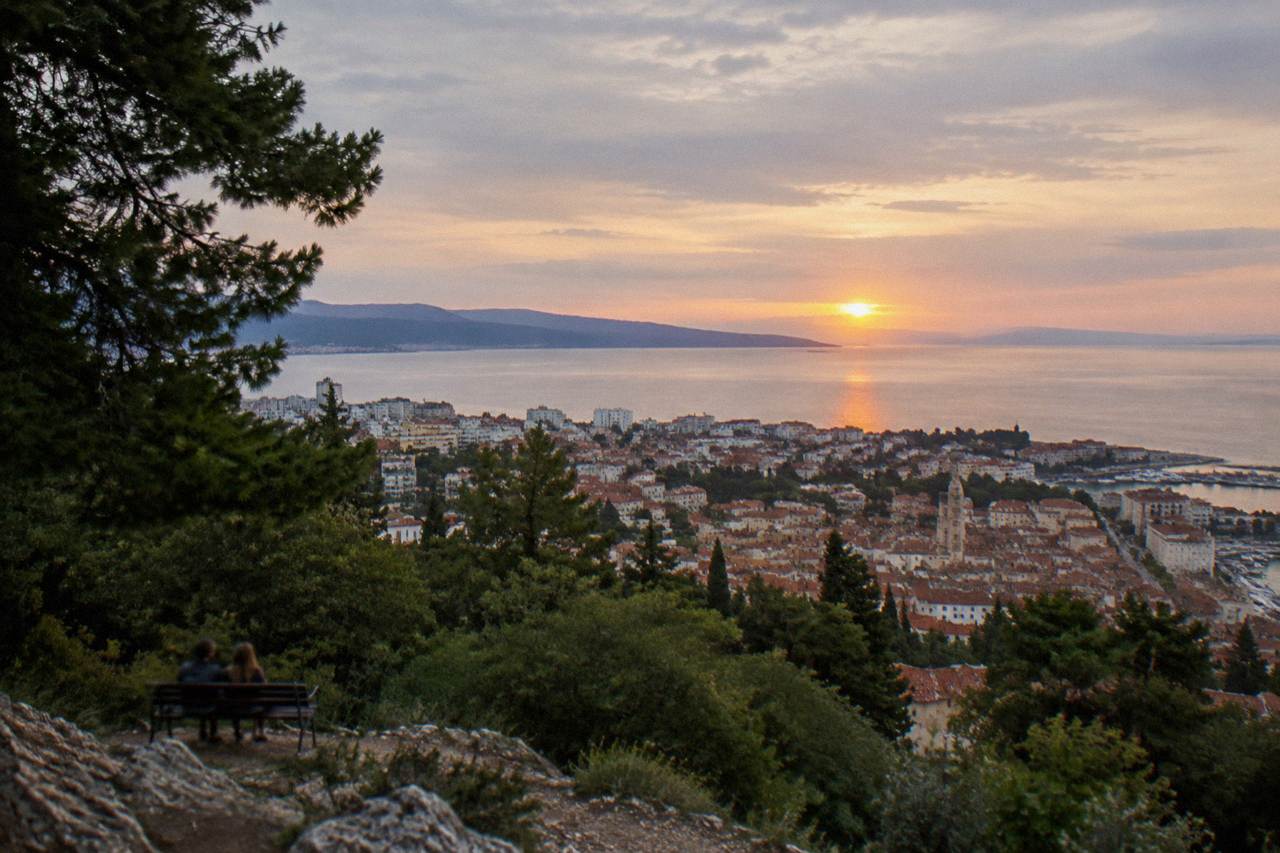
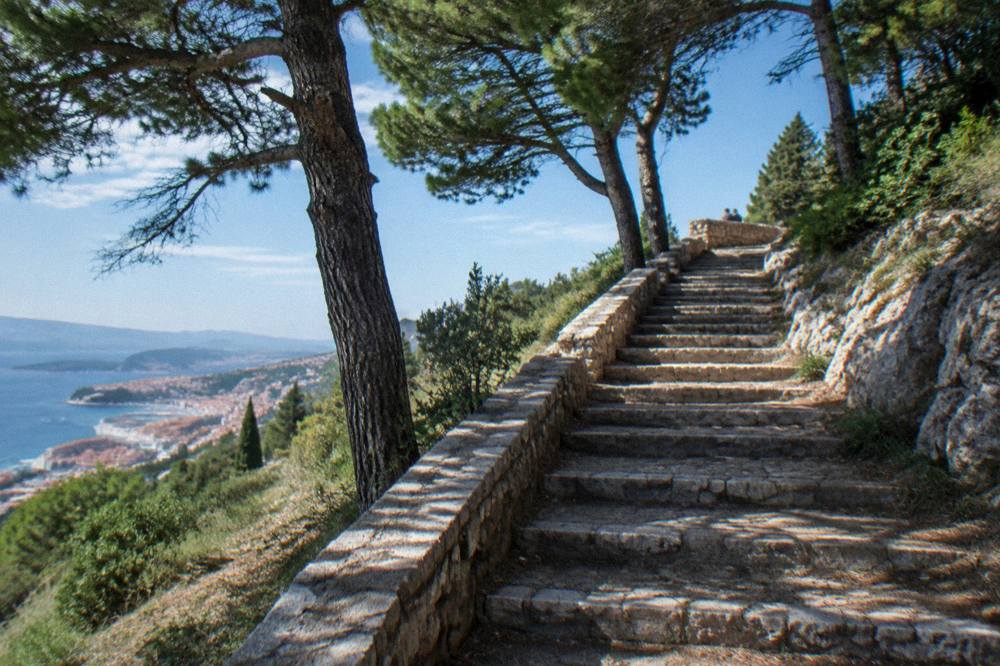
The Marjan hill park is the best place to watch the sunset in Split, and its highest point, Telegrin at 178 m, is reached by 819 steps from Trumbićeva obala on the northern shore. The Marjan park society publishes the peninsula as 3.5 km long and 1.5 km wide, and its western edge looks straight over the open sea, so the sun drops below the horizon rather than behind land. Entry to the park is free.
The Marjan peninsula is the city's big natural advantage at dusk. Because it juts west into the Adriatic, its western paths face open water, and the drop of the sun behind the islands of Šolta and, further out, the silhouette of Vis is visible along the whole western rim. The climb to Telegrin is a real one, 819 steps from the waterfront, and the park society's own data page is the source for that count, the 178 m summit and the peninsula's dimensions. There are gentler options: the southern shore road above Kašjuni is a drive or an easy walk, and the park's road network means you do not have to take the stairs to find a west-facing bench.
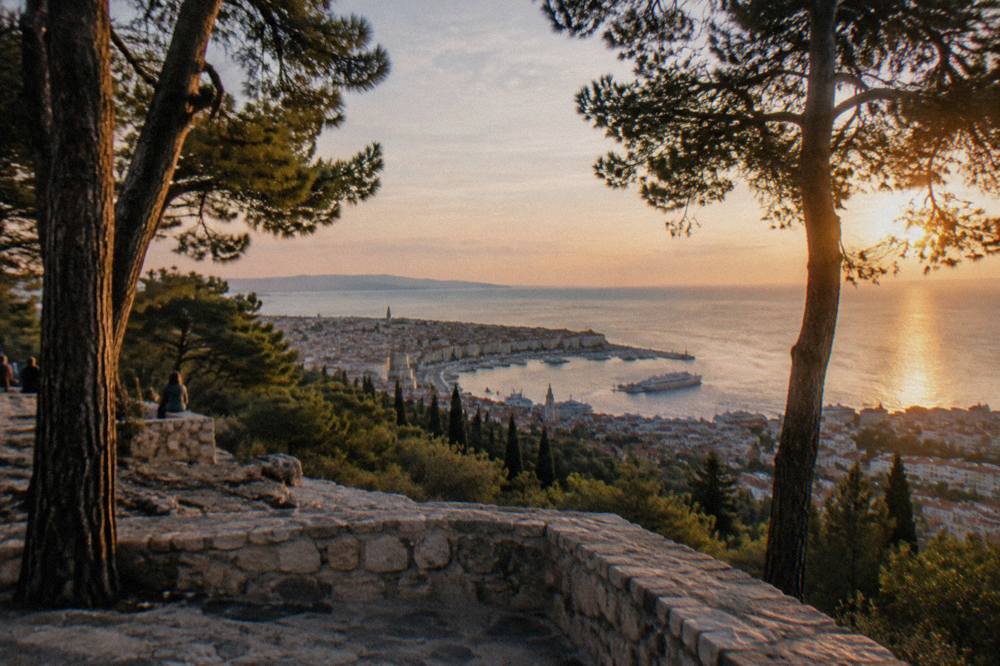
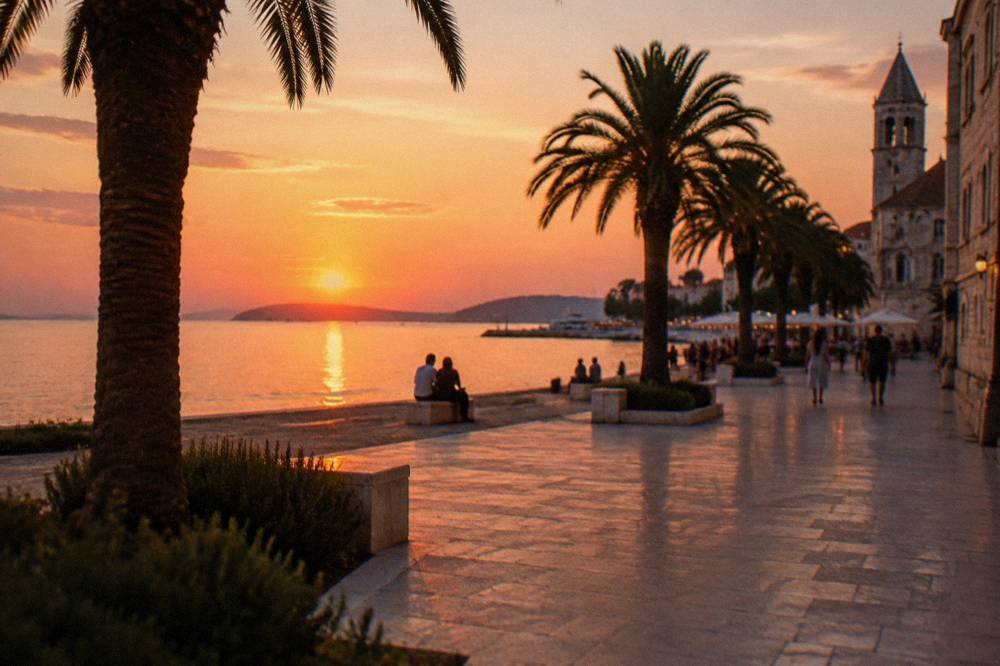
At sea level, the Riva is the classic flat option. The waterfront promenade is free, faces the islands and the channel to Brač, and the Prokurative square just behind it opens a framed west view between its stone wings. Two things to know for planning. The Riva's central section is scheduled for renovation works from November 2026, expected to run a little over a year, so partial closures are likely through 2027. And the Roman guard change on the Peristyle, a free noon event in the 2026 season from 28 May to 27 September, has nothing to do with sunset, but it is the same palace quarter you would walk through on the way down to the water.
A walk that ends at golden hour is exactly what the site's featured tour is built for, a small-group walking tour of the palace and Old Town led by a magister of history, and its tour page lists the current times; the walk covers the palace quarter, the Golden Gate and the streets you would then climb through to reach Marjan's first viewpoints, so an afternoon departure slots before dusk with time to spare.
The table below compares the main free viewpoints on distance, access and what each one faces.
| Viewpoint | Height above sea | Access | Faces at dusk | Cost |
|---|---|---|---|---|
| Telegrin, Marjan | 178 m | 819 steps from Trumbićeva obala | Open sea, Šolta | Free |
| Marjan southern shore, above Kašjuni | Lower slopes | Road and footpaths | Open sea, island silhouettes | Free |
| The Riva | Sea level | Flat walk from the palace, 500 to 600 m | Brač channel | Free |
| Prokurative square | Sea level | Flat, off the Riva | Framed west view between buildings | Free |
| Bačvice and Žnjan beaches | Sea level | Flat walk east of the port | Sea and harbour entrance | Free |
What Time Does The Sun Set In Split Through The Year?
Split's sunset is not published as a single official figure by any official source, and exact times shift daily with the season, so the honest answer is to check a current almanac or weather app for the date of your visit.
What the DHMZ Split-Marjan station table does give is the shape of the year: 353.3 hours of sunshine in July against 120.8 hours in December, and a July mean temperature of 26.2 C against 8.0 C in January, for the 1948 to 2024 period.
The practical pattern matters more than any single clock time. In the depth of summer the evening light lingers long after the sun crosses the horizon, and the sea stays warm enough that a dusk swim at Bačvice is a normal local routine rather than an act of endurance; the live DHMZ sea reading is the only sea figure this site will print, because no official monthly sea-temperature normal exists. In December, dusk arrives in the late afternoon, and the Christmas-season Advent programme, 27 November 2026 to 7 January 2027 with the ice rink at Đardin, is built around that early dark.
Here is the DHMZ Split-Marjan station table, means for 1948 to 2024, which is the record behind every seasonal claim on this page. Full monthly detail and rainfall sit on the site's Split weather page.
| Month | Mean temperature | Sunshine | Notes for sunset planning |
|---|---|---|---|
| January | 8.0 C | Short days | Early dusk, Advent tail ends 7 January |
| April | 14.4 C | Lengthening | Long golden hours, mild terraces |
| July | 26.2 C | 353.3 h | 18 days at 30 C or more |
| August | 25.9 C | Near July levels | 17 days at 30 C or more |
| October | 17.2 C | Shortening | Softer light, emptier viewpoints |
| December | 9.4 C | 120.8 h | Earliest dusks of the year |
November deserves a specific word: it is the wettest month in the DHMZ table at 115.5 mm, against July as the driest at 26.6 mm. A late-autumn trip buys quiet viewpoints and low-season prices, but it also buys the year's highest chance of a sunset hidden behind cloud, and the November 2026 start of the Riva renovation adds another reason to base a winter dusk on Marjan rather than the waterfront.
Can You Watch The Sunset From The Water Or The Islands?
Yes, and the ferry and catamaran timetables are what decide it: Jadrolinija's route pages give the Split to Stari Grad car ferry at about 120 minutes, the Supetar ferry at about 50, the Rogač ferry on Šolta at about 60 and the Vis ferry at about 140, while catamarans run to Hvar town and Jelsa and to Vis on separate lines.
An island sunset means checking the last same-day sailing, because Hvar town itself is reached by catamaran and Stari Grad by car ferry, and the two are not interchangeable.
The foot passenger fares in the Jadrolinija price list are 5.90 EUR off-season and 8.40 EUR in season for the Stari Grad line, and the catamaran fares run at 6.40 EUR low and 10.00 EUR high to Hvar or Jelsa, and 7.20 to 10.00 EUR to Vis. Those are fares the operator's own documents publish, not estimates. Whether any of them work for a same-night sunset return depends entirely on the date's timetable, so the rule is simple: check the operator's sailing list for your date before committing to an island dusk.
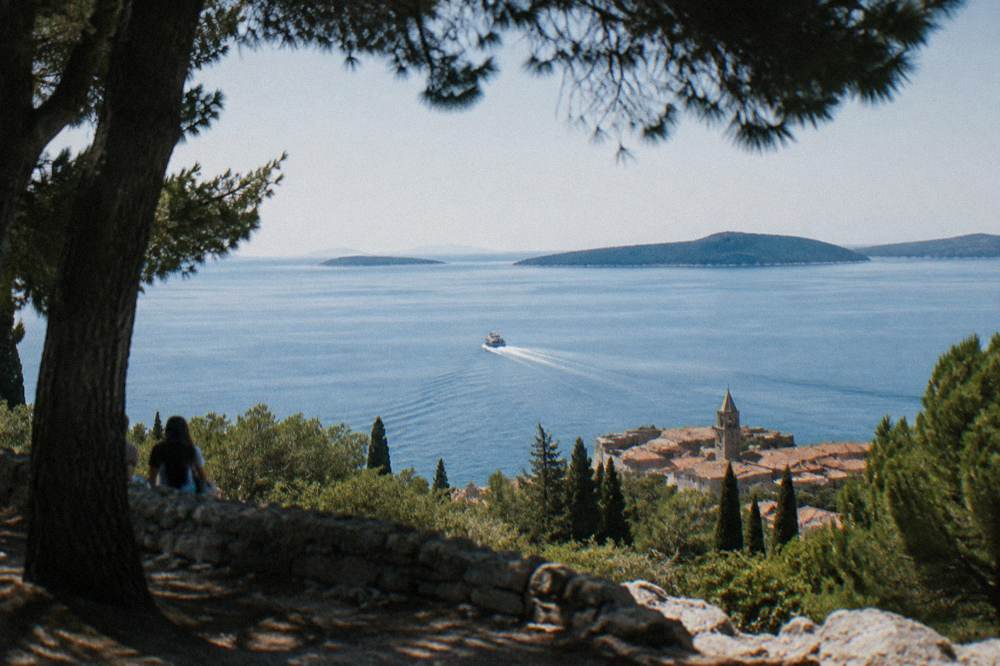
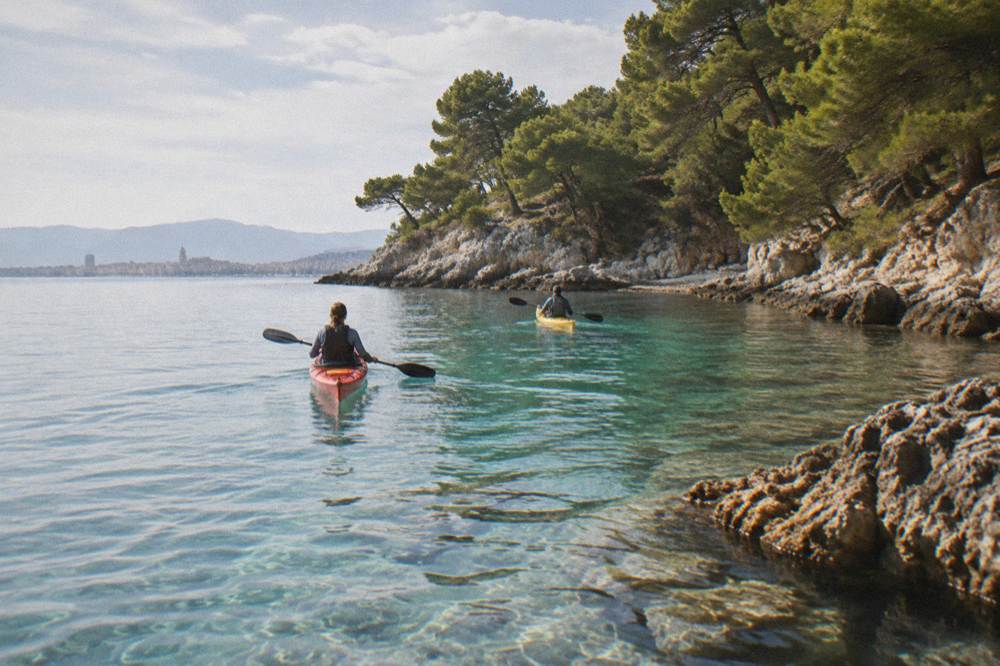
Closer to home, the sea inside the harbour is the easy evening option. An illuminated evening kayak trip departs from the city waterfront and paddles the coast as the light goes, which pairs a sunset with the sight of the illuminated waterfront on the return. The site's boat tours from Split page lists the full range of daytime and evening options, including the Blue Lagoon cruises that return along the coast in the late afternoon.
For readers who like the numbers laid out, this is what the operator's own route pages give for the island crossings.
| Route | Type | Crossing time | Foot passenger fare |
|---|---|---|---|
| Split to Stari Grad, Hvar | Car ferry, line 635 | About 120 min | 5.90 EUR off-season, 8.40 EUR in season |
| Split to Supetar, Brač | Car ferry, line 631 | About 50 min | On the operator's price list |
| Split to Rogač, Šolta | Car ferry, line 636 | About 60 min | On the operator's price list |
| Split to Vis | Ferry | About 140 min | On the operator's price list |
| Split to Hvar town or Jelsa | Catamaran | On the sailing list | 6.40 EUR low, 10.00 EUR high |
| Split to Vis | Catamaran | On the sailing list | 7.20 EUR low, 10.00 EUR high |
Which Sunset Day Trips Work From Split?
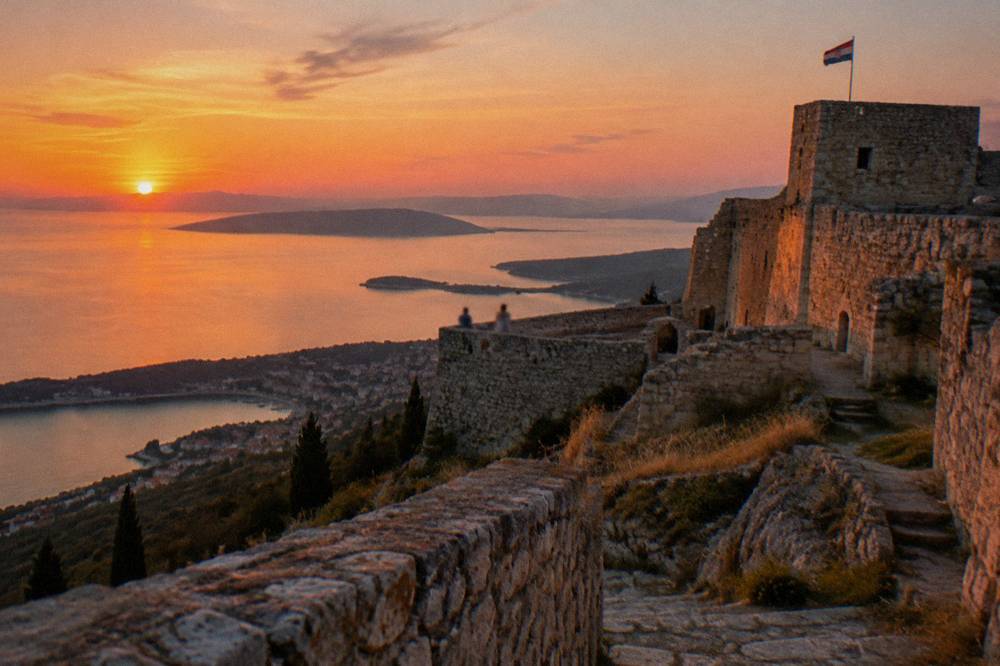
Klis Fortress is the closest elevated sunset trip, 13.9 km and about 22 minutes' drive from the palace by free-flow road data, with a 10 EUR adult ticket that visitors should confirm on site, and it doubles as a Game of Thrones Meereen location. Further afield, the OSRM free-flow figures give Omiš at 38 minutes, Šibenik at 71 and Trogir at 36, all of them west- or south-facing towns where a sunset stop can end a day trip.
Klis is the one that fits a sunset brief most naturally. The fortress sits on a ridge above the Klis pass with a long view down to Split and the sea, the drive is short, and the site keeps daily hours that a reader should confirm locally for the evening visit. A sunset tour of Klis Fortress runs from Split and includes the Game of Thrones framing for readers who came for Meereen. Trogir, a UNESCO-listed town since 1997 on its small island, is another easy dusk: 36 minutes' drive, a waterfront that faces west, and a small-core layout that needs no car once you arrive.
If a guided evening at the fortress appeals, book a Klis Fortress sunset tour here.
The site's day trips from Split page carries the full menu; the table here lists only the destinations where an evening or late-afternoon return through golden light is a realistic part of the plan, with the driving figures the site's road-distance data computed from the palace.
| Destination | Drive from the palace | Free-flow time | Why it works at dusk |
|---|---|---|---|
| Klis Fortress | 13.9 km | 22 min | Ridge view over Split and the sea |
| Salona | 9.1 km | 14 min | Open Roman site, low-angle light |
| Trogir | 29.3 km | 36 min | West-facing UNESCO waterfront |
| Omiš | 25.5 km | 38 min | Cetina river mouth under the cliffs |
| Šibenik | 84.8 km | 71 min | Channel-side old town, fortress view |
| Marjan, in-city | Within Split | 819 steps to Telegrin | The zero-fuel option |
What Does A Split Sunset Evening Look Like Hour By Hour?
A workable dusk plan runs: a late-afternoon walk of the palace quarter, the climb or drive up Marjan for the sun's descent, a return to the Riva or Bačvice as the sky colours, and dinner after dark, since the DHMZ table shows July and August means of 26.2 C and 25.9 C and Croatian dinner habits run late in summer.
The palace cellars keep 8:30 to 20:00 hours Monday to Sunday per the Split City Museum, though their central part is under restoration to the end of 2026 with passage open.
Start inside the walls. Diocletian's Palace, built c. 295 to 305 AD for the emperor who retired here, is a lived-in quarter rather than a ruin, and its west-facing Golden Gate and the Peristyle catch low light an hour or two before sunset in a way midday glare flattens. The substructures, the cellars on the southern side, are the one interior part with published hours, and the Split City Museum's price list shows the City Museum itself at 10.00 EUR adult with the Papalić palace closed Mondays. The Diocletian's Palace guide on this site's root page lays out the full circuit.
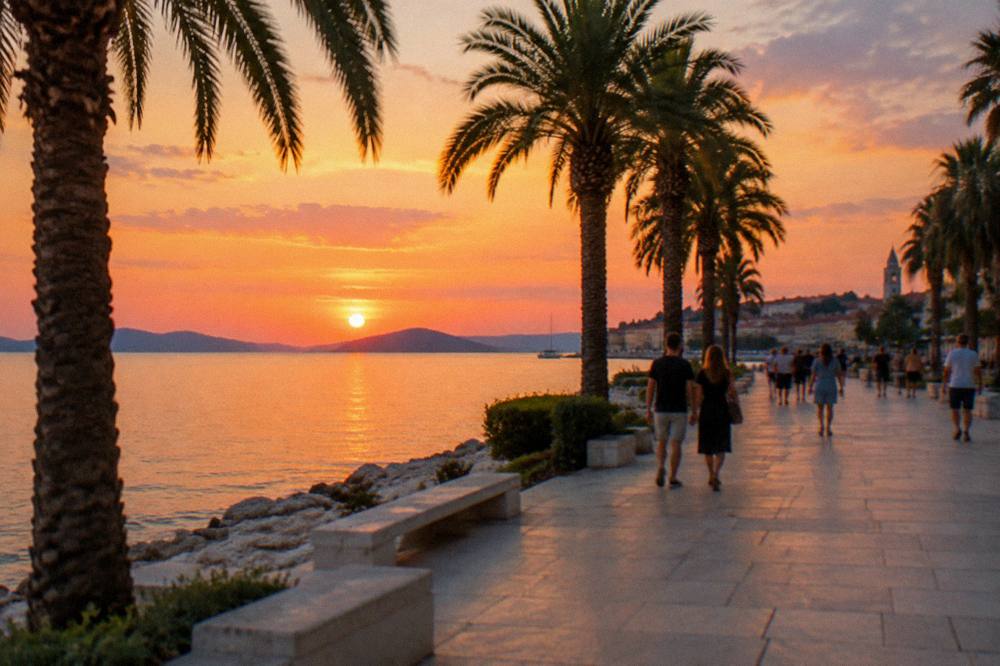
Then move up or out. The 819 steps to Telegrin take a steady walker well under an hour, and the reward is the whole western horizon; the Kašjuni-side road is the fallback for anyone who would rather not climb. Come down as the colour deepens, walk the Riva while the sky is still working, and finish at Bačvice, where picigin, the shallow-water ball game born on that beach in 1908 per the local account, is played into the evening in summer. The site's pages on Split restaurants and Split nightlife pick up the story after dark, and where to stay in Split covers the neighbourhoods that put all of this within a flat walk.
One behavioural note, because the city publishes it: the 2026 public-order rules for the historic core set a 300 EUR fine for drinking alcohol in public in the centre, and a night-time retail alcohol sales ban applies to shops, not bars and terraces, in the summer season. Terrace drinking is licensed and normal; street drinking is not. The rules also cover dress in the historic core, so change out of swimwear before walking back through the old streets, with the fine amount for that set locally and best simply avoided.
Do You Need A Tour To Enjoy Sunset In Split, Or Can You Do It Yourself?
No tour is needed: every headline viewpoint, Marjan, the Riva, the Prokurative, the beaches and the Golden Gate, is free and walkable, and the 500 to 600 m between the palace and the ferry-port waterfront makes the whole circuit flat except the Marjan climb. A tour earns its place when you want interpretation with the light, a historian's palace walk before dusk, a guided kayak on the water, or a Klis fortress trip with transport included.
The self-guided version costs nothing but shoe leather. The guided versions add context, and three fit the dusk window from different angles: the magister-led small-group walk for the palace, the evening kayak for the sea view, and the Klis sunset tour for the ridge. A Zip Line adventure over the Cetina canyon out from Omiš and a Mostar and Kravice day trip are daylight products, but both return through the coastal corridor in the late afternoon, which is worth knowing when you are pairing a big day trip with a same-evening sunset at home in the city.
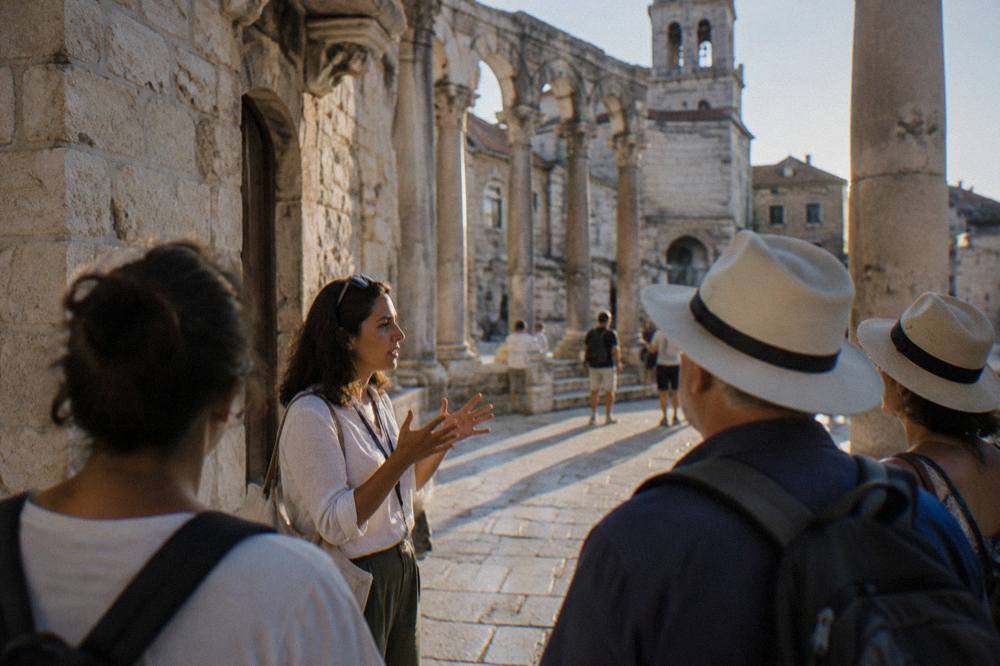
For the featured walk, Check availability against your dates, since departure times move with the season and the operator's live listing carries them. Free or tip-based walks also run locally; confirm the meeting point and the tipping convention with the guide directly, as this site carries no verified details of individual free walks.
This comparison covers the options that bookend a dusk plan.
| Option | What it covers | Sits in the day | Guided |
|---|---|---|---|
| Marjan on your own | Steps, Telegrin, west rim | Late afternoon to dusk | No |
| Palace walking tour | Diocletian's Palace, Old Town | Afternoon, before the climb | Yes |
| Evening kayak trip | City coast from the water | Dusk into darkness | Yes |
| Klis sunset tour | Fortress, ridge views, transport | Late afternoon to evening | Yes |
| Riva and Bačvice walk | Waterfront, beaches, picigin | After the descent | No |
What Should You Know About Weather, Crowds And Timing?
The DHMZ Split-Marjan station table, 1948 to 2024, gives July 353.3 sunshine hours and 26.6 mm of rain against November's 115.5 mm, and 18 days at 30 C or more in July and 17 in August, so summer dusks are near-guaranteed clear but hot and busy, while October's 17.2 C mean and shorter queues trade daylight for comfort. The driest reliable window for a viewpoint without a crowd is late September into early October, after the summer peak but before the November rains.
July and August bring the heat and the festival calendar with them. The Split Summer Festival's 72nd edition ran 14 July to 14 August 2026 across venues including the Peristyle, and Ultra Europe 2027 is fixed for 9 to 11 July at Park Mladeži, dates that put tens of thousands of extra people in the city and on its waterfront; the site's Ultra Europe page covers that weekend in detail. If your trip overlaps those dates, book anything with a boat or a guide well ahead and expect the flat viewpoints to be busy.
Shoulder-season dusks have their own case. October's mean of 17.2 C is still terrace weather, the sea holds summer warmth into autumn, and the Krka and Plitvice park price lists drop on 1 October, 20 EUR and 23 EUR respectively for adults, which matters if a park day trip shares the itinerary with your sunset evening. The best time to visit Split page works through the whole calendar. Whenever you come, the last practical rule is the simplest: be in position half an hour before the published sunset time, because the colour show in Split starts well before the sun touches the water and carries on for twenty minutes after it is gone, and the walk down from Marjan in full dark is a different proposition from the walk up.
Common Questions About Split Sunsets
Where is the best sunset in Split?
Telegrin on Marjan hill, at 178 m and reached by 819 steps from Trumbićeva obala, is the highest free viewpoint and faces the open sea. The Riva, the Prokurative and the city beaches are flat, free alternatives.
Can you see the sunset from the Riva in Split?
Yes. The Riva is a free sea-level promenade facing the Brač channel, about 500 to 600 m from the palace. Note that renovation of its central section is planned from November 2026 for a little over a year, so partial closures are expected through 2027.
Can you watch the Split sunset from a kayak?
Yes, an illuminated evening guided kayak trip departs from the city waterfront and paddles the coast around dusk. Times and availability are on the operator's live listing.
Is Klis Fortress good for sunset?
Yes. Klis Fortress is 13.9 km and about 22 minutes' drive from the palace, sits on a ridge with a long view to the sea, and its reported 10 EUR adult ticket should be confirmed on site. A sunset tour from Split includes transport.
Which month has the best evenings in Split?
By the DHMZ Split-Marjan table for 1948 to 2024, July averages 26.2 C with 353.3 sunshine hours, while October averages 17.2 C with far fewer people. Late September into October is the trade-off point between warmth, light and crowds.
Can you catch a ferry back to Split after an island sunset?
It depends on the date's timetable. Jadrolinija's route pages give roughly 120 minutes to Stari Grad, 50 to Supetar, 60 to Rogač and 140 to Vis, so check the last same-day sailing before planning an island dusk, and remember Hvar town is reached by catamaran while Stari Grad takes the car ferry.