Golden Gate Split
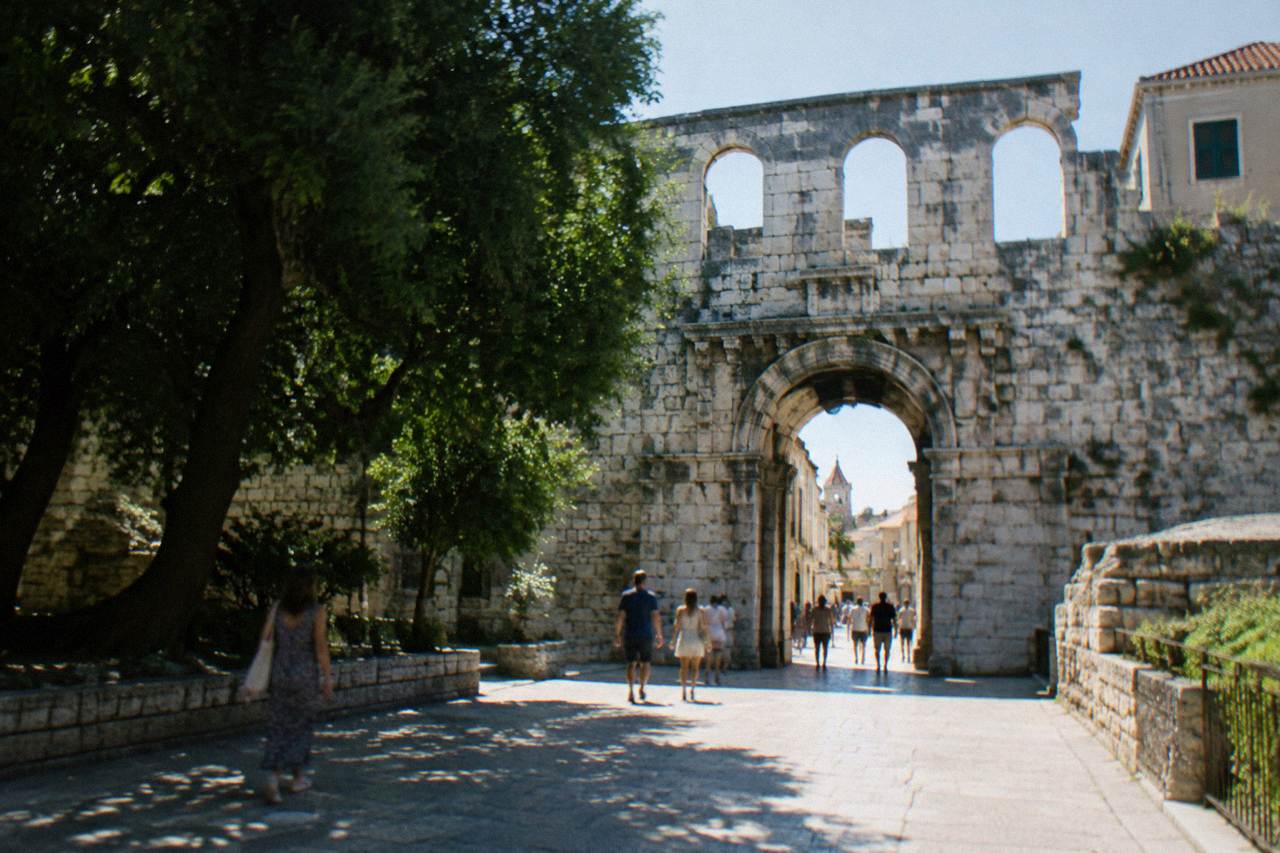
The Golden Gate is the monumental north entrance of Diocletian's Palace in Split, the point where the Roman walled city met the road inland, and today the spot where a large bronze statue of a bishop stands in the open air, free to see at any hour.
Short answer
The Golden Gate is the preserved north gate of Diocletian's Palace in Split, Dalmatia, built c. 295 to 305 AD as part of the UNESCO-listed palace complex. Seeing the gate and the bronze bishop statue beside it costs nothing, the site is open around the clock, and it sits about 500 m from the Riva waterfront.
Split, the coastal city in central Dalmatia on the Adriatic, grew inside and around one building: the palace Emperor Diocletian commissioned for his retirement, constructed c. 295 to 305 AD and inscribed by UNESCO in 1979 as the Historical Complex of Split with the Palace of Diocletian, a property of 20.8 ha. The Golden Gate is the palace's north entrance, the gate that once faced the road running inland toward Salona, and it is one of the few parts of the complex that asks nothing of a visitor: no ticket, no queue, no hours. You walk through it the way Romans did, under the same stone, and you come out beside one of the most photographed bronzes in Croatia, the big statue of a bishop whose story is told further down this page.
This page covers what the gate is, why the statue stands there, what else around it is free, how to reach it on foot from the port and the beaches, and how it fits into a day in the city. For the wider picture of the palace itself, start with the Diocletian's Palace overview, and for a tight schedule see one day in Split.
What Is The Golden Gate In Split?
The Golden Gate is the monumental north gate of Diocletian's Palace in Split, built as part of the palace complex of c. 295 to 305 AD and now the free, always-open northern entrance to the city's Old Town. UNESCO inscribed the whole historical complex in 1979, and the listed property covers 20.8 ha, with the gate on its northern landward side.
The palace was a walled rectangle with gates on its axes, and the north gate was the formal landward entrance, the one a visitor arriving from Salona, the Roman capital of the province, would have used. Split's Old Town is the continuation of that walled interior: the gate does not lead into a monument behind a rope, it leads into streets, shops and flats, because people have lived inside the palace walls continuously since it was built. That is the single detail that makes Split different from almost every other Roman site on the Adriatic.
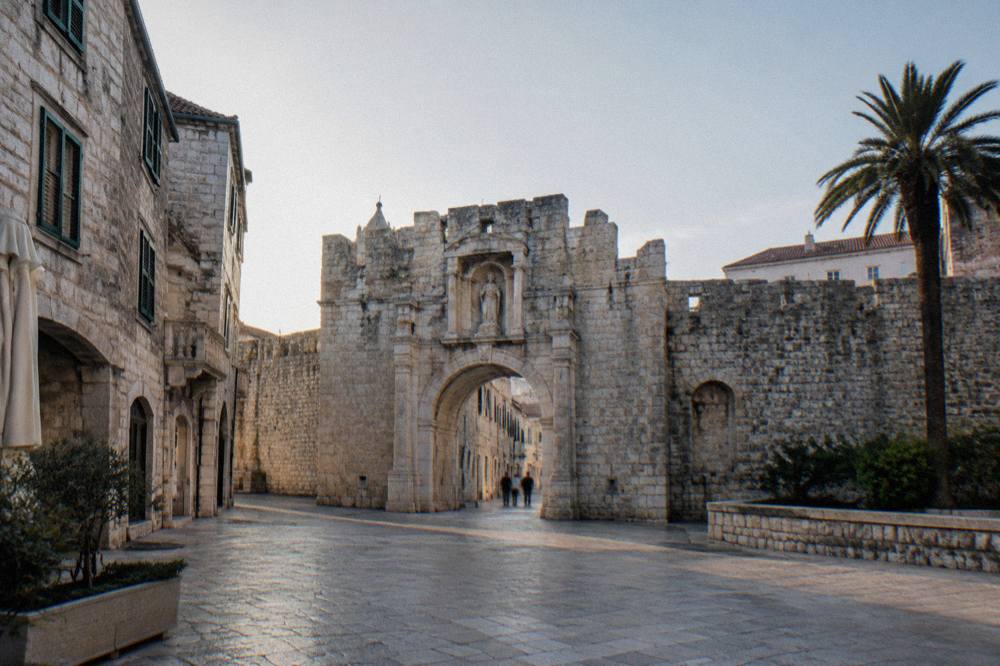
The gate area acts as a hinge between two Split worlds. To the north spreads a leafy square with cafes and the view up toward the park forest of Marjan, described in more detail on the Marjan hill guide. To the south, straight through the arch, the palace interior begins, running down to the Peristyle, the cathedral complex and, beyond the southern wall, the Riva seafront promenade. A walk from the gate to the sea through the palace core is short, unhurried and entirely pedestrian.
Nothing about the gate itself is ticketed.
| Site in or beside the palace | Cost |
|---|---|
| Golden Gate | Free |
| Peristyle | Free |
| Riva promenade | Free |
| Prokurative square | Free |
| Bronze bishop statue at the Golden Gate | Free |
| Diocletian's Palace cellars | Ticketed, city museum price list applies |
| Cathedral of St Domnius complex | Ticketed, from about 5 EUR, combined up to about 15 EUR |
The cellars are run by the Split City Museum, whose price list shows 10.00 EUR adult, 8.00 EUR reduced and 18.00 EUR family for the Papalić Palace site, with the substructures open Monday to Sunday 8:30 to 20:00; the central part is under restoration to the end of 2026 and the passage stays open. The cathedral prices are secondary-guide figures, so treat them as approximate and confirm at the kiosk on the Peristyle. Full details sit on the cathedral of St Domnius page.
Why Is There A Giant Bronze Statue At The Golden Gate?
Beside the Golden Gate stands an oversized bronze statue of a robed bishop with a raised hand, and it is one of the most photographed public monuments in Split. The statue depicts a figure from the early Croatian church associated in local tradition with the use of the Croatian language in worship, and rubbing its polished toe is a local custom said to bring luck.
The statue's placement is deliberate theatre. It faces the square outside the gate, so you meet it before you enter the palace, and its scale against the Roman wall behind it compresses many centuries of Dalmatian history into one frame. The bishop's raised hand and defiant stride read as a gesture of resistance, which is why the monument has become shorthand in Croatia for cultural and linguistic identity rather than for one man's biography.
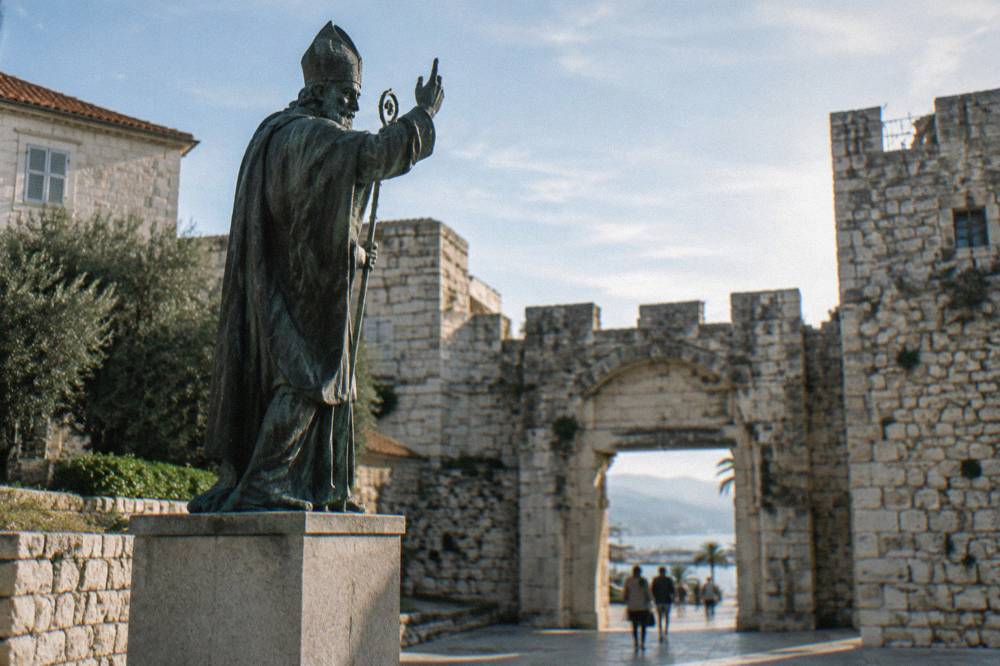
The statue's toe is the detail everyone comes for. Decades of hands have polished that patch of bronze to a bright shine, and the custom is now as much a part of a first visit to Split as walking through the gate itself. Photographers will get the cleanest shots in the first hour after sunrise, when the square is quiet and the light comes low across the facade, though at any hour the spot is busy with people taking the same picture.
The statue also sits on one of the great sculptural traditions of the city, and a deeper dive is easy to combine with the gate. The Meštrović Gallery guide covers the gallery on the Marjan side of the city, which reopened in April 2026 after a fifteen-month energy renovation and charges 12.00 EUR for an adult ticket that also includes the Crikvine-Kaštilac site. Croatia's modern sculpture, and the way Split displays it in public space, is a story the gallery tells far better than a single street-corner bronze can.
For travelers who prefer an orientation with a local operator before walking solo, guided city loops cover the palace quarter and the seafront in one circuit:
To hear the palace explained by someone who teaches its history, book a professor led walking tour here.
The electric tuk-tuk city ride in that set is the one most naturally paired with the Golden Gate, because it loops the city's headline sights, gate included, without a long walk in the heat. July, at a mean of 26.2 C on the DHMZ Split Marjan station record for 1948 to 2024, with 18 days at 30 C or more, is the month when a ride instead of a march earns its keep. You can read more about the tour on its own page for the Electric Tuk-Tuk City Ride.
What Can You See For Free Around The Golden Gate?
Around the Golden Gate, the free list includes the gate itself, the bronze bishop statue, the Peristyle, the Prokurative square, the Riva promenade, the city markets, the park forest of Marjan and the city beaches. A visitor can spend a full day in Split on foot, gate to sea to summit, without buying a single attraction ticket.
The free itinerary writes itself. Through the gate and straight south, the streets of the palace core open onto the Peristyle, the columned courtyard that served the imperial apartments, and the Peristyle guide covers what to look for there, including the Roman guard change ceremony that ran daily at noon from 28 May to 27 September 2026. A few steps west of the Peristyle, the Prokurative, the arcaded square inspired by Venetian models, faces the sea, and beyond it the Riva, the palm-lined waterfront promenade, runs the length of the old city.
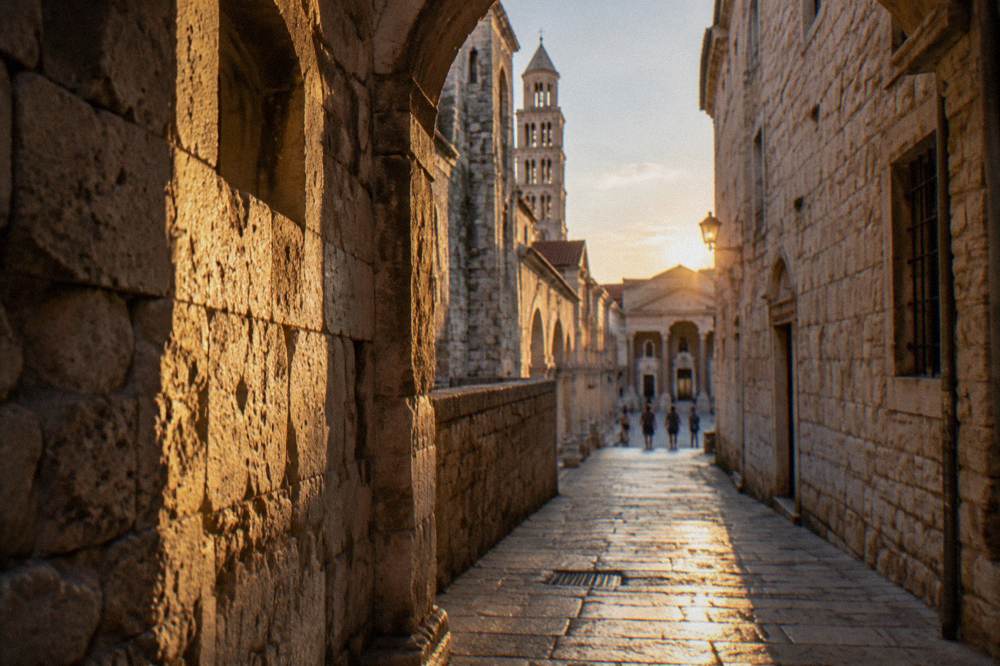
West of the gate, the ground climbs into the Veli Varos quarter and then Marjan, the park forest peninsula whose highest point, Telegrin, stands 178 m above the sea, reachable by 819 steps from Trumbićeva obala. East along the shore, the city beaches begin with Bačvice, the shallow sandy bay where the ball game picigin has been played since 1908 and is now protected intangible heritage of Croatia. None of it costs anything to enter.
| Free site | Direction from the Golden Gate | What it is |
|---|---|---|
| Peristyle | South, through the palace core | Columned imperial courtyard of the palace |
| Prokurative | Southwest of the Peristyle | Arcaded square open to the sea |
| Riva promenade | South, at the waterfront | Palm-lined seafront promenade |
| Marjan park forest | West, up the hill | 3.5 km long, 1.5 km wide peninsula, Telegrin at 178 m |
| Bačvice beach | East along the shore | Sandy city beach, home of picigin since 1908 |
| Green market | Northeast of the gate | The city's daily produce market |
One planning note for 2026 and 2027: the central section of the Riva is scheduled for renovation works planned from November 2026 and expected to last a little over a year, so partial closures along the waterfront promenade are expected through 2027. The promenade stays walkable end to end overall, but staging and hoarding may sit along the central stretch, and the sea-facing view will vary section by section until the works finish.
Food near the gate is covered elsewhere on this site in detail, but the practical habit worth forming is simple: check the posted menu and whether a cover charge appears on it before sitting down anywhere in the Old Town, and check the bill is itemised before paying. Prices in Croatia are in euro, the currency since 1 January 2023, and card payment is normal in the city, a point expanded on the money and cards page of the main Split guide.
How Far Is The Golden Gate From The Port, The Bus Station And The Beaches?
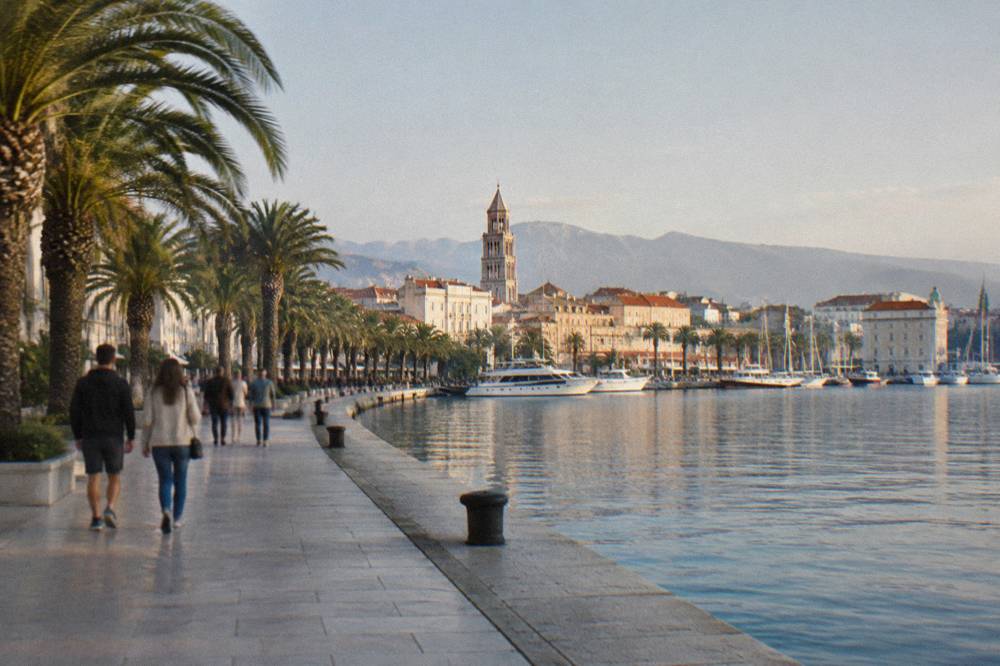
The Golden Gate sits roughly 500 to 600 m from the ferry port, the main bus station and the railway station, which all stand together on Obala kneza Domagoja on the north edge of the harbour. From the cruise berth or the ferry gangway, the walk to the gate is under ten minutes at an easy pace, entirely on pedestrian-friendly streets.
That geography is the quiet advantage of Split as a city break. Transport arrives on one strip, the Old Town begins a few hundred metres away, and the Golden Gate is on the far side of the palace from the port, so a walk from a ship or ferry to the gate crosses the whole length of the Roman street grid, ending at the north wall. The Riva promenade guide and the cruise port day itinerary on a day from the Split cruise port cover the exact route options.
Outbound journeys from the same transport hub are equally close. The island ferries and catamarans leave from the piers by the bus station: the line 635 car ferry to Stari Grad on Hvar takes about 120 minutes, the line 631 to Supetar on Brač about 50 minutes, the line 636 to Rogač on Šolta about 60 minutes, and the ferry to Vis about 140 minutes. Foot passengers on line 635 pay 5.90 EUR off-season and 8.40 EUR in season per the Jadrolinija price list. Note that Hvar town itself is reached by catamaran while Stari Grad takes the car ferry, a mix-up the Split to Hvar ferry page untangles.
| Journey from the palace area | Mode | Approximate figure |
|---|---|---|
| Port and bus station to Golden Gate | On foot | 500 to 600 m |
| Split to Stari Grad, Hvar (line 635) | Car ferry | About 120 min |
| Split to Supetar, Brač (line 631) | Car ferry | About 50 min |
| Split to Rogač, Šolta (line 636) | Car ferry | About 60 min |
| Split to Vis | Ferry | About 140 min |
| Split to Dubrovnik | Coach | About 4 h |
For a day on the water rather than a ferry crossing, the Hvar, Brač and Pakleni islands cruise that departs from this port area is the natural pairing with a city day: it covers three islands with lunch and drinks in one loop from Split and Trogir. Check availability through the operator's live listing.
Which Museums And Sights Are Within Walking Distance Of The Golden Gate?
Within a short walk of the Golden Gate sit the Diocletian's Palace cellars, the Split City Museum, the cathedral complex with its 57 m bell tower, the Ethnographic Museum at 7.00 EUR, the Archaeological Museum at 8 EUR, the Temple of Jupiter inside the cathedral ticket scheme, and, across the harbour side, the Marjan park forest. The gate is the sensible starting point for a museum circuit on foot.
Prices here are official price-list figures where the source page gives them. The Split City Museum at the Papalić Palace charges 10.00 EUR adult, 8.00 EUR reduced, 18.00 EUR family, and is closed Mondays. The Archaeological Museum, founded in 1820, charges 8 EUR, and its combined ticket with the Roman site of Salona, valid within 7 days, costs 10 EUR, a strong deal for anyone also doing the Salona trip. The Ethnographic Museum charges 7.00 EUR, and the Meštrović Gallery 12.00 EUR including Crikvine-Kaštilac.
| Museum or sight | Adult price | Notes |
|---|---|---|
| Split City Museum, Papalić Palace | 10.00 EUR | 8.00 EUR reduced, 18.00 EUR family, closed Mondays |
| Diocletian's Palace cellars | City museum price list | Mon to Sun 8:30 to 20:00, central part under restoration to end of 2026, passage open |
| Archaeological Museum | 8 EUR | Combined with Salona 10 EUR within 7 days, founded 1820 |
| Ethnographic Museum | 7.00 EUR | 4.00 EUR reduced, family 15.00 EUR |
| Meštrović Gallery | 12.00 EUR | Includes Crikvine-Kaštilac, reopened April 2026 |
| Cathedral of St Domnius complex | From about 5 EUR | Combined tickets up to about 15 EUR, secondary figures |
| Temple of Jupiter, the Baptistery of St John | Inside cathedral scheme | About 3 EUR single, secondary figure |
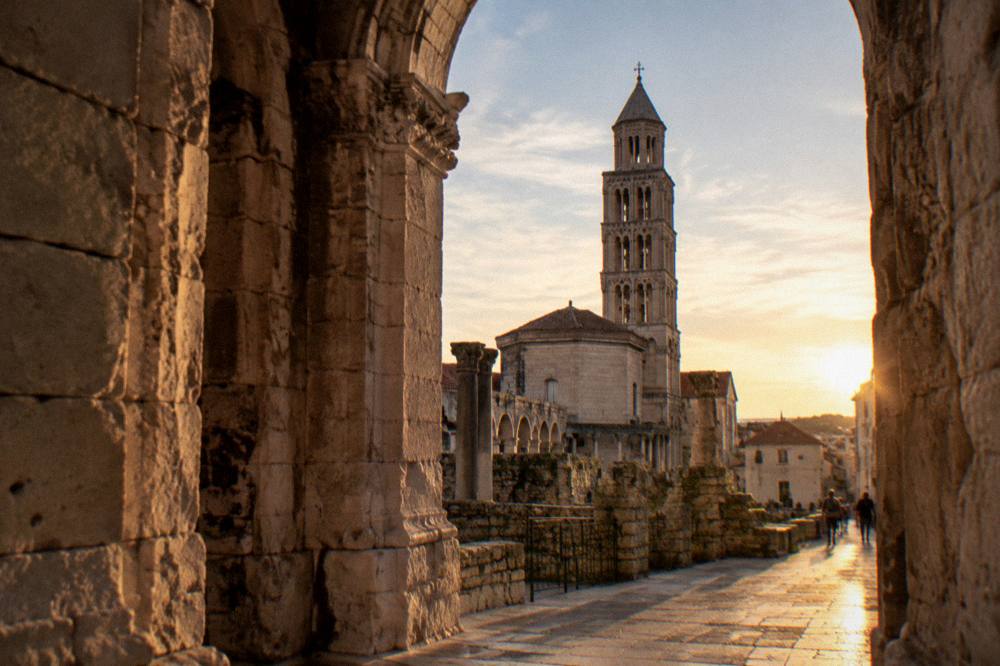
The cathedral figures are secondary-guide numbers, so treat them as a planning range rather than a promise and confirm at the Peristyle kiosk, and remember the dress expectation: shoulders and knees covered. For the structure's history, including the bell tower standing 57 m, see the dedicated pages on the cathedral and the Temple of Jupiter.
One fact from the news cycle that changes the museum picture: the central part of the palace substructures, the cellars directly below the gate's southward axis, is under restoration and conservation until the end of 2026, and the works do not block public passage. A visit now means a partly scaffolded interior, with the interpretive gain that archaeological work in the palace is ongoing and visible, not hidden behind closed doors. Other pages covering the same trip are gathered on Split Croatia Travel Guide.
What Rules Apply Around The Golden Gate And The Old Town?
Around the Golden Gate and Split's historic core, the 2026 public-order rules fine public alcohol consumption at 300 EUR, urination at 300 EUR, climbing on monuments or bathing in fountains at 300 EUR and sleeping in public spaces at 150 EUR, and walking in swimwear or shirtless in the centre is an offence whose fine amount is set locally. Cover up walking back from the beach and buy drinks on licensed terraces, not in the street.
These rules come from the city's Enjoy Respect programme and a 2026 city decision for the Zone A historic core, which includes the gate and the palace streets around it. The practical translation for a visitor is short. Dress normally away from the beach, keep drinks inside bar and cafe terraces, do not climb the walls or the statue for photographs, and expect shop-bought alcohol to be unavailable from retail shelves at night during the summer ban window, which ran 1 June to 15 September 2026 and applies to shops, not to bars or restaurants.
Drones are a separate matter worth a line: the old town and the airport zone are restricted, and national parks ban drones outright, so aerial filming of the gate is not something to attempt without checking the current national rules. The full local context, including safety notes, sits in the existing guidance around this site's safety and rules pages.
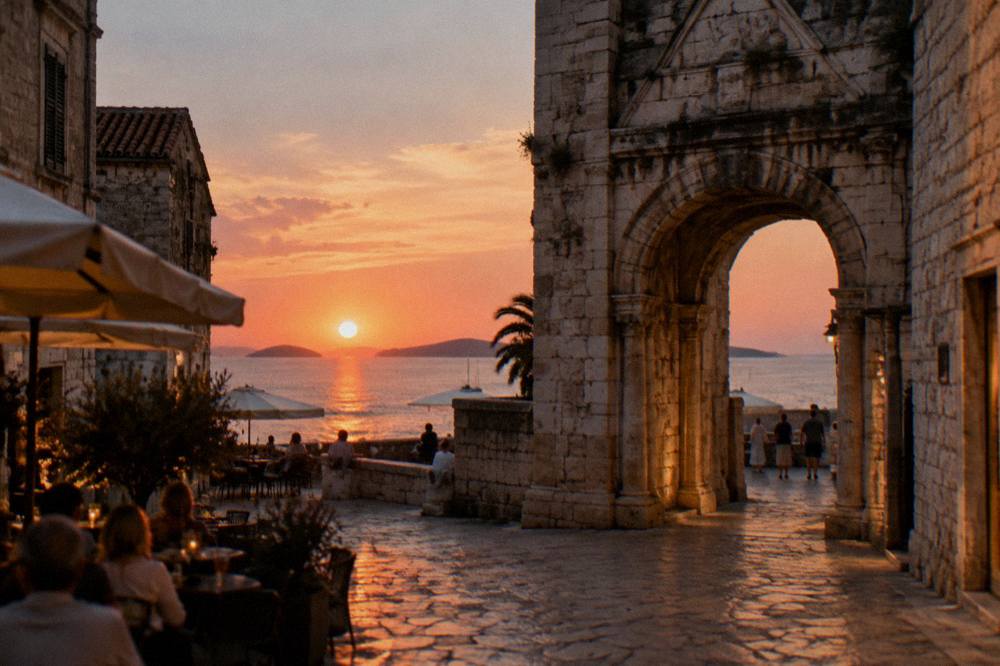
None of this makes the Old Town feel policed. On an ordinary evening the square outside the gate is one of the calmest rooms in the city, with the wall glowing in the last light and the statue holding its pose above the cafe tables. The rules exist to keep it that way through a summer season that, on the DHMZ Split Marjan record for 1948 to 2024, brings a July mean of 26.2 C and 353.3 hours of sunshine, with November the wettest month at 115.5 mm and July the driest at 26.6 mm.
Can You Combine The Golden Gate With Day Trips From Split?
The Golden Gate works as a morning anchor before any of Split's classic day trips, because every main departure point, the ferry piers, the bus station and the tour meeting points on the Riva, lies within about 600 m of the gate. Drive times from the palace run from 22 minutes to Klis Fortress and 36 minutes to Trogir up to about 3 h 15 to Plitvice Lakes, so gate first, trip after, is a workable daily rhythm.
Klis Fortress, the medieval stronghold 13.9 km away that served as a Game of Thrones Meereen location, charges 10 EUR and takes about 22 minutes to reach by car from the palace. Salona, the Roman site whose combined ticket with the Archaeological Museum costs 10 EUR within 7 days, is 9.1 km and about 14 minutes. Trogir, a UNESCO town since 1997, is 29.3 km and about 36 minutes, and Omiš, at the mouth of the Cetina river, 25.5 km and about 38 minutes.
| Day trip destination | Distance by road from the palace | Free-flow drive time |
|---|---|---|
| Salona | 9.1 km | About 14 min |
| Klis Fortress | 13.9 km | About 22 min |
| Trogir | 29.3 km | About 36 min |
| Omiš | 25.5 km | About 38 min |
| Šibenik | 84.8 km | About 71 min |
| Krka National Park, Skradinski buk | 90.2 km | About 74 min |
| Makarska | 86.1 km | About 75 min |
| Plitvice Lakes | 258.1 km | About 3 h 15 |
Park entry prices are seasonal and worth knowing before you commit. Krka charges 7 EUR from January to March and November to December, 20 EUR in April, May and October, and 40 EUR from June to September, with the ticket covering the Skradin boat and Lozovac bus transfers from 1 April to 31 October. Plitvice charges 10, 23 and 40 EUR across the same seasons, with a 25 EUR afternoon slot in peak, timed online entry and the visitor's name mandatory on the ticket. At Krka, swimming is allowed only in clearly marked areas, so forget the old postcard image of bathing at Skradinski buk.
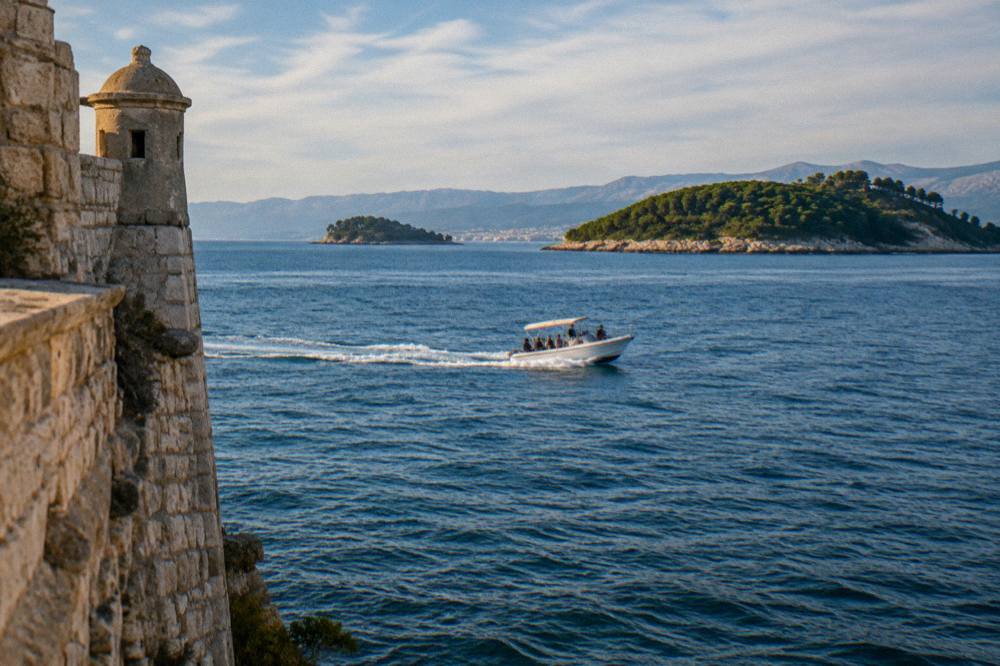
Boat days are the other half of the Split repertoire, and they start and finish on the waterfront a few minutes from the gate. Alongside the Hvar and Brač cruise already mentioned, an all-inclusive version covering Hvar, the Pakleni islands, Brač and Šolta runs from the same port area:
Blue Cave trips from Split to Biševo are the longest boat days, and the cave's own entry fee of 24 EUR in high season, 20 June to 10 September, or 18 EUR in the shoulder season is paid in cash on site, separate from any tour price. The Blue Cave and Vis guide carries the full breakdown.
How Does The Golden Gate Fit Into A First Day In Split?
A first day in Split can start at the Golden Gate, run south through the palace core to the Peristyle and the cathedral, continue to the Riva for the seafront, climb Marjan for the view from Telegrin at 178 m, and finish on Bačvice at sunset, all on foot and with only optional paid entries along the way. The gate is the anchor because it fixes the palace's orientation in one look.
The value of starting north is orientation. Once you have stood outside the gate and looked through it, the palace stops being a maze: the long Roman axis runs from the gate down to the southern sea wall, the Peristyle sits roughly midway, and everything else hangs off that spine. The Diocletian's Palace cellars lie beneath it, and the cellars are in effect a mirrored map of the imperial apartments above, which is why archaeologists care about them and why the current restoration, running to the end of 2026, keeps the passage open rather than closing the site.
For pacing, the seasons matter more than the itinerary. July and August bring means of 26.2 C and 25.9 C on the DHMZ Split Marjan record, with 18 days at 30 C or more in July and 17 in August, so the palace streets are best before 11:00 and after 17:00, with the middle of the day given to Marjan's shade or a beach. October cools to a 17.2 C mean with 77 mm of rain across the month, and November, the wettest month at 115.5 mm, is when the museums and the cellars earn their tickets. The site's Split weather and best time to visit Split pages carry the full monthly table.
Two-day and three-day versions of the same logic, gate on day one, islands on day two, Krka or Plitvice on day three, are laid out in two days in Split and three days in Split. The gate will be walked through again on each of those days regardless, because in Split every route between the port, the Riva, the markets and Marjan passes through the palace, and the north gate is the door the city keeps open.
Common Questions About The Golden Gate In Split
Is the Golden Gate in Split free to visit?
Yes. The Golden Gate, the bronze bishop statue, the Peristyle, the Riva, the Prokurative, the markets, Marjan and the city beaches all cost nothing. Paid sites nearby, such as the palace cellars and the cathedral complex, are ticketed separately.
What is the Golden Gate in Split?
It is the monumental north gate of Diocletian's Palace, the retirement residence built for the emperor c. 295 to 305 AD, now the centre of Split's Old Town. The whole historical complex has been UNESCO-listed since 1979 and covers a property of 20.8 ha.
What is the statue at the Golden Gate?
It is a large bronze of a robed bishop with a raised hand, standing on a pedestal in the square outside the gate. It commemorates a figure from the early Croatian church associated in local tradition with the Croatian language in worship, and rubbing its polished toe is a custom for luck.
How far is the Golden Gate from the Split ferry port and bus station?
About 500 to 600 m. The ferry port, the main bus station and the railway station sit together on Obala kneza Domagoja, a short walk north of the palace.
Can you visit the Golden Gate in the evening?
Yes, the gate is a public street open at all hours, and the square outside fills with cafe tables in the evening. The palace core around it is a living neighbourhood, so normal respect for residents applies late at night.
Are there dress rules at the Golden Gate?
The gate itself is a street, but Split's 2026 public-order rules fine walking in swimwear or shirtless in the historic core, with the amount set locally, and the cathedral a few minutes south expects shoulders and knees covered.
The Golden Gate is where Split hands you its whole story in one frame: a Roman emperor's front door, a defiant bronze bishop holding his ground beside it, and a living city walking through both on its way to the sea. Start there, and the rest of the palace explains itself.
