Split Old Town
The Split Old Town is the living core of a Roman emperor's palace, inscribed by UNESCO in 1979, where about 3,000 years of building stands within 20.8 hectares beside the Adriatic.
Short answer
The Split Old Town is the historical complex of Diocletian's Palace, built around 295 to 305 AD for Emperor Diocletian, inscribed by UNESCO in 1979. The Peristyle, Golden Gate, cellars and cathedral sit inside it, the port, bus and railway stations are 500 to 600 m away, and entry to the streets themselves is free.
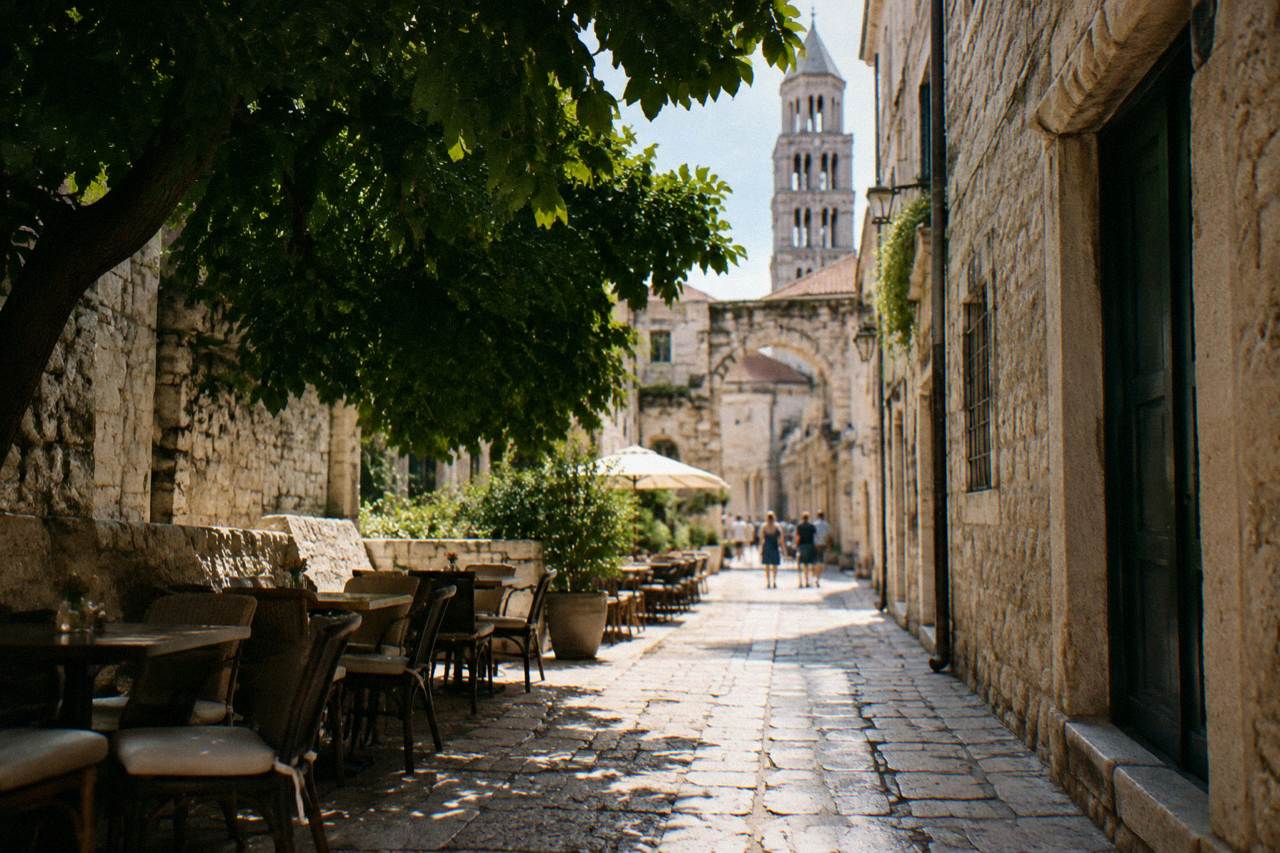
The Split Old Town is not a museum district behind a ticket booth: it is the historical complex of Diocletian's Palace, built around 295 to 305 AD for the Roman emperor Diocletian and inscribed by UNESCO in 1979, with apartments, bakeries and bars packed into its 20.8-hectare property on the Adriatic coast of Dalmatia. Walking through it costs nothing. The ferry port, the main bus station and the railway station sit together on Obala kneza Domagoja, 500 to 600 m from the palace walls, which is why so many day trips to Krka, Trogir, Hvar and Brač begin with a walk across this same grid of limestone streets.
This page from the Split Croatia Travel Guide editorial desk sets out what the palace complex contains, what each ticketed part costs according to the official price lists, how the 2026 public-order rules affect a visit, and which day trips leave from the edge of the Old Town itself.
What Is The Split Old Town?
The Split Old Town is the historical complex of Split with the Palace of Diocletian, a Roman retirement palace begun around 295 AD and finished around 305 AD, later filled with houses, churches and shops, and inscribed by UNESCO in 1979 under criteria (ii), (iii) and (iv) over a 20.8-hectare property. The city of Split, population 160,577 at the 2021 census, grew outward from this core. The palace's southern façade still lines the Riva waterfront, its northern edge sits at the Golden Gate, and the Marjan peninsula park rises just beyond the western walls. The whole area is walkable in twenty minutes end to end.
The palace was a rectangle with towers and gates, and its street plan survives: the cardo runs north from the Peristyle square toward the Golden Gate, while the decumanus cuts east to the Silver Gate and west to the Iron Gate. The Temple of Jupiter became the Baptistery of St John, the emperor's mausoleum became the Cathedral of St Domnius with its 57 m bell tower, and the substructures, the cellar halls beneath the southern half, became the best-preserved Roman basement complex on the Adriatic coast. The Archaeological Museum, founded in 1820, holds much of what was dug out of it.
What makes the area unusual is that it is residential. Roughly three thousand people live inside the palace walls, and the same alleys carry deliveries, laundry and churchgoers alongside the sightseeing. The 2026 moratorium on new short-term rental registrations inside the UNESCO core, extended through 2026, was written precisely to keep that balance. A reader planning where to sleep can compare the palace core against quieter quarters in Veli Varos near Marjan Hill or the beach streets of Bačvice and Firule.
For the palace in depth, see the site's Diocletian's Palace attraction guide and its page on the cellars beneath the southern half.
What Can You See Inside The Split Old Town?
The free sights inside the Split Old Town are the Peristyle, the Riva, the Prokurative square, the Golden Gate, the Grgur Ninski statue, the green market, and every street and square of the palace itself, while the ticketed sights are the palace cellars, the Cathedral of St Domnius complex, the Split City Museum, the Ethnographic Museum and the Baptistery of St John, the former Temple of Jupiter. Nothing in the street plan is behind a turnstile. The money goes into the buildings, and even those are cheap by west-European standards: the Split City Museum's own price list puts the Papalić Palace ticket at 10.00 EUR adult.
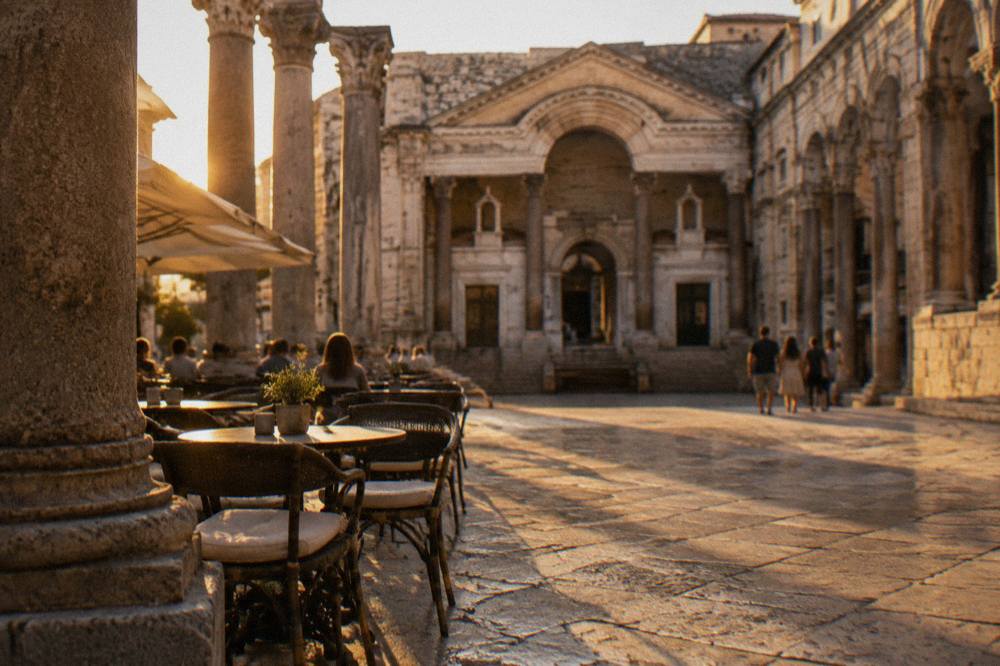
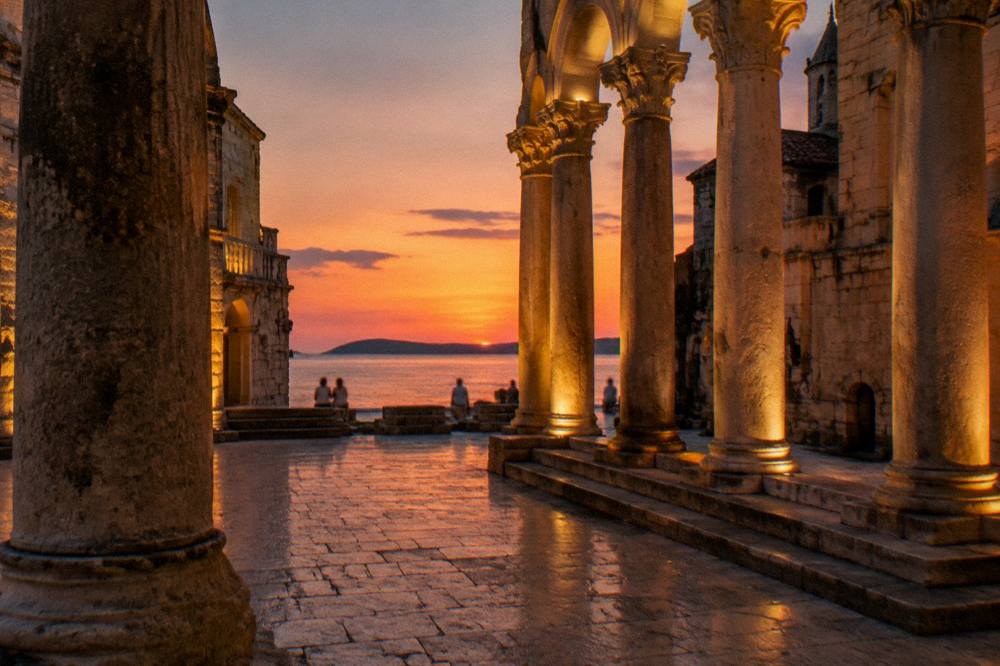
The Peristyle is the heart of the visit. The emperor's porticoed forecourt now holds café tables and, on summer days, the daily Change of Diocletian's Roman Guard at noon, which ran from 28 May to 27 September 2026. Steps up from its western side reach the cathedral and the baptistery; steps down from the southern end reach the cellars. The Peristyle guide covers the square in detail.
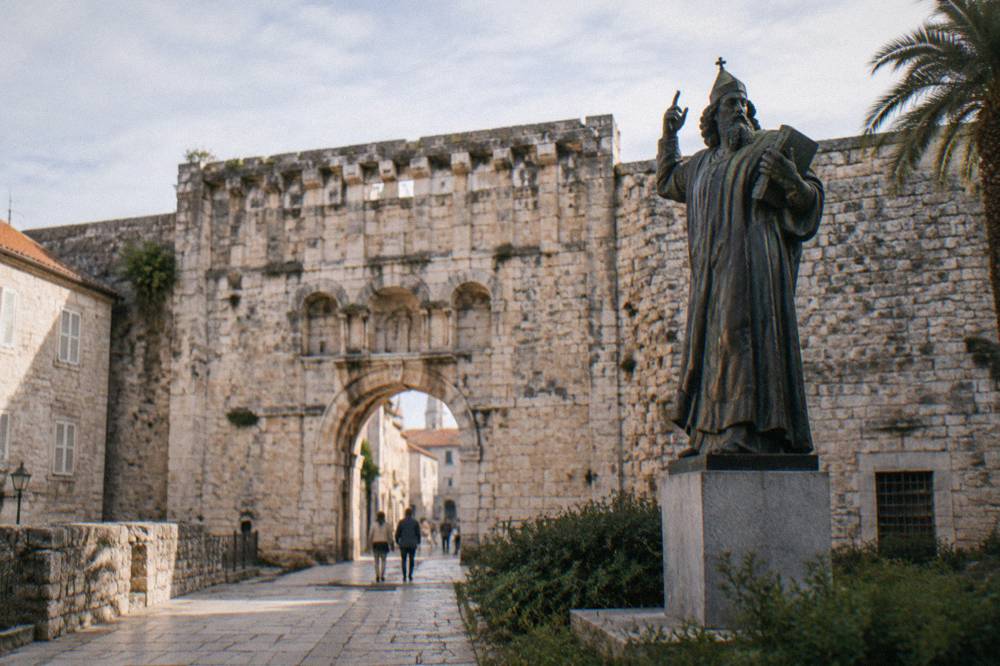
The cellars are the one underground sight, run by the Split City Museum and open Monday to Sunday from 8:30 to 20:00, with the central part under restoration to the end of 2026 while the passage stays open. Above ground, the Golden Gate on the north wall faces the statue of Grgur Ninski, whose bronze toe is polished by passers-by, and the Silver and Iron gates open onto the eastern and western streets. The Riva, the palm-lined waterfront promenade along the southern wall, was rebuilt in the 2000s and is the city's default meeting place, with a central-section renovation planned from November 2026, so partial closures on the Riva should be expected through 2027.
| Sight | Position in the Old Town | Entry |
|---|---|---|
| Peristyle | Central colonnaded square | Free |
| Golden Gate and Grgur Ninski statue | North wall | Free |
| Riva promenade | Along the southern façade | Free |
| Prokurative | West of the north end | Free |
| Palace cellars (substructures) | Beneath the southern half | Ticket, Split City Museum |
| Cathedral of St Domnius complex | East of the Peristyle | Ticket, from about 5 EUR, combined tickets up to about 15 EUR |
| Split City Museum, Papalić Palace | North of the palace core | 10.00 EUR adult |
| Ethnographic Museum | Behind the Vestibule | 7.00 EUR adult |
The cathedral prices come from a secondary guide rather than an official price page, so treat them as approximate and confirm at the Peristyle kiosk where the tickets are sold. Shoulders and knees must be covered inside the cathedral. The site's pages on the cathedral and the Temple of Jupiter carry the details.
A guided walk holds the whole story together, and the related tour on this site, the Split Old Town Diocletian's Palace guided small-group tour, covers the palace, the Peristyle and the gates with a licensed guide: Check availability
Prefer a historian to lead the way? Book a Split walking tour here.
How Much Does A Day In The Split Old Town Cost?
A full day of ticketed sights in the Split Old Town runs to about 40 EUR per adult at 2026 prices: the cellars at 10 EUR, the Split City Museum at 10.00 EUR, the Ethnographic Museum at 7.00 EUR, the Archaeological Museum at 8 EUR, a combined ticket of all five cathedral sites at about 15 EUR, and the Meštrović Gallery at 12.00 EUR if the walk extends past the walls, with every street, gate, square and the Riva free. Croatia has used the euro since 1 January 2023, so there is no exchange arithmetic to do. Accommodation adds about 2.65 EUR per person per night in high-season tourist tax, collected by the host and confirmed at booking.
The single best value among the combined tickets is the Archaeological Museum's own: 10 EUR covers both the museum and the Roman city of Salona, 9.1 km and about 14 minutes' drive away, if used within seven days. The Meštrović Gallery ticket likewise includes the Crikvine-Kaštilac chapel site further along the coast; the gallery reopened in April 2026 after a fifteen-month energy renovation.
| Ticketed site | 2026 adult price | Source |
|---|---|---|
| Palace cellars | 10 EUR | Split City Museum price list |
| Split City Museum, Papalić Palace | 10.00 EUR, family 18.00 | Split City Museum price list |
| Ethnographic Museum | 7.00 EUR, Vestibule 2.00 | Museum site |
| Archaeological Museum | 8 EUR, or 10 EUR with Salona within 7 days | armus.hr price list |
| Cathedral of St Domnius | From about 5 EUR, combined tickets up to about 15 EUR | Secondary guide; confirm at kiosk |
| Meštrović Gallery | 12.00 EUR, includes Crikvine-Kaštilac | Gallery price list |
Reductions follow the standard Croatian pattern: pupils, students and pensioners pay less at the city-run museums, families have capped tickets, and children enter several sites free. The tourist tax is the only mandatory extra, at about 2.65 EUR per person per night in high season (1 April to 30 September), free under 12 and half rate from 12 to 18.
Where Do You Eat In The Split Old Town?
Eating inside the Split Old Town runs from the green market on the east side, where produce stalls operate in the shadow of the Silver Gate, through konoba-style restaurants in the palace alleys and along the Riva, to the café terraces of the Peristyle itself, and the reliable check against overcharging is simple: posted prices on the menu, an itemised bill, and the cover charge printed as a line, which Croatian law requires. The green market and the fish market beside it are the local anchor; the Split green market guide explains how they work. For the deeper food picture, including where Dalmatian prosciutto, fresh sardines and local wine fit into a day, see where locals eat in Split and the site's Split restaurants page.
Costs are moderate rather than cheap. Croatia's adoption of the euro in 2023 removed the kuna cushion, and the palace core carries a location premium. The practical moves are the ones any Dalmatian town rewards: eat where the menu lists weights and origins, check that the cover charge appears on the menu before sitting, and compare the bill against the posted card. Nothing on this site is verified about any individual venue, and prices change with the season.
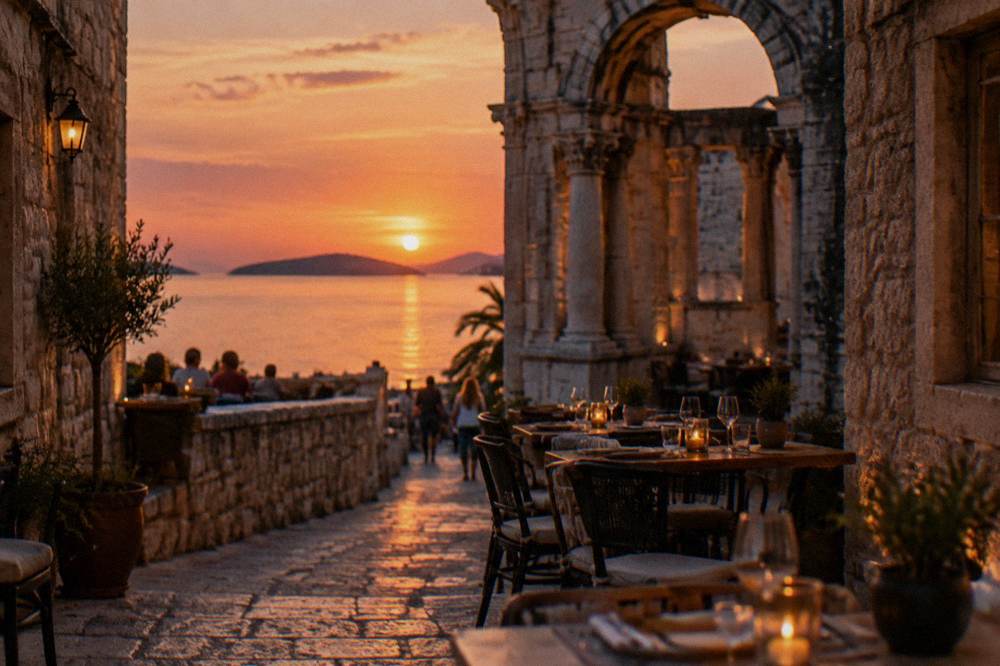
Drinking has one hard rule. Since 2026, consuming alcohol in public in the Zone A historic core, outside licensed terraces, carries a 300 EUR fine, and shops in the centre may not sell alcohol at night during the summer season. Terrace drinking inside a bar is unaffected. The full rules are in the section below.
Is The Split Old Town Walkable?
The Split Old Town is entirely walkable and largely car-free: the ferry port, bus station and railway station sit 500 to 600 m from the Peristyle on Obala kneza Domagoja, and the only real gradient is the climb to Marjan hill, whose highest point Telegrin stands 178 m above the sea, reached by 819 steps from Trumbićeva obala. Cruise passengers dock within an easy walk of the walls, and the site's cruise port day itinerary starts from exactly that geometry.
Inside the walls the surface is polished limestone, worn slick in the rainy months, so street shoes beat sandals after rain. The streets open early and stay busy through the evening in season. The Roman guard change on the Peristyle at noon and the café life around the Vestibule give the day its rhythm; the one day in Split itinerary sequences a first visit, and two days in Split adds Marjan and a beach.
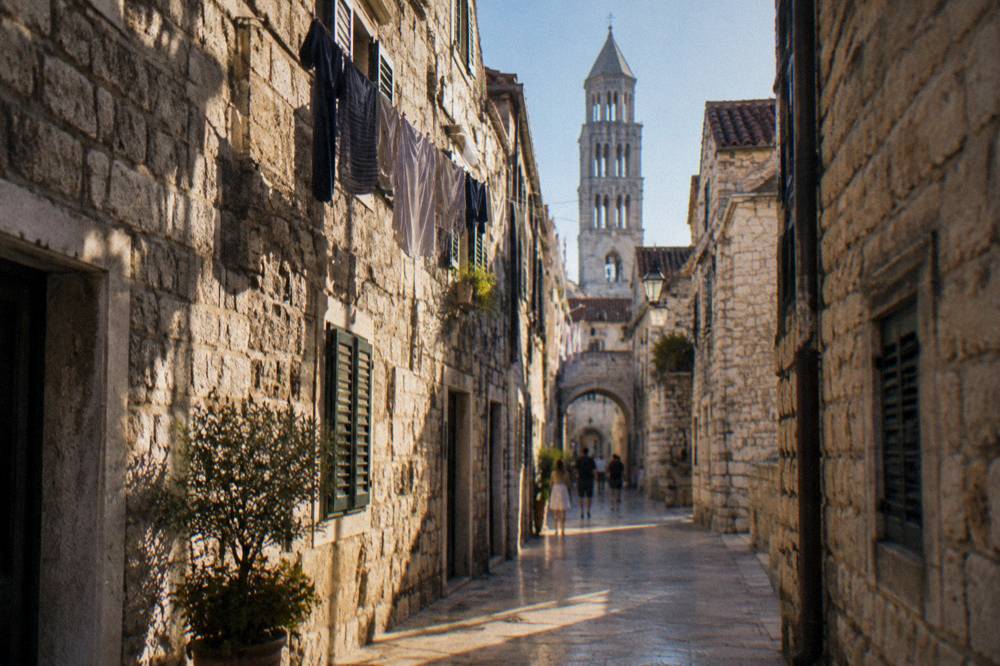
West of the Iron Gate, the stone village of Veli Varos climbs toward Marjan, and it is the quietest quarter within ten minutes of the Peristyle; the Veli Varos area guide maps it. South and east, the Riva leads to the ferry piers, and beyond them the beaches of Bačvice, covered separately, begin the modern city.
What Are The Rules Inside The Split Old Town?
The 2026 Split public-order decision sets fines of 300 EUR for drinking alcohol in the historic centre or within 100 m of schools, for urinating, for vomiting, for climbing on monuments and for bathing in fountains, 150 EUR for sleeping in public spaces, and 300 EUR for touting taxi rides; walking in swimwear or shirtless in the historic centre is also fined, with the amount set locally, and drone flying over the old town is prohibited. The city's Enjoy Respect rules, published on its tourism site, are the enforcement basis, and they matter because the fines are real, not theoretical.
The summer adds one more: shops and supermarkets in the centre, though not bars or restaurants, are banned from selling alcohol at night from 1 June to 15 September, a restriction that repeats automatically from 1 June 2027 unless changed. Licensed terraces are untouched. Dress sense matters too: the cathedral requires shoulders and knees covered, and the swimwear rule applies to the streets between the beach and the apartment.
| Offence | Fine |
|---|---|
| Public alcohol consumption, historic centre | 300 EUR |
| Urinating in public | 300 EUR |
| Vomiting in public | 300 EUR |
| Climbing on monuments or bathing in fountains | 300 EUR |
| Sleeping in public spaces | 150 EUR |
| Taxi touting | 300 EUR |
| Swimwear or shirtless in the historic centre | Fined, amount set locally |
None of this dampens a normal visit. The rules target behaviour, not presence, and the centre's evening life, from the Riva promenade to the Prokurative, runs as it always has. The site's page on what to avoid in Split lists the practical missteps.
When Is The Best Time To Walk The Split Old Town?
The warmest months in Split are July at a 26.2 C mean and August at 25.9 C, with 18 days at 30 C or more in July and 17 in August, while the DHMZ Split-Marjan station table for 1948 to 2024 shows November as the wettest month at 115.5 mm and July the driest at 26.6 mm, which makes May, June and September the calm months for walking the palace streets before the summer heat peaks. July also delivers 353.3 sunshine hours against 120.8 in December, and the annual precipitation total is 809.7 mm, concentrated from October to January.
| Month | Mean temperature (C) | Precipitation (mm) |
|---|---|---|
| January | 8.0 | 77.8 |
| February | 8.5 | 65.2 |
| March | 10.8 | 63.2 |
| April | 14.4 | 62.0 |
| May | 19.2 | 57.5 |
| June | 23.4 | 49.0 |
| July | 26.2 | 26.6 |
| August | 25.9 | 41.3 |
| September | 21.6 | 70.9 |
| October | 17.2 | 77.0 |
| November | 12.7 | 115.5 |
| December | 9.4 | 103.7 |
Figures are DHMZ Split-Marjan station monthly means for the period 1948 to 2024. The event calendar shapes the seasons too: the Roman guard change runs daily at noon from late May to late September, the Split Summer Festival filled the Peristyle from 14 July to 14 August 2026, Advent in Split runs 27 November 2026 to 7 January 2027 with an ice rink at Đardin, and Ultra Europe follows on 9 to 11 July 2027 at Park Mladeži. The best time to visit Split page works through the trade-offs.
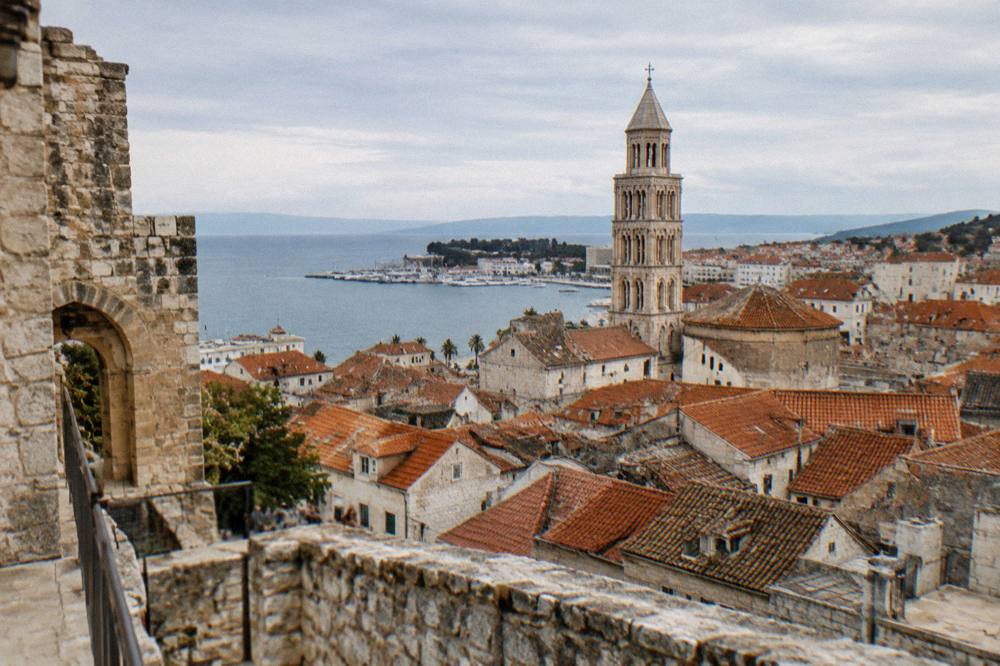
Which Day Trips Leave From The Edge Of The Split Old Town?
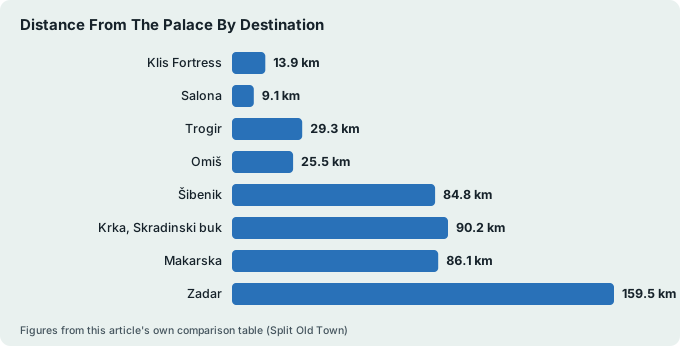
Every major Dalmatian day trip starts within 600 m of the palace: Jadrolinija ferries sail from the piers below the Riva to Stari Grad on Hvar in about 120 minutes, to Supetar on Brač in about 50 minutes and to Rogač on Šolta in about 60 minutes, while the main bus station beside them runs coaches to Dubrovnik in about 4 hours and Zagreb in about 5 hours 30, and driving times from the palace to Krka's Skradinski buk, Trogir and Omiš are 74, 36 and 38 minutes. The Old Town is not just a sight; it is the transport hub of central Dalmatia.
The islands are the closest. A foot passenger on line 635 to Stari Grad pays 5.90 EUR off-season and 8.40 EUR in season, catamarans reach Hvar town or Jelsa for 6.40 EUR low and 10.00 EUR high season, and Vis costs 7.20 or 10.00 EUR by catamaran. Note the distinction that trips up plans: Hvar town itself is reached by catamaran, while the car ferry lands at Stari Grad. The ferries from Split page holds the full picture.
| Destination | Distance from the palace | Free-flow driving time |
|---|---|---|
| Klis Fortress | 13.9 km | 22 min |
| Salona | 9.1 km | 14 min |
| Trogir | 29.3 km | 36 min |
| Omiš | 25.5 km | 38 min |
| Šibenik | 84.8 km | 71 min |
| Krka, Skradinski buk | 90.2 km | 74 min |
| Makarska | 86.1 km | 75 min |
| Zadar | 159.5 km | 2 h |
| Mostar | 173.2 km | 2 h 13 |
| Plitvice Lakes | 258.1 km | 3 h 15 |
| Dubrovnik | 234.8 km | 3 h 21 |
The two inland parks are seasonal in price: Krka costs 7 EUR from January to March and in November and December, 20 EUR in April, May and October, and 40 EUR from June to September, while Plitvice costs 10, 23 and 40 EUR on the same pattern with a 25 EUR afternoon slot in peak, and Plitvice sells timed entry online with the visitor's name on the ticket. The Krka National Park and Plitvice Lakes guides carry the detail, and Trogir and Hvar have their own pages.
Two of the most-booked trips from the Old Town piers:
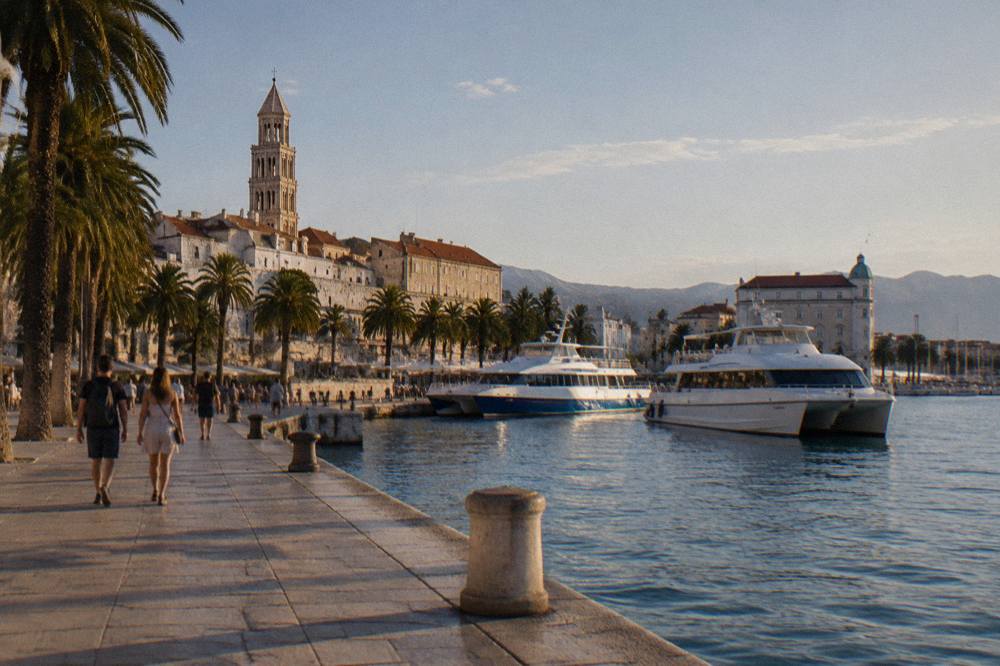
Organised options cover everything the timetables do, with the advantage of not planning them:
How Many Days Should You Give The Split Old Town?
Two days is the practical minimum for the Split Old Town and its immediate surroundings: one day for the palace core, the Peristyle, the cellars, the cathedral complex and the Riva, and a second for Marjan hill, the city beaches and one island or short day trip, with a third day earned by Krka, Plitvice or a full Blue Cave speedboat run. The palace itself rewards a half-day at an unhurried pace; the three days in Split itinerary is the template that fits the area best.
The choice of base matters as much as the count of days. Inside the walls, the atmosphere is unmatched but the nights are lively and the 2026 rental moratorium limits supply; Veli Varos and Meje are quieter and still walkable, while Bačvice, Firule and Žnjan trade proximity for space and beaches. The where to stay in Split guide compares all of them.
Common Questions About The Split Old Town
Is the Split Old Town free to enter?
Yes. The streets, gates, Peristyle, Prokurative, Riva and the statue at the Golden Gate cost nothing. Only the buildings inside, the cellars, the cathedral complex and the museums, charge admission, from 2.00 EUR for the Vestibule viewpoint at the Ethnographic Museum upward.
Is the Split Old Town the same as Diocletian's Palace?
Almost. The Old Town's historic core is the palace, built around 295 to 305 AD and inscribed by UNESCO in 1979, but the wider Old Town also takes in later quarters like Veli Varos west of the walls and the streets around the Prokurative to the north.
Can you walk from the Split cruise port to the Old Town?
Yes. Cruise passengers dock at the port on Obala kneza Domagoja, and the palace walls begin roughly 500 to 600 m away, a walk of under ten minutes along the Riva side of the waterfront.
What is there to do in the Split Old Town at night?
The Peristyle cafés, the bars of the palace alleys and the Riva promenade stay active late in season, and the Split Summer Festival staged performances on the Peristyle through mid-August 2026. Night-time alcohol sales in the centre's shops are restricted in summer, but licensed terraces operate normally.
Is the Split Old Town suitable for children?
The core is compact and traffic-light, the Riva and the green market give it space, and Bačvice beach, home of the ball game picigin, documented from 1908 and now protected intangible heritage, sits a short walk east. The polished stone after rain is the main practical hazard.
Do you need a guide for the Split Old Town?
The palace is legible on foot with a good map, but the layers, Roman substructures, medieval houses, Renaissance loggias, are easier to read with a licensed guide, and small-group walking tours of Diocletian's Palace run daily from near the Riva.
