Split Riva
The Riva is the seafront promenade that runs between Diocletian's Palace and the port of Split, the busiest passenger port in Croatia, and everything practical about it in one place.
Short answer
The Riva is a free, always-open seafront promenade in Split, Dalmatia, about a ten minute walk end to end, lined with palms, cafés and benches, with the ferry port, the main bus station and the railway station all within 600 m of its southern end. A renovation of its central section is planned from November 2026 for a little over a year, so expect partial closures through 2027.
Split, the coastal city in central Dalmatia where the Adriatic meets a Roman palace, gives its seafront over to one long promenade: the Riva. It runs along the western edge of the harbour, with the southern wall of Diocletian's Palace on one side and the ferry piers on the other, and it is free, open at all hours and flat from end to end. The ferry port, the main bus station and the railway station sit together on Obala kneza Domagoja, 500 to 600 m from the palace, which places every transport connection in Split within a short walk of the Riva itself. This page sets out what the promenade is, what it costs, what changes are coming, and how to plan time around it.
What Is The Split Riva?
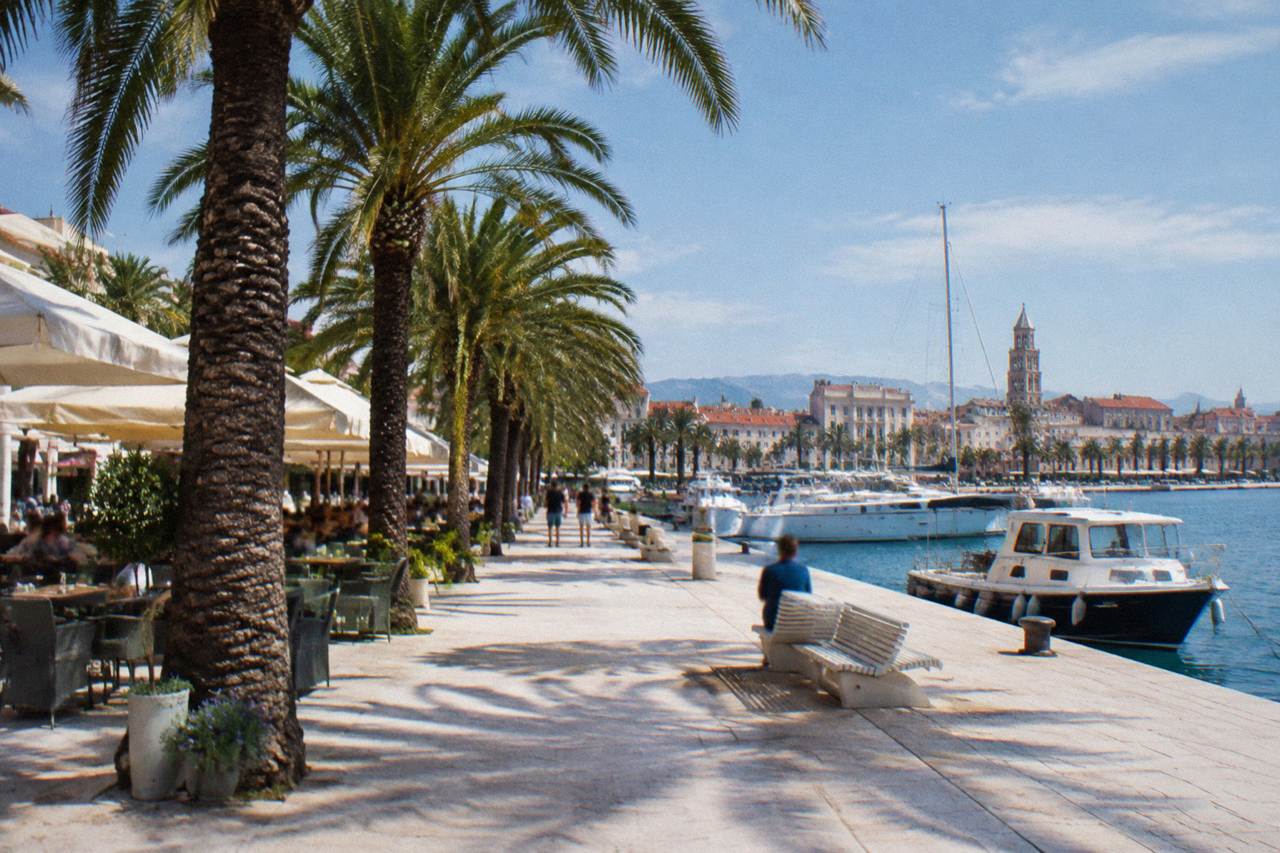
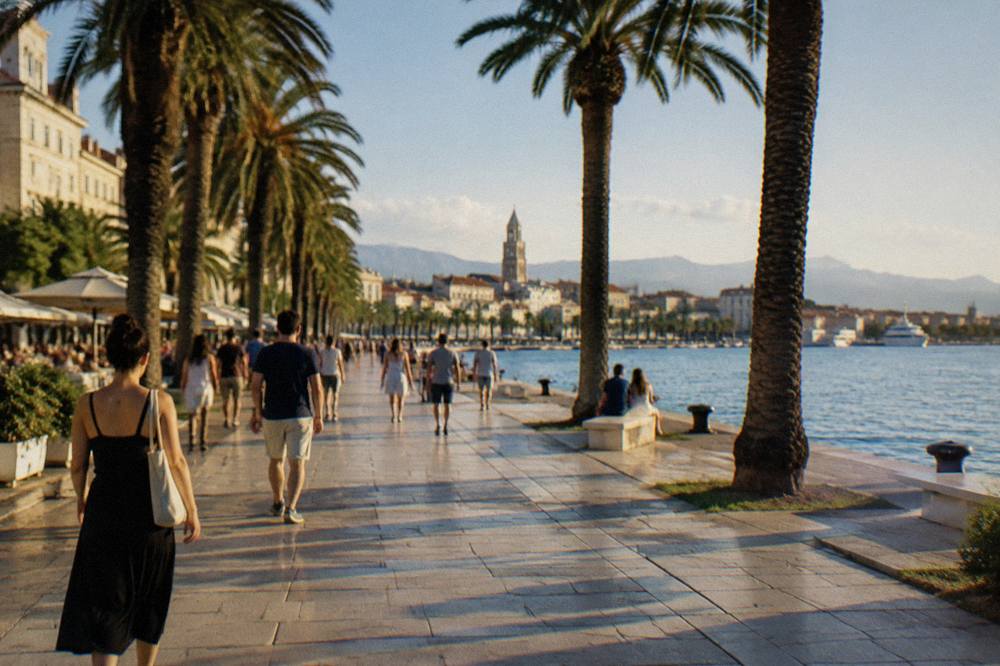
The Split Riva is the city's main waterfront promenade, a free, always-open walkway lined with palm trees, benches and café terraces that separates the southern wall of Diocletian's Palace from the harbour of Split. It needs no ticket, has no closing time, and functions at once as the city's living room, its arrival hall for ferry passengers, and the fastest flat route between the Old Town and the port. The Port of Split's own figures describe it as the frontage of Croatia's busiest passenger port, with 6.05 million passengers carried in 2025, so the promenade doubles as the busiest doorstep in the country.
The name covers the whole seafront stretch, but the part people mean when they say "the Riva" is the pedestrianised section in front of the palace, where the palm rows, the white paving and the terrace chairs sit. The historic complex behind it, the Historical Complex of Split with the Palace of Diocletian, has been on the UNESCO World Heritage list since 1979, and the promenade is the one place where that listing shows itself whole: you stand on the sea and read the palace's southern façade like a page. The Old Town sits directly behind it, and the fishing quarter of Veli Varoš lies a few minutes west.
The promenade also works as a practical spine. Walk it west and it leads toward the Marjan peninsula and the city beaches; walk it east and it becomes Obala kneza Domagoja, with the ferry piers, the main bus station and the railway station one after another. For anyone building a first visit, the one day in Split itinerary naturally begins or ends here, because almost every transport decision in the city gets made within sight of it.
How Long Is The Riva, And How Much Time Does It Deserve?
The pedestrianised Riva in front of Diocletian's Palace is a flat, step-free promenade that takes roughly ten minutes to walk at an unhurried pace from the western end near the Marjan slope to the eastern end at the ferry piers, though cafés, viewpoints and the palace exits stretch that easily into an hour. There is no entry fee at any point, no ticket desk and no gate; the promenade is public space, and the city lists it among the free sights alongside the Peristyle, the Prokurative square, the Golden Gate and Marjan hill.
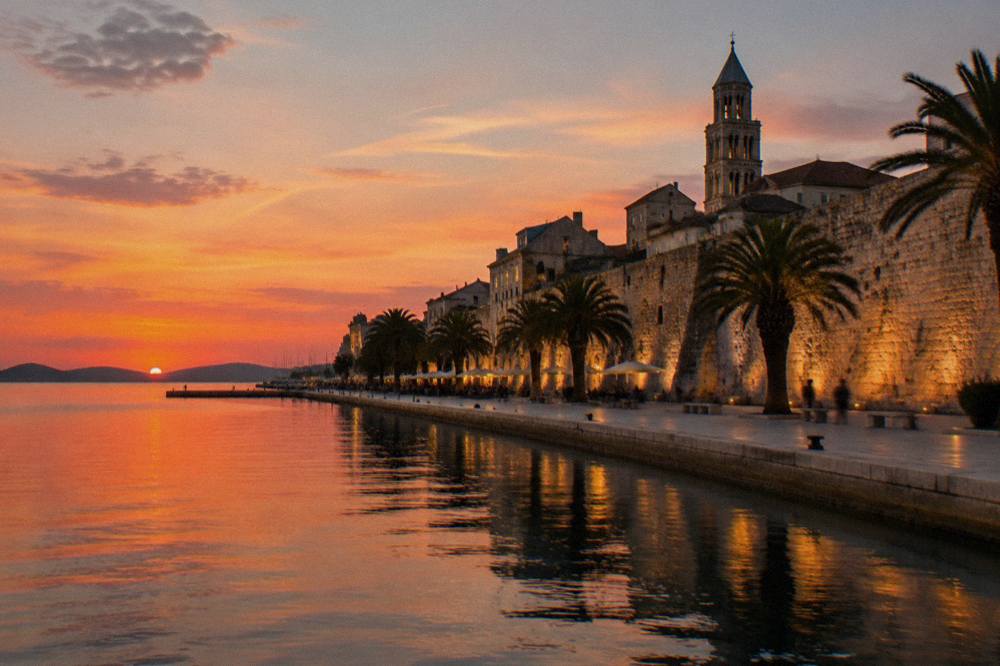
The honest planning answer depends on what else is on the list. A morning ferry arrival can turn the Riva into a 20 minute warm-up walk before entering the palace through the Bronze Gate, which opens straight off the promenade into the substructures. An evening visit is a different experience: the terrace lights come on, the palace wall is lit, and the promenade fills with the pre-dinner crowd. Both are free, and both are within a few minutes of everything in the Old Town, including the Peristyle and the cathedral of St Domnius.
Time budgeting also depends on the season and the clock. The DHMZ Split-Marjan station table (1948 to 2024) puts July sunshine at 353.3 hours against December's 120.8, so summer evenings on the promenade run long and winter ones short. In July the same station records 18 days at 30 C or more, which pushes café time into the shade of the palms by early afternoon.
What Is Changing On The Riva Through 2027?
The central section of the Riva is due for a renovation of about 3.5 to 4 million EUR, designed by the 3LHD studio, with works planned to start in November 2026 and run for a little over a year, so partial closures along the promenade should be expected through 2027. The project covers renewed paving, urban furniture, lighting, awnings and greenery along the central stretch. The promenade as a whole is not being rebuilt: the works target the central section, and the sections in front of the western piers and toward the ferry terminals are outside the main scope.
For trip planning, the practical reading is simple. Anyone visiting in 2027 should expect fenced zones, rerouted foot traffic and construction noise in the middle of the promenade, while the walkway itself is expected to stay usable around the works. Anyone visiting from late 2026 onward who has set their heart on a specific café table or a specific photograph spot on the central stretch should build in flexibility, since terrace seating in the works zone will move or pause.
The renovation is not the only change within sight of the promenade. The Port of Split obtained a location permit in September 2026 for a new passenger and hospitality complex on the eastern coast, and the St Peter pier expansion, a 21.2 million EUR project adding 53 m of length and 5,350 m² of space, advanced through August 2026. None of this blocks the promenade today, but it explains why the eastern end will look like a building site on and off for the next couple of seasons.
Which Ferries And Catamarans Leave From The Riva?
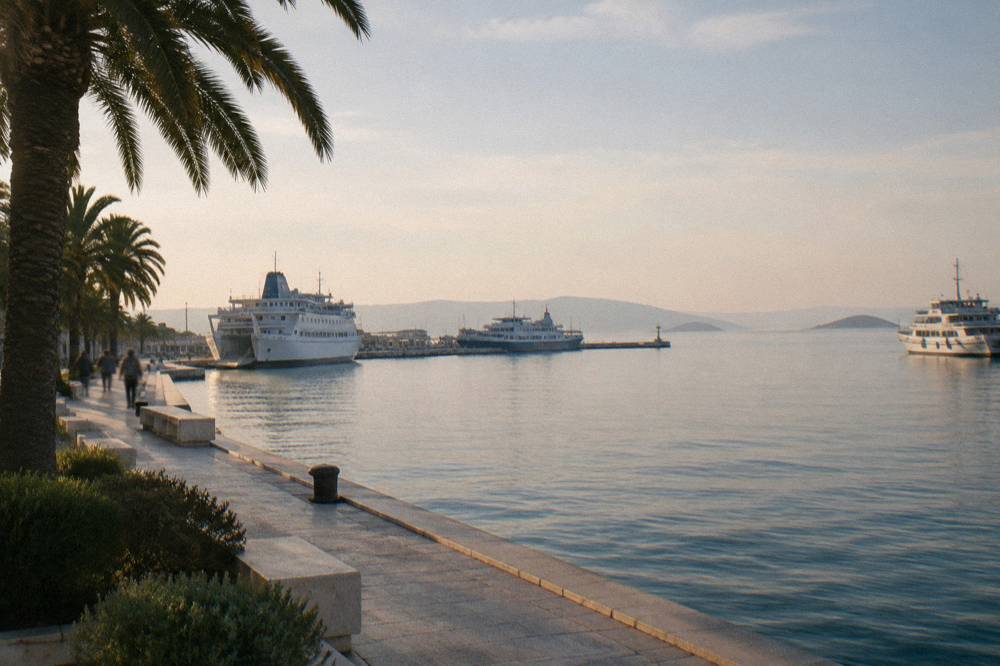
The piers along the Riva carry Jadrolinija's car ferries to Stari Grad on Hvar (about 120 minutes), Supetar on Brač (about 50 minutes), Rogač on Šolta (about 60 minutes) and Vis (about 140 minutes), plus catamaran lines to Hvar town, Jelsa, Bol, Milna and Vis, with foot passenger ferry fares from 5.90 EUR off-season to 8.40 EUR in season on the Stari Grad line. The ferry port, the main bus station and the railway station all sit together on Obala kneza Domagoja at the promenade's eastern end, 500 to 600 m from the palace, so every island connection in Split starts within a ten minute walk of the Old Town.
The distinction that trips up first-time visitors is Hvar. Hvar town itself is reached by catamaran, not by car ferry: the car ferry from Split lands at Stari Grad, on the north side of the island. Jadrolinija's route pages and price list give the detail, and the foot passenger fare on line 635 to Stari Grad is 5.90 EUR off-season and 8.40 EUR in season. Catamaran fares run at 6.40 EUR low season and 10.00 EUR high season to Hvar or Jelsa, and 7.20 EUR low and 10.00 EUR high to Vis, figures reported from the operators' fare tables.
| Route from Split | Type | Sailing time | Foot passenger fare |
|---|---|---|---|
| Stari Grad, Hvar (line 635) | Car ferry | about 120 min | 5.90 EUR off-season, 8.40 EUR season |
| Supetar, Brač (line 631) | Car ferry | about 50 min | on the Jadrolinija price list |
| Rogač, Šolta (line 636) | Car ferry | about 60 min | on the Jadrolinija price list |
| Vis | Car ferry | about 140 min | on the Jadrolinija price list |
| Hvar town / Jelsa | Catamaran | on the operator's schedule | 6.40 EUR low, 10.00 EUR high |
| Vis | Catamaran | on the operator's schedule | 7.20 EUR low, 10.00 EUR high |
One 2026 timetable change matters for Brač: from 2026 the Split to Supetar line has no off-season timetable at all, operating only high-season and low-season schedules, the fifth Croatian line to move to that arrangement. Jadrolinija's own news page carries the change. Summer 2026 also added a Split to Bari international ferry line. The full picture, including Italy routes and island-hopping plans, sits on the ferries from Split page and the Split to Hvar ferry guide.
Is The Riva Free, And What Nearby Sights Cost Money?
The Riva itself is completely free, with no ticket, gate or closing time, as are the Peristyle, the Prokurative square, the Golden Gate, the Grgur Ninski statue, the green market, Marjan hill and the city beaches; the paid sights begin inside the palace walls, where the Split City Museum charges 10.00 EUR adult and the substructures are open Monday to Sunday 8:30 to 20:00. The city museum's own price list gives 8.00 EUR reduced and 18.00 EUR for a family ticket at the Papalić Palace, closed Mondays, and the palace cellars, run by the same museum, carry their own tariff on the same list.
This split between free outside and paid inside shapes most budgets. A visitor can walk the promenade, read the palace façade, climb Marjan to the Telegrin viewpoint at 178 m via 819 steps from Trumbićeva obala, and swim at Bačvice without spending anything on sights at all. The moment curiosity goes indoors, the tickets start, and the Diocletian's Palace cellars and the cathedral complex are the two that draw the money.
| Sight | Adult price | Notes |
|---|---|---|
| Riva promenade | free | public space, always open |
| Peristyle, Golden Gate, Prokurative | free | open squares |
| Marjan hill park | free | Telegrin 178 m, 819 steps from Trumbićeva obala |
| Split City Museum (Papalić Palace) | 10.00 EUR | 8.00 reduced, family 18.00, closed Mondays |
| Palace cellars | on the City Museum price list | Mon to Sun 8:30 to 20:00 |
| Cathedral of St Domnius complex | from about 5 EUR, combined up to about 15 EUR | shoulders and knees covered |
| Meštrović Gallery | 12.00 EUR | includes Crikvine-Kaštilac |
Two caveats the sources force. The cathedral's prices come from a secondary guide rather than an official price page, so treat the figures as approximate and confirm at the Peristyle kiosk. And the central part of the palace cellars is under restoration to the end of 2026, with the public passage staying open through the works, so a 2026 or early 2027 visit sees scaffolding inside as well as out.
Where Does The Riva Fit In A Walk Of The Old Town?
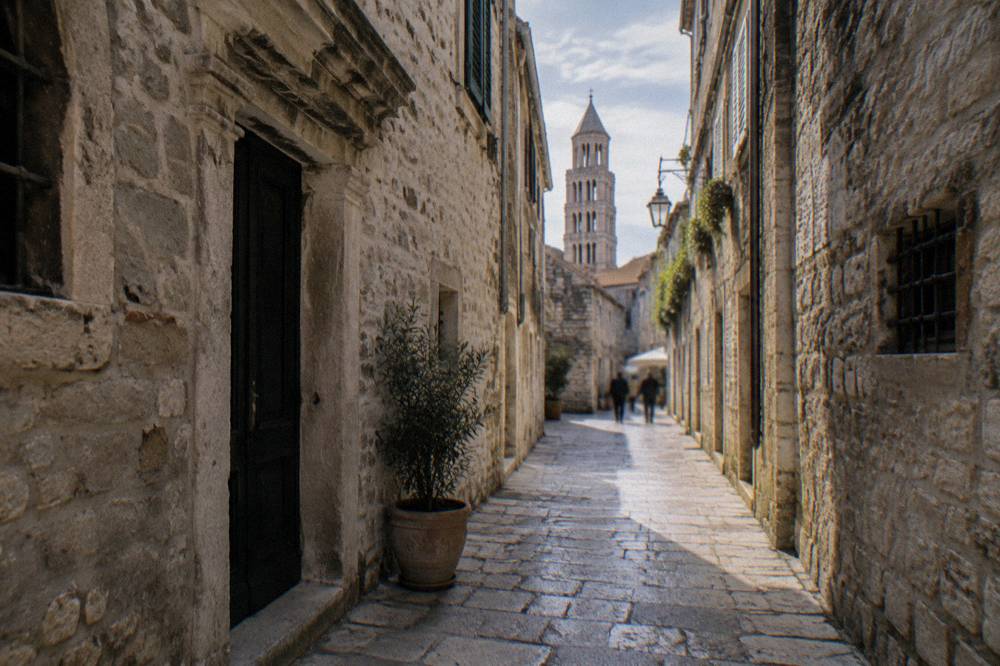
The Riva anchors the southern edge of every sensible Old Town walk, because the Bronze Gate of Diocletian's Palace opens directly onto it, the Silver and Iron Gates sit a few minutes east, and the Golden Gate with the Grgur Ninski statue closes the loop at the northern edge, a circuit that covers the Peristyle, the cathedral and the cellars without ever being more than five minutes from the sea. A flat, logical order is promenade to Bronze Gate to Peristyle to Golden Gate, then back through the palace streets to the Riva for a coffee with the ferry traffic in view.
Curious about the stories behind the palace walls? Book a history walking tour here.
The palace itself was built c. 295 to 305 AD for the emperor Diocletian, and its UNESCO listing since 1979 covers a 20.8 ha property in which the modern city is literally embedded: streets, shops and apartments occupy the ancient footprint. That is why the Old Town walk feels like no other, and why a guide adds value on a first visit; the layout rewards explanation. The Diocletian's Palace page carries the full breakdown, and the Peristyle is the palace's open heart on the route.
For visitors with a cruise day, the arrangement is even kinder. Cruise passengers dock within an easy flat walk of the promenade, and the Split cruise port day itinerary is built around exactly that geography: Riva first, palace second, Marjan or a beach if the hours allow. The port's own figures put 2025 cruise passengers at 487,377, and cruise ships have been calling since 2002.
When Is The Best Time Of Day To Be On The Riva?
The DHMZ Split-Marjan station table (1948 to 2024) gives a July mean of 26.2 C and records 18 days at 30 C or more in July and 17 in August, which makes early morning and the evening hours the comfortable slots on the promenade in high summer, while in winter, with a January mean of 8.0 C, midday sun on a sheltered bench becomes the better bet. Rain matters less than the calendar suggests: July is the driest month at 26.6 mm and November the wettest at 115.5 mm on the same station record.
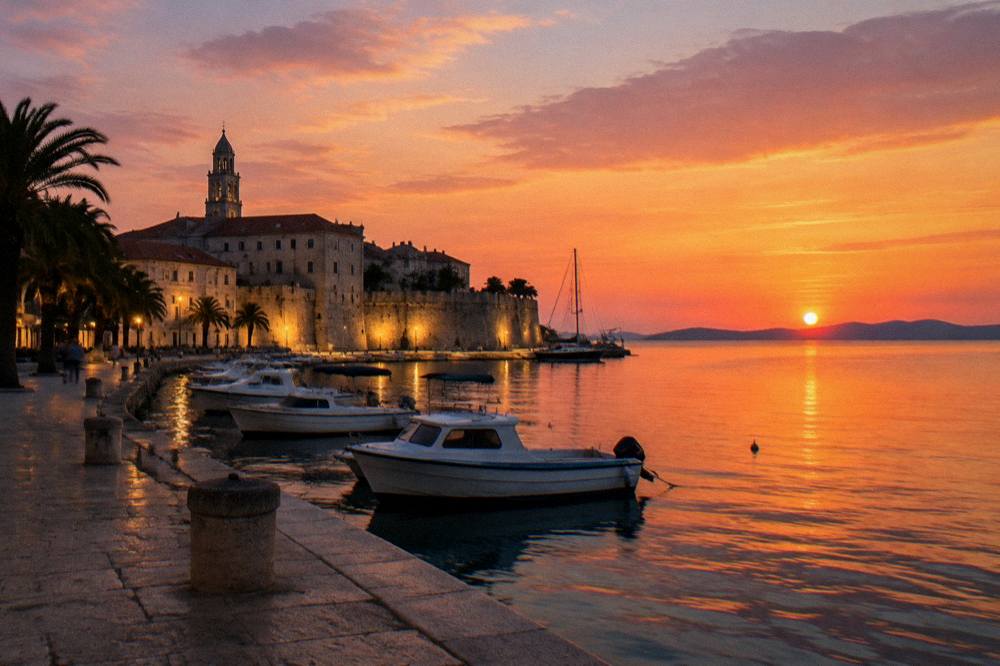
The promenade's rhythm follows the light. Morning belongs to ferry commuters and runners heading toward Marjan. Midday brings the shade-seekers under the palms, since the promenade faces south and the palace wall offers little cover until late afternoon. Evening is the promenade at its fullest, with the terrace chairs full and the palace wall lit after dark. The same station table gives about 2,600 sunshine hours a year in Split, so the odds of an evening walk in daylight are good in every month.
Season by season, the practical picture looks like this, using the station's monthly means:
| Period | Mean temperature | Rain | Promenade conditions |
|---|---|---|---|
| December to February | 8.0 to 9.4 C | 65.2 to 103.7 mm | mild, quiet, Advent lights 27 Nov 2026 to 7 Jan 2027 |
| March to May | 10.8 to 19.2 C | 57.5 to 63.2 mm | pleasant walking, fewer crowds |
| June to August | 23.4 to 26.2 C | 26.6 to 49 mm | hot middays, long bright evenings |
| September to November | 12.7 to 21.6 C | 70.9 to 115.5 mm | warm sea air, November the wettest month |
One winter note: Advent in Split runs 27 November 2026 to 7 January 2027 with the ice rink at Đardin, a few minutes inland from the promenade, which makes the winter Riva livelier than the climate table alone would suggest.
What Can You See From The Riva, And What Runs Alongside It?
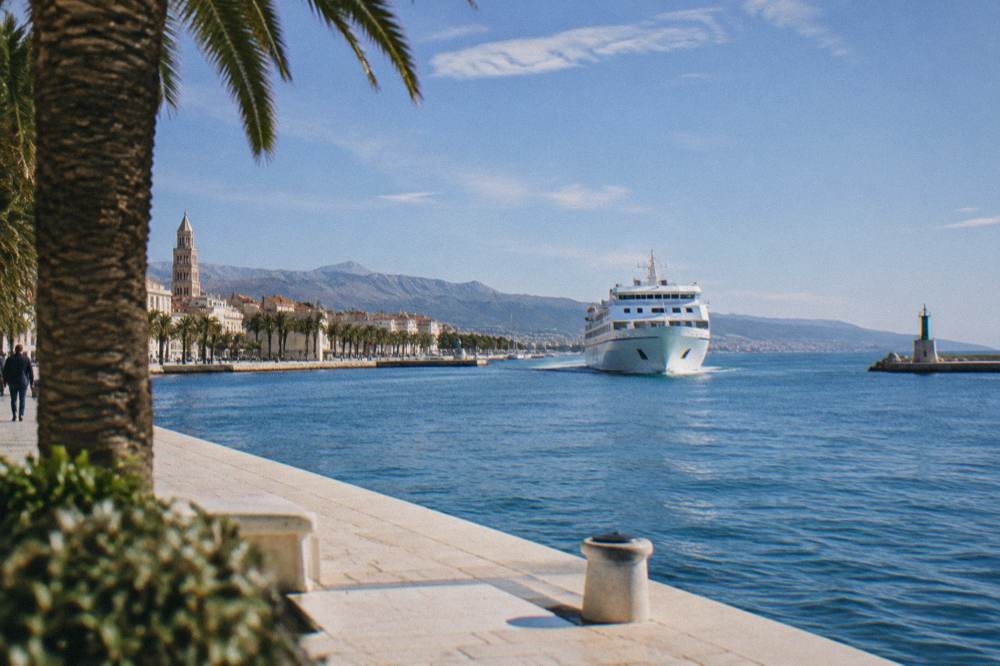
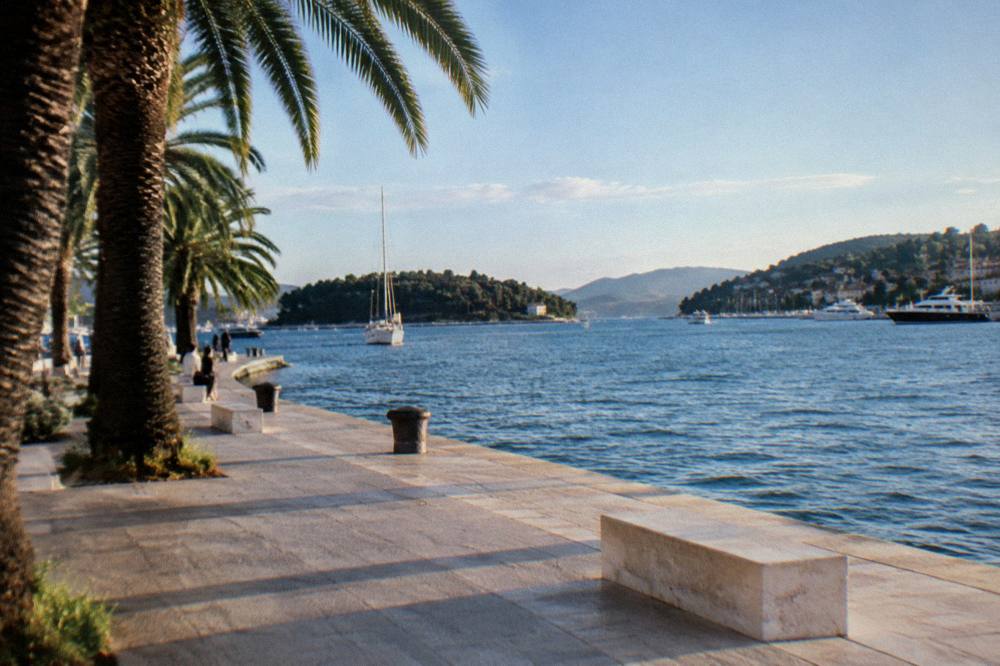
From the Riva you look south across the harbour to the peninsulas of Split, west toward the Marjan hill ridge with its Telegrin summit at 178 m, and out to the islands of Brač, Šolta and Hvar on clear days, while along the promenade itself the palm rows, the bronze model of the palace and the café terraces line a walk broken by the Vestibule, the Bronze Gate and the Prokurative square at its western inland corner. The view changes with the ferry schedule: the big white hulls of the Jadrolinija fleet, the catamarans of Kapetan Luka, TP Line and Bura Line, and the occasional cruise ship at anchor all pass in front of you, which is why the promenade doubles as the best free ship-spotting in Croatia.
Inland, the promenade's back edge is a compressed sight list. The Bronze Gate leads through the cellars up to the Peristyle. The Golden Gate and the Gregory of Nin statue sit at the far northern side of the palace. The green market and the Prokurative square sit just west of the palace's northern edge. The Marjan hill park begins at the promenade's western end, and the Bačvice beach lies fifteen minutes east along the shore, where picigin, the ball game protected as intangible heritage, was born on the sand in 1908.
What Rules Apply On The Riva And In The Historic Core Behind It?
Split's public order rules, in force since 2026, fine drinking alcohol in the historic centre 300 EUR, urinating in public 300 EUR, climbing on monuments or bathing in fountains 300 EUR, and sleeping in public spaces 150 EUR, while walking in swimwear or shirtless in the historic centre is also a fined offence with the amount set locally, so the Riva is a place to arrive dressed and to buy drinks on a terrace rather than a shop. The city's Enjoy Respect page carries the fines, and a separate seasonal rule bans night-time retail alcohol sales in shops between 21:00 and 06:00 from 1 June to 15 September, with the ban due to repeat from 1 June 2027 unless changed.
The rules matter on the promenade because it sits inside the Zone A historic core. Two practical habits cover it. First, save the swimwear for the beach: Bačvice and the other city beaches are minutes away, and the walk back through the old streets in a swimsuit is the exact behaviour the rules target. Second, keep drinking on licensed terraces, which the rules expressly allow.
The full checklist of what the fines cover:
| Behaviour in the historic core | Fine |
|---|---|
| Drinking alcohol in public (outside licensed terraces) | 300 EUR |
| Urinating or vomiting in public | 300 EUR |
| Climbing monuments or bathing in fountains | 300 EUR |
| Sleeping in public spaces | 150 EUR |
| Taxi touting | 300 EUR |
| Swimwear or shirtless in the centre | fined, amount set locally |
Drones add one more restriction worth naming: the old town and the airport zone are no-fly areas, and national parks ban drones outright, so aerial photography of the promenade is not an option for casual visitors.
How Do You Get To The Riva From The Airport, The Bus Station Or A Cruise Ship?
Split Airport sits in Kaštel Štafilić, 20 km from Split and 6 km from Trogir by the airport's own pages, with the Platanus shuttle running from the airport to the main bus station on Obala kneza Domagoja for 10 EUR one way and 15 EUR return, which lands passengers within about 600 m of the promenade; Promet Split's city bus lines 37 and 38 also stop at the airport, with the fare of a few euros confirmed on board. Driving from the palace, the airport is 24.9 km and about 31 minutes free-flow.
Every other arrival mode converges on the same spot. The main bus station, the railway station and the ferry piers sit side by side on Obala kneza Domagoja, 500 to 600 m from the palace, meaning a flat five minute walk separates every long-distance arrival in the city from the Riva. Cruise passengers dock at the same waterfront, which is why the promenade is often a cruise visitor's first and last impression of Split; the port counted 487,377 cruise passengers in 2025 within its total of 6.05 million.
The onward connections from the promenade's eastern end, with the figures for each exact journey:
| Journey | Time |
|---|---|
| Riva to Split Airport, driving (from the palace) | 24.9 km, about 31 min free-flow |
| Airport to main bus station by Platanus shuttle | 10 EUR one way, 15 EUR return |
| Split to Trogir | 29.3 km, about 36 min driving |
| Split to Omiš | 25.5 km, about 38 min driving |
| Split to Šibenik | 84.8 km, about 71 min driving |
| Split to Dubrovnik by coach | about 4 h |
| Split to Zagreb by train | about 7 h 15 to 8 h 10 |
For a wider view of what else sits within reach of the promenade, the Split Croatia Travel Guide day trip pages cover Krka, Plitvice, Mostar and Dubrovnik, and the two days in Split and three days in Split itineraries place the Riva inside a fuller plan.
Common Questions About The Split Riva
Is the Split Riva free?
Yes. The Riva is public space with no ticket, no gate and no closing time, and the city lists it among the free sights alongside the Peristyle, the Prokurative, the Golden Gate and Marjan hill.
How long does it take to walk the Riva in Split?
The pedestrianised promenade takes roughly ten minutes end to end at an unhurried pace. Cafés, viewpoints and the palace exits easily stretch the visit to an hour or more.
Will the Riva be closed for renovation in 2027?
Partial closures should be expected through 2027. A renovation of the central section, about 3.5 to 4 million EUR with a 3LHD design, is planned from November 2026 for a little over a year, but the promenade is not being rebuilt as a whole.
Can you see the islands from the Riva?
Yes. The promenade looks south across the harbour toward Brač, Šolta and Hvar on clear days, and the ferry and catamaran traffic to all three passes directly in front of it.
Can you drink alcohol on the Riva?
Only on licensed café terraces. Public drinking in the historic centre carries a 300 EUR fine, and shops in the core cannot sell alcohol at night from 1 June to 15 September under the seasonal rule.
How far is the Riva from the ferry port and the bus station?
About 500 to 600 m. The ferry port, the main bus station and the railway station sit together on Obala kneza Domagoja, a flat five minute walk from the promenade and the palace.
The Riva rewards the unhurried. It costs nothing, connects everything, and in 2027 it will still do both, fences and all, which is more than can be said for any other single street in the city.
