Split Car Rental
Split sits at the centre of Dalmatia's road network, with Krka, Plitvice, Trogir, Omiš and Mostar all within a day's drive, so a car unlocks the region. This guide covers where to pick one up, the driving times, ferry rules for the islands, the old-town rules that catch drivers out, and the days a boat or a kayak beats four wheels.
Short answer
A rental car in Split pays off for the inland and long-distance day trips, above all Krka at about 74 minutes and Plitvice at about 3 hours 15 by road, and for the coastal stretch to Omiš and Makarska. It is the wrong tool inside the palace walls and for Hvar town, which is reached by catamaran on foot. The airport sits 20 km away in Kaštel Štafilić, with a 10 EUR shuttle to the bus station by the ferry port.
Split is a coastal city in central Dalmatia, and its road position is the reason a rental car is worth thinking about here: the ferry port, the main bus station and the railway station sit together on Obala kneza Domagoja, 500 to 600 m from Diocletian's Palace, and from that single spot the whole of southern Croatia fans out by road. Krka National Park is about 74 minutes away at free-flow speeds, Omiš 38 minutes, Trogir 36. The trade-off is the city itself, where the historic core is pedestrian stone lanes and the rules on drinking, dress and parking in the old town were tightened in 2026. This guide lays out both sides: what a car genuinely unlocks from Split, and the days the ferries or a kayak from the beach do the job better.
Is Renting A Car In Split A Good Idea?
A car in Split earns its keep for the inland and long-distance day trips, above all Krka at about 74 minutes, Plitvice at about 3 hours 15 and Mostar at about 2 hours 13 by road, and for the coastal drive to Omiš and Makarska. Inside the city it is close to useless: the old town is a pedestrian zone of stone lanes, and the palace, the Riva, the beaches and Marjan are all walkable from the port area.
The honest framing is a hub-and-spoke one. Split works as a base you explore on foot, with the car reserved for spokes where public transport is slow or absent. A train runs to Zagreb in about 7 hours 15 to 8 hours 10, and coaches reach Dubrovnik in about 4 hours and Zagreb in about 5 hours 30, so even some long hops do not strictly need a car. The full day-trip menu shows which destinations are served by tours and coaches and which reward driving.
Where Do You Pick Up A Rental Car In Split?
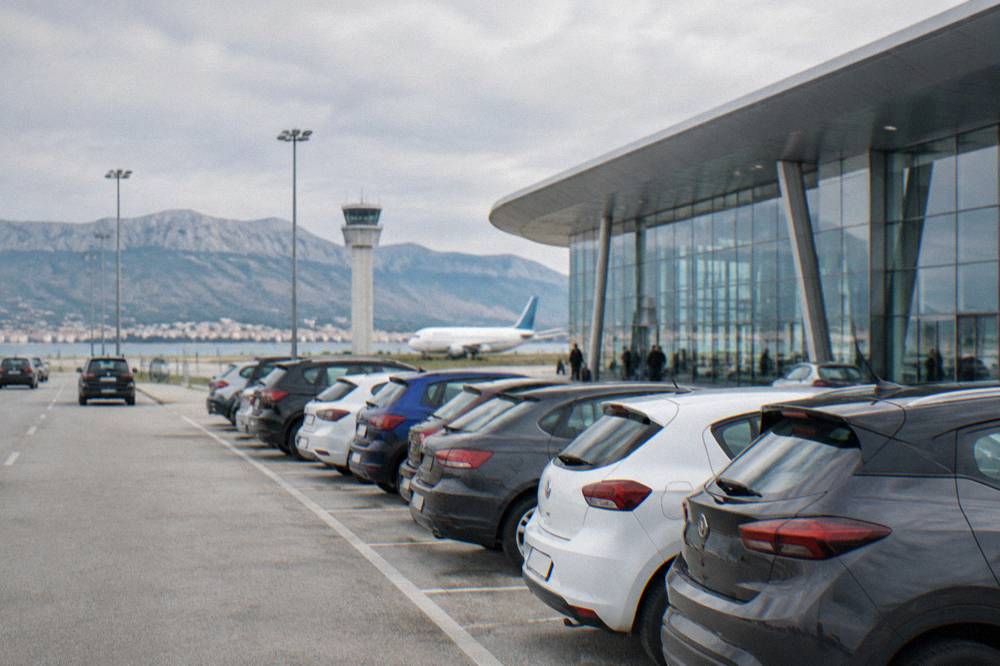
The main pickup point is Split Airport (SPU) in Kaštel Štafilić, which the airport's own pages place 20 km from Split and 6 km from Trogir, with agency desks at the terminal and a drive to the palace of 24.9 km, about 31 minutes free-flow. In the city, agencies cluster around the ferry-port and bus-station area on Obala kneza Domagoja, 500 to 600 m from the palace, which is also where you return a car before a ferry to the islands.
To see how the desks at the terminal compare, book a Split Airport car rental here.
Two things about the airport are worth knowing before you book. First, the distance: the airport is in the Kaštela belt, not the city, so a "Split airport" pickup still involves a half-hour drive. Second, the alternatives if nobody is flying: the Platanus shuttle runs from the airport's North parking to the main bus station by the ferry port at 10 EUR one way and 15 EUR return, and Promet Split city buses on lines 37 and 38 stop at the airport for a few euros, confirm on board. Both are described in the airport guide, and the transfer options from terminal to centre are compared in Split Airport To City Centre.
What Should You Check Before Signing The Rental Agreement?
Check four things in writing before signing: the fuel policy and whether it is full-to-full, the excess amount and what the deposit hold on your card will be, whether cross-border driving into Bosnia and Herzegovina is permitted, and whether the ferry transport of the vehicle to an island is allowed.
Day trips to Mostar, at about 2 hours 13 by road, cross a border, and island hopping means putting the car on a Jadrolinija ferry, and either one can void a cheap rate if the contract excludes it.
No car-hire rate is quoted on this page, because none is published by the operators themselves: the desk's advice is to compare the operator's live listing and read the exclusions rather than the headline figure. The cross-border point matters specifically for Mostar, whose rebuilt Old Bridge is a UNESCO World Heritage site, and for Počitelj and the Kravice waterfalls, all of which sit in Bosnia and Herzegovina. Insurance and excess policies vary by operator, so the figure to ask for is the deposit hold, not just the daily rate. Croatia has used the euro since 1 January 2023, so every quote should be in EUR with no conversion surprises.
How Far Is Each Day Trip From Split By Car?
Free-flow driving times from Diocletian's Palace run about 14 minutes to Salona, 22 to Klis Fortress, 36 to Trogir, 38 to Omiš, 71 to Šibenik, 74 to Krka's Skradinski buk entrance, 75 to Makarska, 2 hours to Zadar, 2 hours 13 to Mostar, 3 hours 15 to Plitvice and 3 hours 21 to Dubrovnik. The airport is 24.9 km, about 31 minutes. These are computed free-flow figures, so add time in July and August.
| Destination | Distance from the palace | Free-flow time |
|---|---|---|
| Salona | 9.1 km | 14 min |
| Klis Fortress | 13.9 km | 22 min |
| Split Airport (Kaštel Štafilić) | 24.9 km | 31 min |
| Trogir | 29.3 km | 36 min |
| Omiš | 25.5 km | 38 min |
| Šibenik | 84.8 km | 71 min |
| Krka, Skradinski buk | 90.2 km | 74 min |
| Makarska | 86.1 km | 75 min |
| Zadar | 159.5 km | 2 h |
| Mostar | 173.2 km | 2 h 13 |
| Plitvice Lakes | 258.1 km | 3 h 15 |
| Dubrovnik | 234.8 km | 3 h 21 |
The pattern in the table shapes the decision. Everything up to Makarska is an easy half-day or full-day radius; Plitvice at 3 hours 15 each way is a long day and a coach tour with entry tickets is a serious alternative; Dubrovnik at 3 hours 21 by road versus about 4 hours by coach is nearly a wash, which is why the Split to Dubrovnik comparison rarely hinges on the car alone.
Can You Take A Rental Car On The Ferries To Hvar, Brač, Šolta Or Vis?
Car ferries run from Split to Stari Grad on Hvar in about 120 minutes, Supetar on Brač in about 50, Rogač on Šolta in about 60 and Vis in about 140, with foot passengers paying 5.90 EUR off-season and 8.40 EUR in season on the Stari Grad line. Hvar town itself is reached by catamaran on foot, not by car ferry, and vehicle space on every line sells out in summer, so book the crossing before you book anything else.
| Route | Operator line | Approximate sailing | Foot passenger fare |
|---|---|---|---|
| Split to Stari Grad (Hvar) | Jadrolinija 635 | 120 min | 5.90 EUR off-season, 8.40 EUR in season |
| Split to Supetar (Brač) | Jadrolinija 631 | 50 min | see Jadrolinija price list |
| Split to Rogač (Šolta) | Jadrolinija 636 | 60 min | see Jadrolinija price list |
| Split to Vis | Jadrolinija | 140 min | see Jadrolinija price list |
| Catamaran to Hvar town or Jelsa | lines 9603, 9602 | fast sailing | 6.40 EUR low, 10.00 EUR high |
| Catamaran to Vis | line 9602 | fast sailing | 7.20 EUR low, 10.00 EUR high |
The distinction that trips people up is Hvar town versus Stari Grad: the car ferry docks at Stari Grad on the north side of the island, and Hvar town is a drive or a catamaran away. From 2026 the Supetar line runs with no off-season timetable at all, only high and low season schedules, which reflects how busy the Brač crossing has become. If the plan is beaches and one town, the Hvar ferry guide and the boat-trip options often beat a car-plus-ferry combination outright.
What Are The Rules For Parking And Driving In Split's Old Town?
The historic core inside and around Diocletian's Palace is closed to ordinary traffic, so a rental car is parked outside and the old town is walked, and a 2026 city decision added fines of 300 EUR for drinking alcohol in the historic centre, urinating, vomiting, climbing on monuments or bathing in fountains, and 150 EUR for sleeping in public spaces. Walking in swimwear or shirtless in the centre is also fined, with the amount set locally.
Confirm your parking tariff on the meter or garage sign, as no tariff is published uniformly.
The practical layout: the useful car parks sit at the edges of the centre, near the ferry port and along the western approaches to Marjan, and from any of them you are within walking range of the Peristyle, the Golden Gate, the Riva and the green market, all of which are free to enter. The palace substructures, run by the Split City Museum, are open 8:30 to 20:00 daily with the central part under restoration to the end of 2026 and the passage staying open, so even the ticketed core needs no car. One more 2026 rule to know: shops in the city may not sell alcohol at night in summer, and the historic-centre drinking ban carries that 300 EUR fine, none of which a driver wants to test.
Do You Need A Car For Krka And Plitvice, Or Does A Tour Win?
Entry to Krka costs 40 EUR in June to September, 20 EUR in April, May and October and 7 EUR in January to March and November to December, and Plitvice costs 40 EUR in June to September, 23 EUR in April, May and October and 10 EUR in the winter months, per the parks' own 2026 price lists, and the Krka ticket includes the Skradin boat and Lozovac bus transfers.
A car gives you timing freedom; a tour gives you a driver for a 6 to 7 hour round trip to Plitvice.
| Park | Jan to Mar | Apr, May, Oct | Jun to Sep | Notes |
|---|---|---|---|---|
| Krka (all land sites) | 7 EUR | 20 EUR | 40 EUR | Skradin boat and Lozovac bus included 1 Apr to 31 Oct |
| Krka outlying sites (Roški slap, Kistanje, Burnum, Eco Campus) | 7 EUR | 12 EUR | 20 EUR | separate tariff band |
| Plitvice Lakes | 10 EUR | 23 EUR | 40 EUR | 25 EUR afternoon slot in peak; timed online entry, visitor's name on ticket |
Two rules matter as much as the prices. Swimming at Krka is allowed only in clearly marked areas, and the ban on swimming at Skradinski buk is enforced, so do not build the drive around a swim under the falls. Plitvice uses timed online entry with the visitor's name on the ticket, which in practice rewards whoever books first, driver or tour passenger alike. The deeper question of which park suits which traveller is covered in the Krka and Plitvice comparison, and what to avoid in Split style planning applies: a 3 hours 15 drive each way to Plitvice is a commitment, not a detour.
When Is A Boat Or A Kayak Better Than A Car In Split?
For everything on the water, the car loses: the Blue Lagoon trips, the five-island speedboat runs to the Blue Cave and Hvar, and the kayak sessions off the city beaches all leave on foot from the Split seafront, and the Blue Cave on Biševo is entered by boat with a fee of 24 EUR in high season and 18 EUR in shoulder season paid in cash on site. Hvar town has no car ferry link at all, only catamarans for foot passengers.
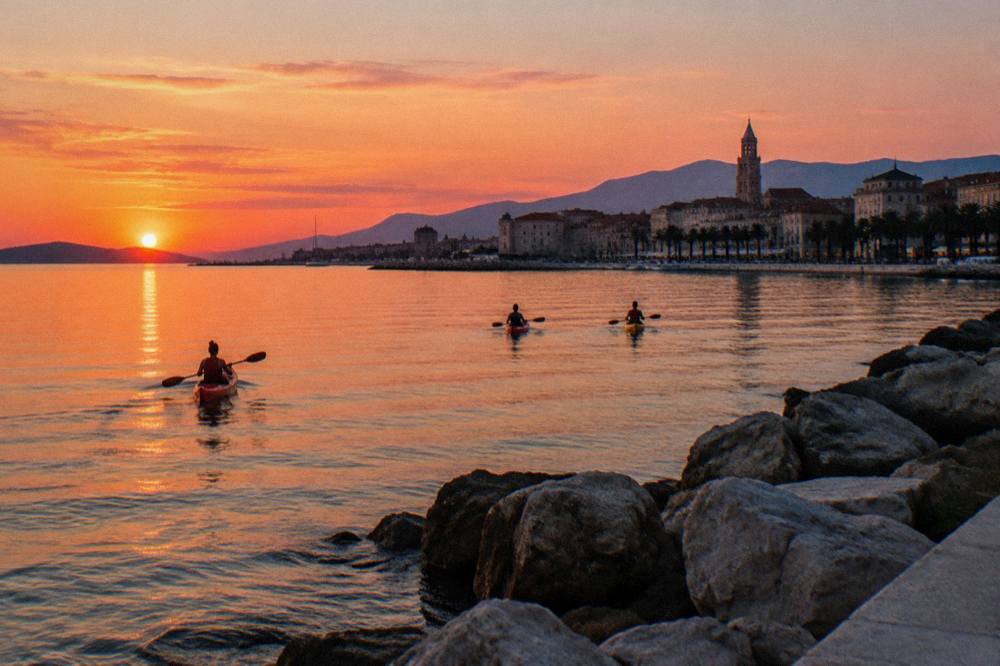
The boat-trip economy in Split is large enough that whole categories of day trip never touch a road. Blue Lagoon and three-island cruises, speedboats to the Blue Cave and Hvar, and evening sails all dock within a short walk of the palace. On the smaller scale, kayaking off Bačvice or beneath Marjan needs nothing but a swimsuit, which is one reason the editorial desk points drivers at a paddle as often as at a gearbox. The boat tours guide and the rental options for skippering your own craft are covered in Split Boat Rental.
How Does Split's Weather Affect A Driving Holiday?
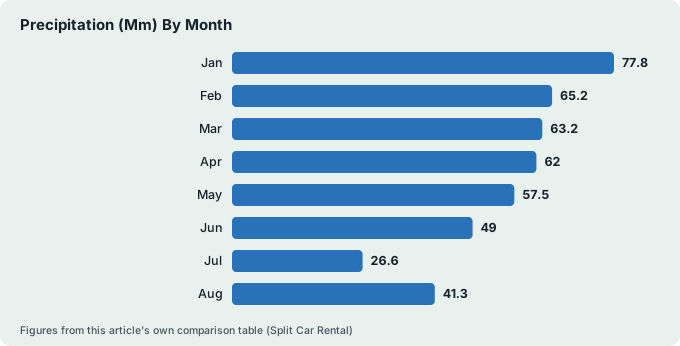
The DHMZ Split-Marjan station table for 1948 to 2024 shows a July mean of 26.2 C and a January mean of 8.0 C, with July the driest month at 26.6 mm and November the wettest at 115.5 mm, so summer driving is dry but busy and autumn driving is mild but wetter. Sunshine runs 353.3 hours in July against 120.8 in December, about 2,600 hours across the year.
| Month | Mean temperature (C) | Precipitation (mm) | DHMZ Split-Marjan, 1948 to 2024 |
|---|---|---|---|
| --- | --- | --- | --- |
| Jan | 8.0 | 77.8 | station mean |
| Feb | 8.5 | 65.2 | station mean |
| Mar | 10.8 | 63.2 | station mean |
| Apr | 14.4 | 62.0 | station mean |
| May | 19.2 | 57.5 | station mean |
| Jun | 23.4 | 49.0 | station mean |
| Jul | 26.2 | 26.6 | station mean |
| Aug | 25.9 | 41.3 | station mean |
| Sep | 21.6 | 70.9 | station mean |
| Oct | 17.2 | 77.0 | station mean |
| Nov | 12.7 | 115.5 | station mean |
| Dec | 9.4 | 103.7 | station mean |
For a driver, the table translates simply. July and August bring 18 and 17 days at 30 C or more respectively, which means hot parked cars and peak traffic on the coastal road to Omiš and Makarska. November is the wettest month, and the Adriatic coastal road is at its most demanding in heavy rain. Shoulder months, May and June, September and October, pair mild means with lighter traffic, which the best time to visit and weather guides cover in detail.
What Documents And Border Rules Apply To Drivers In 2026?
Croatia has been in the Schengen area since 1 January 2023 and uses the euro since the same date, the EES biometric entry system is fully operational at external borders from 10 April 2026, and ETIAS is not yet live with no fixed start date, so visa-exempt visitors currently need no pre-travel authorisation. A valid driving licence from an EU or recognised country, the vehicle papers and the rental contract are what police ask for, and the emergency number is 112.
The border detail matters only if Mostar or Dubrovnik is on the route. Mostar involves crossing into Bosnia and Herzegovina and back, which since 10 April 2026 means EES biometric registration for non-EU nationals at each external Schengen crossing, adding time at the Metković border in summer. The drive to Dubrovnik stays inside Croatia but skirts the Neum corridor, so it also crosses Bosnia and Herzegovina briefly unless you take the Pelješac bridge route; either way the rental contract must permit cross-border driving, and the desk's advice is to confirm that clause in writing. Drones are also worth a mention for road-trippers: the old town and the airport zone are no-fly areas, and national parks ban them.
What Are The Alternatives If You Skip The Car Entirely?
Split is walkable at its core, with the palace, the beaches, Marjan and the markets all within reach on foot, coaches run to Dubrovnik in about 4 hours and Zagreb in about 5 hours 30, the train reaches Zagreb in about 7 hours 15 to 8 hours 10, and catamarans carry foot passengers to Hvar town, Jelsa and Vis, so a car-free week built on boats, coaches and walks is entirely realistic. The decision comes down to whether Krka, Plitvice or Mostar is on the list.
A workable split, so to speak, is a car for two or three days of the week and none for the rest. Pick up at the port-area desks on the morning of the Krka or Mostar day, return it that evening, and spend the island days on the water. For the water days the desk rates a kayak session or a gastro walk above any drive: the kayak trips run from the city beaches themselves, and the food-and-market walk through the green market covers ground no road reaches. If the balance still feels unclear, the longer is-it-worth-renting-a-car answer works through the arithmetic question by question, and where to stay matters too, since a base near the port puts every transport mode within a ten-minute walk.
Common Questions About Renting A Car In Split
Is Renting A Car In Split Worth It?
It depends on the itinerary. Driving times of about 74 minutes to Krka, 38 to Omiš and 36 to Trogir make a car the fastest option for inland and coastal day trips, while the old town, the beaches and the islands are better handled on foot and by boat. A car for two or three days, parked the rest of the week, is the pattern the desk would draw.
How Far Is Split Airport From The City Centre?
The airport's own pages give 20 km from Split and 6 km from Trogir, in Kaštel Štafilić. Driving from the palace is 24.9 km, about 31 minutes free-flow. The Platanus shuttle runs to the main bus station by the ferry port at 10 EUR one way and 15 EUR return.
Can You Drive To Hvar?
Not to Hvar town. The car ferry from Split docks at Stari Grad in about 120 minutes, and Hvar town is reached by catamaran as a foot passenger, at 6.40 EUR low season and 10.00 EUR high season. Vehicle space on summer sailings needs advance booking.
Can You Park Inside Diocletian's Palace?
No, the historic core is closed to ordinary traffic. Park at the edges near the ferry port or Marjan and walk in; the palace, the Peristyle, the Golden Gate and the Riva are all free to enter and within walking range of the port-area car parks.
Do You Need A Car For Plitvice Lakes From Split?
Plitvice is 258.1 km and about 3 hours 15 of free-flow driving each way, so a car and a coach tour both mean a long day. Entry uses timed online tickets with the visitor's name on them, at 40 EUR in June to September and 23 EUR in April, May and October, so book entry before deciding how to travel.
Can You Take A Rental Car To Mostar?
Only if the rental contract permits cross-border driving, which the desk advises confirming in writing before booking. Mostar is about 2 hours 13 by road from Split, and the crossing into Bosnia and Herzegovina is an external Schengen border where EES biometric checks apply from 10 April 2026.
The short version: rent for the spokes, walk the hub, and let the boats own the sea days. That is how Split rewards a driver, and how the Split Croatia Travel Guide would plan the week.