Split Shopping
Shopping in Split runs from the green market stalls beside Diocletian's Palace to gallery shops and island day trips, in a country that has used the euro since 1 January 2023.
Short answer
Split's shopping core sits in and around Diocletian's Palace: the green market stalls, the shops of the Old Town lanes, and museum shops such as the Meštrović Gallery and the Split City Museum. Croatia uses the euro, tourist tax of about 2.65 EUR per night in high season is collected by your accommodation, and markets are free to browse.
Shopping in Split means a compact, walkable core in and around Diocletian's Palace, a city of 160,577 people (2021 census) that anchors the central Dalmatian coast. The palace, begun around 295 to 305 AD for Emperor Diocletian and inscribed by UNESCO in 1979 as the Historical Complex of Split, is itself the main shopping district: its lanes hold the densest run of small shops, and the green market sits a short walk away. Croatia has used the euro since 1 January 2023 and has been in the Schengen area since the same date, so a euro-zone shopping trip runs with no currency exchange for euro-area visitors.
This Split Croatia Travel Guide page walks through what you can actually buy, where the shopping areas sit, which markets and museum shops are worth the walk, and how ferry and driving times shape a shopping day trip. Where a price matters, it comes from the institution's own published list, and where something varies, the page says so instead of guessing.
What Can You Buy In Split?
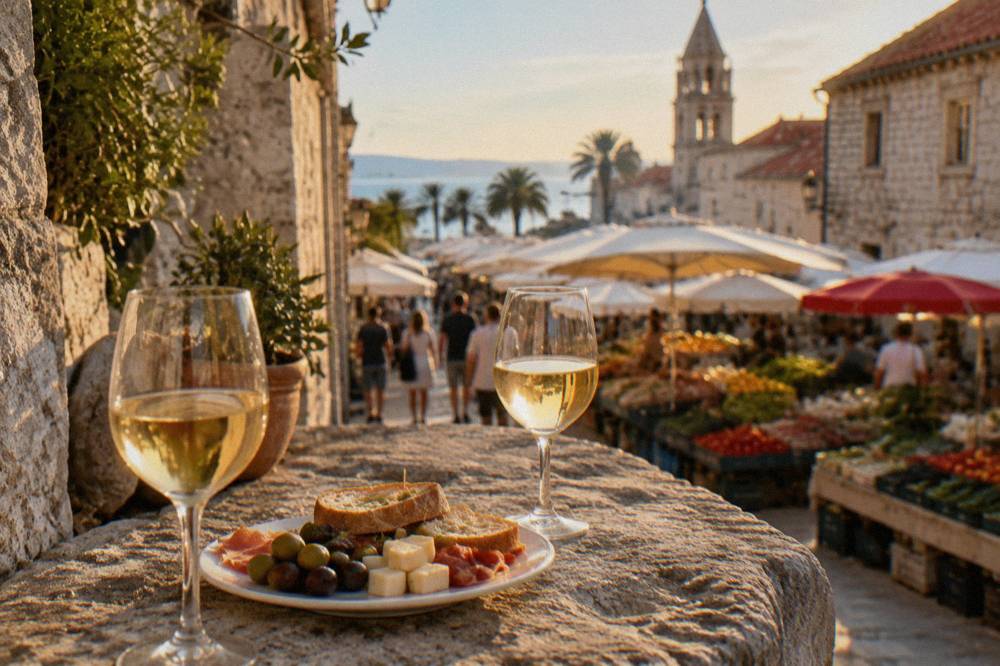
The realistic shopping list in Split is food and wine from the green market, olive oil and lavender products from Dalmatian producers, museum-shop books and prints, and everyday euro-zone high-street goods in the centre's small shops. There is no giant mall culture here: the city's retail identity is small, owner-run and food-first, and the durable souvenir buys are edible ones rather than branded merchandise.
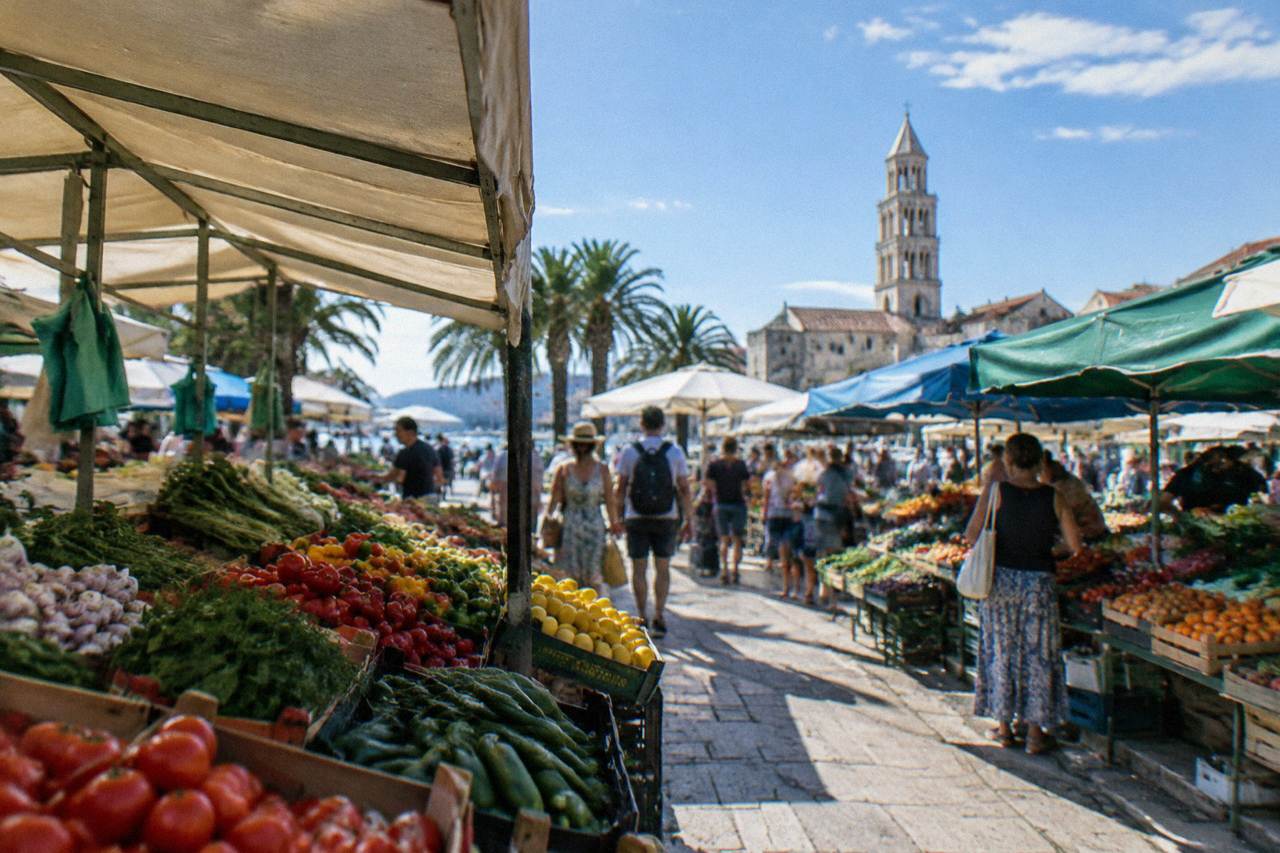
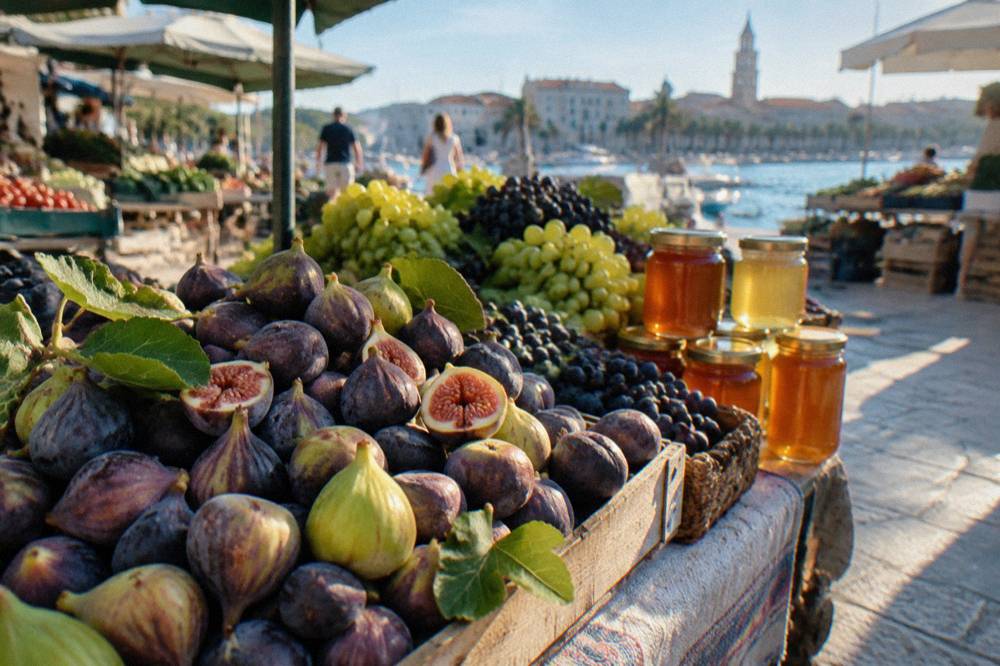
The green market beside the palace is the anchor. Stalls there sell seasonal Dalmatian produce, and the market belongs to the same free-to-enter category as the Peristyle, the Riva and the Marjan park: no ticket, no entry fee. The green market has its own guide context on this site, covering what the stalls sell and how the market fits a food-focused day in the city.
Beyond food, the museum shops are the second real shopping stop. The Split City Museum, at 10.00 EUR adult entry with its shop in the Papalić Palace, the Archaeological Museum, founded in 1820, and the Meštrović Gallery all sell publications and reproductions tied to their collections. For a fuller picture of the city's food-buying culture, the Split restaurants guide explains how market produce reaches the table.
What Split does not offer is a purpose-built luxury retail district.
Where Are The Main Shopping Areas In Split?
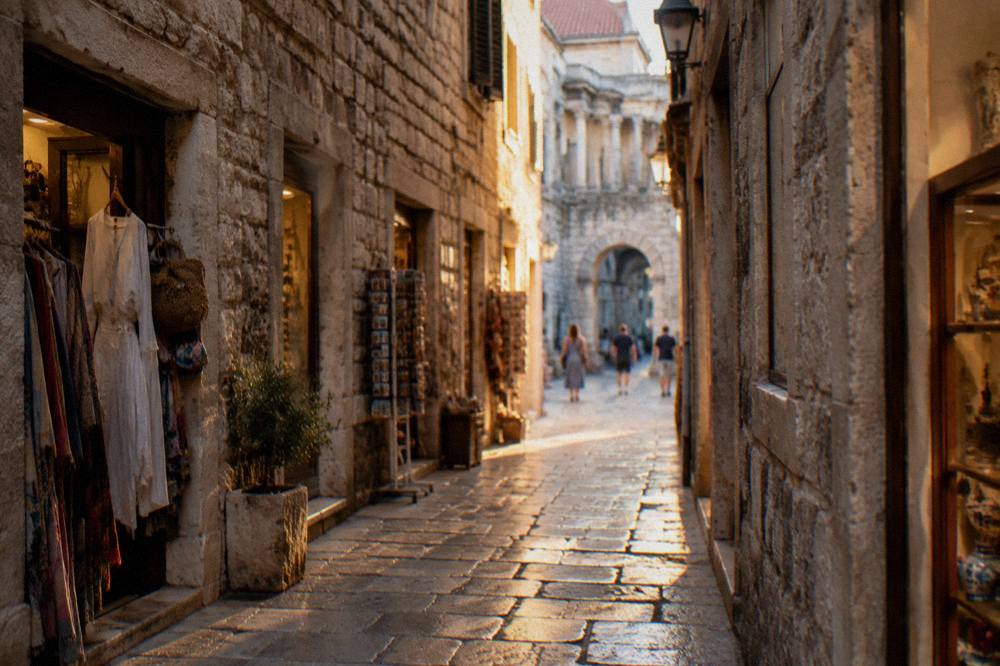
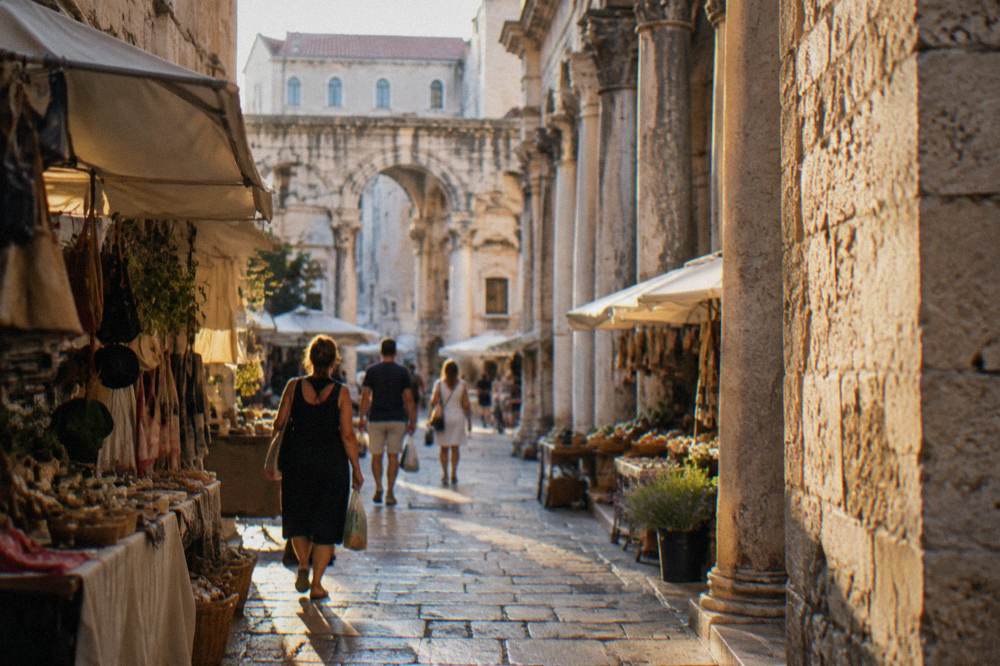
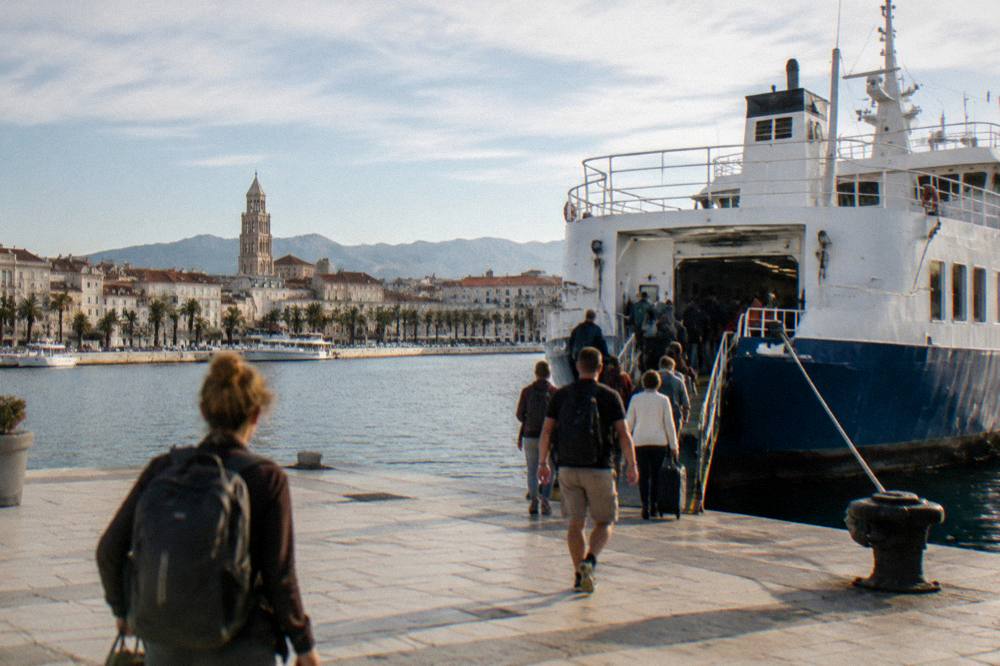
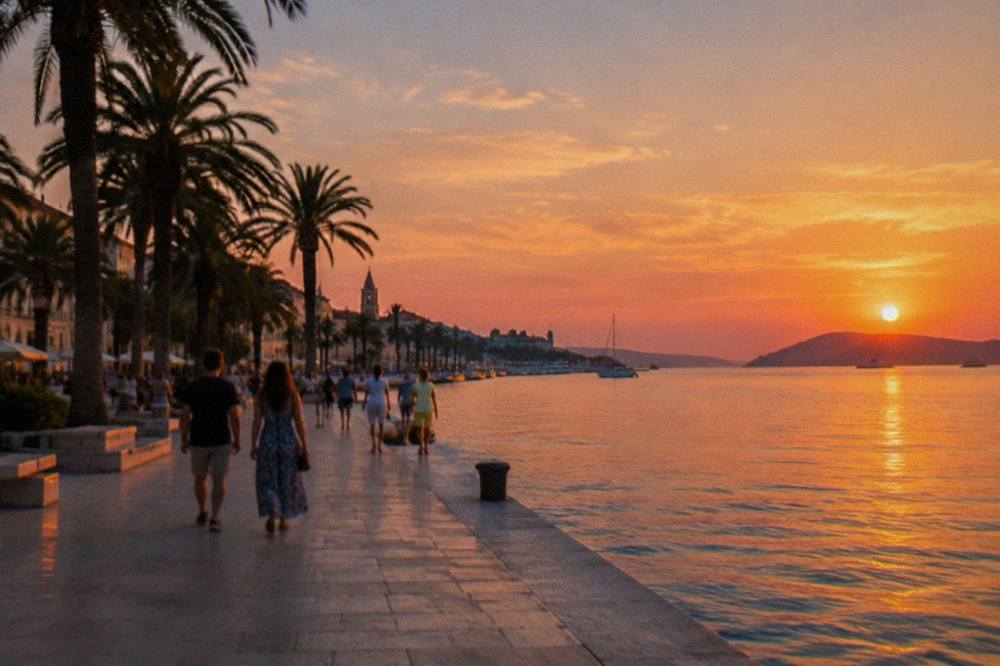
The main shopping areas of Split are the lanes inside Diocletian's Palace, the streets immediately around it including the Riva waterfront, and the green market area by the palace walls, all within 500 to 600 m of each other. The ferry port, main bus station and railway station sit together on Obala kneza Domagoja, 500 to 600 m from the palace, so arriving shoppers reach the core on foot without transport.
The palace itself is the district. Its substructures, run by the Split City Museum and open Monday to Sunday 8:30 to 20:00, sit under the same lanes, and the central part is under restoration to the end of 2026 with the passage staying open, so shoppers move through the usual routes regardless. The Riva promenade runs along the water side of the core; note that a renovation of its central section is planned from November 2026 for a little over a year, so partial closures on the Riva are expected through 2027.
The Golden Gate end of the palace, with the Grgur Ninski statue, and the Prokurative square complete the walkable loop. Every one of these spaces is free to enter, which makes a shopping walk in Split unusually cheap: the spend happens in the shops, not at any gate.
A budget note that fits here: the Split on a budget guide collects the free layer of the city, and a market-and-palace shopping day uses almost all of it. Anyone matching a shopping trip against the city's wider sightseeing can start from the things to do in Split overview.
After a morning of market lanes and museum shops, the afternoons open up quickly. The rafting option below is the one this site features alongside its shopping coverage, and the other two picks suit travellers who want a fortress sunset or a cross-border waterfall day between retail sessions.
Which Split Markets Should You Visit?
The green market by Diocletian's Palace is the market to visit in Split, free to enter and a short walk from the Riva, and it anchors the city's food-shopping culture alongside the smaller stalls that appear around the old core. Market areas in Split are public space, so browsing costs nothing, and the buys that matter are seasonal Dalmatian produce and pantry goods.
The green market's role in the city's food life is documented across this site's food coverage, and the practical advice is simple: buy what is in season, ask prices before weighing, and pay in euro cash or card as the stall allows. Picigin, the ball game born on Bačvice beach in 1908 and now protected intangible heritage of Croatia, is part of the same local culture a market morning exposes, played on the sand a short way east of the centre.
Two honest cautions from the city's own rules. Buying alcohol to drink in the historic centre is fined: the city's published rules set 300 EUR for alcohol in the historic centre or within 100 m of schools. And from 2026, shops and supermarkets in Split face a night-time retail alcohol sales ban in the summer season, 1 June to 15 September, with bars and restaurants unaffected, so a late-evening bottle buy from a shop may simply not be possible in high summer. Confirm current enforcement locally.
The market district also connects to the city beach layer. Bačvice, the city's central beach, is free like the markets, and the Split beaches guide covers it. A market, palace and beach day needs no ticket anywhere.
For shoppers carrying bags who want the wider city without walking it, the electric tuk-tuk ride above covers the city highlights, and the operator's live listing carries the current price and availability.
What Are The Museum Shops And Galleries In Split?
Split's museum shops sit inside its ticketed institutions, and the adult prices are 10.00 EUR for the Split City Museum, 12.00 EUR for the Meštrović Gallery including Crikvine-Kaštilac, 8 EUR for the Archaeological Museum, 7.00 EUR for the Ethnographic Museum, and 10 EUR combined for the Archaeological Museum plus Salona within 7 days. Each shop sells publications and reproductions tied to its own collection.
The Meštrović Gallery reopened in April 2026 after a 15-month energy renovation, with a fresh exhibition on the gallery house itself, so its shop is running alongside a renewed building. The Split City Museum's price list gives 10.00 EUR adult, 8.00 EUR reduced and 18.00 EUR family, and it is closed Mondays. The Archaeological Museum's combined ticket, valid across seven days, pairs a city museum visit with the Salona site, whose summer hours (1 June to 30 September) run daily 9:00 to 20:00.
| Institution | Adult ticket | Notes from the price list |
|---|---|---|
| Split City Museum (Papalić Palace) | 10.00 EUR | 8.00 reduced, family 18.00, closed Mondays |
| Meštrović Gallery | 12.00 EUR | Includes Crikvine-Kaštilac, reopened April 2026 |
| Archaeological Museum | 8 EUR | 4 EUR children, students, retirees |
| Museum plus Salona combined | 10 EUR | Valid within 7 days |
| Ethnographic Museum | 7.00 EUR | 4.00 reduced, family 15, Vestibule 2.00 |
| Klis Fortress | 10 EUR | 3 EUR children, daily 9:00 to 17:00 |
The Cathedral of St Domnius complex also has a kiosk on the Peristyle, and its ticket scheme runs several single-site and combined options; prices there are secondary-reported, so write only "from about 5 EUR, combined tickets up to about 15 EUR" and check at the kiosk. The cathedral complex requires shoulders and knees covered, which matters for shoppers wandering in from a beach morning.
Evening options round out a shopping day nicely, and the illuminated kayak trip above runs from the city's own waterfront, with details on the operator's live listing.
Is Shopping Cheaper In Split Than Elsewhere?
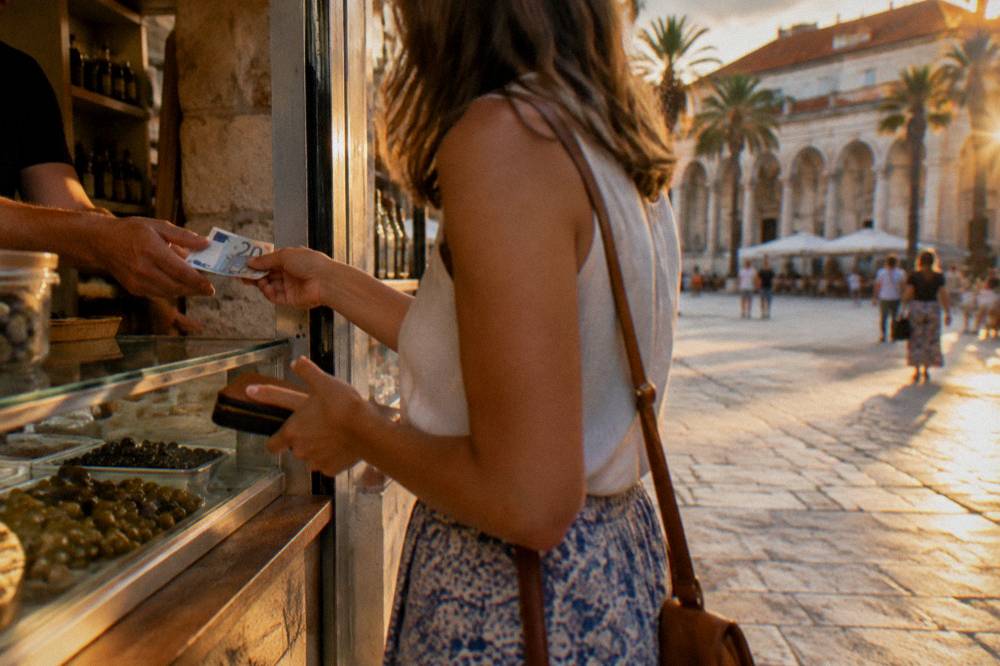
Split runs on the euro, Croatia's currency since 1 January 2023, so euro-area visitors face no exchange cost, and the city's main shopping experiences, the markets, the palace lanes, the Riva and Marjan, are free to enter. The unavoidable added cost is the tourist tax, about 2.65 EUR per person per night in high season, 1 April to 30 September, under 12 free and 12 to 18 half, collected by the accommodation and confirmed at booking.
The honest price comparison inside Croatia is Split against Dubrovnik, and the clearest published marker is the Dubrovnik city walls ticket at 40 EUR for 2026, high season March to November, against Split's fully walkable UNESCO core, which charges nothing at any gate. This site's Split versus Dubrovnik guide works through the fuller comparison.
Practical spending notes that come from the city's own published rules rather than guesswork:
| Cost item | Figure | Source basis |
|---|---|---|
| Currency | Euro, since 1 January 2023 | ECB changeover page |
| Tourist tax, high season | About 2.65 EUR per person per night (1 April to 30 September) | County decision |
| Tourist tax, children | Under 12 free, 12 to 18 half | County decision |
| Historic-centre alcohol fine | 300 EUR | City of Split published rules |
| Airport shuttle (Platanus) | 10 EUR one way, 15 EUR return | Operator's own page |
| Ferry on foot to Stari Grad | 5.90 EUR off-season, 8.40 EUR in season | Jadrolinija price list |
Those are confirm-at-booking items, and any page that quotes them for Split is estimating.
Can You Combine Shopping With A Day Trip From Split?
Yes, and the travel times make it easy: Trogir is 36 minutes' drive from the palace, Šibenik 71 minutes, Omiš 38 minutes and Klis 22 minutes, while the car ferry to Stari Grad on Hvar takes about 120 minutes on foot for 5.90 EUR off-season or 8.40 EUR in season. Catamarans reach Hvar or Jelsa for 6.40 EUR low season and 10.00 EUR high, and Vis for 7.20 and 10.00 EUR.
One ferry fact prevents a classic mistake: the car ferry lands at Stari Grad, while Hvar town itself is reached by catamaran. The ferries from Split guide covers the routes in full, and the Split to Hvar ferry guide works through the Hvar options specifically. On Hvar, the Fortica fortress charges 12 EUR, open 9:00 to 20:00, which pairs a viewing stop with the town's small shops.
| Day trip from the palace | Drive time, free-flow | Notes |
|---|---|---|
| Klis Fortress | 22 min | 10 EUR entry, Meereen location |
| Salona | 14 min | Via 10 EUR combined museum ticket |
| Trogir | 36 min | UNESCO listed 1997 |
| Omiš | 38 min | Mirabela 4 EUR, 6 EUR from 1 June to 30 September |
| Šibenik | 71 min | Cathedral UNESCO 2000 |
| Mostar | 2 h 13 | Old Bridge UNESCO 2005 |
| Dubrovnik | 3 h 21 | Walls 40 EUR (2026) |
The Split day trips guide collects the full set. Coach times for longer runs are secondary-reported: about 4 hours to Dubrovnik and about 5 hours 30 to Zagreb, while the train to Zagreb runs about 7 h 15 to 8 h 10. Those figures suit planning, not scheduling: confirm timetables before committing.
The featured Cetina rafting trip above is a strong pairing with an Omiš day, since the river runs to the town, and availability is on the operator's live listing.
What Is The Best Time Of Year For Shopping In Split?
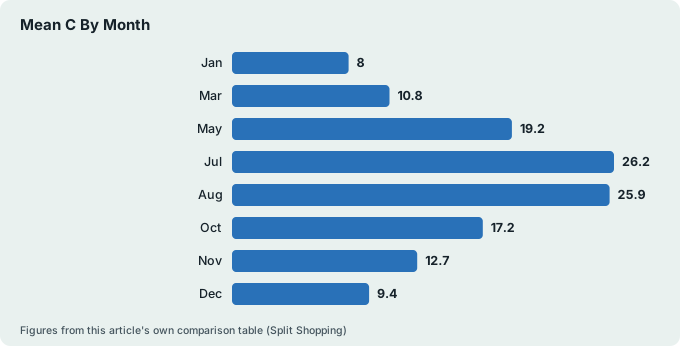
The warmest, driest shopping months are July at a 26.2 C mean with 26.6 mm of rain and August at 25.9 C with 41.3 mm, per the DHMZ Split-Marjan station table for 1948-2024, while November is the wettest month at 115.5 mm and January the coolest at 8.0 C. July also brings the most sunshine, 353.3 hours, against 120.8 hours in December.
High summer is peak market season but also the busiest: the DHMZ table records 18 days at 30 C or more in July and 17 in August, so a market walk is an early-morning job in those weeks. Shoulder months trade crowds for rain risk: October averages 77 mm and May 57.5 mm, with means of 17.2 C and 19.2 C respectively.
| Month | Mean C | Precipitation mm | Notes |
|---|---|---|---|
| Jan | 8.0 | 77.8 | Coolest month |
| Mar | 10.8 | 63.2 | Quiet lanes |
| May | 19.2 | 57.5 | Sudamja, city day, 7 May |
| Jul | 26.2 | 26.6 | Warmest and driest, 353.3 sunshine hours |
| Aug | 25.9 | 41.3 | Peak cruise and ferry season |
| Oct | 17.2 | 77.0 | Quieter markets |
| Nov | 12.7 | 115.5 | Wettest month, Advent from 27 November 2026 |
| Dec | 9.4 | 103.7 | Advent in Split, ice rink at Đardin |
The seasonal calendar matters more than the weather alone. Advent in Split runs 27 November 2026 to 7 January 2027 with the ice rink at Đardin, the 72nd Split Summer Festival ran 14 July to 14 August 2026 with the 2027 edition not yet announced, and Ultra Europe 2027 is set for 9 to 11 July 2027 at Park Mladeži, a weekend when city-centre shopping competes with a major festival crowd. The best time to visit Split guide and the Split weather guide carry the full climate picture.
How Do You Get From Split Airport To The Shops?
Split Airport sits in Kaštel Štafilić, 20 km from Split and 6 km from Trogir by the airport's own pages, and the Platanus shuttle runs from the airport's north parking to the main bus station by the ferry port for 10 EUR one way or 15 EUR return. The bus station lies 500 to 600 m from the palace, so the shopping core is a short walk from the shuttle's stop.
City bus lines 37 and 38 also stop at the airport; their fare is a few euros, confirm on board, because no verified official figure exists. The airport handled 3,881,186 passengers in 2025 and 3,376,272 from January to September 2026, so summer arrivals are heavy and the shuttle queue can move slowly at peak times. The airport guide and the airport to city centre guide cover every option in detail.
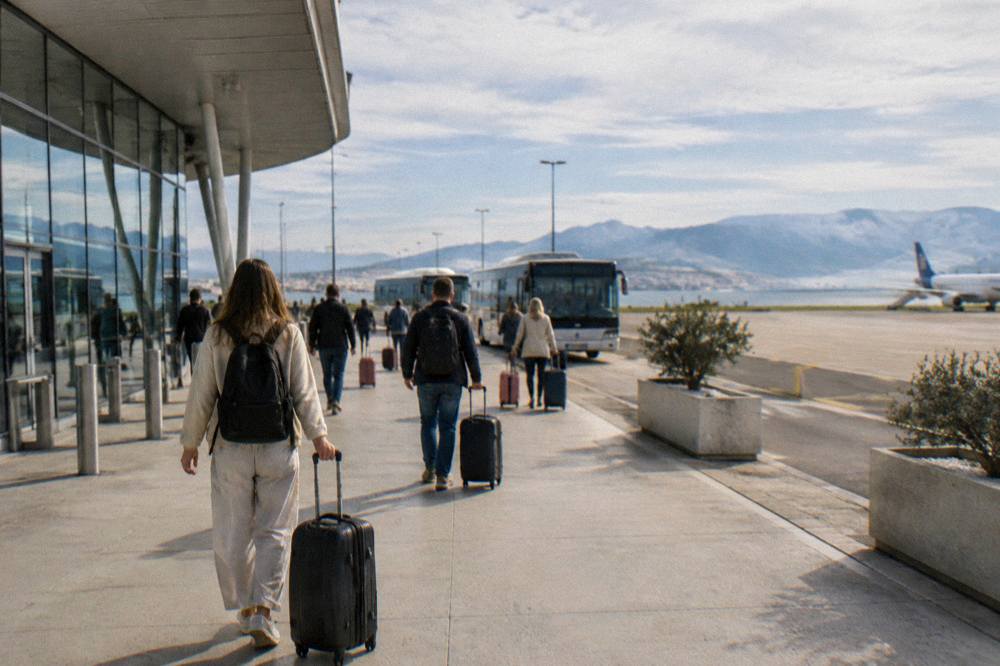
Driving from the palace to the airport is 24.9 km, about 31 minutes free-flow. For visitors staying in the city without a car, the shuttle plus a walk covers the airport-to-shops run end to end, and the airport's own pages give the distances if a hire car or transfer is part of the plan.
Common Questions About Split Shopping
Is Split good for shopping?
Split suits small-scale, food-first shopping: green market produce, Dalmatian pantry goods, museum-shop publications and the shops of the palace lanes, all in a walkable UNESCO core that charges no entry fee. It is not a luxury-mall destination, and anyone shopping for high-end goods should expect a limited selection.
What currency do I need for shopping in Split?
The euro, Croatia's currency since 1 January 2023. Cards are widely accepted in shops; market stalls vary, so carrying some euro cash is practical.
When are the shops in Split open?
Opening hours vary by shop and by season, and no verified central timetable exists, so confirm locally. Museum hours are published: the palace cellars run Monday to Sunday 8:30 to 20:00, and the Split City Museum is closed Mondays.
Is there a tourist tax on shopping trips to Split?
The tourist tax is charged per night by your accommodation, not on purchases: about 2.65 EUR per person per night in high season, 1 April to 30 September, with under 12 free and 12 to 18 half, confirmed at booking.
Can I buy alcohol at night in Split in summer?
From 2026, shops and supermarkets in Split face a night-time retail alcohol sales ban from 1 June to 15 September, while bars and restaurants are unaffected. Drinking in the historic centre is fined 300 EUR under the city's published rules.
Which market should I visit in Split?
The green market beside Diocletian's Palace is the city's main market, free to enter and a short walk from the Riva, the Peristyle and the ferry port hub on Obala kneza Domagoja.
Shopping in Split rewards a slow pace: one market morning, one museum shop, one walk through lanes that were built as a Roman palace around 295 to 305 AD. The buys that travel well are the edible ones, the entry fees on the cultural stops are published and modest, and every figure that matters on this page, from the 10.00 EUR city museum ticket to the 26.6 mm of July rain, comes straight from the institution's or the station's own published record.