Split Rainy Day
Rain in Split rarely shuts the city down. The palace cellars are under the palace itself, the museums hold their hours whatever the sky does, and the DHMZ Split-Marjan station table shows the wet days cluster in autumn and winter. Here is how to spend one.

Short answer
On a rainy day in Split, go underground into the Diocletian's Palace cellars, open 8:30 to 20:00 daily, visit the City Museum, the Archaeological Museum and the Ethnographic Museum, eat a long lunch in the Old Town, and use the wet hours for a food tour or a museum circuit instead of a beach morning.

Split sits on the Adriatic coast of central Dalmatia, and its climate gives the city wet months as surely as it gives it dry ones. The DHMZ Split-Marjan station table, covering the period 1948 to 2024, puts November at 115.5 mm of rain and July at just 26.6 mm, so a visitor in late autumn will meet rain and a visitor in midsummer almost certainly will not. A wet day in Split is not a lost day. The city's headline sight, Diocletian's Palace, is largely a covered network of halls, cellars and lanes, the museum circuit runs on fixed hours regardless of weather, and the food scene works better in rain than in a heatwave. This itinerary from Split Croatia Travel Guide lays out a full day, from the underground cellars in the morning to a long dinner under stone vaults at night.
What Can You Actually Do In Split When It Rains?
The working answer is a covered circuit: the Diocletian's Palace cellars in the morning, the Split City Museum or the Archaeological Museum at midday, a long indoor lunch in the Old Town, the Ethnographic Museum or the Meštrović Gallery in the afternoon, and a cinema-length dinner under the vaults in the evening. Almost all of it sits within a ten-minute walk, so the rain barely touches you between stops.
The geography helps. The cellars, the City Museum, the Peristyle, the cathedral complex and the green market all sit inside or on the edge of the palace footprint, and the Riva promenade connects them to the ferry-port end of town in a straight line. An umbrella survives a day like that. The Meštrović Gallery is the one detour, up toward Marjan, and its 12.00 EUR adult ticket, which also covers the Crikvine-Kaštilac chapel site, buys a full afternoon of indoor looking at sculpture and drawings. The gallery reopened in April 2026 after a fifteen-month energy renovation, with a new exhibition on the Meštrović house, so the building itself is part of the display.
One planning note matters more than any other: check what is actually open on your weekday. The Split City Museum in Papalić Palace is closed Mondays. The cellars, run by the same museum, run Monday to Sunday, 8:30 to 20:00. Build the day around those two facts and the rest falls into place. A second note follows from the first: the palace layer of the plan carries no car, no timetable and no ticket queue beyond the kiosk, so the whole morning can be decided over coffee. If the rain settles in for the full day, stretch the museum circuit and drop nothing. If it clears by mid-afternoon, the Riva and the Marjan hill steps above Meje will be running with water and empty of company, and the 819 steps from Trumbićeva obala to the Telegrin summit at 178 m are a genuinely good walk once the surface dries.
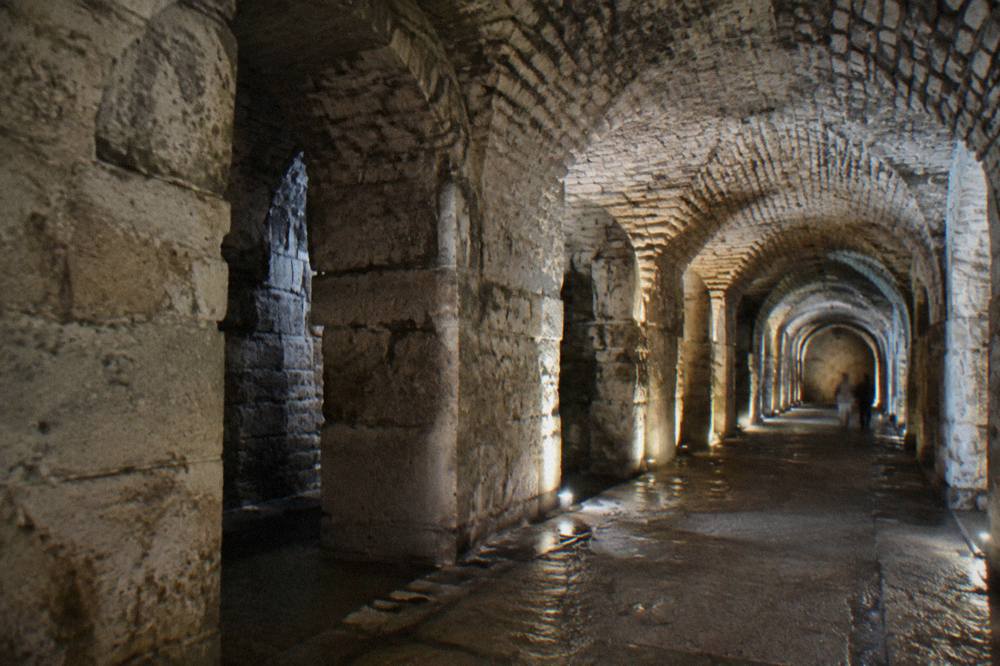
Which Museums In Split Are Worth A Wet Afternoon?
Split has six indoor ticketed options that hold their hours in any weather: the palace cellars at 8:30 to 20:00 daily, the Split City Museum at 10.00 EUR, the Archaeological Museum at 8.00 EUR with a 10.00 EUR combined ticket that adds Salona, the Ethnographic Museum at 7.00 EUR, the Meštrović Gallery at 12.00 EUR and Klis Fortress at about 10 EUR a short drive out. Together they fill more than one rainy day.
The cellars are the natural first stop, and not only because they are underground. The Split City Museum's price list and hours page gives the substructures Monday to Sunday, 8:30 to 20:00, and the museum's own adult ticket at 10.00 EUR, 8.00 EUR reduced, family 18.00 EUR. The central part of the cellars is under restoration to the end of 2026, with the passage staying open, so some halls will be scaffolded, and that is worth knowing before you go rather than after.
The Archaeological Museum, founded in 1820, charges 8.00 EUR for adults, 4.00 EUR for children, students and retirees, and its combined 10.00 EUR ticket adds the Salona Roman site and holds for seven days. On a genuinely foul day Salona is an outdoor ruin, so buy the combined ticket only if a dry window is plausible within the week. The Ethnographic Museum at 7.00 EUR covers Dalmatian folk dress, tools and interiors, with a 2.00 EUR Vestibule add-on that is quick and dry.
Taken together, the full circuit, cellars, City Museum, Archaeological Museum and Ethnographic Museum, adds up to the sum of the adult tickets at the prices above, and the cellars alone could carry the first two hours of any day. That is a deliberate stack, not an accident: the City Museum's own price list prices the family ticket at 18.00 EUR, the Ethnographic Museum lists a family ticket at 15, and the Meštrović Gallery lists its family ticket at 20.00 EUR, so households with children can run the same wet-day plan at a materially lower per-person cost.
| Museum or site | Adult ticket | Hours that matter | Wet-day note |
|---|---|---|---|
| Palace cellars (Split City Museum) | 10.00 EUR | Mon to Sun 8:30 to 20:00 | Fully underground; central part in restoration to end of 2026 |
| Split City Museum, Papalić Palace | 10.00 EUR, reduced 8.00 EUR | Tue to Sun 9:00 to 20:00 | Closed Mondays |
| Archaeological Museum | 8.00 EUR | Check locally | Combined ticket with Salona 10.00 EUR, valid 7 days |
| Ethnographic Museum | 7.00 EUR, reduced 4.00 EUR | Check locally | Vestibule add-on 2.00 EUR |
| Meštrović Gallery | 12.00 EUR | Check locally | Ticket includes Crikvine-Kaštilac; reopened April 2026 |
| Klis Fortress | About 10 EUR | Daily 9:00 to 17:00 | Mostly open-air, so save it for a dry day |
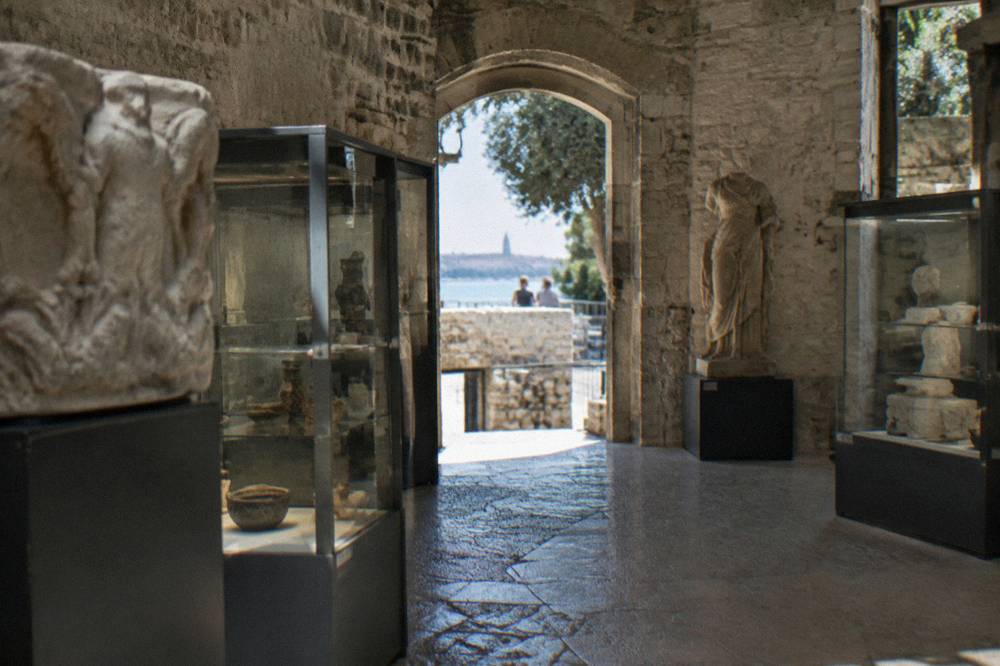
Where Can You Eat Well On A Rainy Day In Split?
The Old Town's stone-vaulted konobas, the green market's covered hall and the café tables under the cellars' arches are the dry-day backbone: rain changes the menu not at all, since pršut, cheese, pasticada and brudet are indoor dishes. The green market traders move under cover, fish still lands at the port each morning, and a long lunch is the most reliable rain plan the city has.
A wet afternoon is also the moment for a guided food walk, because the guide takes the route decisions and the stops are chosen for their roofs. The site's featured pick is the Historical and Gastro Treasures tour with green market visit, which walks the Old Town and the market with tastings along the way, Check availability. Rain does not stop it, and market halls are exactly where Split keeps its weatherproof food culture.
For a self-guided version, start under the green market's roof, work through the prosciutto and cheese stalls, then move into the palace lanes. Two checks any reader can make: posted menu prices at the door, and whether the cover charge appears on the menu itself. Itemised bills are standard. If the rain turns heavy, the cellars' southern edge has café tables far enough under stone to keep a coffee dry. The city's wider food page and its restaurant listings go deeper on individual kitchens, but the wet-day logic is simple: stone roofs, a short walk between stops, and dishes that were built for slow eating rather than quick service. A rain afternoon in Split is the one time a long lunch is not a scheduling mistake but the plan itself.

Is Diocletian's Palace Still Worth Visiting In The Rain?
Yes, and in one sense it is better in the rain: the cellars are a covered labyrinth under the palace, the cathedral complex, from about 5 EUR with combined tickets up to about 15 EUR, is almost entirely interiors, and the Peristyle and Golden Gate cost nothing to dart between under an umbrella. Only the bell tower climb, at 57 m, loses its appeal in a downpour.
The palace was built c. 295 to 305 AD for Emperor Diocletian, and its UNESCO listing, inscribed in 1979, covers a historical complex of 20.8 hectares in which people still live and trade. Rain makes the covered layer obvious. The cellars run under the whole southern half, the cathedral complex sells five single-site tickets and colour-coded combinations from the Peristyle kiosk, and shoulders and knees must be covered inside. Hours vary, so confirm them at the kiosk on the day.
The Peristyle itself is open air, but it takes thirty seconds to cross, and the lanes around it, the Vestibule, the Golden Gate and the Grgur Ninski statue are all free and all reachable in short dashes. On a wet day the palace empties of casual foot traffic and the stone photographs dark and wet, which is its own reward. The Roman guard change ceremony that ran on the Peristyle at noon through the 2026 season, from 28 May to 27 September, is an open-air event, so in rain the calendar, not the weather, is the thing to check. Inside the lanes, the shops and galleries that line the cellars' upper level keep ordinary retail hours, which makes the palace one long covered arcade with Roman walls.

Can You Still Do A Boat Trip Or Kayak Tour In Wet Weather?
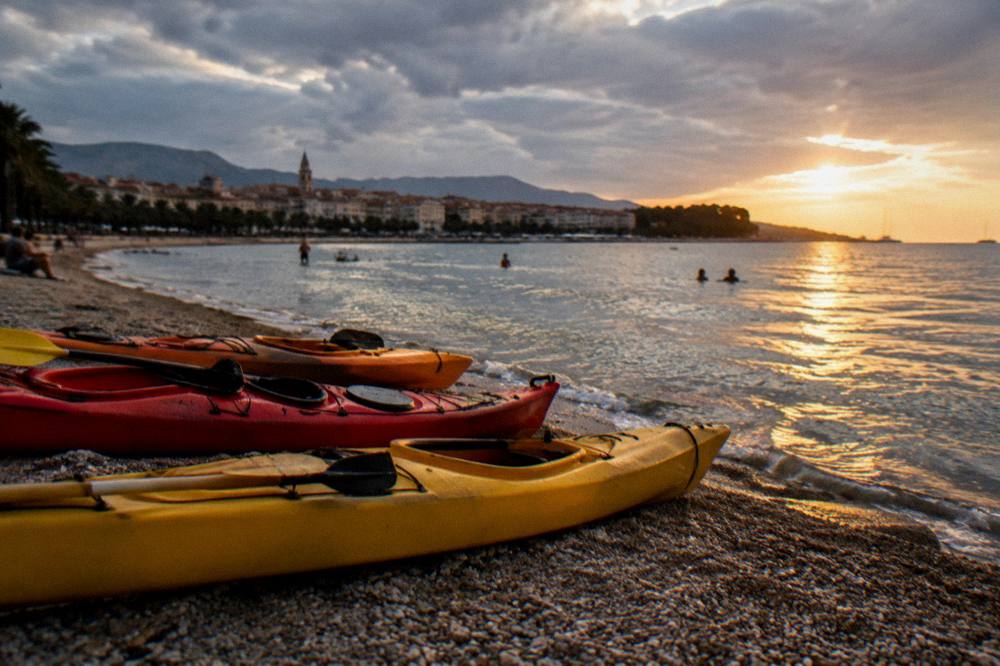
Boat trips run on the operator's sea-state judgment, not on rain alone: light rain with a calm channel usually still sails, while wind and swell cancel. Kayaking in rain is normal for the activity and operators supply dry bags, but tours stop for electrical storms. The rule is to book with free cancellation and let the operator make the call on the morning.
Split's port logged 6.05 million passengers in 2025, its own page calls it Croatia's busiest passenger port, and that traffic does not pause for autumn drizzle. The island routes to Šolta, Brač and Hvar keep sailing in rain. Jadrolinija's route pages give the line 631 to Supetar on Brač at about 50 minutes, line 636 to Rogač on Šolta at about 60 minutes and line 635 to Stari Grad on Hvar at about 120 minutes, with foot passenger fares on the Stari Grad line at 5.90 EUR off-season and 8.40 EUR in season. A scheduled ferry is a legitimate rain-day plan in itself: covered decks, an island town of lanes, and a return sailing the same afternoon. If a wet day turns into a wet week and a sea day opens up, the guided kayak option is the shortest commitment on the water.
For a longer window of clearer sky, a multi-island speedboat day covers Hvar and the Pakleni islands in one departure. Again, the operator decides on the morning whether the sea allows it, and the Hvar guide on this site covers what the island offers once you land.
Which Day Trips From Split Work When The Weather Turns?
The indoor-heavy and short-haul trips work best: Trogir at 36 minutes by car, Klis at 22 minutes and Salona at 14 minutes are close enough to attempt between showers, while Krka at 74 minutes and Plitvice at 3 hours 15 are outdoor parks whose waterfalls are actually at their fullest after rain, though the paths are wettest then too.
The OSRM free-flow driving times from the palace give the honest picture below. Rain adds stopping distance and slows the coastal road, so treat each figure as a floor. Krka's ticket is also seasonal: the 2026 price list shows 40 EUR from June to September, 20 EUR in April, May and October, and 7 EUR from January to March and in November and December, with the Skradin boat and Lozovac bus transfers included from 1 April to 31 October. Plitvice runs 10, 23 and 40 EUR on the same seasonal pattern, with a 25 EUR afternoon slot in peak and the visitor's name required on the ticket for timed online entry.
| Day trip from the palace | Free-flow driving time | Wet-day verdict |
|---|---|---|
| Salona | 14 min | Outdoor ruins; best in a dry window |
| Klis Fortress | 22 min | Open-air fortress, about 10 EUR |
| Trogir | 36 min | Compact walled town, lanes give some cover |
| Omiš | 38 min | Outdoor; Mirabela 4 EUR, 6 EUR from 1 June to 30 September |
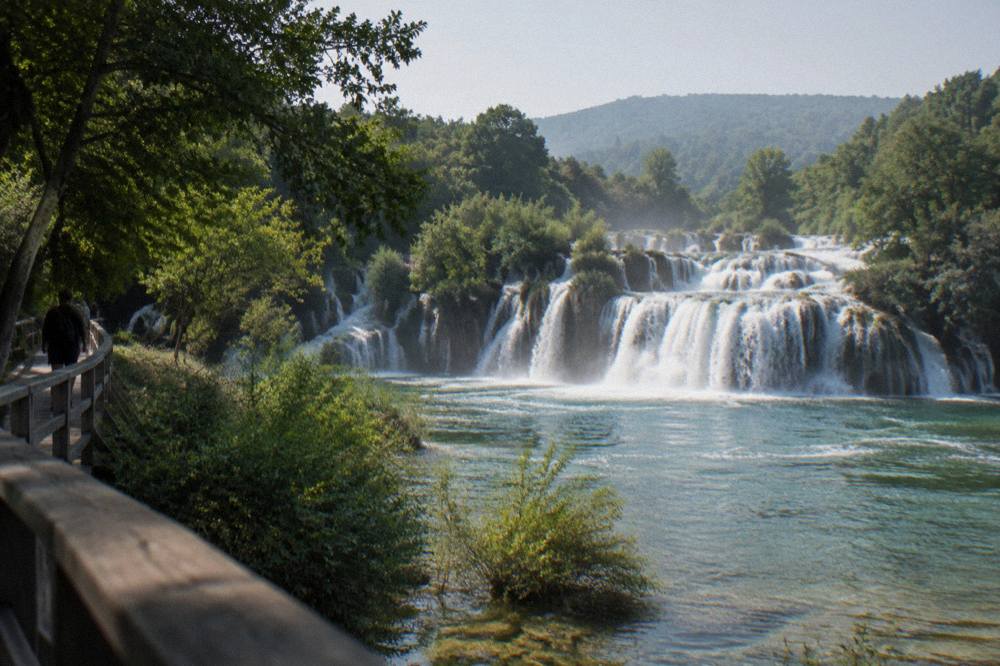
| Krka, Skradinski buk | 74 min | Waterfalls fullest after rain; swimming only in marked areas |
| Šibenik | 71 min | Cathedral interior is a strong wet stop |
| Plitvice Lakes | 3 h 15 | Long drive; boardwalks are slippery in rain |
For a fuller comparison of every option, see the site's Split day trips guide, and for the two park headliners the Krka National Park and Plitvice Lakes pages carry the seasonal tickets in detail. A note on Krka and rain: swimming in the park is allowed only in clearly marked areas, and after heavy rain those areas can close, so follow the posted signs on the day. Trogir deserves its own mention on a mixed-weather day, since its UNESCO-listed old town, inscribed in 1997, is compact enough that a shower costs you ten minutes rather than an afternoon, and the drive back along Čiovo keeps the whole loop short. The Trogir comparison aside, the short table above is the honest ranking for wet weeks: the closer the trip, the more control you keep over the weather window.
How Much Does It Rain In Split, And When Should You Expect It?
The DHMZ Split-Marjan station table, covering 1948 to 2024, shows November as the wettest month at 115.5 mm and July as the driest at 26.6 mm, with autumn, September to November, totalling 263.4 mm against winter's 246.7 mm. Rain in Split is concentrated from October to January, and the warm half of the year from May to August is genuinely dry by comparison.
The monthly means put January at 8.0 C and July at 26.2 C, so winter rain is cool rather than brutal, and even the wet months keep usable daylight. Sunshine runs 353.3 hours in July but only 120.8 hours in December, which is the real winter constraint: short, grey days rather than all-day storms. There are 18 days at 30 C or more in July and 17 in August, so summer visitors planning around heat should not be planning around rain at all.
| Month | Mean temperature | Precipitation |
|---|---|---|
| Jan | 8.0 C | 77.8 mm |
| Feb | 8.5 C | 65.2 mm |
| Mar | 10.8 C | 63.2 mm |
| Apr | 14.4 C | 62.0 mm |
| May | 19.2 C | 57.5 mm |
| Jun | 23.4 C | 49.0 mm |
| Jul | 26.2 C | 26.6 mm |
| Aug | 25.9 C | 41.3 mm |
| Sep | 21.6 C | 70.9 mm |
| Oct | 17.2 C | 77.0 mm |
| Nov | 12.7 C | 115.5 mm |
| Dec | 9.4 C | 103.7 mm |
All figures are DHMZ Split-Marjan station means for 1948 to 2024. The table says the quiet truth about a Split rainy day: if you are here between June and August, one is unlikely, and if you are here in November, this page is your friend. The month-by-month column also settles a common planning question, because October and April sit close together at 77.0 and 62.0 mm, yet October's mean of 17.2 C against April's 14.4 C makes October the warmer of the two shoulder months. Neither month is a washout; both reward a plan with covered options held in reserve.
What Should You Pack For A Wet Day In Split?
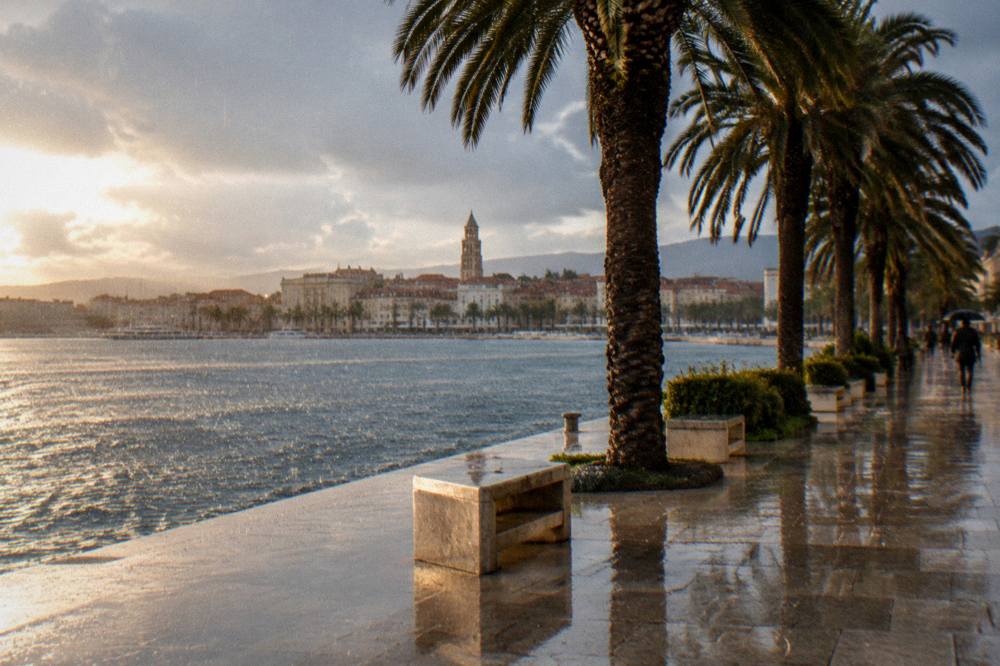
Pack for stone, not mud: shoes with real grip, because the palace's polished limestone slabs turn slick in rain, a compact umbrella rather than a golf umbrella, because the Old Town lanes are narrow, and one warm layer for the vaulted interiors, which hold the cold. The streets dry fast when the rain stops, so nothing heavier is needed.
The limestone underfoot is the item visitors underestimate. Centuries of foot traffic have polished the palace paving, and wet polished stone is the city's one genuine rainy-day hazard. Grip beats waterproofing in a shoe here. An umbrella that folds into a bag beats a raincoat with a hood on a warm October day, when the mean is still 17.2 C. From December, at a 9.4 C mean, the layer matters more.
A small day bag also earns its place for the museum circuit: the combined Archaeological Museum and Salona ticket is valid seven days, so keeping the receipt lets a dry window later in the week complete the pair. If your stay is longer, the site's one day in Split and two days in Split itineraries show how to slot the covered stops into a wider plan, and the things to do in Split page carries the full list for the dry days in between. Families can take the same advice with a slight change of weights, since the family tickets at the City Museum, the Ethnographic Museum and the Meštrović Gallery make a shared museum afternoon the cheapest covered activity in the city, a theme the Split with kids itinerary develops further.
Common Questions About A Rainy Day In Split
Is A Rainy Day In Split A Lost Day?
No. The palace cellars, four museums, the cathedral complex and the covered market all run in rain, and the food scene is entirely indoors. A wet day costs you the beach and the bell tower view, nothing else.
Does It Rain A Lot In Split?
It depends sharply on the month. The DHMZ Split-Marjan table for 1948 to 2024 puts November at 115.5 mm and July at 26.6 mm, with autumn at 263.4 mm against winter's 246.7 mm. Summer is dry, late autumn is not.
Are The Diocletian's Palace Cellars Open In Bad Weather?
Yes. They are underground and covered, and the Split City Museum runs them Monday to Sunday, 8:30 to 20:00. The central part is under restoration to the end of 2026, with the passage staying open.
Do Boat Trips From Split Get Cancelled For Rain?
Rain alone rarely cancels a trip; wind and sea state do. Operators make the call on the morning of departure, so booking with free cancellation and checking with the operator is the practical approach.
Which Month Is The Wettest In Split?
November, at 115.5 mm on the DHMZ Split-Marjan station table for 1948 to 2024, ahead of December at 103.7 mm. July is the driest month at 26.6 mm.
Is The Green Market In Split Covered?
The market hall gives the traders cover, which is why it appears in this itinerary. Confirm stall hours locally on the day, as they vary by season and weekday.
A rainy day in Split, planned around the cellars, the museums and a long lunch, ends up covering the same ground a sunny one does, just under better roofs.
