Hajduk Split
Hajduk Split is the football club of Split, the coastal city in Dalmatia, Croatia, built in and around Diocletian's Palace on the Adriatic. This guide covers what a match day in the city involves: how fixtures are confirmed, how the Poljud stadium fits into the city's transport map, what the local public-order rules mean for fans, and how to build the rest of the day around kick-off.
Short answer
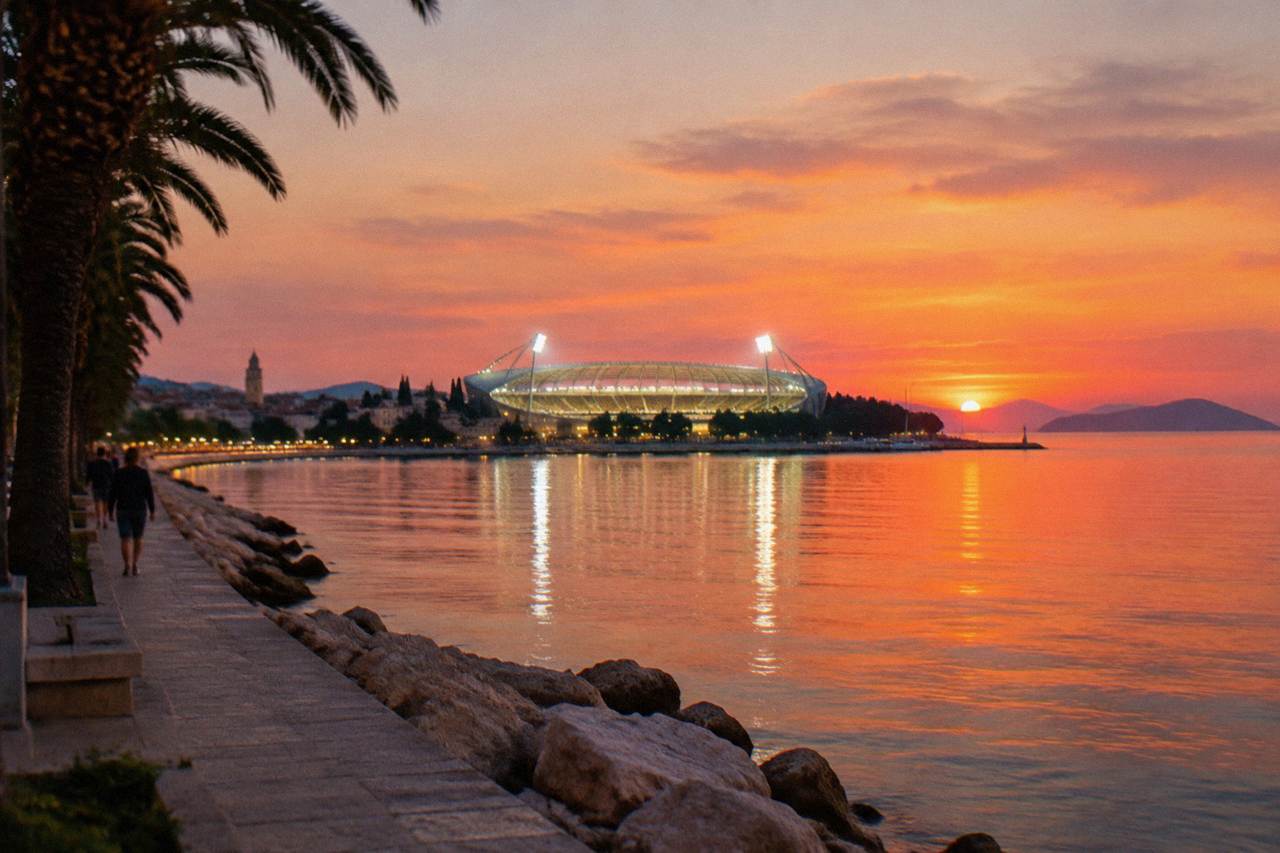
Hajduk Split plays its home matches at the Poljud stadium on the city's northern side. Fixtures and tickets are confirmed through the club's own channels, and the ferry port, main bus station and railway station hub sits 500 to 600 m from Diocletian's Palace, from where local buses cross the city.
Split, the coastal city in central Dalmatia on the Adriatic Sea, lives around Diocletian's Palace by day and around its football club by weekend. Hajduk Split is that club, and a home match is one of the few events that moves the whole city at once, from the lanes inside the palace walls to the stadium on the northern shore. This guide reports what the sources say about planning a match day here: how to confirm a fixture, how the city's transport hub connects to everything else, which local rules apply to fans in the historic centre, and what a visitor can do with the rest of the day before and after kick-off.
The city itself is compact in the way that matters for match day. The ferry port, the main bus station and the railway station sit together on Obala kneza Domagoja, 500 to 600 m from the palace, so a visitor arriving by ferry, coach or train lands in one place with the Old Town a short walk away. Croatia uses the euro since 1 January 2023, is a Schengen member, and the emergency number is 112. Those three facts cover the practical backbone of any day in Split, football or otherwise.
What Is Hajduk Split And Why Does Match Day Change The City?
Hajduk Split is the football club of the city of Split, in Dalmatia, Croatia, and it plays its home matches at the Poljud stadium on the northern side of the city. On a home match day the club's supporters, known as Torcida, gather in and around the historic centre before moving toward the ground, and the city's transport, bars and streets reorganise around that flow. The club is one of the fixed points of civic life in a city of 160,577 residents at the 2021 census.
Split is not a big capital with several clubs dividing its loyalties. It is a single-club city, and the club's name carries the city's name in it. That concentration is what makes a match day here different from watching football in a larger metropolis: the crowd is not one neighbourhood's crowd, it is the city's crowd. The 2021 census figure of 160,577 residents for the City of Split, reported by the Croatian Bureau of Statistics, gives a sense of scale. When a significant share of a city that size turns toward one stadium at the same hour, the effect on traffic, terraces and the Riva waterfront is visible without any statistic being needed.
The club's supporter culture is part of the draw for visitors. Torcida, the organised supporter group, is famous within Croatian football, and match days in Split are known for the noise and colour that group brings. The editorial position here is simple: report what the club's own channels publish, and treat anything a forum or a resale page claims as a rumour until the club says it. Founded dates, trophy counts and league positions change season to season and are not printed on this page; the club's own site is the place to read them.
For a visitor planning a trip around football, the honest framing is this: the match is the anchor, and Split supplies everything else. The Peristyle, the Riva, the Prokurative, the Golden Gate, the Grgur Ninski statue, the markets, Marjan and the city beaches are all free to enter, and all of them sit within walking or short-bus range of the match-day routes. The things to do in Split overview maps the full list for the days when there is no fixture.
How Do You Confirm A Hajduk Split Fixture Before You Travel?
Fixtures are confirmed only through the club's own official channels and the league's official calendar, and both should be checked in the week before travel because kick-off dates and times in Croatian football are routinely moved for television scheduling. No fixture list is printed on this page, because match dates change and a printed list would age badly. The rule that works: check the club's official site after booking travel, then check again two days before the match.
Croatian league scheduling is driven by broadcast slots, which means a Sunday afternoon fixture can become a Saturday evening fixture with relatively little notice. That is not unique to Split, but it matters more for a visitor who has built a three-day trip around one match. The practical sequence the club's own channels support is straightforward: find the fixture, note the stated kick-off time, then reconfirm close to travel. If the club sells tickets through its own online channel, that channel will also carry the authoritative fixture time, since a ticket listing with a wrong kick-off helps nobody.
Visitors flying in should also know what the airport's own pages say. Split Airport (SPU) sits in Kaštel Štafilić in the Kaštela belt, 20 km from Split and 6 km from Trogir, and handled 3,881,186 passengers in 2025. Driving from Diocletian's Palace to the airport is 24.9 km, about 31 minutes free-flow. The Split airport guide and the airport to city centre guide cover the transfer options, including the Platanus shuttle, which the operator's own page prices at 10 EUR one way and 15 EUR return between the airport and the main bus station by the ferry port.
A match day pairs naturally with the wider city calendar. Advent in Split runs 27 November 2026 to 7 January 2027 with the ice rink at Đardin, and the Croatian National Theatre's season runs 25 September 2026 to 14 June 2027, so an autumn or winter fixture can share a weekend with either. Sudamja, the city's celebration of its patron St Domnius on 7 May every year, falls inside the run-in of a typical league season. The Split weather guide and the best time to visit Split guide help with picking the weekend.
How Do You Get To The Poljud Stadium On Match Day?
The Poljud stadium sits on the northern side of Split, and local city buses run there from the centre, with the transport hub on Obala kneza Domagoja, 500 to 600 m from Diocletian's Palace, acting as the natural starting point. On match days the streets around the stadium fill on foot from the surrounding neighbourhoods, and the club's own match-day information carries any special transport arrangements. Confirm the bus route and fare on the operator's own site before setting out.
The city's geography works in a visitor's favour. Split is stretched along the shore between the Marjan peninsula on the west and the Poljud side to the north, with the palace in the middle. The single transport hub, where the ferry port, the main bus station and the railway station sit together, is the reference point for everything: it is 500 to 600 m from the palace, and city bus services fan out from there. Promet Split runs the city network, and its lines 37 and 38 are the ones the operator lists as stopping at the airport, which tells a visitor the network is designed around the hub rather than around a scattering of terminals.
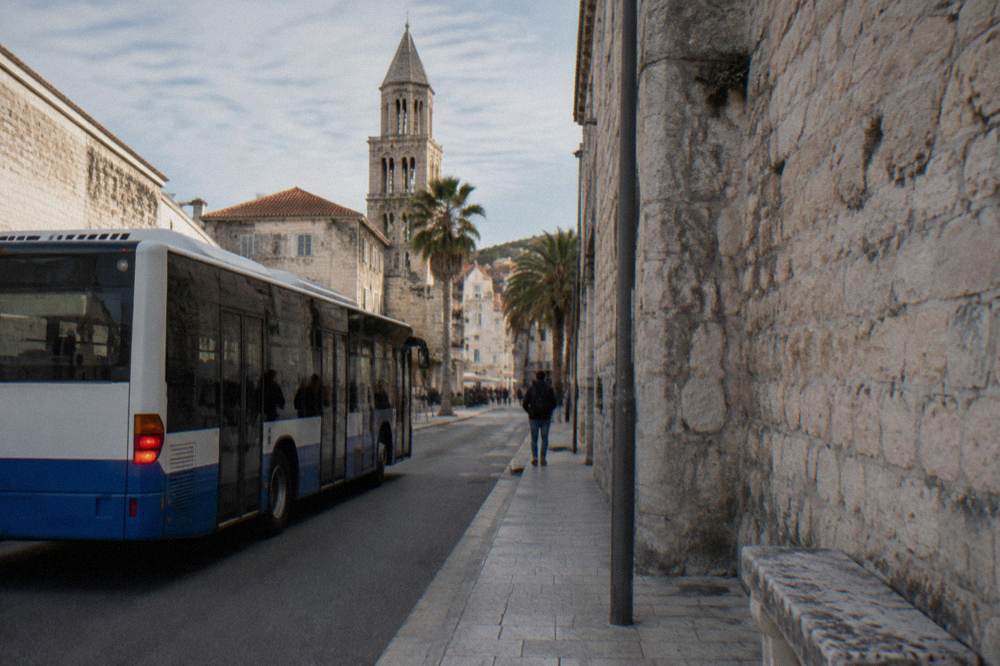
The getting around Split picture is covered across this site's transport pages, and the operator's own tariff page is the authority for fares. On the day itself, the flow of supporters on foot is its own navigation aid in a city of this size.
One warning worth carrying from the fresh rules file: the historic centre has a published set of public-order rules, and they apply to fans as much as to anyone else. The city's decision for Zone A, the historic core, bans public alcohol consumption outside licensed terraces, and the official tourism site lists the fines. Alcohol in the historic centre or within 100 m of schools carries a 300 EUR fine, as do urinating in public, climbing on monuments or bathing in fountains, and vomiting; sleeping in public spaces carries 150 EUR, and touting for taxis 300 EUR. A pre-match drink belongs on a terrace with a licence, not on the Riva with a bottle from a shop. Between 1 June and 15 September a night-time ban on retail alcohol sales in shops also applies, from 21:00 to 06:00, with bars and restaurants unaffected.
| Offence in Split | Fine |
|---|---|
| Drinking alcohol in the historic centre or within 100 m of schools | 300 EUR |
| Urinating in public | 300 EUR |
| Climbing on monuments or bathing in fountains | 300 EUR |
| Vomiting in public | 300 EUR |
| Sleeping in public spaces | 150 EUR |
| Taxi touting | 300 EUR |
The swimwear rule deserves a separate sentence, because summer visitors do trip on it: walking through the historic centre in swimwear or shirtless is an offence under the same city decision, and the fine amount is set locally, so this page prints no figure. Change at the beach, not on the way through the palace lanes. The Split safety guide and the site's other practical pages carry more on city rules, and the what to avoid in Split overview collects the common visitor errors in one place.
How Do You Get Tickets For A Hajduk Split Home Match?
Tickets for Hajduk Split home matches are sold through the club's own ticketing channels, and this page prints no price, because verified pricing sits with the club and varies by stand and fixture. The reliable route is the club's official site and ticket office: buy there, take the electronic or printed ticket the club issues, and treat any resale offer on the street or a social platform as a risk. Nothing in the material supports a guaranteed walk-up price on match day.
The reason this page stays silent on numbers is the same reason it stays silent on fixture times: club ticketing changes by opponent, by stand and by season, and a printed figure would be a guess dressed as a fact. The club's own channels show current availability, stand allocation and prices in one place. For a visitor, the practical checklist is short. Buy from the club's channel before travel where that option exists. Keep the ticket the club issues, since stadium entry on match day works from it. And if buying in person in Split, use the club's own ticket office locations as the club lists them, not an intermediary.
Visitors should also plan the day around the reality that a match occupies an afternoon or an evening, leaving the rest of the day free. That is where Split's day-trip network comes in, and it is unusually dense for a city of this size. The driving times below are free-flow calculations from Diocletian's Palace, so match-day traffic around the stadium will stretch them.
| Destination from Diocletian's Palace | Driving time, free-flow |
|---|---|
| Salona | 14 min |
| Klis Fortress | 22 min |
| Trogir | 36 min |
| Omiš | 38 min |
| Šibenik | 71 min |
| Krka National Park, Skradinski buk | 74 min |
| Makarska | 75 min |
| Zadar | 2 h |
| Mostar | 2 h 13 |
| Plitvice Lakes | 3 h 15 |
| Dubrovnik | 3 h 21 |
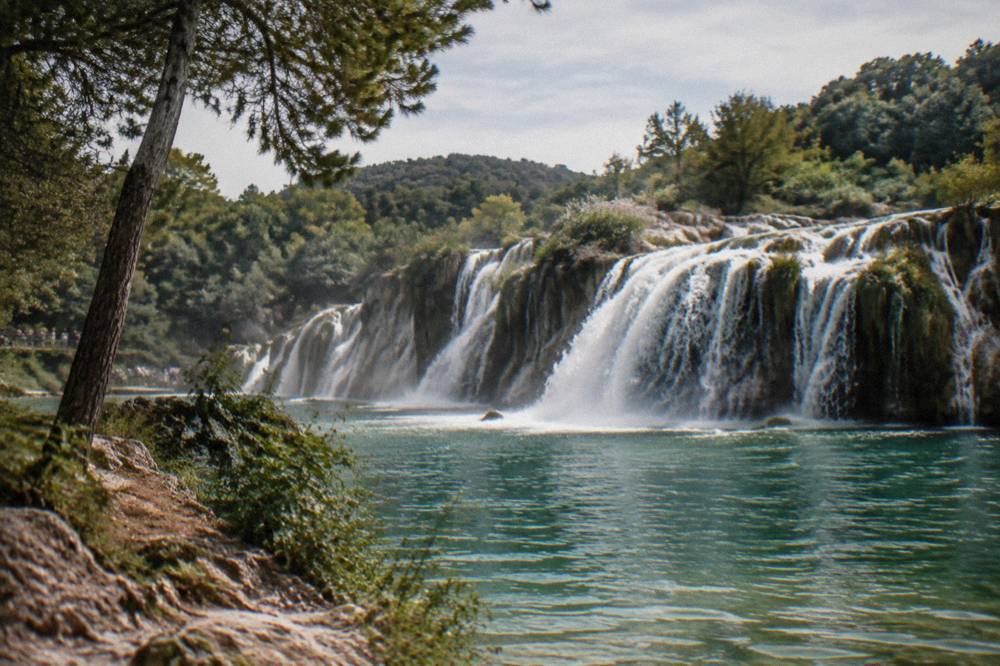
A morning trip with a late return is the pattern that fits an evening kick-off, and a Krka waterfalls departure is the classic version of it: the Krka tour with boat cruise and swimming covers the park's waterfalls, a boat cruise and swimming, and the operator's live listing carries the current price, dates and free-cancellation terms. Check availability. The Split day trips guide maps the full range, from Klis Fortress, a Game of Thrones Meereen location at 10 EUR for adults per the visitor site's price sheet, to Salona's Roman ruins on the 10 EUR combined Archaeological Museum ticket, valid for seven days.
What Is Match-Day Atmosphere Like, And What Should First-Timers Expect?
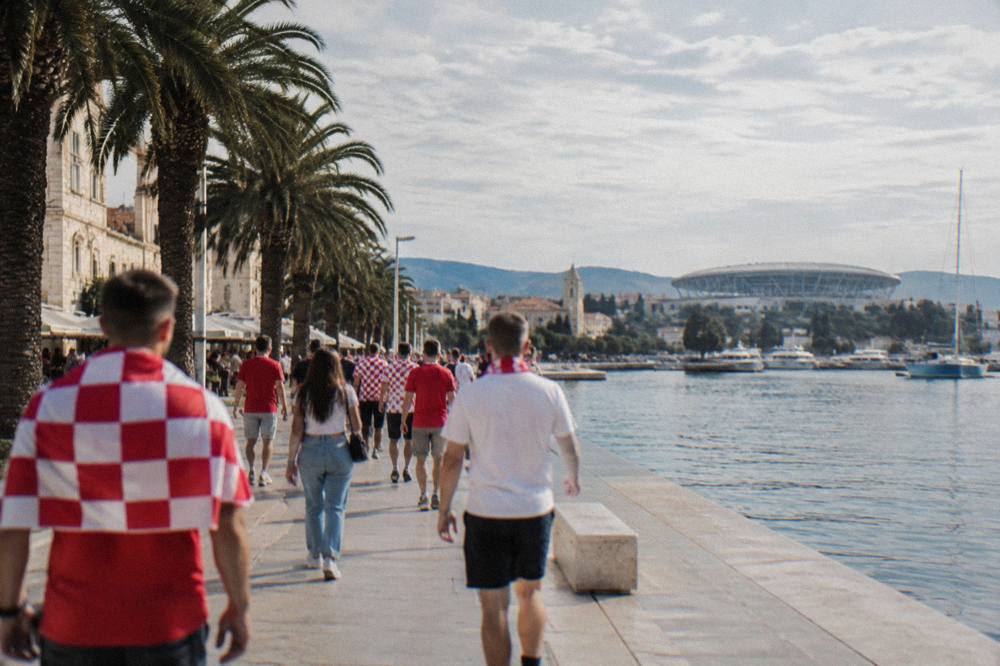
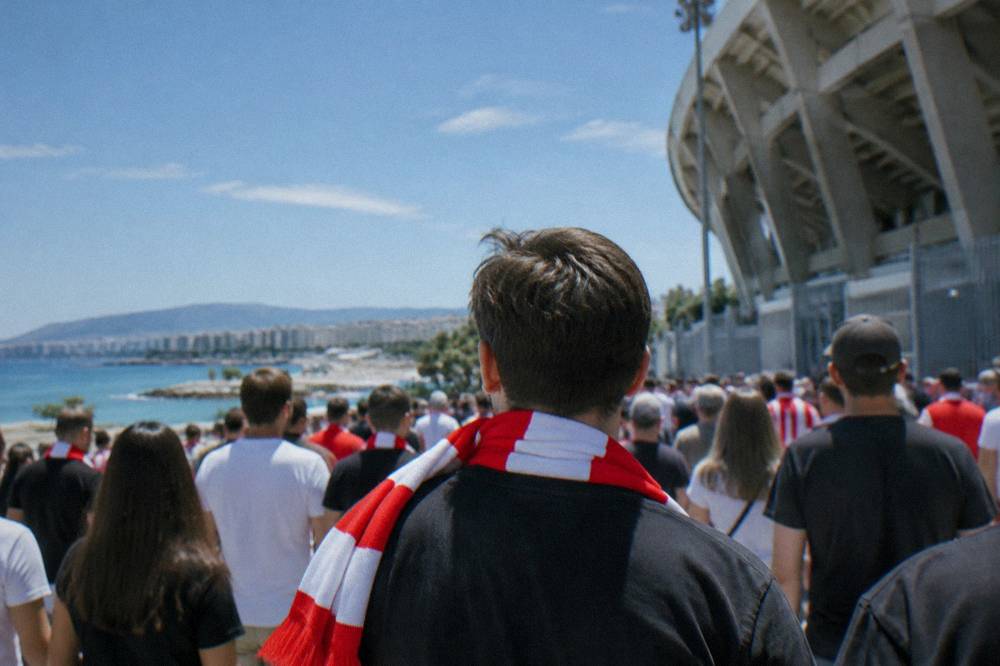
Match day in Split means a visible crowd in red and white moving through the palace streets and along the shore toward the Poljud stadium, with the Torcida supporter group providing the noise, flags and smoke that Croatian football is known for. First-timers should expect standing, singing and dense crowds on the approaches, arrive early, and keep belongings in closed pockets or the stadium's approved bag rules. The atmosphere is intense but civic, and families attend regularly.
The honest advice, reported rather than lived: this desk has no first-person match report to give, and would not print one if it did. What the sources support is structural. Torcida is the club's supporter group and one of the best-established in Croatian football. Matches are family occasions as well as supporter occasions, which is why the club sells tickets across stands rather than in a single bloc. And the stadium sits in a residential part of the city, so the walk to it passes ordinary streets, bakeries and bus stops, not a purpose-built entertainment district. More of these guides are collected on Split Croatia Travel Guide.
Two practical points follow. First, arrive early enough that the walk to the ground is part of the experience rather than a race, since the approaches fill in the last hour before kick-off. The Split restaurants guide and the Split food guide map the city's eating, from the green market inside the historic core to the konoba tables further out, and the Split nightlife guide covers the after-match options along the shore.
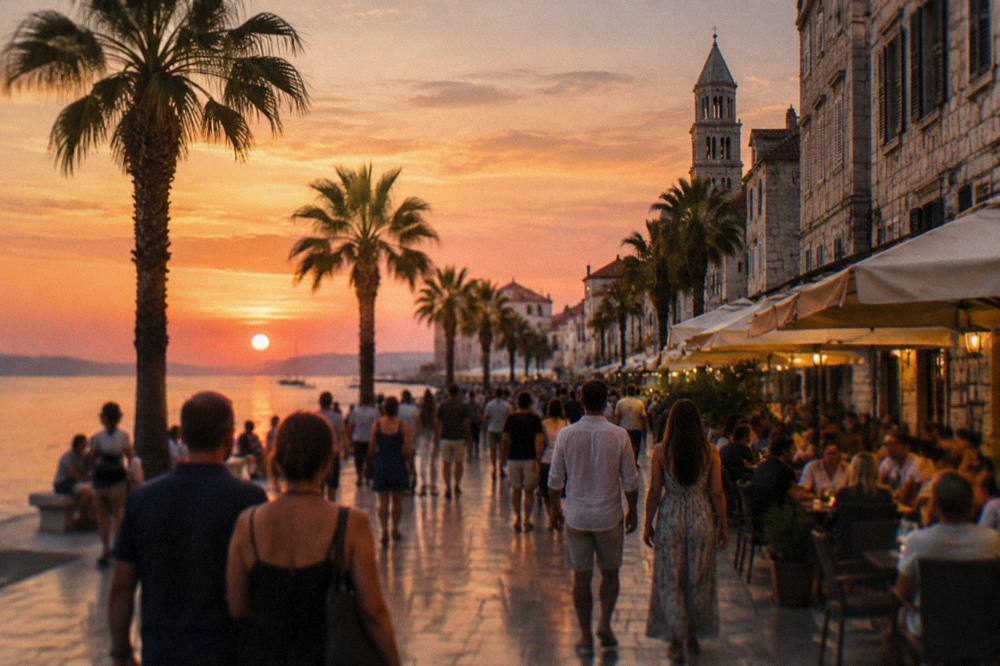
The public-order rules already tabled above apply with particular force on match days, when the centre is at its fullest. The terrace rule is the one visiting fans most often misjudge: a beer bought in a shop must be drunk off the street, and the 300 EUR fine for public drinking in the historic centre is listed on the official tourism site. Licensed terraces are everywhere in Split, so compliance costs nothing in enjoyment.
Can You Combine A Hajduk Split Match With Islands Or National Parks?
Yes, and Split is built for it: the ferry port and catamaran terminals sit 500 to 600 m from Diocletian's Palace, with car ferries to Stari Grad on Hvar in about 120 minutes, to Supetar on Brač in about 50 minutes and to Rogač on Šolta in about 60 minutes, plus catamarans to Hvar town, Jelsa and Vis, so an island morning before an evening kick-off is a realistic plan. The day-trip coach and tour network covers Krka, Plitvice, Trogir, Salona and Klis on the same logic.
The distinction that trips visitors is Hvar town versus Stari Grad. Hvar town itself is reached by catamaran, while the car ferry on line 635 lands at Stari Grad; confusing the two means planning a swim stop against the wrong timetable. Jadrolinija's price PDF gives the line 635 foot passenger fare as 5.90 EUR off-season and 8.40 EUR in season, and the catamaran fares from the same material run at 6.40 EUR low and 10.00 EUR high to Hvar or Jelsa, and 7.20 EUR low and 10.00 EUR high to Vis. From 2026, the Split to Supetar line runs with no off-season timetable at all, only high-season and low-season sailings, one of five such lines in Croatia.
| Route from Split | Type | Sailing time | Foot passenger fare |
|---|---|---|---|
| Stari Grad, Hvar (line 635) | Car ferry | about 120 min | 5.90 EUR off-season, 8.40 EUR in season |
| Supetar, Brač (line 631) | Car ferry | about 50 min | confirm with the operator |
| Rogač, Šolta (line 636) | Car ferry | about 60 min | confirm with the operator |
| Vis | Ferry | about 140 min | confirm with the operator |
| Hvar or Jelsa | Catamaran | confirm with the operator | 6.40 EUR low, 10.00 EUR high |
| Vis | Catamaran | confirm with the operator | 7.20 EUR low, 10.00 EUR high |
The ferries from Split guide and the Split to Hvar ferry guide carry the detail, and the Split boat tours guide covers the skip-the-timetable version: a Blue Lagoon or five-islands speedboat trip returns to the city in time for an evening match. The Blue Lagoon cruise with food and drinks below is one of the booking options that fits that shape.
For a fuller day, the two national parks sit at opposite ends of the effort scale. Krka is 74 minutes' free-flow driving from the palace and Plitvice 3 h 15, which is why guided coach versions exist for both. The park price lists are seasonal and worth quoting exactly, because the "40 EUR all year" claim that circulates online is wrong for both parks.
| Park | Jan to Mar | Apr, May, Oct | Jun to Sep |
|---|---|---|---|
| Krka, all accessible land sites | 7 EUR | 20 EUR | 40 EUR |
| Plitvice Lakes | 10 EUR | 23 EUR | 40 EUR, 25 EUR afternoon slot |
Plitvice sells timed entry online through its official webshop and prints the visitor's name on the ticket. Krka's ticket includes the Skradin boat and Lozovac bus transfers from 1 April to 31 October, and the park's own rules page states that swimming is allowed only in clearly marked areas, so the old "swim at Skradinski buk" advice is off the table. The guided Plitvice option below is the coach-and-guide version for a match-weekend day trip.
What Is The Weather Like On Match Days Across The Season?
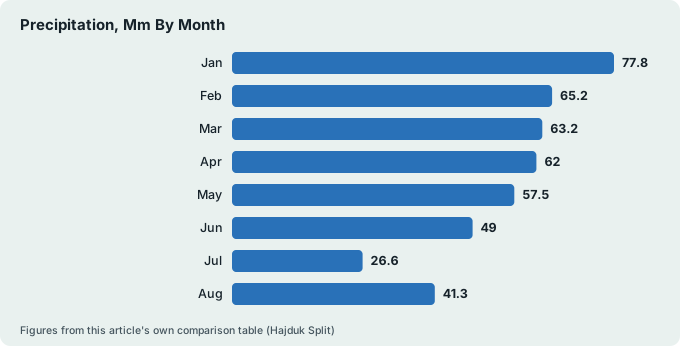
The football season in Croatia runs through autumn, winter and spring, and the DHMZ Split Marjan station table for 1948 to 2024 shows what that means in practice: a January mean of 8.0 C, a July mean of 26.2 C, November the wettest month at 115.5 mm and July the driest at 26.6 mm. An evening match in February is a coat and rain plan, while one in August means 17 days of the month at 30 C or more.
Those station figures are the authority for anything this site says about Split's climate, and they map neatly onto a season's worth of match days. Autumn fixtures arrive with September's 21.6 C mean and October's 17.2 C, but November's 115.5 mm of rain makes waterproofs the sensible call. Winter matches, whenever they fall between December's 9.4 C mean and February's 8.5 C, are cold by Dalmatian standards rather than by northern European ones. Spring warms fast, from 10.8 C in March to 19.2 C in May, and the run-in in May can feel like early summer. The sunshine figures say July manages 353.3 hours against December's 120.8, so a winter evening kick-off under lights is the norm rather than the exception.
| Month | Mean temperature, DHMZ Split Marjan 1948 to 2024 | Precipitation, mm |
|---|---|---|
| Jan | 8.0 | 77.8 |
| Feb | 8.5 | 65.2 |
| Mar | 10.8 | 63.2 |
| Apr | 14.4 | 62.0 |
| May | 19.2 | 57.5 |
| Jun | 23.4 | 49.0 |
| Jul | 26.2 | 26.6 |
| Aug | 25.9 | 41.3 |
| Sep | 21.6 | 70.9 |
| Oct | 17.2 | 77.0 |
| Nov | 12.7 | 115.5 |
| Dec | 9.4 | 103.7 |
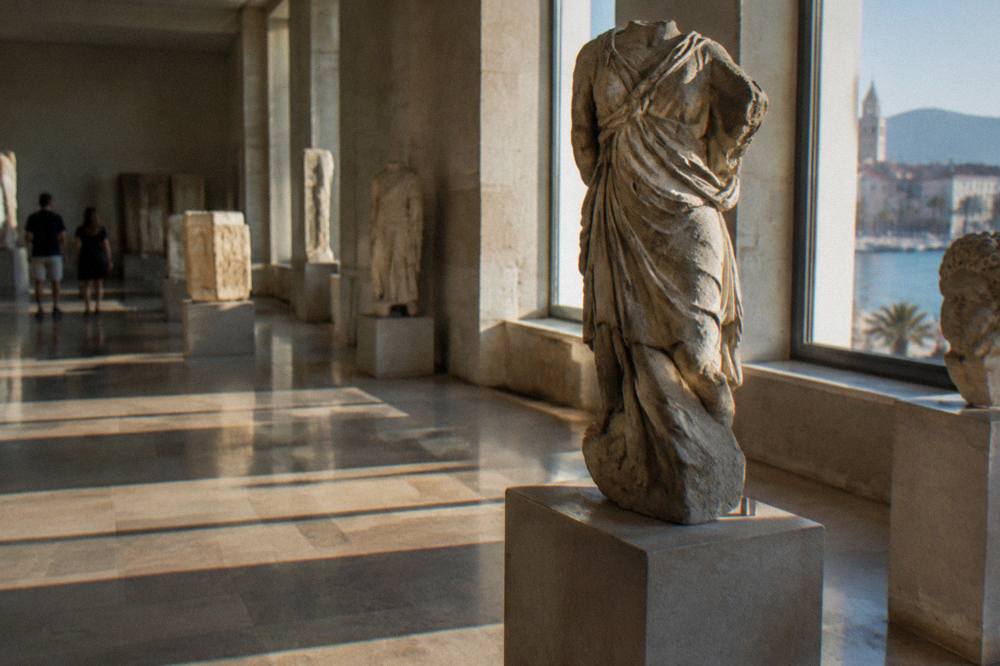
A rainy match day also has indoor answers. The Split City Museum at Papalić Palace charges 10.00 EUR for adults, 8.00 reduced, with a family ticket at 18.00, and is closed Mondays. The Meštrović Gallery, reopened in April 2026 after a fifteen-month energy renovation, charges 12.00 EUR for adults and includes the Crikvine-Kaštilac site. The Archaeological Museum charges 8 EUR, or 10 EUR combined with Salona within seven days, and the Ethnographic Museum 7.00 EUR. The cathedral complex is described by secondary guides as from about 5 EUR, with combined tickets up to about 15 EUR, and shoulders and knees must be covered; confirm current arrangements at the Peristyle kiosk. The rainy day in Split plan collects these into a full day.
Where Should You Stay For A Hajduk Split Match Weekend?
The best base for a match weekend is the area between Diocletian's Palace and the transport hub on Obala kneza Domagoja, 500 to 600 m apart, because it puts the Old Town, the Riva, the ferry piers and the bus routes toward the Poljud stadium within one walkable district. Visitors wanting quiet after a night match should look west toward Marjan or the Bačvice and Firule side rather than inside the palace walls themselves.
Hotel rates vary by match, so the choice is framed by geography instead of price. The palace district is where the match-day crowd gathers, which makes it the liveliest and the loudest. Bačvice and Firule put the city's main sandy beach, the home of picigin, the ball game born there in 1908 and now protected intangible heritage of Croatia, between the room and the centre. Meje and the Marjan side trade noise for hillside quiet above Kašjuni beach. The where to stay in Split guide breaks the districts down, and the Split apartments and Split hostels rundowns cover the budget ends.
One accommodation fact belongs on this page because it applies to every visitor: the tourist tax. In Split-Dalmatia County it runs at about 2.65 EUR per person per night in high season, from 1 April to 30 September, with children under 12 free and 12 to 18 at half rate, collected by the accommodation and confirmed at booking. The word "about" is doing real work there, and the final figure appears on the accommodation's confirmation.
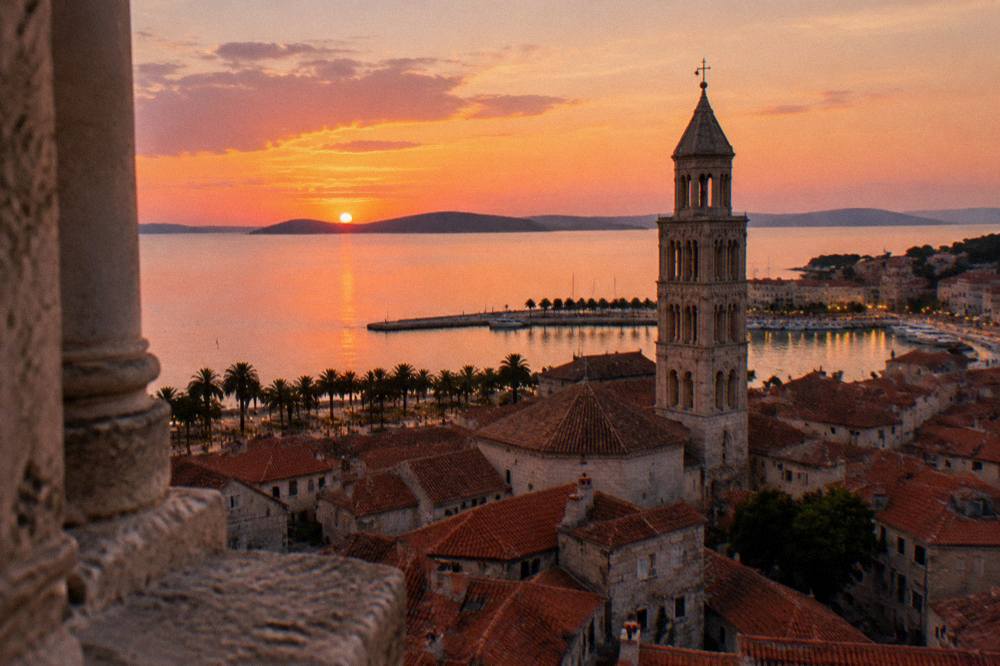
A match weekend can also borrow from Split's bigger events calendar. Ultra Europe 2027 runs 9 to 11 July 2027 at Park Mladeži, and the Ultra Europe guide covers that weekend separately. The Split vs Dubrovnik comparison is worth a read for anyone splitting a trip between the two cities and wondering which one deserves the football weekend.
Common Questions About Hajduk Split Match Days
Where does Hajduk Split play its home matches?
Hajduk Split plays its home matches at the Poljud stadium on the northern side of the city. Local buses run there from the centre, and the transport hub on Obala kneza Domagoja, 500 to 600 m from Diocletian's Palace, is the natural starting point. Confirm the route on the bus operator's own site.
How do I buy Hajduk Split tickets?
Through the club's own ticketing channels, online or at the club's ticket office as the club lists them. This page prints no price, because ticketing varies by stand and fixture. Treat street or social-platform resale offers as a risk and buy from the club directly.
Can I drink alcohol in the street before the match in Split?
No. Drinking alcohol in the historic centre or within 100 m of schools carries a 300 EUR fine under the city's public-order rules. Between 1 June and 15 September, shops may not sell alcohol at night, from 21:00 to 06:00, though bars and restaurant terraces are unaffected.
Can I combine a Hajduk Split match with a day trip?
Yes. An evening kick-off leaves the day free for Krka, Plitvice, Trogir, Salona, Klis or an island trip. Ferries to Stari Grad take about 120 minutes, to Supetar about 50 and to Rogač about 60, and catamarans serve Hvar town, Jelsa and Vis, all from the port 500 to 600 m from the palace.
What should I wear to a winter match in Split?
The DHMZ Split Marjan station table for 1948 to 2024 gives a January mean of 8.0 C and February 8.5 C, with December rainfall at 103.7 mm and November the wettest month at 115.5 mm. A warm layer and a waterproof are the sensible call for any fixture between November and March.
Is a match day in Split suitable for families?
Matches in Split are family occasions as well as supporter occasions, and the club sells tickets across multiple stands. Arrive early for the walk to the Poljud stadium, plan food before entering the stadium perimeter, and keep the public-order rules in the historic centre in mind.
A Hajduk Split match day works as the anchor of a weekend rather than a standalone event, and the city rewards the visitor who plans around it: a morning at Krka or on an island, an afternoon in the palace streets, an evening kick-off, and a late terrace on the Riva afterwards, with the ferry port, the bus station and the railway all within 600 m of where the whole thing starts.
