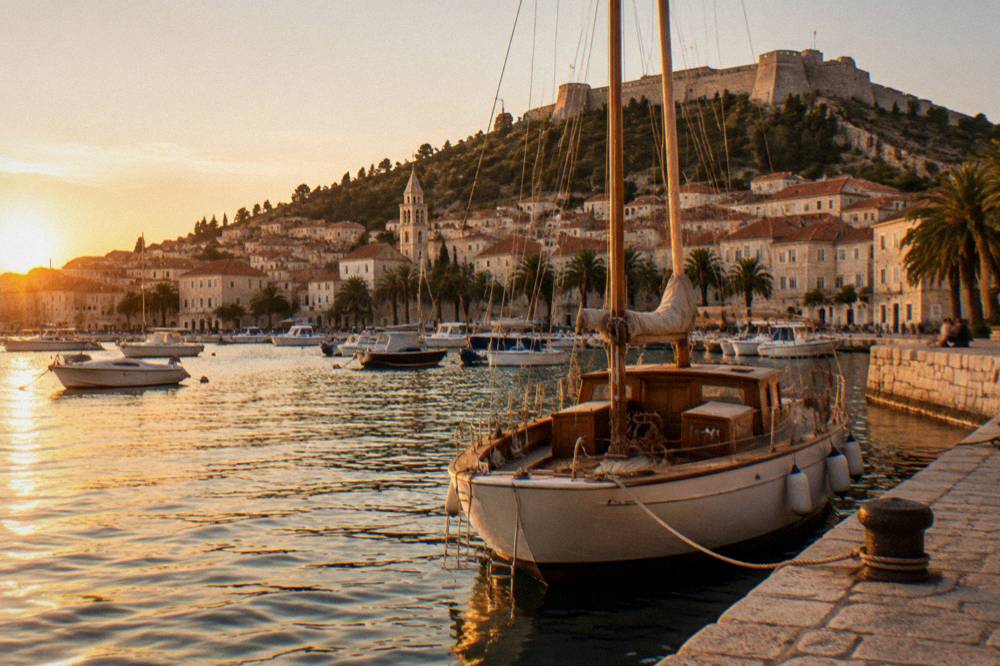
Split Vs Hvar: Which One Deserves Your Days On The Dalmatian Coast
Split is a coastal city in Dalmatia built in and around Diocletian's Palace, while Hvar is an island two hours offshore by car ferry. This comparison sets out what each one does better, with the ferry figures, ticket prices and climate numbers the sources actually publish.
Short answer
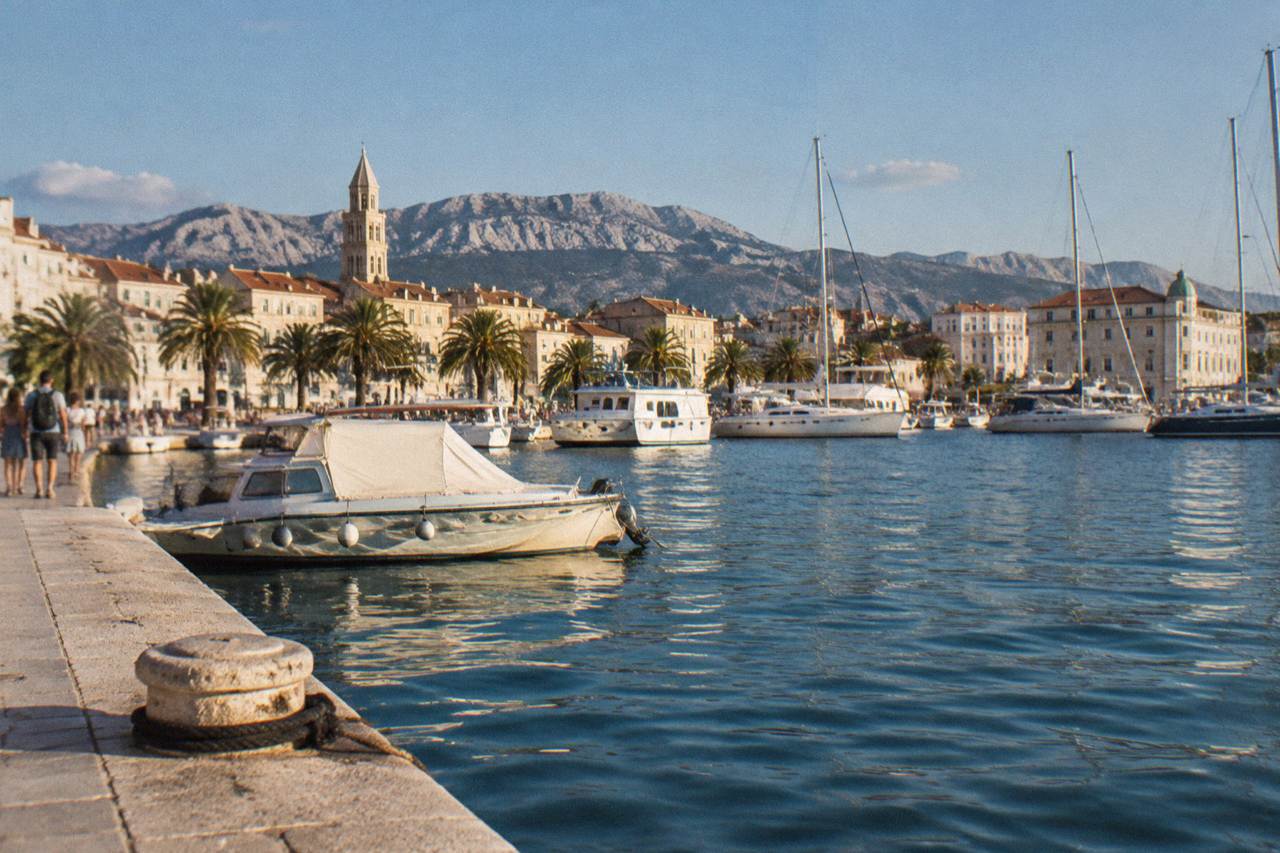
Stay in Split if you want a walkable city, the palace, transport links and day trips; add Hvar as an overnight or day visit by catamaran if beaches, island pace and nightlife are the point of the trip.
Split is a coastal city in central Dalmatia on the Adriatic, built in and around Diocletian's Palace, with the Marjan peninsula park forest on its western side and the islands of Brač, Šolta, Hvar and Vis offshore. Hvar is one of those islands: its town, Hvar, is a catamaran stop, while its car-ferry port is Stari Grad, about 120 minutes from Split by Jadrolinija's line 635. The two are not rivals so much as complements, and the honest answer to which one you should choose depends on what the trip is for. The Split Croatia Travel Guide desk compares them here using only what the operators, museums and the meteorological service publish.
Which Is Better For A First Trip, Split Or Hvar?
For a first trip to Dalmatia, Split is the more practical base and Hvar is the more focused escape: Split gives you the UNESCO-listed palace complex inscribed in 1979, a working city of 160,577 people at the 2021 census, the region's busiest passenger port at 6.05 million passengers in 2025, and the departure point for every major day trip, while Hvar gives you an island town of stone squares, a fortress above the harbour and swimming off the Pakleni islands.
A week in Split with two nights on Hvar covers both.
Split works as a base because the transport sits in one place: the ferry port, the main bus station and the railway station share Obala kneza Domagoja, 500 to 600 m from the palace. Hvar works as a destination because everything a visitor wants is within walking distance of where the boats arrive, and the sea is immediately around it.
Neither choice is wrong, but they are different products. Split is a city you explore for days; Hvar is an island you slow down on. The pages on things to do in Split and the guide to Hvar as a day trip lay out each side in detail, and the comparison below works through the decision question by question.
How Do You Get From Split To Hvar?
The car ferry, Jadrolinija line 635, runs Split to Stari Grad on Hvar in about 120 minutes and costs a foot passenger 5.90 EUR off-season or 8.40 EUR in season; Hvar town itself is reached by catamaran, on lines that call at Milna, Hvar and Vis or at Bol, Stari Grad and Jelsa, with Split to Hvar or Jelsa fares of 6.40 EUR low season and 10.00 EUR high season. Kapetan Luka (Krilo), TP Line and Bura Line also operate Split catamarans.
To see the current ferry and catamaran timetables, book a Split to Hvar ferry ticket here.
The distinction matters more than anything else in this comparison: Stari Grad is the ferry port on the north side of the island, and Hvar town is a separate catamaran stop on the south side. Confusing the two leaves you arranging an island transfer you had not planned for. The Split to Hvar ferry guide untangles the routes, and the question of where the ferry from Split to Hvar arrives is answered separately on the answers pages.
| Route | Type | Journey time | Foot passenger fare |
|---|---|---|---|
| Split to Stari Grad (line 635) | Car ferry | about 120 minutes | 5.90 EUR off-season, 8.40 EUR in season |
| Split to Hvar town | Catamaran | varies by line and call order | 6.40 EUR low season, 10.00 EUR high season |
| Split to Vis | Catamaran (the car ferry takes about 140 minutes) | varies by line and call order | 7.20 EUR low season, 10.00 EUR high season |
The operator's own timetable decides on any given day; treat every crossing as a booking question, not an assumption. Timetables, vehicle space and the day's actual departures are all confirmed at booking, which is also the moment you learn whether a foot-passenger ticket or a vehicle deck slot is the right purchase.
What Does Split Offer That Hvar Does Not?
Split offers the layered, free-to-walk historic core of Diocletian's Palace, a stretch of ticketed museums inside and around it, the Marjan park forest rising to Telegrin at 178 m, and the departure point for Krka, Plitvice, Trogir, Salona, Klis, Omiš and the islands: a concentration of sights and connections no island town matches. The Peristyle, the Riva, the Golden Gate and Marjan itself cost nothing to enter.
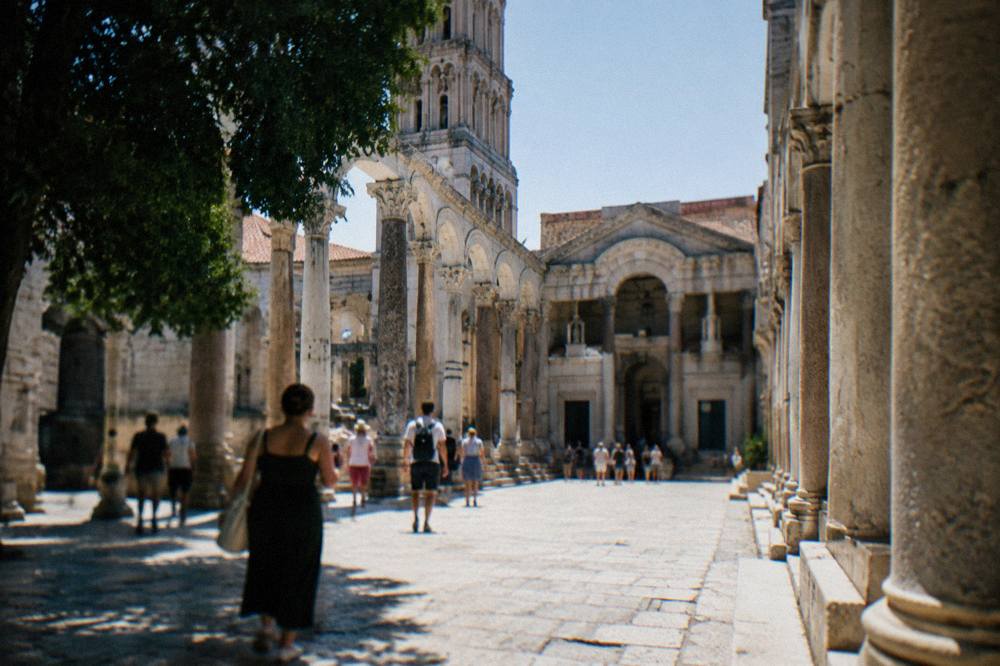
The palace is the reason Split exists as a visitor destination at all. Built c. 295 to 305 AD for Emperor Diocletian and UNESCO-inscribed in 1979 as part of a 20.8 ha property, it functions as a living quarter: streets, bars, flats and churches inside Roman walls. The Diocletian's Palace guide covers the layout; the cellars, run by the Split City Museum and open 8:30 to 20:00 daily, are the one interior you pay for on that scale, with the museum's own price list showing a 10.00 EUR adult ticket.
Marjan is the second thing Hvar has no equivalent of: a 3.5 km by 1.5 km park forest on a peninsula at the city's western edge, with 819 steps from Trumbićeva obala to the Telegrin viewpoint at 178 m. On a hot afternoon that climb buys the whole channel view. The Marjan Hill guide maps the paths, and the split weather guide carries the DHMZ Split-Marjan station numbers, 1948 to 2024, that tell you how hot a hot afternoon is: a July mean of 26.2 C, with 18 days at 30 C or more in July and 17 in August.
The museum layer is a city layer. The Archaeological Museum, founded in 1820, charges 8 EUR, or 10 EUR combined with the Roman site of Salona within 7 days. The Meštrović Gallery, reopened in April 2026 after a 15-month energy renovation, charges 12.00 EUR including Crikvine-Kaštilac. The Ethnographic Museum charges 7.00 EUR. None of that exists on an island whose headline sight is a single fortress.
Then there are the connections. Split's day-trip radius is enormous, and every figure below is a driving time from the palace computed on free-flow routing.
| Day trip from Split | Driving time | Notes |
|---|---|---|
| Salona | 14 minutes | Combined ticket with the Archaeological Museum, 10 EUR within 7 days |
| Klis Fortress | 22 minutes | 10 EUR adult, a Game of Thrones Meereen location |
| Trogir | 36 minutes | UNESCO historic city, inscribed 1997 |
| Omiš | 38 minutes | Cetina river canyon, Mirabela fortress 4 EUR |
| Krka, Skradinski buk | 74 minutes | 7 / 20 / 40 EUR by season |
| Šibenik | 71 minutes | St James Cathedral, UNESCO 2000 |
| Plitvice Lakes | 3 hours 15 | 10 / 23 / 40 EUR by season, timed online entry |
The day trips from Split guide expands on all of these. The point for this comparison is simple: a week in Split can absorb Krka, Trogir and an island or two without repacking a bag, while a week on Hvar absorbs Hvar, the Pakleni islands and whatever boats you can catch.
What Does Hvar Offer That Split Does Not?
Hvar offers an island scale of everything: a car-free old town of stone lanes above a harbour, the Fortica fortress above it at 12 EUR, the Pakleni islands a short boat ride from the riva, lavender and hill villages inland, and a swimming-and-boat culture that a city of 160,577 people cannot reproduce. Its sights are fewer but its water is the destination.
The Fortica, sometimes called Španjola, sits above Hvar town; the Hvar tourist board's fee page lists it at 12 EUR, open 9:00 to 20:00. That is the island's headline ticketed sight, and from its walls the Pakleni chain reads as a single panorama. Below it, the town's squares and the waterfront run on foot traffic rather than vehicles.
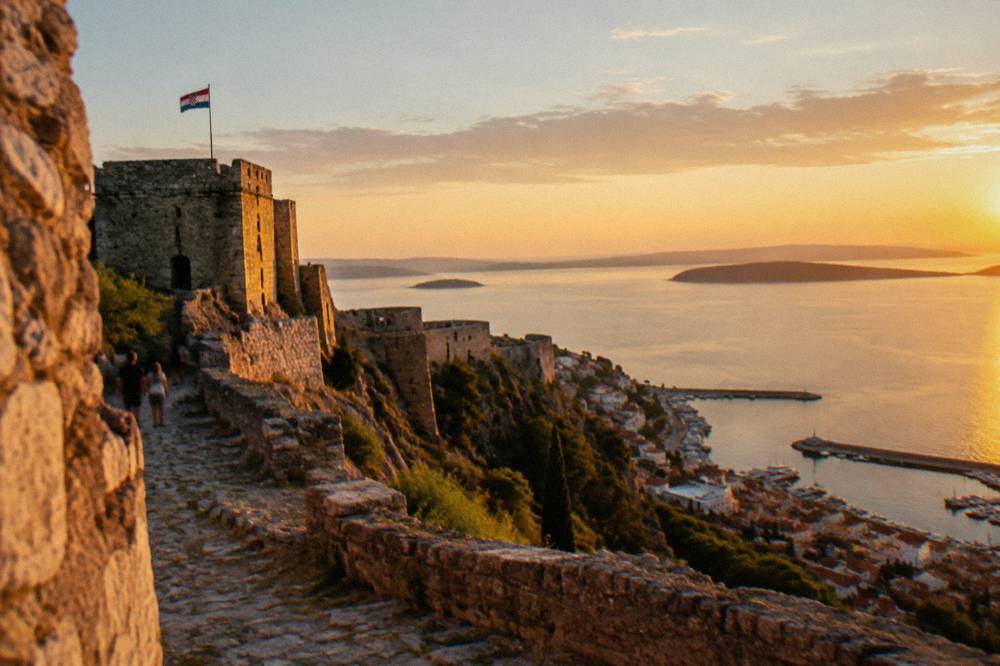
The Pakleni islands are Hvar's answer to Marjan, except the answer is by boat. They are the regular first stop of the island cruises from Split, together with swimming stops on this coast and, on longer itineraries, the Blue Cave on Biševo, whose 2026 entry fee is 24 EUR in high season, 20 June to 10 September, and 18 EUR in the shoulder months, paid in cash on site. The Blue Cave and Vis guide and the boat tours from Split guide set out what those full-day trips cover.
Inland Hvar is the part day visitors never see: hill villages, lavender fields and the island's agricultural interior between Stari Grad and Hvar town. Split has nothing comparable because Split is not an island; its hinterland is the Dalmatian mainland, which rewards a rental car toward Klis and Salona instead. The Split car rental guide covers that option, with the honest caveat that a car is a burden in the palace streets and pointless on Hvar if you are staying in town.
Split Vs Hvar Beaches: Where Is The Swimming Better?
Split's swimming is city swimming: Bačvice, the sandy bay where picigin was born in 1908 and which holds protected intangible heritage status, plus Kašjuni beneath Marjan and Žnjan to the east, all reachable on foot or by city bus, while Hvar's swimming is rock-and-cove swimming around the Pakleni islands and the town's own pebble bays, reached on foot or by water taxi. For pure water and setting Hvar wins; for convenience without leaving a city, Split holds its own.
The Split beaches guide covers the city's options bay by bay, including Bačvice and Kašjuni. Picigin, the shallow-water ball game played in Bačvice's waist-deep water, is the one beach tradition Split owns outright and Hvar does not.
No Blue Flag claim is made for any Split beach here; visitors who want that certification should check the current award list before choosing a bay. On Hvar the swimming question is instead a boat question: the coves that make the island famous are mostly reached by taxi boat or on an organised trip, and the sea state on the day decides which of them are pleasant.
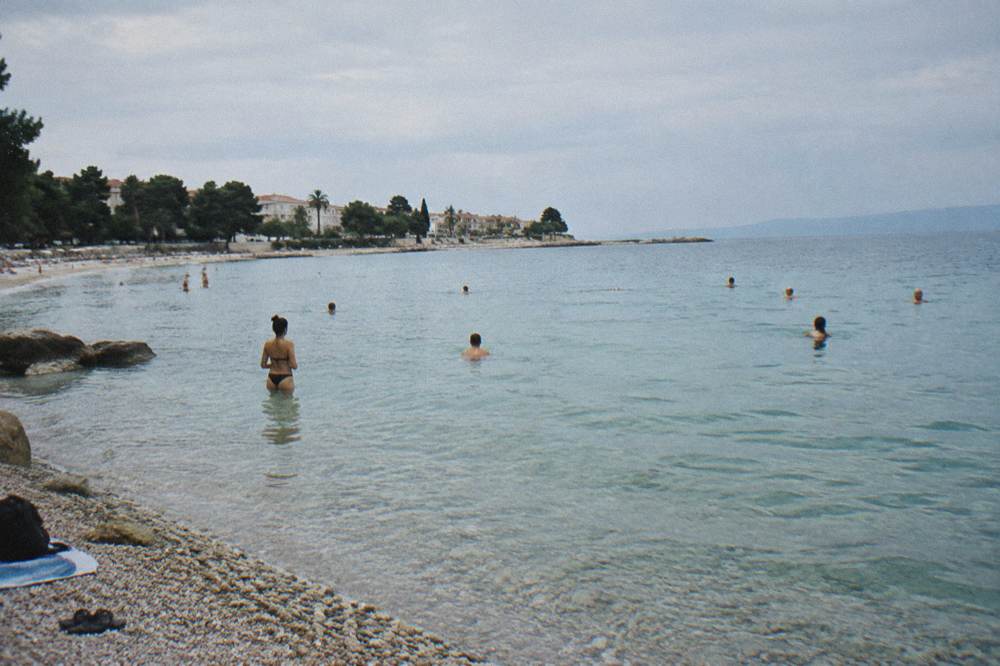
A note on sea temperature, because comparison articles abuse it: no official monthly sea-temperature normal exists for either place. The DHMZ Split-Marjan station publishes a live coastal reading, 20.4 C on the morning of 12 October 2026, and that is the only sea figure that belongs in print. Anyone promising you "24-degree water in May" for either destination is estimating.
Split Vs Hvar Nightlife: Which One Parties Harder?
Split's nightlife runs through the old town's bars, the Riva and beach clubs at Bačvice and Žnjan into late summer, plus Ultra Europe at Park Mladeži on 9 to 11 July 2027, while Hvar town's nightlife concentrates on its waterfront and is famous enough that people ask whether it has quieted down; both are seasonal, and both thin out hard once the summer boats stop. Neither is a year-round party destination.
The Split nightlife guide covers the city side, and the Ultra Europe guide covers the festival, whose 2027 dates are confirmed for 9 to 11 July at Park Mladeži. That week, Split is one of the loudest cities on the Adriatic.
On the Hvar side, the question is Hvar no longer a party island gets its own answer page. Split's scene is distributed across a whole city and survives into the shoulder months on local custom alone.
One rule applies to both and is worth knowing before a first evening: Split's public-order rules fine public alcohol consumption in the historic centre at 300 EUR, with the same fine for urinating in public, climbing on monuments or bathing in fountains, and 150 EUR for sleeping in public spaces. Night-time retail alcohol sales in shops, as distinct from bars, were banned in the 2026 season between 1 June and 15 September. None of this touches a drink on a licensed terrace; it touches the street outside.
Where Should You Stay, Split Or Hvar?
Stay in Split if the trip is under four nights, if you arrive by air, or if day trips are the priority, because the airport is 20 km away with a 10 EUR shuttle to the main bus station; stay on Hvar if the trip is four nights or more and the point is beaches, boats and island pace, accepting that every arrival and departure runs to a ferry or catamaran timetable. Split's accommodation is vast and city-priced; Hvar's is smaller and peaks hard in July and August.
The where to stay in Split guide maps the city's districts, from the palace core outward, and the flight connections are covered in the flights to Split guide: the airport handled 3,881,186 passengers in 2025, and United Airlines ran a seasonal Newark service, the airport's first transatlantic route, from 30 April 2026. The airport to city centre guide explains the Platanus shuttle, 10 EUR one way and 15 EUR return, and the city bus lines 37 and 38 that stop at the terminal.
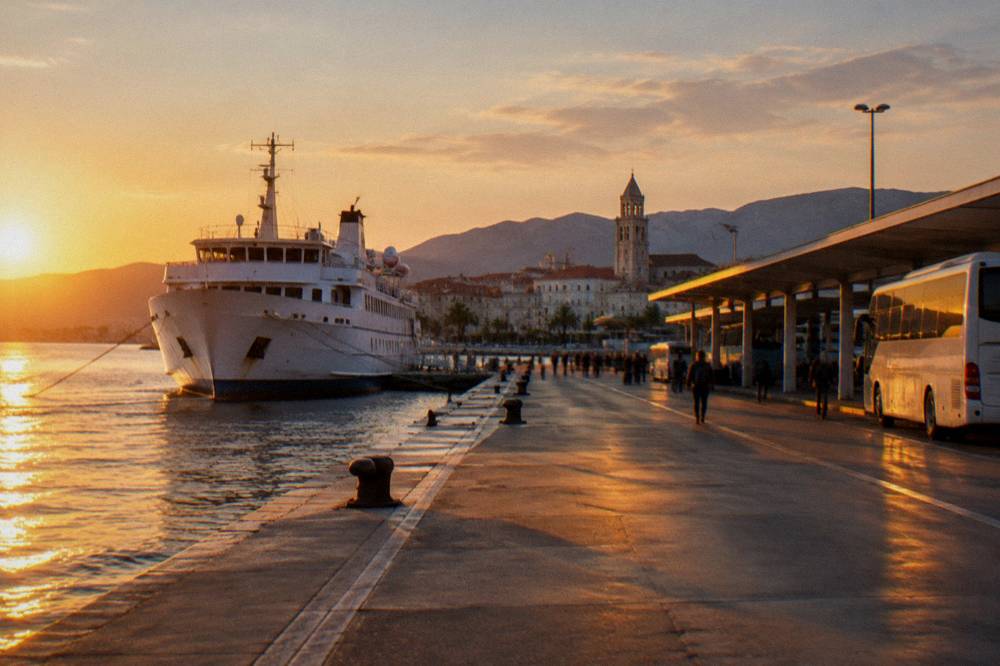
On Hvar you arrive by sea or you do not arrive, and the island's accommodation calendar follows that fact. The comparison is not about quality on either side; it is about what a ferry timetable does to a short trip. Two nights on Hvar inside a Split week is a rhythm that works with the boats rather than against them.
Tourist tax is charged by accommodation on both, at about 2.65 EUR per person per night in high season, 1 April to 30 September, with under-12s free and 12 to 18s at half rate; the exact amount is confirmed at booking. No nightly rate for any property on either side belongs on this page.
Is Hvar More Expensive Than Split?
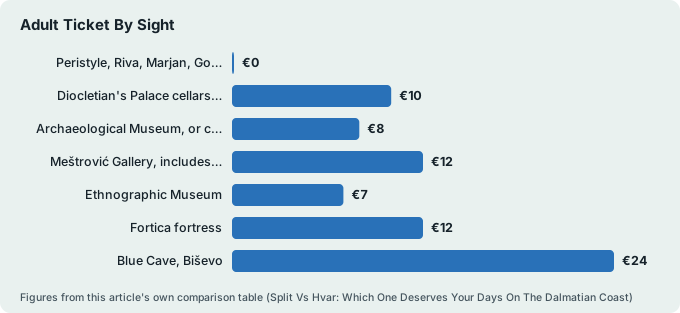
On the published figures, Split is the cheaper place to be a tourist: its headline sights include genuinely free ones, the Peristyle, the Riva, Marjan and the city beaches, its ferry and catamaran crossings to the islands cost between 5.90 and 10.00 EUR on foot, and its museums top out at 12.00 EUR, while Hvar adds a 12 EUR fortress, cash-only entry fees for boat caves and a boat dependency that puts a price on every beach and cove.
Accommodation and food pricing are seasonal on both and are confirmed at booking.
Ticket against ticket, the two look like this:
| Sight | Place | Adult ticket |
|---|---|---|
| Peristyle, Riva, Marjan, Golden Gate | Split | Free |
| Diocletian's Palace cellars / City Museum | Split | 10.00 EUR |
| Archaeological Museum, or combined with Salona | Split | 8 EUR, or 10 EUR combined within 7 days |
| Meštrović Gallery, includes Crikvine-Kaštilac | Split | 12.00 EUR |
| Ethnographic Museum | Split | 7.00 EUR |
| Cathedral of St Domnius complex | Split | from about 5 EUR, combined tickets up to about 15 EUR |
| Fortica fortress | Hvar town | 12 EUR |
| Blue Cave, Biševo | Biševo island | 24 EUR high season, 18 EUR shoulder, cash on site |
Food comparisons live on their own pages: the Split restaurants guide and the Split food guide cover the city side, including where locals eat, and any Hvar food price a comparison article quotes from memory should be treated as a guess. What is structural, not seasonal: on an island, the water taxi to the nice cove is a real line in a daily budget in a way the walk to Bačvice never is.
How Many Days Do You Need For Split And Hvar Together?
Split rewards two to three full days before day trips, covering the palace, Marjan, the Riva and the museums, and Hvar rewards one to two nights, which is enough for the Fortica, the town and one Pakleni boat day; the standard combination is a Split base of four to six nights with one or two of them relocated to Hvar, ordered around the ferry and catamaran timetable rather than a fixed formula. The one day in Split, two days and three days itineraries scale the city side.
The order matters less than the boat times. Going out to Hvar mid-trip, rather than at the start, keeps the airport transfer simple on arrival day and puts the island leg where a rest day belongs. Coming back, the line 635 ferry lands you at Stari Grad with a 120-minute crossing; the catamaran lands you at the heart of Split's harbour, 500 to 600 m from the palace.
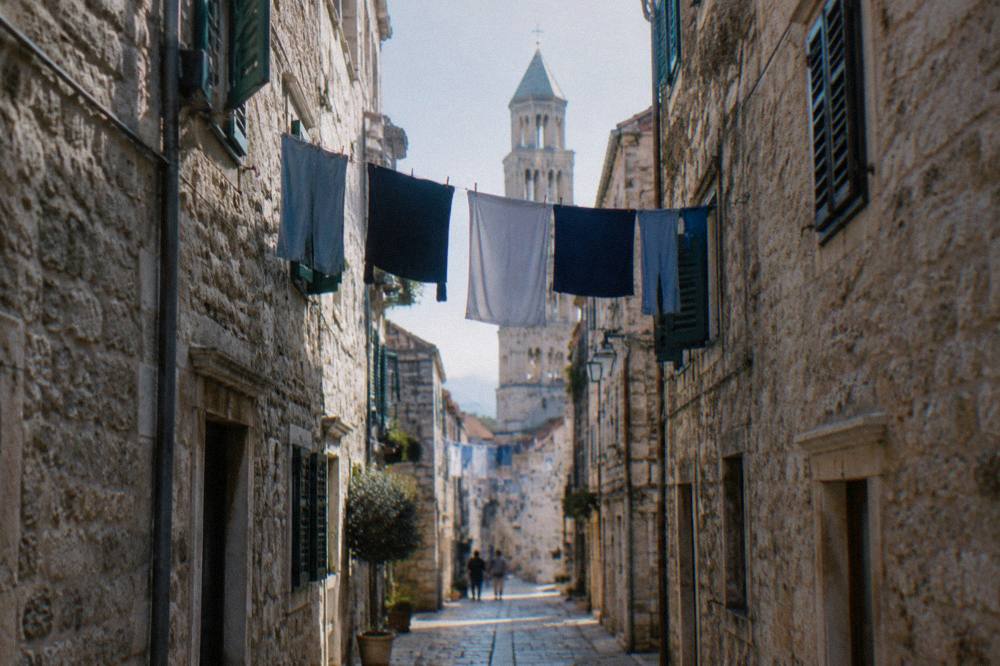
Timing the whole question against the climate record helps. The DHMZ Split-Marjan station table, 1948 to 2024, gives the coast its shape:
| Month | Mean temperature C | Precipitation mm |
|---|---|---|
| January | 8.0 | 77.8 |
| March | 10.8 | 63.2 |
| May | 19.2 | 57.5 |
| July | 26.2 | 26.6 |
| September | 21.6 | 70.9 |
| November | 12.7 | 115.5 |
July is the driest month at 26.6 mm and November the wettest at 115.5 mm. What the Split table does tell you is when both places are busiest: the July and August means of 26.2 C and 25.9 C, with 18 and 17 days at 30 C or more respectively, are the months when every boat is full.
When Is Each One At Its Best?
Split is at its best from late April to June and from mid-September to October, when the DHMZ Split-Marjan means sit at 14.4 C in April, 19.2 C in May and 17.2 C in October, the day trips run and the queues thin; Hvar is at its best from June to September, when the catamaran and boat schedules are at full frequency and the island's water-dependent appeal is the whole point.
Advent in Split, from 27 November 2026 to 7 January 2027 with the Đardin ice rink, gives the city a winter season Hvar does not match.
The best time to visit Split guide works through the calendar month by month, and the question of the best month to visit style comparisons all come back to the same two forces: the weather record and the boat timetable. An island is a different place in October, quieter and partly closed, and no amount of good weather changes the schedule.
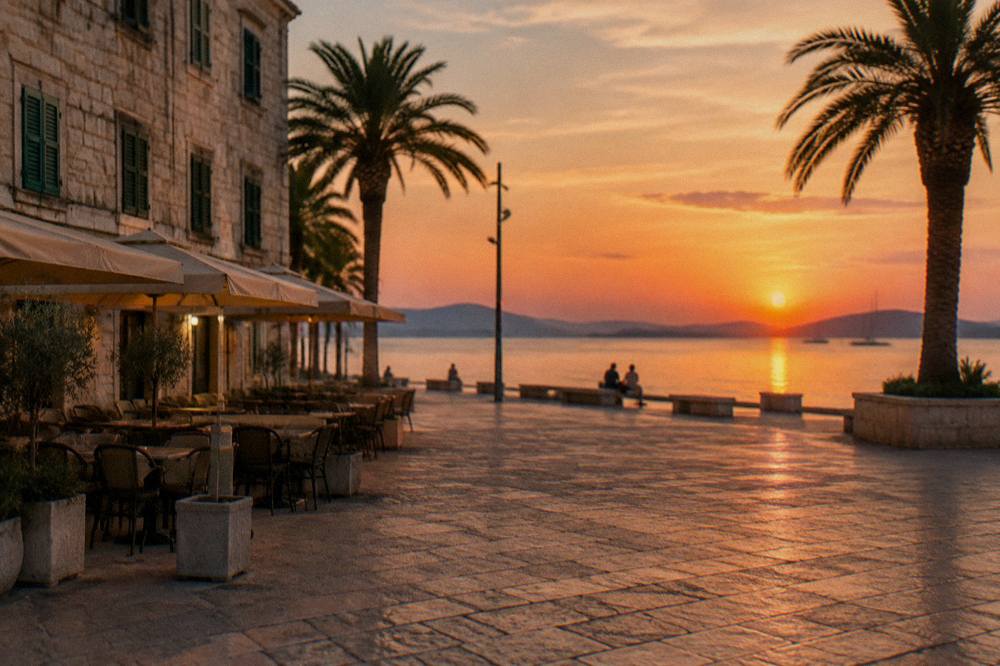
The Roman guard change on Split's Peristyle ran at noon daily from 28 May to 27 September 2026, which makes the palace itself part of the summer season. The Split Summer Festival's 72nd edition ran 14 July to 14 August 2026; its 2027 dates had not been announced. Hvar's calendar, by contrast, is not a festival calendar but a boating one, and it opens and closes with the season.
Can You Combine Split And Hvar In One Trip Without A Car?
Yes, and it is the standard way to do it: arrive at Split airport, take the 10 EUR Platanus shuttle or a bus on lines 37 or 38 to the main bus station by the ferry port, walk 500 to 600 m to the palace to stay, and reach Hvar as a foot passenger on the line 635 ferry to Stari Grad for 5.90 to 8.40 EUR or the catamaran to Hvar town for 6.40 to 10.00 EUR, needing no vehicle at any point.
A car helps only for mainland day trips, and it is dead weight on Hvar town's lanes.
Everything in that answer is a walk or a boat. The palace core is pedestrian, the port is beside it, and the islands begin at the port's gates. Even the adventures reachable from Split run on transport or gather you at a meeting point: the zip line above the Cetina canyon, the kayak routes off the city beaches, the rafting runs on the Cetina. The getting around Split guide covers the city buses and the walkability question in full.
For anyone weighing the pair against other combinations, the site also compares Split versus Dubrovnik and the Split to Dubrovnik route, and answers is Hvar nicer than Split head to head. The short version of all of them: Split is the hub, and the islands, including Hvar, are what the hub is for.
Common Questions About Split Vs Hvar
Is Hvar nicer than Split?
Hvar is smaller, quieter outside July and August and built around water and boats; Split is larger, layered with Roman remains and museums, and connected to everywhere. Nicer depends on whether the trip wants an island or a city. The full head-to-head sits on the is Hvar nicer than Split answer page.
Can you do Hvar as a day trip from Split?
Yes. The catamaran reaches Hvar town directly and the line 635 ferry reaches Stari Grad in about 120 minutes, and organised island trips run daily in season. Day-trip details are on the Hvar day trip guide.
Is Split or Hvar better for beaches?
Split has city beaches on foot, including Bačvice, where picigin has been played since 1908; Hvar has coves and the Pakleni islands, reached by boat. For convenience choose Split, for water and setting choose Hvar.
Which is more expensive, Split or Hvar?
On published tickets, Split has more free headline sights and its museums cost 7.00 to 12.00 EUR, while Hvar's fortress is 12 EUR and its famous coves often need a paid boat. Accommodation and food prices are seasonal on both and are confirmed at booking.
Do you need a car for Split and Hvar?
No. The airport shuttle, city buses, ferries and catamarans connect the whole route, and Hvar town's lanes are pedestrian. A car helps only for mainland day trips such as Klis and Salona.
How many days should you split between Split and Hvar?
Two to three days in Split plus one or two nights on Hvar is the standard combination, ordered around the boat timetable. The city itineraries for one day and two days scale the Split side.
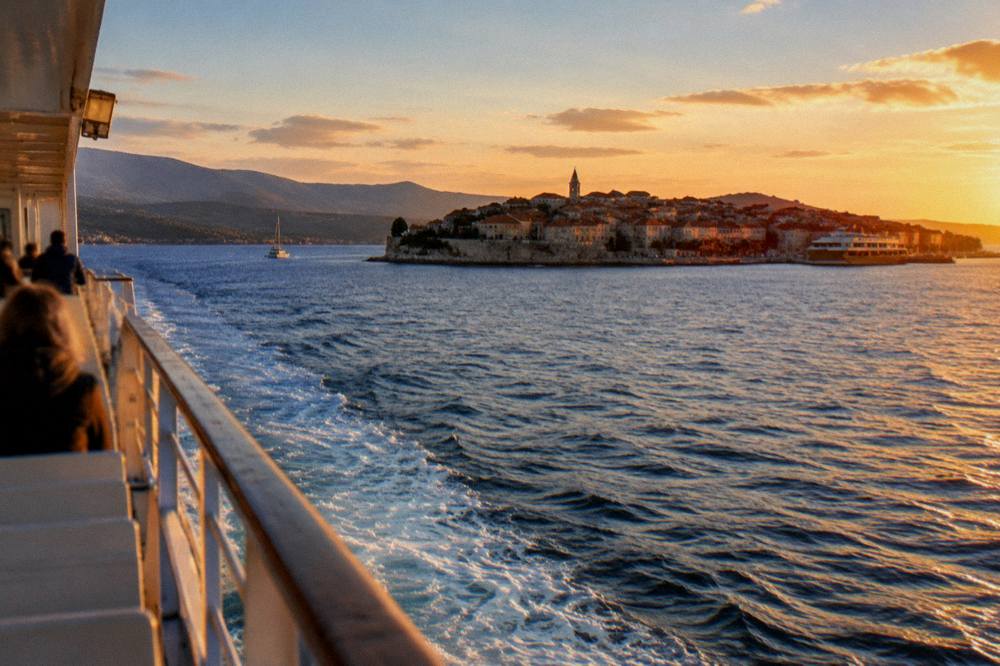
Choosing between them is really choosing an order: the city first, with its palace, museums, Marjan climbs and day-trip radius, then the island, with its fortress, coves and boats, reached on a crossing whose price and length the operators publish and whose timetable you check when you book. Either order works, and the ferry between them takes about two hours.